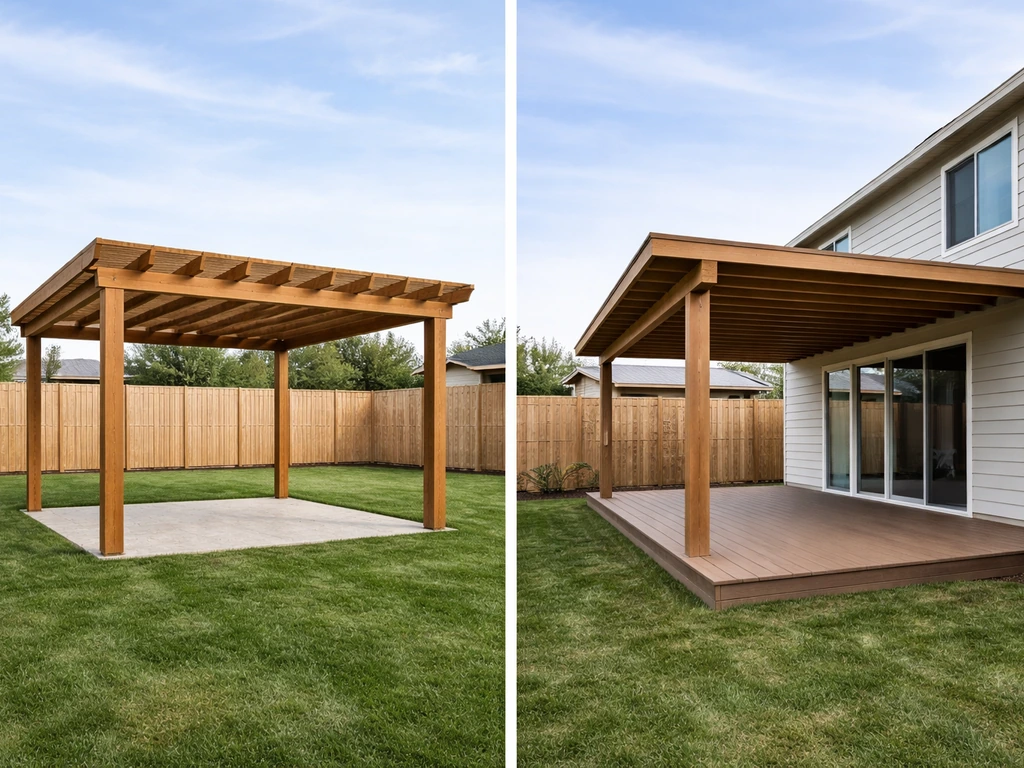
A patio is a ground-level hardscaped surface with no overhead structure. A pergola adds an open overhead frame above that space, giving partial shade but no real rain protection. Lowe’s describes the main difference as the roof: a pergola has an open-air style with an overhead frame, while a gazebo has a roof (and open sides). A gazebo is a fully roofed, freestanding structure with open sides. Those three sentences cover the core difference, but the right choice depends on how much shade and privacy you actually need, what you want to spend, and what your local permit office (and HOA) will let you build.
Patio vs Pergola vs Gazebo: How to Choose Right

Miles Hart
8 Jun 2026
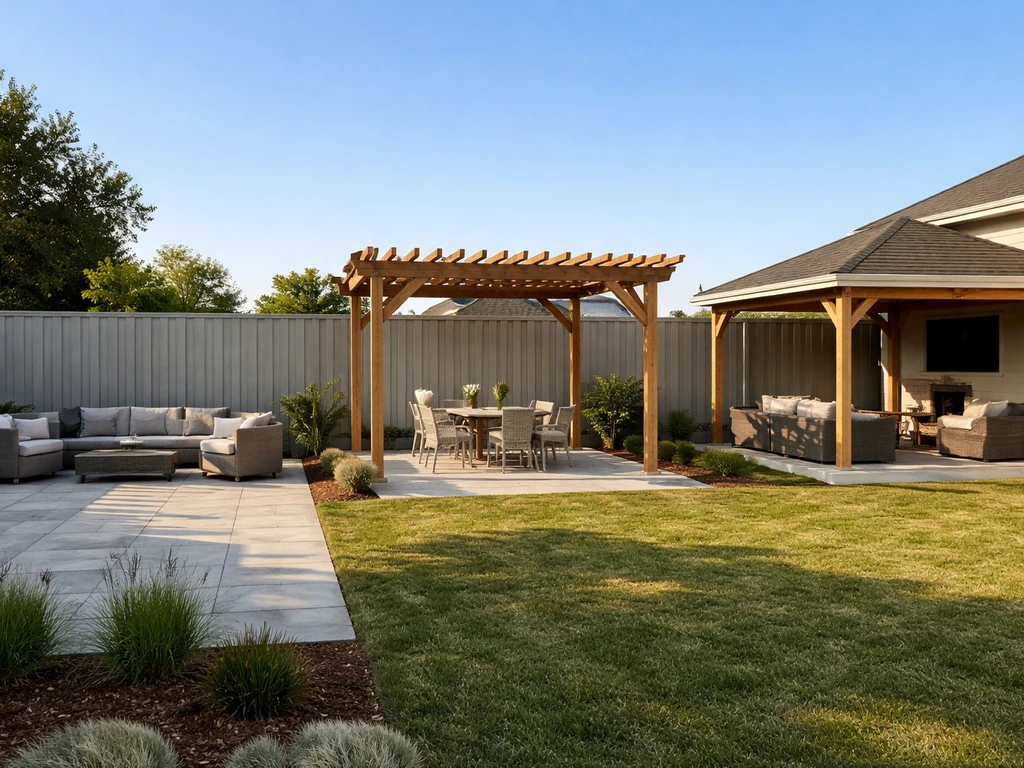
What each one actually is
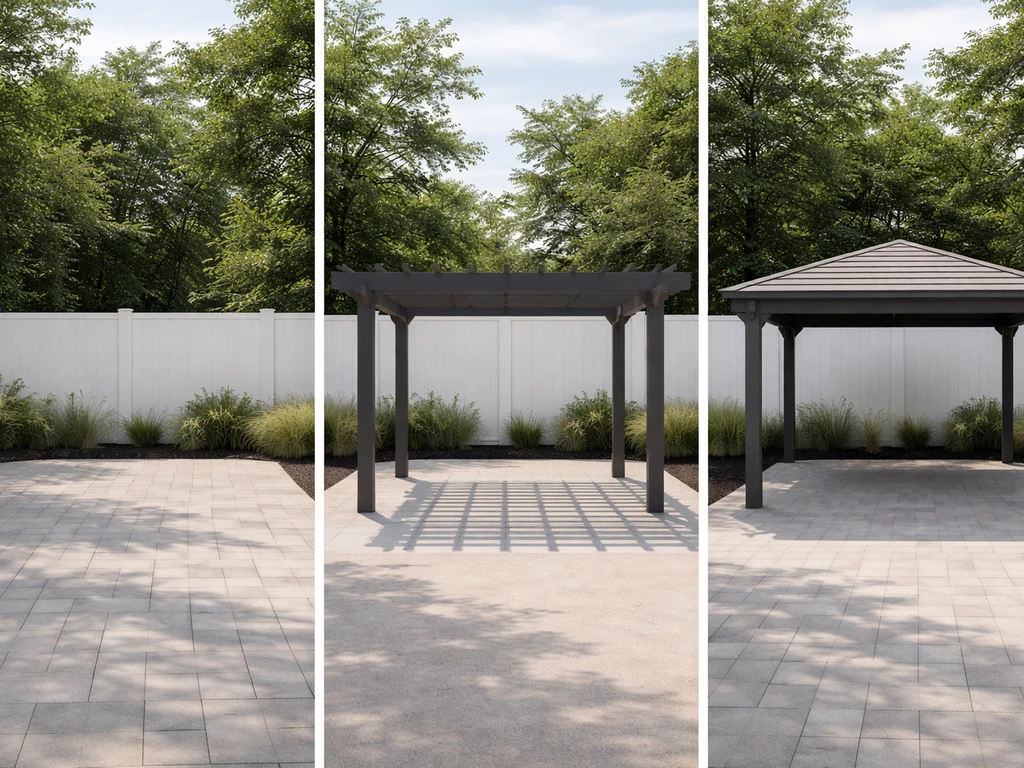
A patio is just a finished outdoor floor, typically concrete, pavers, brick, or natural stone. It can be any shape, any size, and it sits at or near grade. It has no roof unless you add one separately (an umbrella, a pergola above it, or a full patio cover). The patio itself is the foundation for everything else.
A pergola is an overhead structure built on posts, typically with an open lattice, spaced rafters, or louvered beams as the 'roof.' It doesn't keep rain off you, but it does filter sunlight. How much shade it provides depends on slat spacing, roof orientation, the sun angle at your latitude, and the time of day. A pergola can be freestanding or attached directly to the house. Attached pergolas are very common and usually anchor directly to a ledger board on the home's exterior wall.
A gazebo is a fully roofed, freestanding structure with open sides. It typically sits on a concrete pad or deck platform and is positioned as a destination in the yard rather than an extension of the house. Gazebos range from prefab kit models in the 10x12 or 12x12 footprint to larger custom-built octagonal or hexagonal structures. The roof is solid, so you get real rain and sun protection.
| Feature | Patio | Pergola | Gazebo |
|---|---|---|---|
| Structure type | Ground surface only | Open overhead frame on posts | Fully roofed freestanding structure |
| Shade level | None (unless add-ons) | Partial (filtered) | Full (solid roof) |
| Rain protection | None | Little to none | Yes |
| Attached to house? | Often yes | Yes or freestanding | Typically freestanding |
| Privacy | None built-in | Low (open frame) | Moderate with curtains |
| Typical footprint | Any size | 100–400+ sq ft | 100–200 sq ft (kits); larger custom |
| Permits usually required? | Sometimes | Often | Usually |
Who each one fits best
A patio is the right starting point for almost everyone. It's the most flexible, lowest-commitment option. If you want a defined outdoor dining or lounging space and you're not sure yet how much coverage you need, start with a patio and add shade later. Patios work especially well for open entertaining, kid play areas, grilling zones, and fire pits. The limitation is obvious: no overhead shelter means sun and rain exposure.
A pergola suits homeowners who want to visually define their outdoor space and get partial shade without boxing themselves in. Pergolas are excellent over outdoor dining tables, kitchen areas, or hot tubs. Because they're open, they feel light and airy, and climbing plants like wisteria or jasmine can turn the structure into a living canopy over time. The trade-off is that you won't stay dry in a downpour, and the shade isn't total. City of Scottsdale guidance notes that horizontal shade structures like pergolas are most effective in the middle of the day, which matters if your main goal is afternoon heat relief.
A gazebo fits homeowners who want a dedicated, self-contained outdoor room, whether that's a reading nook, a hot tub enclosure, a formal entertaining pavilion, or a garden focal point. The roofed structure provides real protection from sun and light rain. Many homeowners add curtain panels on two or three sides for privacy while leaving the best-view side open. A 10x12 gazebo typically takes about six to eight curtain panels for full coverage, but partial coverage on two or three sides is the most common approach. The downside is that gazebos can feel imposing in smaller yards and tend to cost significantly more than a basic patio or pergola.
Shade and privacy at a glance
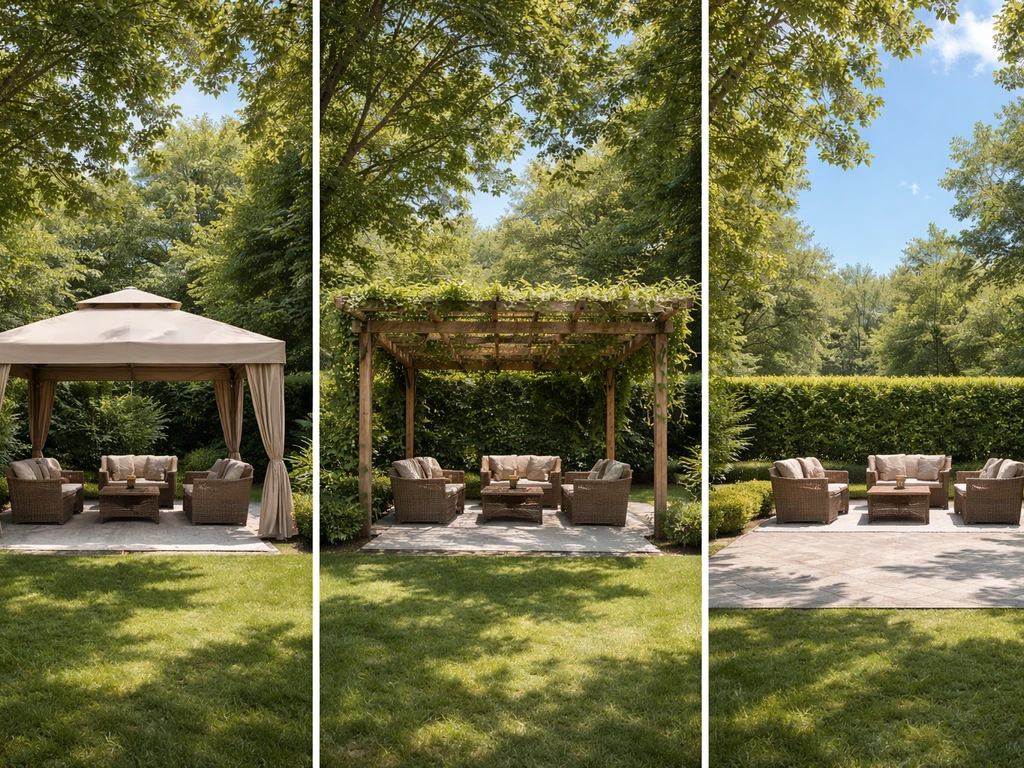
- Need full sun and rain protection: gazebo wins
- Want partial shade, open feel, and climbing plants: pergola
- Just need a usable outdoor floor surface and flexibility: patio
- Want privacy on a budget: add a pergola with curtain panels or shade sails over a patio
- Hot tub placement: a pergola or gazebo both work; gazebo offers more weather protection
What each one costs to build
Patios are the most affordable starting point. Installed costs run roughly $5 to $35 per square foot depending on material. A concrete slab patio runs toward the lower end; natural stone or complex paver patterns push toward the top. A 300-square-foot concrete patio might cost $1,500 to $4,500 installed in most markets. Stamped concrete, stone, or pavers with a decorative edge will run much higher. The slab itself is the cost driver, and thickness and reinforcement matter, especially if you plan to place heavy structures or furniture on it.
Pergolas have a wide range depending on whether you go prefab or custom. Prefabricated pergola kits run about $1,450 to $5,750 installed on average, which translates to roughly $10 to $40 per square foot. Custom-built pergolas with pressure-treated pine typically land at $25 to $40 per square foot, while aluminum and vinyl options tend to come in lower. Angi puts the average pergola build between about $2,100 and $6,400, with a 100-square-foot example running around $4,200. Add-ons like motorized louvers, string lighting, shade screens, or a built-in fan push the number up quickly.
Gazebos are the most expensive of the three on a per-project basis. Custom-built gazebos run roughly $8,600 to $14,400 on average, or about $60 to $100 per square foot. Kit gazebo assembly is cheaper at around $5 to $10 per square foot for labor, but you're still paying for the kit itself. Regional variation is real: a covered patio or pergola project in some markets can run $40,000 to $125,000 once you factor in high-end materials, concrete work, electrical, and finishing. These numbers reflect full outdoor living builds, not simple kit installs.
| Structure | Typical installed cost | Per sq ft range | Major cost drivers |
|---|---|---|---|
| Patio | $1,500–$15,000+ | $5–$35/sq ft | Material (concrete vs. pavers vs. stone), size, site prep |
| Pergola (prefab) | $1,450–$5,750 | $10–$40/sq ft | Material, size, attachments, add-ons |
| Pergola (custom) | $4,000–$10,000+ | $25–$40/sq ft | Wood species, custom dimensions, footings, features |
| Gazebo (kit) | $3,000–$8,000 | $5–$10/sq ft labor | Kit cost, size, foundation, anchoring |
| Gazebo (custom) | $8,600–$14,400+ | $60–$100/sq ft | Roofing, size, octagonal vs. rectangular, foundation |
Add-ons worth budgeting for
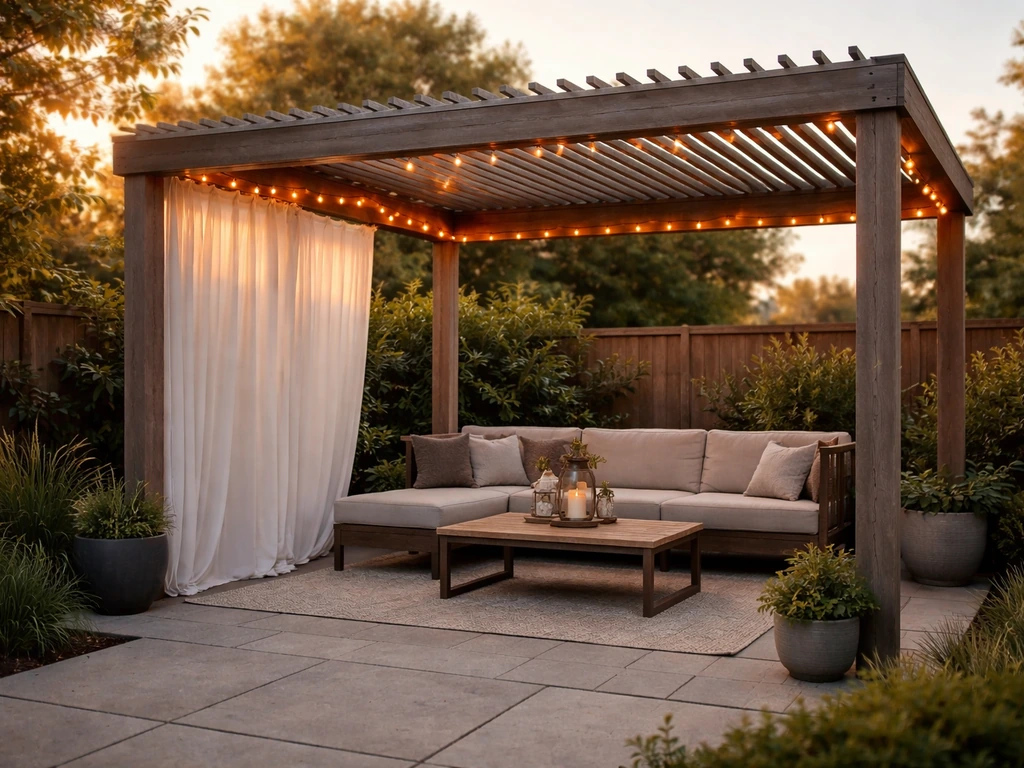
- Curtains or privacy screens: $200–$800 depending on panels and hardware
- String lighting or recessed fixtures: $300–$2,000 depending on wiring complexity
- Motorized louvered roof system: $5,000–$15,000+ (popular pergola upgrade)
- Outdoor heater or ceiling fan: $200–$600 per unit plus electrical
- Concrete footing upgrades: $500–$2,000 depending on size and depth
Permits, HOA approvals, and site rules
This is the section most homeowners skip until it's too late. All three structure types can require permits, and the rules vary significantly by municipality. A basic ground-level concrete patio usually doesn't need a permit in most jurisdictions, but check your local code before assuming. The moment you add a roof, posts anchored into concrete, or an attachment to the house, permits almost always come into play. If you're wondering whether a gazebo can go on a patio, the short answer is yes, but it depends on your patio base, drainage, and whether permits are required for posts or anchoring can a gazebo go on a patio.
Pergolas attached to the house typically follow the IRC's patio cover rules. The City of Boise, for example, has a specific residential patio cover construction policy for wood-framed pergolas attached to single-family homes, tying permitting requirements to the attachment type and roof envelope. The 2021 IRC Appendix AH requires patio covers to handle a minimum vertical live load of 10 psf, with higher requirements where snow loads exceed that number. If you're in a region with significant snow, your pergola structure needs to be engineered accordingly.
Gazebos have their own set of local rules. Some municipalities cap gazebo height (Cape Coral, FL specifies a maximum height measured from a rear setback), and most require anchoring to meet wind uplift standards. Hackettstown, NJ's permit guide requires gazebos of 200 square feet or less to be anchored to prevent wind uplift, and notes that HOA approval may be required on top of the city permit. Setback requirements (how far from property lines or the house) are almost universal, so measure your intended location before you design anything.
- Check local setback requirements before choosing your site location
- Confirm whether your HOA requires separate ACC approval before the city permit
- Understand whether your structure is classified as 'attached' or 'freestanding', since that often changes which rules apply
- In snow regions, verify your design meets local snow load requirements, not just the 10 psf IRC minimum
- Permit fees are often priced per square foot by structure type, so a larger gazebo costs more to permit than a small pergola
DIY vs. hiring a contractor
A basic concrete or paver patio is the most DIY-accessible of the three, especially for smaller areas. Concrete pours require renting equipment and knowing how to level, but it's well within reach for a capable homeowner. Pavers are more forgiving since they can be relaid if something shifts. The biggest risk in DIY patios is getting the base compaction and drainage slope wrong, which causes settling and pooling later.
DIY pergolas are very achievable, especially with a prefab kit. The main challenges are getting your post layout square and level, setting footings at the right depth, and choosing the right fasteners. Lowe's DIY guidance notes that post lengths should allow 8 feet of clearance between the lower supports and the deck floor, which is a typical target for comfortable headroom. Pergola kits USA recommends footing holes of at least 24x24x24 inches for standard posts. On fasteners, stainless steel or hot-dipped galvanized hardware is essential at anchor points. Rust at the base is the most common DIY failure point. For attached pergolas or any structure requiring a permit, you'll need drawings and possibly an engineer's stamp.
Gazebos are the hardest to DIY well. Kit gazebos are manageable for experienced DIYers with a helper (or two), but the roofing, post alignment, and anchoring all need to be done right. Custom gazebos, especially octagonal or multi-sided designs with complex roof framing, are generally contractor work. Concrete anchoring for stability is straightforward in concept but requires a proper footing and anchor bolt setup. For anything larger than a basic kit or in a jurisdiction with structural inspections, hire a professional.
| Structure | DIY difficulty | Biggest DIY challenge | When to hire a contractor |
|---|---|---|---|
| Patio (concrete) | Moderate | Level pour, drainage slope | Large areas, complex shapes, or slopes |
| Patio (pavers) | Moderate-Easy | Base compaction | Large projects or retaining walls |
| Pergola (kit) | Moderate | Post layout, footing depth | Attached to house, permit required, large size |
| Pergola (custom) | Hard | Structural framing, ledger attachment | Almost always for custom work |
| Gazebo (kit) | Hard-Moderate | Roof assembly, anchoring | Most situations unless very experienced |
| Gazebo (custom) | Very Hard | Complex roof framing, engineering | Always |
Maintenance, durability, and how they hold up over time
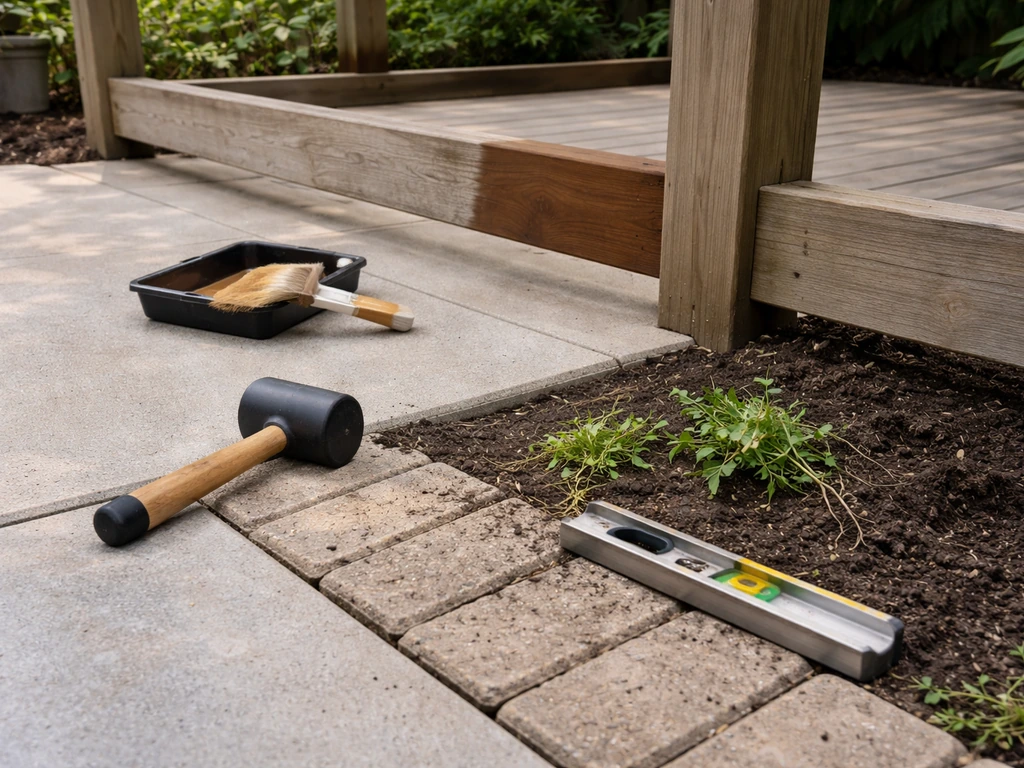
Patios are the lowest-maintenance option in most cases. Concrete needs sealing every few years to prevent cracking and staining. Pavers occasionally need to be releveled and re-sanded at the joints. Natural stone is durable but can be slippery when wet and may need periodic sealing. Generally, a well-installed patio with a proper base can last 20 to 30 years with minimal intervention.
Pergola maintenance depends almost entirely on the material. Wood pergolas (especially pressure-treated pine or cedar) need to be stained or sealed every one to two years to prevent UV damage, drying, and cracking. Constant moisture accelerates rot, so keeping wood off direct ground contact matters. Aluminum pergolas are genuinely low-maintenance: they don't rot, warp, crack, or attract termites, but the powder coating can fade or chip if not cleaned regularly, especially if bird droppings or tree sap sit on the surface. Vinyl falls between the two in maintenance needs but can yellow or become brittle in prolonged UV exposure over many years.
Gazebos face the most weather stress because the roof catches full snow and rain loads. If you're in a region with heavy snow, make sure your gazebo is rated for the local ground snow load. Wind is also a factor: an improperly anchored gazebo is a liability in a storm. Quality prefab kits from reputable manufacturers typically include load ratings. Wood gazebos need the same stain and seal regimen as wood pergolas. Metal and composite roofed kits generally hold up better in wet climates.
How each one affects home value and curb appeal
All three can add value, but none of them guarantees a specific return on investment. HomeLight frames patio value impact as conditional: location, patio type, buyer demand, and design quality all affect whether you recoup your investment. In general, a well-designed outdoor living space that matches the style of the home and the neighborhood tends to have a positive effect on buyer perception.
Patios tend to have the widest buyer appeal because they're the most neutral. A clean, well-finished paver or flagstone patio with good lighting and a fire pit checks a lot of boxes for buyers. Functional upgrades like outdoor kitchens, durable surfaces, and proper drainage have more consistent resale impact than purely decorative features. In resale/value-oriented guidance, buyer and appraisal perception tends to respond most to durable patio surfaces, professional landscaping, functional lighting, and features like built-in fire pits or outdoor kitchens functional upgrades like outdoor kitchens, durable surfaces, and good lighting have more consistent resale impact than purely decorative features..
Pergolas can offer a better return on investment than gazebos because they cost less to build while still creating what appraisers and agents call a 'defined outdoor room.' An outdoor dining area under a pergola with string lights reads as usable, finished space, which competes well in buyer conversations. According to one ROI analysis, defined outdoor rooms consistently outperform open-air patios in perceived value.
Gazebos can be a strong visual selling point in larger yards where they read as an intentional garden feature rather than a crowded add-on. In a smaller backyard, a large gazebo can make the yard feel smaller and may not resonate with all buyers. If you're building primarily with resale in mind, keep the gazebo proportional to the lot and make sure it complements rather than dominates the landscape.
How to pick the right one for your situation
Before you design anything, answer these questions honestly. If you are trying to decide between a pergola, a patio, or an alfresco setup, compare how much coverage you need and what kind of rain protection you expect pergola vs patio vs alfresco. They'll save you time, money, and the frustration of building the wrong thing. If you're comparing floating options for relaxing on the water, the decision is different for a patio boat vs pontoon boat.
- What do you actually need overhead? If it's just shade during meals, a pergola or patio umbrella may be enough. If you want to sit outside during a light rain, you need a solid roof, which means a gazebo or a covered patio/patio cover structure.
- How big is your outdoor space? A gazebo in a small urban backyard often looks cramped. Pergolas are easier to scale to available space.
- What's your budget? Patio under $5,000 is very achievable. Pergola under $10,000 is realistic. A quality gazebo rarely comes in under $5,000 to $8,000 even for a good kit, and custom work starts at $8,600.
- Are you in a snow or high-wind region? This affects structure choice, material, anchoring requirements, and permit complexity. Check your local live load requirements before committing to a design.
- Does your HOA or ACC have approval requirements? Find out before you design, not after you buy materials.
- What are your setbacks? Measure the distances from your house, property lines, and any easements. A freestanding gazebo that has to be 10 feet from the property line may not fit where you imagined.
- How much ongoing maintenance are you willing to do? Wood is beautiful but needs consistent upkeep. Aluminum or composite materials cost more upfront but dramatically reduce annual maintenance.
- Are you planning to DIY or hire out? If DIY, a prefab pergola kit or paver patio is the most realistic scope. A custom build of any kind benefits from a licensed contractor, especially for footings and any electrical work.
Quick scenario guide
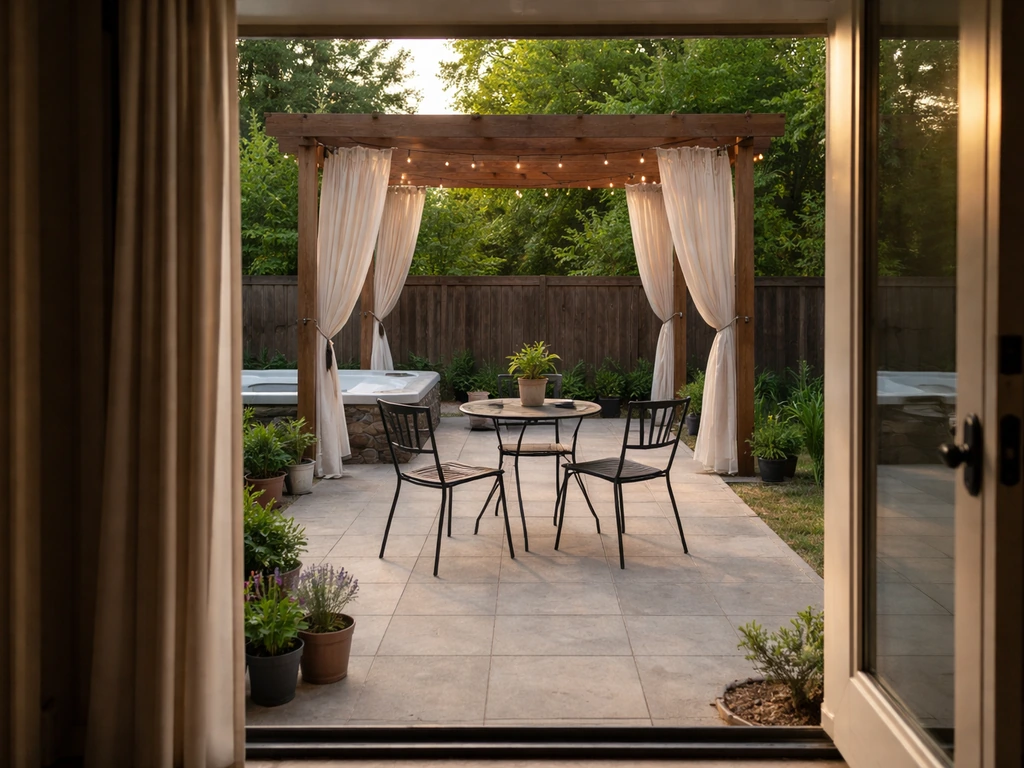
- Outdoor dining area off the back door, moderate budget: patio with a pergola above it
- Hot tub shade and some privacy: pergola with curtain panels, or a gazebo sized to fit the tub
- Garden focal point in a larger yard: gazebo
- Entertaining space for 10 to 20 people: extended patio with attached pergola or patio cover
- Tight budget, starting from scratch: concrete patio now, pergola later
- Wet climate with frequent rain: solid-roof structure like a gazebo or louvered pergola with drainage
- Resale-focused build: paver patio with pergola and lighting tends to offer the best balance of cost, appeal, and ROI
Your pre-design checklist
- Measure your available outdoor space and mark where you'd want the structure to go
- Check local setback requirements for the structure type you're considering (attached vs. freestanding)
- Contact your HOA or ACC if applicable and get approval requirements in writing
- Pull a sample permit application from your municipality to understand what documentation you'll need
- Get at least two contractor quotes before deciding to DIY or hire out
- Decide on your primary use case: dining, lounging, hot tub, or entertaining, since that drives size and shade requirements
- Set a realistic total budget including site prep, foundation, the structure itself, and at least a few add-ons (lighting, curtains, or fans)
The honest bottom line: most homeowners are best served by starting with a well-built patio and layering in a pergola once they understand how they actually use the space. A patio umbrella is a convenient, low-cost option for quick shade, but it offers far less coverage and stability than a canopy patio umbrella vs canopy. If you’re using a patio umbrella for evening shade, you should close it at night to protect it from wind and weather exposure should patio umbrellas be closed at night. If you are comparing patio umbrella vs pergola, the main difference is how much coverage and weather protection you want. A gazebo makes sense when you have a specific need for a fully protected, defined outdoor room and enough yard to give it breathing space. If you are deciding between gazebo vs patio, the key is how much real rain protection and privacy you need, since a gazebo is fully roofed while a patio usually isn’t. None of these is the wrong choice if you match it to what you actually need rather than what looks best in a Pinterest search.
FAQ
Can I put a gazebo directly on an existing patio, or does it need separate footings?
A gazebo can sometimes be set on a patio pad, but in many installs the posts must be anchored to dedicated footings or engineered supports for stability and wind uplift resistance. If your patio base is only a slab over poor soil, you may need reinforcement or new post footings, especially for larger (over kit-size) gazebos.
What should I consider for privacy if I choose a pergola instead of a gazebo?
Pergolas give openness, so privacy usually comes from add-ons rather than the structure itself. Common approaches are shade screens or retractable privacy panels on two sides, adding planter walls, or using climbing plants that take time to fill in (often a full growing season or more).
How do I estimate “shade coverage” for a pergola without guessing?
Start by measuring the exact time of day you want shade (for example, 1 to 5 pm) and then check the sun angle for your latitude. Pergola outcomes vary a lot with slat spacing and orientation, so it helps to test with temporary shade fabric stretched over the intended post line before committing.
Is a pergola considered a “roof” for insurance or code purposes?
Often it is treated differently than a fully roofed cover because rain is not intended to be blocked, but local code definitions can still classify it as a structural roof component if it has solid elements or attachments. If you are adding electrical, ceiling fans, or heat sources, confirm with your insurer and permit office whether the structure is treated as a covered or enclosed area.
Do all three require permits, or are some usually permit-free?
A basic ground-level patio is commonly permit-exempt in many places, but it is not universal. Permits are more likely once you add posts anchored into concrete, any overhead structure that changes load paths, or an attachment to the house. The safest approach is to ask your permit office using a simple description and rough dimensions before purchasing materials.
What’s the biggest mistake people make when DIY-ing a patio under a pergola or gazebo?
Most issues come from ignoring drainage and base preparation. Even if the patio looks level at first, a small slope error or un-compacted base can cause settling and gaps that then misalign the pergola posts or complicate gazebo anchoring. Plan the drainage path first, then pour or install the base with the correct reinforcement for any future loads.
How much stronger should the structure be if I live in a snow or high-wind area?
You will typically need to follow local design loads for snow accumulation and wind uplift, not generic “kit” assumptions. For pergolas attached to the house, attachment method and ledger sizing matter, and for gazebos the anchoring system (post anchors plus footing design) is usually the critical point in high-wind areas.
Are gazebos worth it if my goal is mostly evening use?
They can be, because the fully roofed design protects seating from evening light rain and reduces sun glare at all hours, but you should size them to your backyard scale. If your yard is small, a gazebo that dominates the sightlines can reduce usable open space even if it functions well.
What curtain-panel strategy works best if I want a gazebo that feels private but not boxed in?
A common approach is full or near-full coverage on the sides that face the street or neighbors, then leaving the best-view side open for airflow and sightlines. Using removable or motorized curtains (instead of fixed walls) also helps you adapt seasonally and reduces maintenance.
Does adding electricity change which option is best?
Electricity is compatible with all three, but routing and code compliance are different depending on whether the structure is open-air or roofed. A pergola often needs careful weatherproofing for fans or wiring under the slats, while a gazebo can simplify overhead lighting but may still require GFCI protection and conduit to buried runs.
How should I think about maintenance planning when choosing wood vs aluminum vs vinyl?
If you want the lowest ongoing effort, aluminum is usually the easiest long-term choice since it resists rot and pests. With wood, plan a regular staining or sealing schedule and prevent direct contact with soil. Vinyl can look good initially but can yellow or become brittle over long UV exposure, so it helps to budget for periodic assessment.
What’s a quick rule of thumb for choosing patio vs pergola vs gazebo for first-time buyers?
If you are unsure, start with a patio because it is the flexible base and you can add partial shade later. Choose a pergola if your main need is defined seating and heat reduction most of the day, and choose a gazebo when you need a dedicated, fully protected room (rain and sun) and privacy that does not depend on add-ons.
Next Article
Gazebo vs Patio: Cost, Uses, and Which Fits You
Side-by-side gazebo vs patio guide on cost, uses, layout, ROI, DIY vs pro, permits, and maintenance to choose right outd