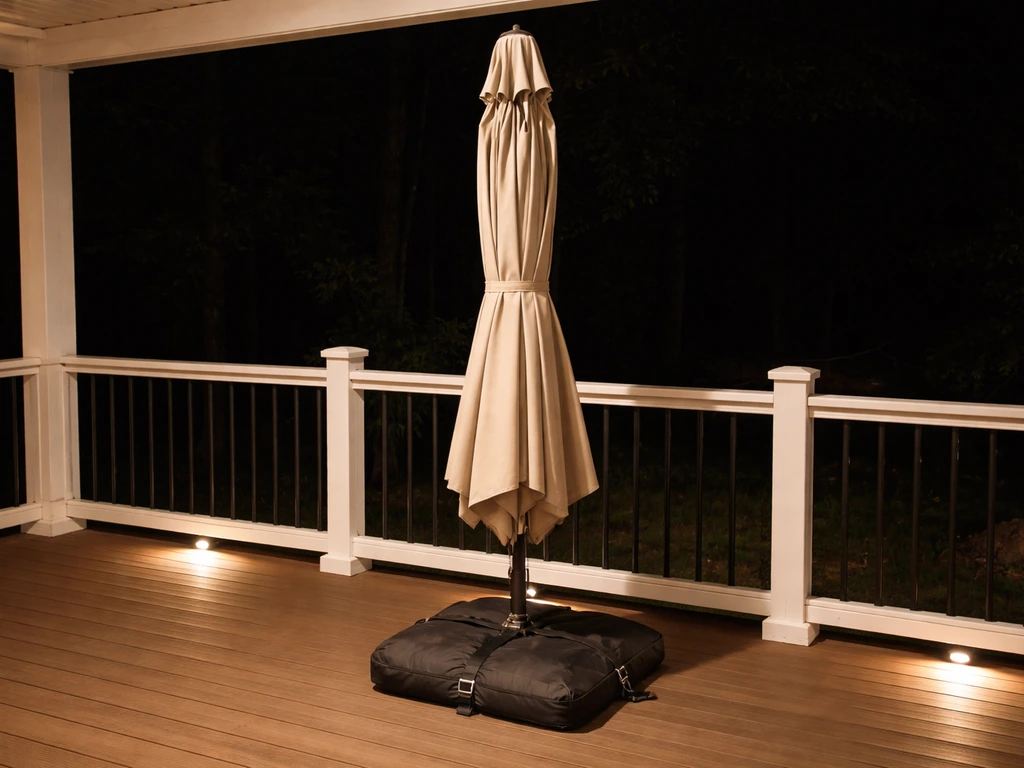
A patio umbrella is a portable, single-pole shade solution that costs $50 to $900+, sets up in minutes, and moves with you when your furniture layout changes. A canopy covers a defined area (typically a 10×10 or 10×20 ft footprint) with a fabric roof stretched over a frame, either popped up temporarily or bolted down semi-permanently. Both add shade and weather protection, but they solve different problems: umbrellas are about flexibility and focused shade for a table or chair grouping, while canopies are about covering more square footage with a sheltered room-like feel. Which one makes sense depends on how you use your patio, how often you get wind, and whether you want something you can stash in the garage or something that stays put all season.
Patio Umbrella vs Canopy: Choosing Shade for Your Patio and Value

Who this guide is for
If you are trying to decide how to add shade or covered space to a patio without committing to a permanent structure like a pergola or gazebo, this comparison is for you. It covers the practical differences between umbrellas and canopies across cost, coverage, wind performance, installation effort, and long-term value. It also flags where permits, HOA rules, and safety recalls can catch homeowners off guard, and it touches on how these options compare to more permanent alternatives so you can make a confident decision without overbuilding or underbuilding for your space.
The quick verdict
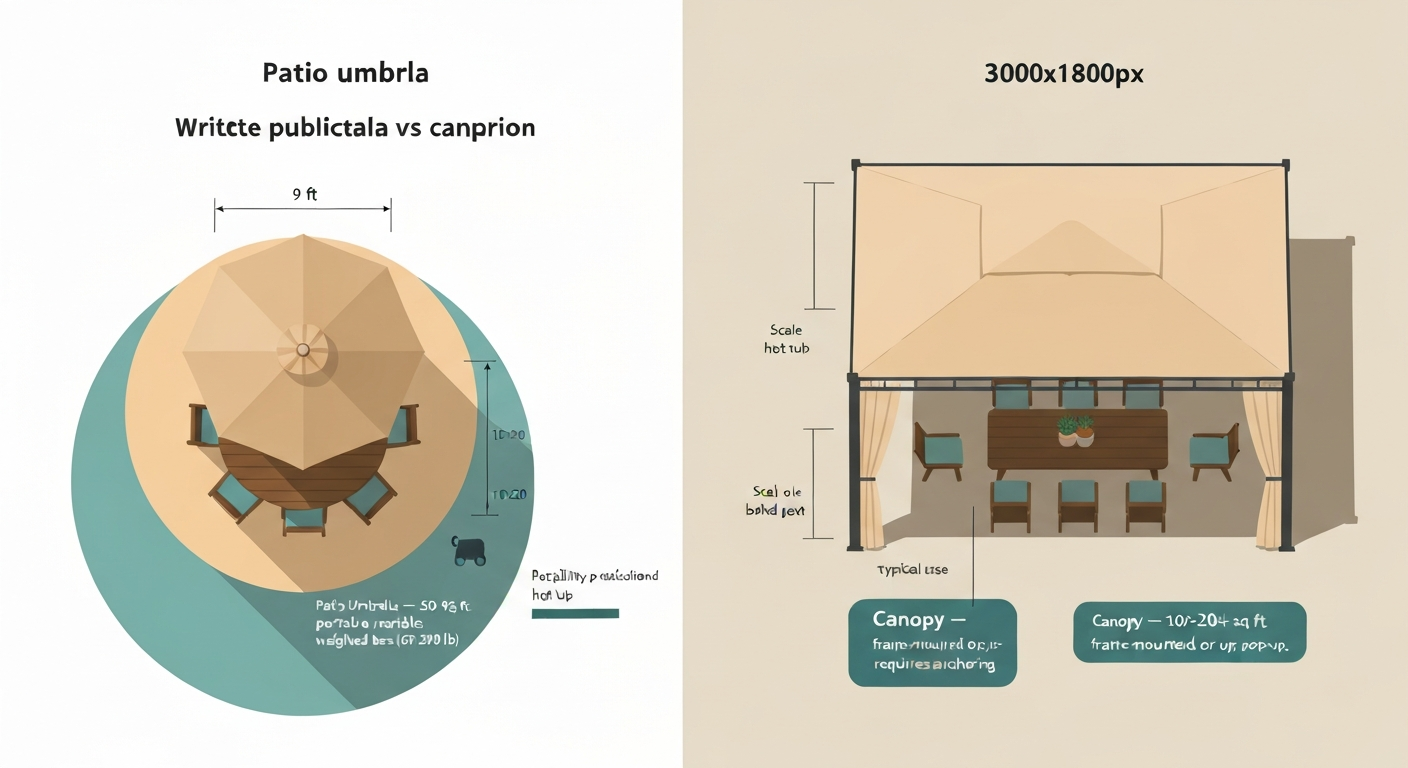
For most homeowners with a standard dining or lounge setup, a quality patio umbrella in the $200 to $500 range covers a 9 to 11 ft circle, stores easily, and handles moderate wind when properly baseweighted. A canopy makes more sense when you need to cover a larger gathering area (150 to 200+ sq ft), want partial weather protection on multiple sides, or need a semi-permanent shaded zone for a hot tub, outdoor kitchen, or workspace. Pop-up canopies are cheaper per square foot but require proper anchoring every single time you use them and are not really designed for permanent installation. If you are already wondering about more substantial structures, the comparison between umbrellas and pergolas is worth reading alongside this, since pergolas occupy a different budget and permanence tier entirely. For a deeper comparison, see our patio umbrella vs pergola guide.
Side-by-side feature comparison
| Feature | Patio Umbrella | Pop-Up Canopy | Frame-Mounted Canopy |
|---|---|---|---|
| Typical coverage area | 50–95 sq ft (circular) | 100–400 sq ft (rectangular) | 100–400 sq ft (rectangular) |
| Fabric materials | Polyester, olefin, solution-dyed acrylic (Sunbrella) | Polyester (most consumer), polyester-oxford blends | Polyester, canvas, solution-dyed acrylic |
| Frame materials | Aluminum, steel, wood, fiberglass ribs | Powder-coated steel, aluminum | Galvanized steel, aluminum |
| Portability | High — folds flat, stores in a bag | High — folds into a carry bag | Low to none — posts anchored to surface |
| Setup time | Under 5 minutes | 5–15 minutes | Several hours to days (installation) |
| Wind resistance (anchored) | Moderate — dependent on base weight | Low to moderate — stakes/weights required | Moderate to high — depends on anchoring method |
| Waterproofing | Partial — fabric sheds light rain | Partial to full — depends on fabric and side walls | Full coverage possible with sidewalls |
| Typical lifespan | 3–10 years (fabric); 5–15 years (frame) | 2–5 years (consumer); 5–10 years (commercial grade) | 5–15 years (frame); 3–7 years (fabric cover) |
| Permit typically required? | No | No (temporary use) | Sometimes — check local rules above 120–200 sq ft |
| HOA approval often needed? | Rarely | Sometimes for extended use | Often yes |
Fabric quality is the single biggest driver of how long either option lasts. Premium umbrellas and canopy covers made with solution-dyed acrylic (Sunbrella is the most recognized brand) hold their color far better than basic polyester because the color is baked into the fiber rather than printed on. Sunbrella fabrics also resist mold and UV degradation significantly better than budget polyester, which fades visibly within one or two seasons of direct sun exposure. If you are buying something you plan to use for more than a couple of years, the fabric upgrade is worth the cost difference.
Cost comparison: what you actually spend
Patio umbrella price ranges
Entry-level umbrellas (7 to 9 ft, polyester fabric, steel pole) start around $50 to $100 at big-box retailers. Mid-range models with larger canopies (9 to 11 ft), aluminum frames, and better fabric run $150 to $400. Premium cantilever or large market umbrellas with Sunbrella fabric and commercial-grade hardware typically cost $500 to $900 or more. The Home Depot, Patio Umbrellas category (pricing examples and price‑range guidance) shows listings from roughly $50 at the low end through several hundred dollars, with many premium models and large cantilevers approaching the $700–$900 range The Home Depot — Patio Umbrellas category (pricing examples and price‑range guidance). That price does not include a base. A proper weighted base for a large cantilever umbrella can add $80 to $200 on its own, and Treasure Garden (a major umbrella manufacturer) recommends minimum base weights of roughly 100 to 200+ lb for 10 to 11 ft cantilever models. You can buy modular add-on weights (30 lb cast iron increments are common) to build up to the required ballast, which is a practical solution if you already have a base and need to increase stability.
Canopy price ranges
Consumer pop-up canopies (10×10 ft) from discount brands are widely available for $60 to $220 at mass retailers. Branded commercial-grade pop-ups like the E-Z UP 10×10 Vista run closer to $150 to $500 depending on model and accessories. Frame-mounted semi-permanent canopy kits (with posts, hardware, and a fabric cover) cover more ground and cost $300 to $1,500 for a DIY kit. Professional installation of a frame-mounted canopy or sail shade adds labor that can range from $200 to $800 or more depending on the scope and surface type. Sidewall panels for pop-ups are usually sold separately at $30 to $100 per wall.
Ongoing upkeep costs
| Cost Item | Patio Umbrella | Pop-Up Canopy | Frame-Mounted Canopy |
|---|---|---|---|
| Replacement fabric/cover | $40–$200 | $30–$150 | $80–$300 |
| Base weights or anchoring | $40–$200 (one-time) | $20–$60 (weight bags, stakes) | $100–$400 (post hardware, concrete) |
| Storage solution | $20–$60 (cover/bag) | $0 (carry bag included) | N/A (stays installed) |
| Annual cleaning supplies | $10–$30 | $10–$30 | $10–$30 |
| Professional repair/service | Rare — DIY-friendly | Rare — replace vs repair | Occasional — frame inspection |
Wind, weather, and how long they actually hold up
Wind is the number one reason either of these fails prematurely, and both options require deliberate anchoring to perform safely. For umbrellas, the base weight is everything. Manufacturers like Treasure Garden publish minimum base weight specifications for each model, and under-weighting an umbrella in even moderate wind (15 to 20 mph gusts) can tip it over and cause property damage or injury. A 9 ft market umbrella needs at least 50 lb of ballast; a 10 to 11 ft cantilever generally needs 100 to 200 lb. That is a lot of concrete or cast iron sitting on your patio, and it is not optional if you live somewhere with afternoon wind events.
Pop-up canopies have a worse reputation for wind because many users skip the anchoring step. E-Z UP's own instructions explicitly warn users never to leave a pop-up canopy unattended and to take it down in high winds. Weight bags filled with sand (typically 20 to 40 lb each, one per leg) or ground stakes are required, not optional extras. Consumer-grade pop-ups with thin-wall steel frames bend or collapse at wind speeds that a properly anchored umbrella with a solid base would survive. Commercial-grade frames (thicker-wall steel or aluminum, truss reinforcement) handle wind significantly better but cost more. Frame-mounted semi-permanent canopies with posts set in concrete or bolted to a concrete patio are the most wind-stable option in this category, but they lose all portability.
Waterproofing varies by fabric and construction. Most standard polyester umbrella and canopy fabrics shed light rain adequately but are not true waterproof membranes. Seams on cheap canopy tops are often taped rather than welded, and they leak at the seams after a season or two. Premium fabrics with a waterproof backing or PVC coating hold up better in sustained rain. If your primary goal is rain protection (not just sun shade), look for fabrics rated for water resistance, and expect to reapply a waterproofing spray treatment every one to two seasons to maintain performance on any fabric canopy.
For long-term durability, frame material matters as much as fabric. Powder-coated steel rusts at cut edges and weld points over time; aluminum frames do not rust but can pit and corrode in coastal environments. Fiberglass ribs on umbrellas flex without snapping better than steel ribs, which is why quality umbrella manufacturers use fiberglass in wind-prone models. A mid-range umbrella with a solid aluminum pole, fiberglass ribs, and Sunbrella fabric will realistically last 7 to 10 years of seasonal use. A budget pop-up canopy left up frequently through summer storms may not make it past two seasons.
Patio umbrellas: pros and cons
What works well
- Highly portable: moves with furniture, folds for storage, and takes up minimal space in a garage or shed
- Fast setup and takedown: no tools required, operational in under five minutes
- Works well for defined seating areas like a dining table or a pair of lounge chairs
- Lower upfront cost than canopy systems for equivalent shade quality
- Wide variety of styles, colors, and sizes to match patio furniture
- Tilt mechanisms (manual or auto-tilt) let you track the sun's angle through the day
- No permit required and rarely triggers HOA restrictions
- Easy to close and store overnight, which extends fabric life significantly
Where umbrellas fall short
- Coverage is circular and limited to roughly 50 to 95 sq ft, which is not enough for large gatherings or wide open areas
- Requires a heavy base (100 to 200 lb for large cantilevers) that is awkward to move and must be weighted correctly every time
- Not designed to stay open in sustained wind or during storms — leaving one open overnight in windy conditions risks damage
- Canopy is typically not waterproof, only water-resistant
- Center-pole umbrellas require a table with a center hole, limiting furniture compatibility
- Mechanical parts (crank, tilt hub, pulley) wear out or break, particularly on budget models — check CPSC recall listings before buying since structural failures have triggered consumer safety recalls
Canopies: pros and cons
What works well
- Covers significantly more area than an umbrella: a 10×20 ft canopy shelters roughly 200 sq ft
- Rectangular footprint fits neatly over outdoor dining sets, hot tubs, or workspace areas
- Sidewall panels add rain and wind protection not possible with an umbrella
- Frame-mounted versions are semi-permanent and do not need to be reassembled daily
- Pop-ups are genuinely fast to set up for events or weekend use
- Commercial-grade models are built for repeat use and handle moderate wind better than consumer pop-ups
- More affordable per square foot of coverage than building a pergola or gazebo
Where canopies fall short
- Pop-up canopies are genuinely dangerous if not anchored correctly every single time — unsecured frames blow over in 20+ mph gusts
- Consumer-grade pop-up frames have a short lifespan; the frame usually fails before the fabric
- Frame-mounted semi-permanent canopies lose all the portability benefit and may require permits depending on size and jurisdiction
- Bulky to store: a 10×20 pop-up with sidewalls and a carry bag takes up substantial garage space
- The aesthetic is more utilitarian (event-tent look) than a nice umbrella or a wood pergola
- HOA rules more likely to require approval for a canopy structure than for an umbrella, particularly if it is visible from the street or neighboring properties
- Fabric covers typically need replacement every three to five years even on well-maintained frames
Sizing and placement: getting it right before you buy
How to size a patio umbrella
The standard rule is that umbrella diameter should exceed the table diameter by 2 to 3 feet on each side. A 48-inch round dining table needs at least a 9 ft umbrella. A 60-inch rectangular table with four to six chairs benefits from an 11 ft market umbrella or a cantilever that can offset to the side. For a lounge area with no table, a 9 ft cantilever on an adjustable arm gives you the most flexibility because you can position the canopy precisely over the chairs without a center pole eating up table space or floor area.
Placement matters for safety. Center-pole umbrellas need a hole in the table and enough clearance around the pole so diners are not bumping into it. Cantilever umbrellas need a clear zone of at least 1 to 2 ft on the arm side for the base and frame, and the overhang should not extend over anything it could fall on if the base tipped. On a windy site, always position the umbrella so the tilt opens away from the prevailing wind direction, reducing the sail effect.
How to size a canopy
A 10×10 ft canopy (100 sq ft) comfortably fits a standard 6-person dining table and chairs with 18 to 24 inches of clearance on each side. A 10×20 ft canopy (200 sq ft) covers a larger dining area or a hot tub plus a seating zone. When measuring, account for the leg footprint: the posts on a 10×10 canopy sit at the corners, so the actual interior clearance is slightly less than 10 ft square. Leave at least 3 ft of clear walking path around the outside of the canopy legs so the frame is not a tripping hazard. For frame-mounted canopies, check that post placement does not conflict with any underground utilities, drainage lines, or irrigation.
Clearance and overhead considerations
Both umbrellas and canopies need adequate clearance above the seating area. A minimum of 7 ft from the ground to the underside of the fabric is the comfortable standing clearance for most adults. Most market umbrellas with a 2-piece pole and table mount end up at 7.5 to 8.5 ft of clearance at the perimeter. Low-profile pop-up canopies can be set to an interior height of 6.5 ft in compact mode, which feels tight for standing but works for seated gatherings. Check the adjustable-height settings on any canopy frame before buying if you are tall or plan to mix standing and seated use.
Anchoring, installation, and the DIY question
For umbrellas, DIY installation is straightforward. The only real decision is between a freestanding base (weighted with sand, water, or cast iron plates) and an in-ground mount (a sleeve embedded in concrete that accepts the pole directly). In-ground mounts are more stable and look cleaner but commit the umbrella to one location. A good freestanding base for a 9 to 11 ft umbrella weighs 50 to 150 lb empty and usually needs additional plate weights added to meet the manufacturer's minimum recommendation. For large cantilever umbrellas requiring 200 lb of ballast, that usually means buying a purpose-built base and adding modular weight plates progressively.
For pop-up canopies, anchoring is non-negotiable regardless of wind forecast. The four options are: steel ground stakes (driven through the leg feet into soil, suitable for grass or dirt patios), screw-in earth anchors (for firmer soil), weight bags filled with sand (3 to 5 gallons per leg, hung from the frame feet, suitable for concrete or pavers), and tie-down straps to adjacent fixed structures. Most consumer pop-ups ship without adequate anchoring hardware, so budget $20 to $60 extra for weight bags or stakes.
Frame-mounted semi-permanent canopies require more involved installation. Posts typically bolt to a concrete surface with sleeve anchors (a weekend DIY project if you are comfortable with a hammer drill) or are set in concrete footings (slightly more involved but achievable for a competent DIYer). The more complex part is ensuring the post layout is square, the frame is level, and the fabric cover is tensioned evenly. If the canopy exceeds 120 to 200 sq ft, check local building codes: many jurisdictions require a permit for structures above that threshold, and some require engineer-stamped drawings for any permanent canopy attached to the house structure. Some municipalities treat small detached shade structures under specific size thresholds as permit-exempt; see Municipal planning/permit example, Glendale Heights (planning minutes showing permit rules for accessory structures) for a local example blank" rel="noopener noreferrer">Municipal planning/permit example — Glendale Heights (planning minutes showing permit rules for accessory structures). Designers of permanent or semi-permanent canopies should follow ASCE/SEI 7 wind provisions and use ASCE wind maps to determine site basic wind speed (ASCE, ASCE 7 & SEI Standards (Minimum Design Loads)) blank" rel="noopener noreferrer">ASCE — ASCE 7 & SEI Standards (Minimum Design Loads). For reference, the International Residential Code treats some awnings as permit-exempt if they project 54 inches or less and are supported entirely by an exterior wall, but freestanding canopy structures often do not qualify for that exemption.
Permits, HOA rules, and safety you should not skip
Permit thresholds for temporary and semi-permanent shade structures vary widely by jurisdiction. In many municipalities, temporary pop-up canopies used for personal gatherings do not require a permit for short-duration use. However, the International Building Code (and many local adoptions) sets thresholds where tents or canopies used for gatherings exceeding roughly 120 to 200 sq ft often trigger permit and inspection requirements. Some jurisdictions (like the Village of Woodbury, NY, as one documented example) require permits for canopies over 400 sq ft and tents over 200 sq ft, with fire safety and egress standards attached. The practical takeaway: for personal residential use with a standard pop-up canopy, you are almost certainly fine without a permit. For anything frame-mounted, semi-permanent, or over 120 to 200 sq ft, call your local building department before you build.
Canopies used for gatherings or events also fall under fire code requirements in many places. IBC Chapter 31 and NFPA 701 set flame-propagation standards for membrane structures, and some jurisdictions require fabric compliance certificates and fire marshal inspection for temporary structures used for public events. For a backyard birthday party, this is rarely enforced. For anything that looks like a commercial event or public gathering, take it seriously.
HOA rules are a separate layer entirely. Many HOA architectural guidelines require prior approval for any visible shade structure, including canopies, awnings, and sometimes even large umbrellas. Common restrictions include setback distances from property lines, height limits, color and material requirements, and whether temporary structures can remain in place for extended periods. Read your CC&Rs before you buy anything that will be visible from the street or adjacent lots. Getting an after-the-fact violation notice is a frustrating way to learn this lesson.
On the consumer safety side: both umbrellas and canopies have seen CPSC recalls related to mechanical failures. Structural issues like arm and pivot breakage on certain umbrella models have led to formal recalls. Before putting a stored umbrella back into service each season, check the CPSC recall database for your brand and model. This takes five minutes and can prevent a serious injury.
Maintenance and seasonal care
For umbrellas, the biggest longevity habit is closing them when not in use, especially overnight or when wind picks up. An umbrella left open overnight in a summer thunderstorm is far more likely to end up damaged or tipped over than one that was closed and secured. This is such a common question for umbrella owners that it is worth stating plainly: close your umbrella every night if you want it to last. Leaving it open exposes the fabric to unnecessary UV degradation, dew, and wind stress. Sunbrella and similar solution-dyed acrylic fabrics can be cleaned with a mild soap and water solution (a soft brush, rinse well, and air dry completely before closing). Avoid pressure washers, which damage fabric coatings.
For canopies, clean the fabric cover at the start and end of each season. Never store a canopy with wet or damp fabric folded inside the bag because mold grows fast in that environment and it is nearly impossible to reverse on a canopy top. Frame care means wiping down metal joints, checking for rust spots at any cut edges or weld points, and lubricating any locking pins or slider mechanisms annually. Pop-up frames that develop bent legs or cracked joints should be retired, because a compromised frame is a collapse waiting to happen.
How these options compare to pergolas, gazebos, and awnings
Umbrellas and canopies occupy the most affordable, least permanent tier of outdoor shade structures. Pergolas offer shade through a louvered or lattice roof (usually no solid fabric coverage unless you add shade sails or a retractable canopy), cost $1,500 to $8,000+ for DIY kits or professional installation, and add measurable property value. For a deeper comparison of pergolas, patios, and alfresco options, see pergola vs patio vs alfresco. Gazebos enclose a defined outdoor room with a solid roof and partial walls, typically $2,000 to $10,000+ installed, and are genuinely permanent additions that may or may not work on an existing patio surface. If you’re unsure whether a gazebo will work on your existing patio, see our guide 'can a gazebo go on a patio' for foundation, load-bearing, and permit considerations. For a direct comparison to help decide between a built gazebo and using your existing patio space, see gazebo vs patio. Awnings (retractable or fixed, attached to the house wall) split the difference: they cover a larger zone than an umbrella, attach to the structure, and often qualify for a specific permit exemption for small projections but require professional installation for the powered retractable versions that cost $1,500 to $4,000. For a deeper look at permanence, cost, and resale impact, see our patio vs pergola vs gazebo guide.
If you want shade this weekend and flexibility next year, start with a quality umbrella or a commercial-grade pop-up canopy. If you are planning a patio renovation and thinking two to three years ahead, a pergola or frame-mounted canopy with a proper foundation gives you more weather protection and adds more visual permanence to the space. The right comparison is always the one that matches your actual timeline and budget, not the one that looks best in a catalog. For an unrelated comparison of small watercraft, see our guide on patio boat vs pontoon boat for help choosing between those two options.
Does shade structure choice affect property value?
Patio umbrellas and pop-up canopies do not meaningfully affect property value because they are personal property, not fixtures, and they are not listed in a home sale as an improvement. Frame-mounted semi-permanent canopies are in a gray zone: they may or may not convey with the property, and buyers may view them positively (as a covered outdoor space) or negatively (as a maintenance item). Permanent structures like pergolas and gazebos consistently show up in real estate data as appealing outdoor features that can support asking prices, particularly in markets where outdoor living is valued. If property value is part of your decision, a well-built pergola or solid patio cover does more for resale than a canopy tent, even a nice one.
Quick buying checklist before you decide
- Measure your patio area and the specific zone you need shaded (in square feet)
- Decide if you need the option to move or store the structure seasonally
- Check your local building department's permit threshold for shade structures (typically 120 to 200 sq ft triggers review)
- Review your HOA CC&Rs for approval requirements before buying anything visible from the street
- For umbrellas: confirm the base weight meets the manufacturer's minimum for your model size
- For canopies: budget for anchoring hardware (stakes, weight bags, or sleeve anchors) separately from the canopy purchase price
- Choose solution-dyed acrylic fabric over basic polyester if the structure will stay up most of the season
- Check the CPSC recall database for your umbrella or canopy model before first use each season
- For pop-up canopies: plan your storage space before you buy — a 10×20 canopy with sidewalls is bulky
- If you think you will want something more permanent in two to three years, price a pergola kit now so the canopy decision is made with full cost context
FAQ
What is the basic difference between a patio umbrella and a canopy?
A patio umbrella is a single freestanding shade device (center‑pole or cantilever) designed primarily for portable, temporary shade for a table or seating area. A canopy (pop‑up or frame canopy) is a framed membrane structure that creates a larger covered footprint; pop‑ups are portable and temporary, while frame‑mounted canopies can be heavier duty for repeated use. Umbrellas prioritize point coverage and portability; canopies prioritize broader footprint coverage and temporary event use.
What are the main pros and cons of umbrellas versus canopies?
Umbrellas: pros — easy to move, quick to open/close, lower cost for small areas, good for table shading; cons — limited coverage, require substantial base ballast for stability, poorer wind performance for large diameters. Canopies: pros — cover larger areas, rapid shade for multiple people, widely available sizes, tie‑down and anchoring options; cons — bulkier to store, more visible footprint, pop‑ups can be vulnerable in wind and require careful anchoring and takedown in bad weather.
How do costs compare (materials and retail price ranges)?
Patio umbrellas: entry models ~$50–$150, midrange $150–$500, large premium/cantilever models with durable fabrics (Sunbrella, aluminum/steel frames) often $500–$900+. Pop‑up canopies: consumer 10×10 models ~$60–$250; branded/premium instant canopies (E‑Z UP commercial lines) typically $150–$500+ depending on frame strength and fabric. Add costs for bases/ballast, anchors, delivery, and professional installation if applicable.
How do umbrellas and canopies perform in wind and weather?
Both are vulnerable to high winds. Large umbrellas (especially cantilevers) require heavy bases or modular ballast (100–200+ lb recommended for large models) and should be closed in strong gusts. Pop‑up canopies rely on stakes, screw anchors or ballast and manufacturer guidance; they should be secured and taken down in high winds. For semi‑permanent membrane installations, professional design to code (ASCE 7 wind loads) is required. Neither is ideal as a permanent roof replacement in severe weather without engineered support.
How should I size and place an umbrella or canopy on my patio?
Match coverage to use: umbrella diameters commonly 6–11 ft; a 9–11 ft umbrella suits a 4–6 person table or lounge group. For canopies, choose footprint (e.g., 10×10, 10×20) large enough for furniture circulation and setbacks. Leave 2–3 ft of clearance around furnishings for movement. Consider sun path (orientation), proximity to doors/paths, overhead obstructions, and wind exposure; cantilever umbrellas allow offset placement where a center pole would be obtrusive.
What anchoring or installation options exist and when should I use professional help?
Umbrella anchoring: portable weighted bases (concrete/cast iron), modular add‑on weights, inground anchors for umbrella sleeves set in concrete, or deck‑mounted bases. Canopy anchoring: stakes/screw anchors for soft ground, ballast bags/weights for hard surfaces, and frame‑anchored deck mounts for repeated use. DIY is common for portable units; professional help is recommended for permanent or semi‑permanent structures (deck‑mounted bases, installed posts, or any membrane structure requiring engineering to meet local code or ASCE wind provisions).
Should Patio Umbrellas Be Closed at Night? Simple Rules
Rules on closing patio umbrellas at night, when to leave open, and how to secure and dry wet covers to prevent mildew.