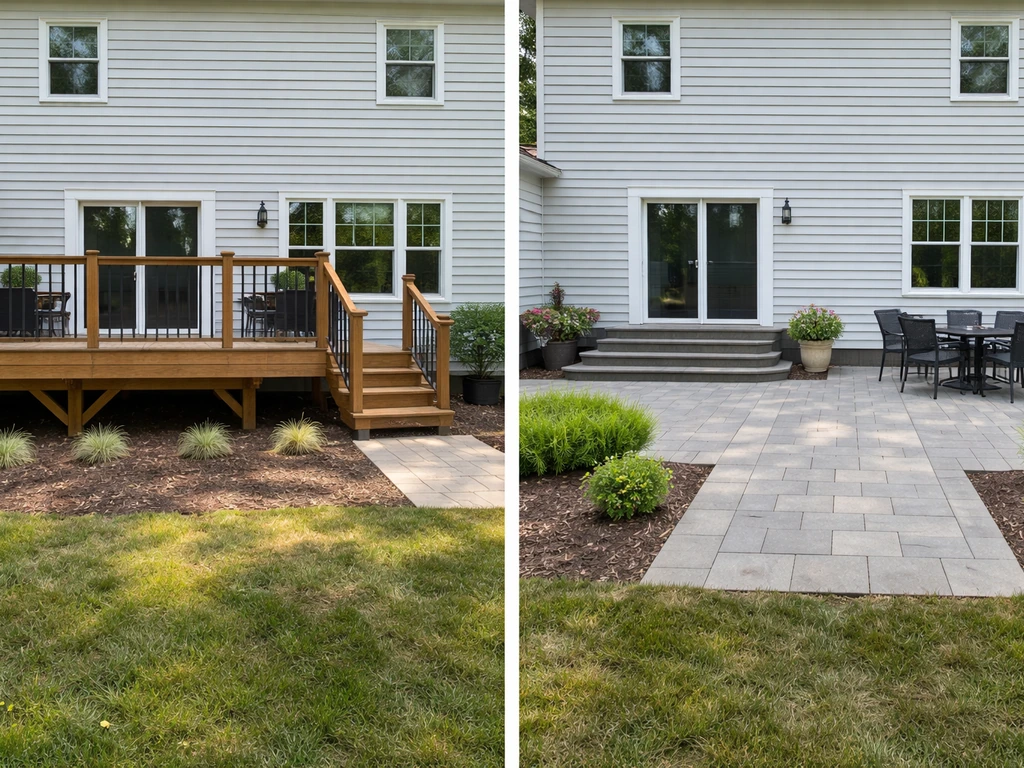
If your yard is flat and you want the most affordable, low-maintenance option, build a patio. If your yard slopes, your house sits elevated, or you want a raised outdoor living space that connects directly to an interior door, a deck usually makes more sense. Neither is universally better, the right call depends almost entirely on your specific site, budget, and how you plan to use the space. If you're wondering whether a patio and a deck are the same thing, the answer is no: they differ in how they're built and how they sit on your property is patio and deck the same.
Should I Build a Patio or Deck? Costs, Pros, and Choice Guide

Miles Hart
15 Jun 2026
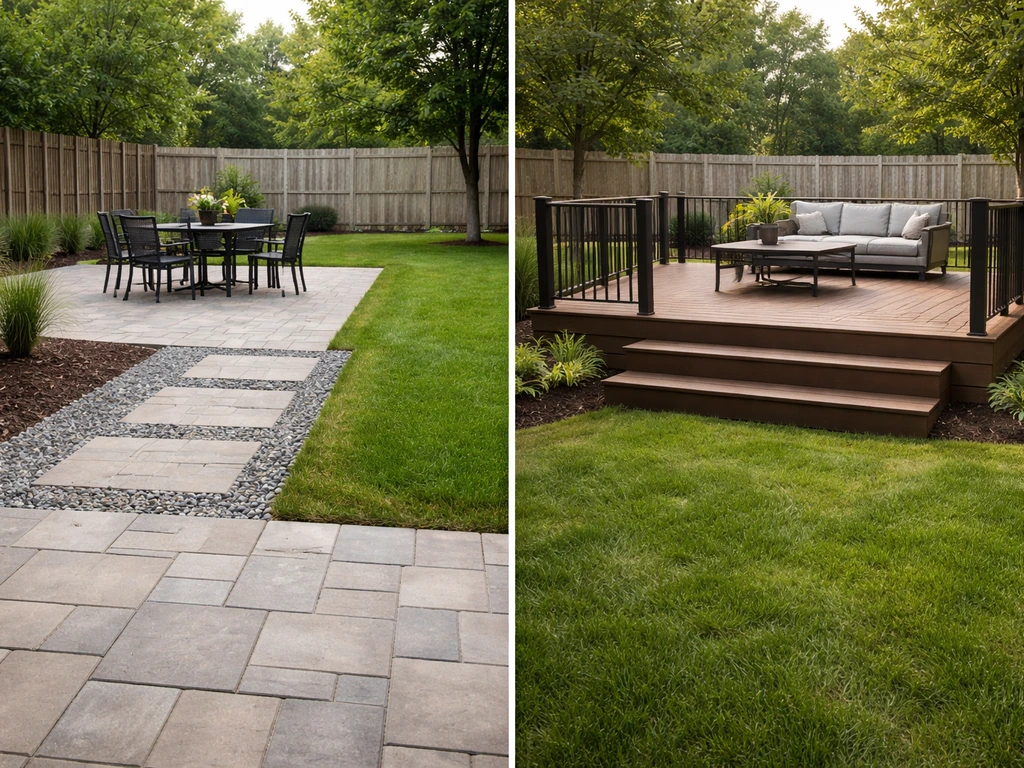
Patio vs deck basics: what each one actually is
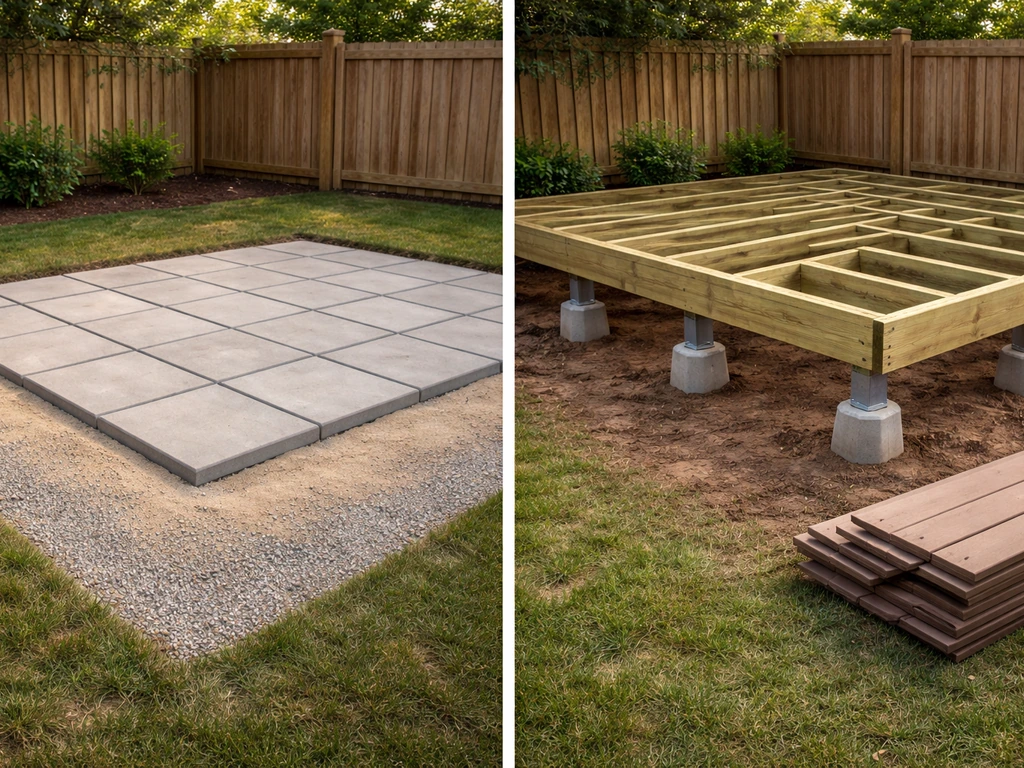
A patio is a ground-level hardscape. It sits directly on the earth, built on a prepared base, typically compacted gravel, about an inch of bedding sand, and then the surface material on top, whether that's concrete pavers, natural stone, poured concrete, or brick. There's no framing, no structural posts, and no real elevation. The whole assembly sits on the ground and relies on proper base prep and grading for drainage.
A deck is a raised platform built on a structural subframe: footings in the ground, posts, beams, and joists all working together to hold the surface off the ground. If you're wondering, “is a deck a patio,” the short answer is no, because a deck is raised and built on a structural frame.
Most residential decks are attached to the house using a ledger board, a horizontal member bolted directly to the house's rim joist or band joist, which also means the deck connection has to be flashed properly with corrosion-resistant flashing to keep water out of the wall. Some decks are freestanding, meaning they support themselves entirely with their own post-and-beam system, which makes them a bit more involved to engineer but removes the ledger-to-house water risk.
The surface materials differ significantly too. Patios typically use concrete pavers, natural flagstone, poured concrete, or brick, all relatively affordable and widely available. Decks are most commonly built from pressure-treated lumber, cedar, redwood, composite decking (like Trex or Fiberon), or engineered wood products, and they almost always include a railing system if the deck is more than 30 inches off the ground. Each material category has its own cost profile, maintenance demands, and aesthetic range.
Cost comparison: what you'll actually spend
Patios are generally cheaper to build, but there's meaningful variation depending on materials and site conditions. A basic poured concrete patio runs roughly $8 to $12 per square foot installed. A paver patio with a proper aggregate base typically lands between $15 and $25 per square foot depending on the paver style and labor market. Natural flagstone can push $20 to $35 per square foot. For a 400-square-foot patio, a common size for a modest backyard, you're looking at roughly $3,200 to $10,000 depending on material choice.
Decks cost more because of the structural complexity. A basic pressure-treated wood deck runs $25 to $35 per square foot installed. Composite decking adds $10 to $20 per square foot on top of that. Railing systems, stairs, and permit fees (which are almost always required for decks and sometimes required for patios over a certain size) can add another $2,000 to $5,000 to a typical project. A 400-square-foot pressure-treated deck commonly comes out to $10,000 to $14,000 installed; composite finishes can push that to $18,000 or more.
Permits deserve a specific mention because homeowners often skip them and regret it at resale. Decks almost universally require a building permit because they're structural. Patios sometimes require permits too, especially if they're attached to the house or affect drainage. Budget $200 to $1,000 for permits depending on your municipality, and factor in the time, because permit reviews can add two to six weeks to a project.
Long-term upkeep costs also differ. A pressure-treated wood deck needs to be cleaned and resealed or stained every one to three years. If you skip that, expect splintering, warping, and graying within five years. A composite deck needs less maintenance (mostly occasional cleaning) but costs more upfront. Paver patios hold up well with minimal maintenance if the base was installed correctly, the main issue is joint sand washing out over time, which requires periodic re-sanding. Poured concrete can crack and may need patching or sealing every few years.
| Feature | Patio | Deck |
|---|---|---|
| Typical installed cost per sq ft | $8–$35 depending on material | $25–$55 depending on material |
| 400 sq ft total estimate | $3,200–$10,000 | $10,000–$22,000+ |
| Permit usually required? | Sometimes | Almost always |
| Annual maintenance cost | Low–moderate (mostly resealing/sand) | Moderate–high (staining/sealing wood) |
| Lifespan with proper care | 25–50+ years | 15–30 years (wood); 25–40 years (composite) |
How your property shapes the decision
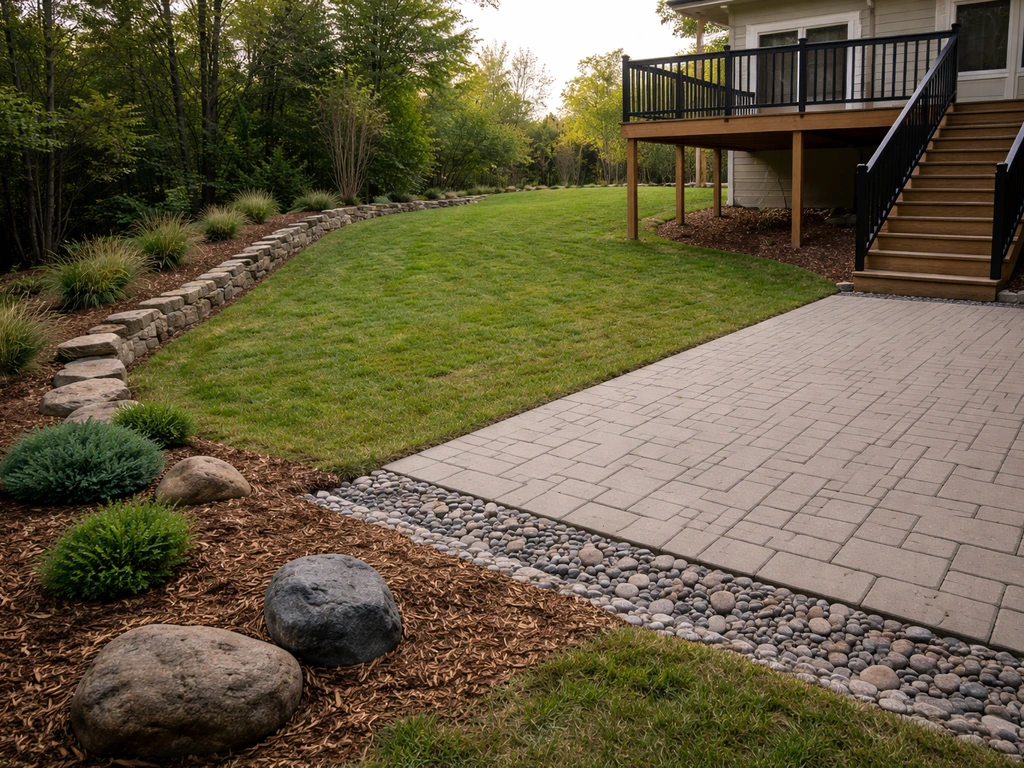
Your yard's topography is often the deciding factor, and it's the one homeowners most frequently overlook when comparing costs online. If you have a flat yard, a patio is almost always easier and cheaper, you excavate to depth, compact a gravel base, and build up from there.
If your yard slopes significantly (more than 6 to 8 inches across the area you want to cover), a patio requires either excavation and regrading (expensive) or a retaining wall (even more expensive). A deck handles slope naturally, since posts can be cut to whatever height is needed to keep the surface level.
If you're still weighing the options after reading this, revisit the difference between a patio and a deck to confirm which choice better matches your layout and site deck handles slope naturally.
Drainage is critical for patios specifically. A properly built paver patio relies on the base assembly to manage water, undisturbed subgrade at the bottom, compacted aggregate base above that, about an inch of bedding sand, and then the surface. Every layer needs to slope slightly away from the house (typically a 1-inch drop per 8 feet). If this is done wrong, you get pooling water, frost heave in cold climates, and eventually shifting or sinking pavers.
Patio installers warn that when drainage is handled poorly, you can see water pooling and other failures that emerge below the surface water pooling and other failures below the surface. A good patio contractor will spot soil and drainage problems before they start; a bad one won't mention it until you have standing water on your new patio.
Soil conditions matter for decks too. Deck footings need to extend below the frost line (anywhere from 12 inches in mild climates to 48 inches in cold northern states) and bear on stable soil. Expansive clay soils, high water tables, or rocky ground can complicate footing installation significantly and add cost. If you're in an area with difficult soil, get a soil assessment before finalizing your deck design.
Sun and shade preferences are worth thinking through practically. A deck attached to your house is typically positioned right where your door exits, so its orientation is fixed by the house layout. A patio is more flexible; you can position it anywhere in the yard, including under an existing tree or in a spot that gets more evening shade. If you want to capture afternoon sun or avoid it, a detached patio (or even a freestanding deck) gives you more placement options than an attached deck does.
HOA rules and local zoning setbacks are real constraints too. Many municipalities require decks to sit a minimum distance from property lines (commonly 5 to 10 feet). Some HOAs restrict deck materials, staining colors, or railing styles. Patios face fewer restrictions in most areas, though covered patios and pergolas often trigger the same permit requirements as decks. Check with your local building department before you design anything.
Comfort, maintenance, and how each one ages
Barefoot comfort is one of those things you won't think about until summer. Wood decks get hot in direct sun, pressure-treated and cedar surfaces can reach uncomfortable temperatures on a 90-degree day. Composite decking runs even hotter in dark colors. Concrete and stone patios also absorb heat but tend to stay somewhat cooler because they sit on the ground. Lighter-colored concrete pavers in particular stay reasonably comfortable underfoot in most climates.
Wood decks require the most consistent maintenance of any option. Pressure-treated lumber should be sealed within the first year and then every one to three years after that. Skip a season and you'll see checking (small surface cracks), graying, and potential splintering. Cedar and redwood are naturally more resistant but still benefit from regular sealing. Composite decking sidesteps most of this, it doesn't rot, doesn't splinter, and only needs occasional washing, but it costs significantly more upfront and can show fading or staining from mold and mildew in humid climates.
Patios made from concrete pavers are highly durable and easy to repair. If a single paver cracks or a section settles, you can pull up just those pieces, regrade the base, and reset them, without replacing the whole surface. Poured concrete is more permanent but also more prone to cracking (especially in freeze-thaw climates), and repairs are harder to make look seamless. A well-built paver patio in a mild climate can genuinely last 50 years with minimal intervention.
Weather exposure affects decks more dramatically than patios simply because the structure has more exposed surfaces. The ledger board connection to the house is a particular vulnerability, without proper flashing, water gets behind the band joist and rots the house framing, not just the deck. This isn't a reason to avoid a deck, but it's a reason to make sure whoever builds yours installs flashing correctly and that your permit inspection actually checks it.
Aesthetics and what it means for your home's value
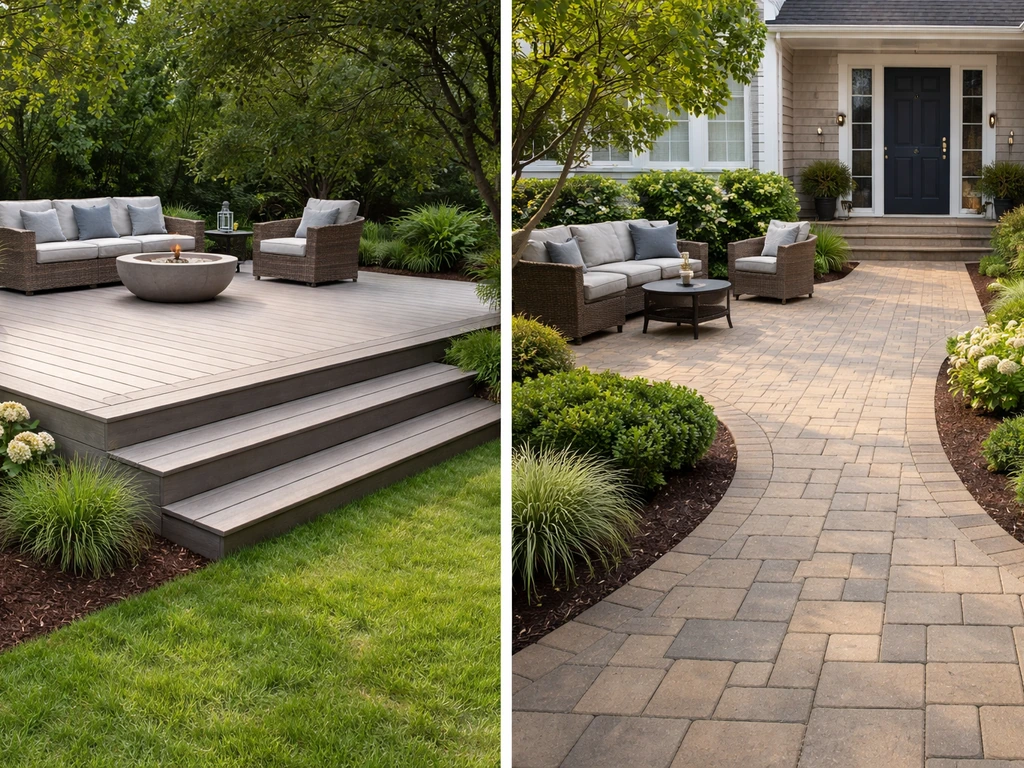
Both patios and decks can significantly improve a home's appeal and livable square footage, but they register differently with buyers. A deck, especially a composite deck with clean lines, built-in lighting, and a well-designed railing system, reads as a premium feature and tends to photograph well. In markets where outdoor entertaining is a selling point, a high-quality deck can return 60 to 75 percent of its cost at resale according to Remodeling Magazine's Cost vs. Value data. A basic pressure-treated deck returns somewhat less.
Patios have strong curb appeal in their own right, particularly in warmer climates or regions where buyers expect ground-level outdoor living. A well-designed natural stone or paver patio with proper edging, lighting, and landscaping integration can look genuinely impressive. In many Sun Belt markets, buyers prefer patios specifically because they're lower maintenance and better suited to the climate. The key for resale is quality of execution: a poorly built patio with uneven pavers and bad drainage is a liability, not an asset.
One thing that can hurt you at resale: an unpermitted deck. If you build a deck without permits and a buyer's home inspector spots it (and they usually do), you may need to retroactively permit and potentially bring it up to current code, or tear it down. That scenario has killed more than a few real estate deals. Whatever you build, pull the permit.
DIY or hire a pro: honest guidance on both
A paver patio is probably the most DIY-friendly outdoor project in this category, if you're comfortable with physical labor, can rent a plate compactor, and are willing to spend a weekend on base prep. The skills required are mostly about patience and precision: getting the base depth right, compacting properly in lifts, setting the bedding sand at a consistent depth, and keeping the pavers level as you go. A 200-square-foot patio is a reasonable first project; larger or more complex layouts with curves and multiple paver types are harder to DIY cleanly.
Poured concrete is not a good DIY project unless you have real experience. The timing windows are tight, mistakes are permanent, and hiring a concrete contractor typically costs less than you'd think because they have the equipment and crew to do it fast.
A basic attached deck is doable for an experienced DIYer with strong carpentry skills, but it involves more risk than a patio. The ledger-board connection is a structural and waterproofing detail that's easy to get wrong. Footing depth calculations depend on local frost lines and soil bearing capacity. Railing heights and baluster spacing are code items that inspectors check carefully. That said, many confident DIYers build their own decks successfully, just budget more time than you think (a 200-square-foot deck can easily take a skilled homeowner three to four weekends), and be prepared to pull permits and pass inspections.
Where to draw the DIY line: if your site has significant slope, complex drainage issues, or you're in a region with deep frost lines and difficult soil, hire a professional for at least the site prep, footings, and framing. You can finish with DIY decking and railing if you want to save money on labor while keeping the critical structural work in expert hands.
| Task | DIY Feasibility | Main Risk if DIY |
|---|---|---|
| Paver patio (flat yard) | Good for intermediate DIYers | Poor drainage from bad base prep |
| Poured concrete patio | Low — best left to pros | Permanent mistakes, timing errors |
| Basic attached wood deck | Moderate — requires carpentry skill | Ledger connection failures, code errors |
| Composite deck (complex design) | Low–moderate | Material cost if mistakes made |
| Freestanding deck | Moderate — no ledger risk | Footing depth and structural sizing |
Make the call: a decision checklist and your next steps
Work through these questions honestly and the right answer usually becomes clear.
- What does your yard look like? If it's flat and drains well, a patio is simpler and cheaper. If it slopes more than 6 to 8 inches across your target area, a deck handles that better.
- What's your budget? If you're working with under $8,000 for a 300–400 sq ft space, a concrete or basic paver patio is more realistic. Decks in that size range usually start around $10,000 installed.
- How close is the nearest door? Attached decks connect seamlessly to a doorway at the same height. If the door exits 2+ feet above grade, a patio requires steps down; a deck can meet the door flush.
- How much maintenance are you willing to do? If the honest answer is 'not much,' lean toward pavers or composite decking. If it's 'I'll stay on top of it,' wood deck or any patio works fine.
- What do homes sell for in your neighborhood? In warm-weather markets, patios often match buyer expectations better. In areas where outdoor entertaining seasons are short, a well-built deck often adds more perceived value.
- Are you DIYing or hiring? If hiring, get at least three quotes. If DIYing, realistically assess your skill level and available time before committing to either project.
- Have you checked local permits and HOA rules? Do this before you design anything. A quick call to your municipal building department tells you what's required and whether there are setback restrictions.
Concrete next steps to take this week
- Measure your target area and sketch a rough layout — note where the door exits and where the yard slopes.
- Call your local building department (or check their website) to confirm permit requirements and setback rules for both patios and decks.
- Get soil information if you're leaning toward a deck: check your local frost depth online (NOAA frost depth maps work well) to know how deep footings need to go.
- Gather three contractor quotes — specify the same square footage and material tier for all three so quotes are comparable.
- If you're DIYing a paver patio, calculate your material needs (surface pavers, base aggregate, bedding sand) based on your square footage and base depth, and price out rentals for a plate compactor.
- Review HOA guidelines if applicable — specifically look for restrictions on deck materials, railing styles, or surface colors before you get attached to a design.
- Decide on your primary use case: if entertaining large groups is the priority, size up by at least 20 percent from your first instinct — outdoor furniture takes more space than most people expect.
The patio vs. deck decision isn't complicated once you run it through the filter of your actual yard, your real budget, and how you plan to live in the space. If you're still torn, re-check the question is it easier to build a deck or patio by comparing yard slope, base prep, permit needs, and long-term upkeep.
If you want, you can also compare the patio vs deck costs and maintenance side by side to decide which patio or deck which is better for your situation. Once you compare the two, you can choose the deck or patio setup that best matches your yard and lifestyle deck or patio difference. Most homeowners who go through this exercise find that one option clearly fits better, and the other one only looked appealing in the abstract.
Get the site measurements, make the permit call, and get a few quotes. You'll have a confident answer within a week.
FAQ
I want the space to connect to my house, should I build a patio or deck for best access?
Start by measuring the area and mapping where people will walk and where the door opens. If the deck can be placed within typical setback limits and you can include stairs or a ramp without blocking drainage, a deck often wins for flow and access. If you need minimal height changes and the surface can stay ground-level with a consistent drainage slope away from the house, a patio is usually the simpler, cheaper fit.
If my yard slopes, does that automatically mean I should choose a deck?
Watch for a mismatch between your yard grade and your finished height. Patios need the whole base build-up to drain correctly, while decks can be leveled by adjusting post lengths. If your slope exceeds about 6 to 8 inches across the footprint, patios typically require regrading or retaining walls, which can erase the usual cost advantage.
Why do cost comparisons online sometimes show patios as cheaper, but my quote was similar or higher?
Yes, and it changes the “cheap vs expensive” math. A deck is structurally supported and often needs deeper, inspected footings, which raises baseline cost and timeline. Patios can be low-cost on flat sites, but when you add engineered drainage, retaining walls, or major excavation, the patio budget can jump quickly.
Should I build a patio or deck if I want to put something heavy like a hot tub or pergola?
If you plan to install a hot tub or heavy outdoor kitchen, treat it as a structural load decision. Decks are designed around beams and joists, so you can specify load requirements, but you may need additional reinforcement and ledger details. Patios rely on soil bearing and base prep, so if the patio is only on pavers over a thin base, it may not handle point loads without extra foundation work.
What part of each option is most likely to cause problems later?
If you care about long-term reliability, prioritize the connection details. On decks, the ledger board plus flashing is a common failure point if water intrusion occurs behind the siding or into band joists. On patios, drainage and subgrade compaction are the key, if water pools or the base shifts, pavers will settle or heave.
If I’m trying to avoid permits, can I build something small that still works as a patio or deck?
Ask your building department what counts as a “deck” or “platform” versus a “patio” in your area, because rules vary. Many places require permits for decks almost by default, patios only sometimes, and both can trigger permits if they attach to the house, add a roof, or alter drainage. Get that answer before you choose a design.
How does climate (especially freeze-thaw) affect the patio vs deck decision?
In freeze-thaw regions, patios are more sensitive to base drainage and frost heave, while decks are more sensitive to footing depth below the frost line. If you can’t reliably compact the base and maintain drainage, patio performance drops. If footings are shallow or soil is unstable, deck settlement and cantilever issues can appear.
If comfort in summer matters, which is better, a deck or a patio?
Think about how much of the surface will be exposed to sun and how often you’ll use it in summer. Wood decks can become uncomfortable in direct sun, dark composite is often worse, and rail shadows can help only partially. Ground-level patios with lighter pavers tend to stay more comfortable, especially if you can place them under partial shade.
Which is more DIY-friendly for a first project, patio or deck, and where do people usually get in trouble?
For DIY, a paver patio is usually the safest path because the work is mostly excavation, base compaction, and setting. But if your design has curves, multiple paver heights, or a tight drainage situation, it stops being “simple” quickly. Deck DIY is feasible mainly if you already understand framing, ledger waterproofing, and code-checked railing and footing rules.
Which option is easier to modify later if I want lighting, stairs, or landscaping changes?
Plan to coordinate with grading and landscaping before you finalize materials. Patios can be relatively easy to repair piece-by-piece if you need to replace pavers later, but only if edging and base depth were done correctly. Decks can look “built-in” with lighting and railing, but upgrades often require running electrical and ensuring it stays weatherproof.
If both can be built correctly, which one is better for preventing water damage to my home?
Yes, and it’s more about water management than the specific material. A deck can still create runoff that affects your foundation or lawn, and a patio can still be fine if you direct water away and keep joints and surfaces draining. The decision should be based on your ability to maintain proper slopes, flashing, and where water ends up after rain.
Next Article
Is a Deck a Patio? Deck vs Patio Differences Checklist
Is a deck a patio? Learn key differences and a checklist to spot your structure, including covered and low-deck edge cas