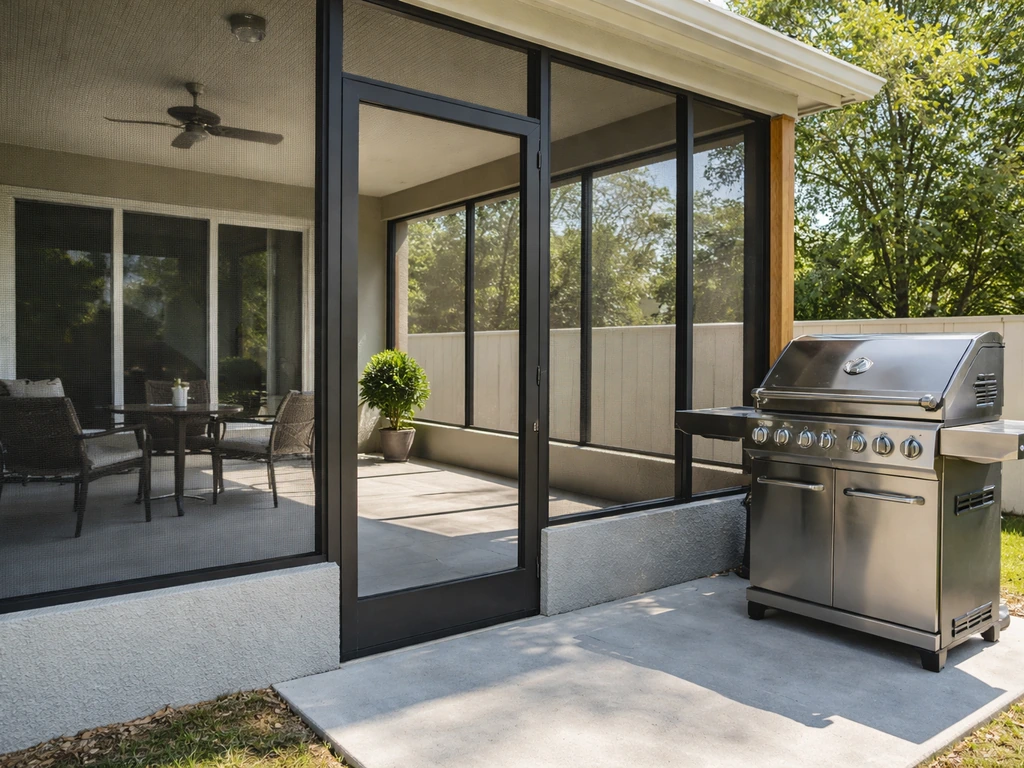
A grill is not typically classified as patio furniture. Patio furniture refers to seating, tables, loungers, and decorative pieces designed for outdoor living. A grill is an outdoor cooking appliance, and that distinction matters more than it sounds because it affects your insurance coverage, HOA compliance, lease terms, local fire code obligations, and even how a built-in grill affects your property value.
Is a grill considered patio furniture? Answer, Rules & Safety

Miles Hart
5 Aug 2026
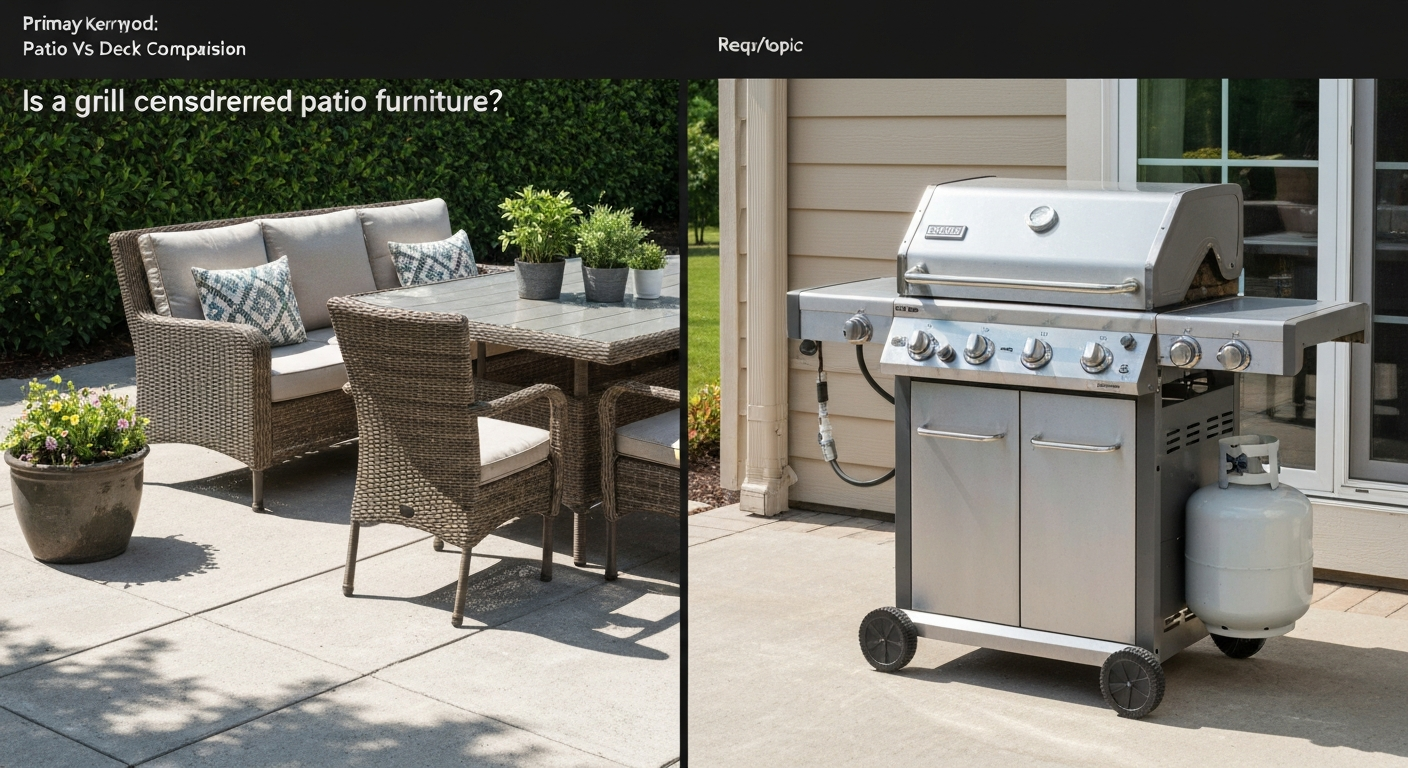
Patio Furniture vs Grills: What the Terms Actually Mean
Patio furniture is broadly understood as movable or semi-permanent furnishings that make an outdoor space livable: chairs, sofas, dining sets, side tables, ottomans, hammocks, and similar pieces. They're decorative and functional for resting or dining, but they don't cook food or generate heat as a primary function.
A grill, by contrast, is an outdoor cooking appliance. Whether it's a freestanding gas model, a charcoal kettle, a pellet smoker, or a built-in island setup, it is governed by appliance safety standards, fuel codes, and fire codes rather than furniture regulations. The relevant standards include ANSI Z21.58 / CSA 1.6 (the U.S. and Canadian safety testing standard for outdoor gas cooking appliances), NFPA 54 / ANSI Z223.1 (the National Fuel Gas Code for gas appliance installation), and NFPA 58 (the Liquefied Petroleum Gas Code for propane cylinder storage and handling). None of these apply to a patio chair.
The blurry middle ground is the built-in grill. A built-in gas grill set into a permanent masonry or noncombustible outdoor kitchen island is treated by assessors and insurers more like a home improvement or fixture than furniture. It can add to your home's assessed value, it requires a permit in many jurisdictions, and removing it is not as simple as folding up a chair. Freestanding grills, including large propane carts, are portable appliances, not furniture. Even a grill cover, cart, or side table accessory sold alongside a grill does not reclassify the grill itself as furniture.
Why the Classification Actually Matters
This isn't just a semantic argument. The way your grill is classified touches four real areas of homeowner life.
Building and fire codes
International Fire Code (IFC) Section 308.1.4, which most U.S. municipalities adopt in some form, prohibits charcoal burners and other open-flame cooking devices from being operated on combustible balconies or within 10 feet (3,048 mm) of combustible construction. That 10-foot rule is not a suggestion; it's a minimum clearance with specific exceptions for one- and two-family dwellings, sprinkler-protected buildings, and approved natural gas installations. Jurisdictions including San Antonio, Mesa (AZ), and Fairfax County (VA) all enforce variations of this rule. No equivalent code governs where you place a patio table.
Homeowners insurance
Grills are responsible for an average of roughly 11,400 home fires per year in the United States, according to statistics from NFPA and USFA data cited by fire authorities. Insurers are well aware of this number. Many carriers include language in underwriting guidelines that can reduce or deny coverage on a grill-related claim if the grill was being used in violation of local fire code or HOA/lease rules. A patio chair fire is a freak accident. A grill fire in a prohibited location is a foreseeable risk you took on knowingly. That distinction can cost you a claim.
HOA rules and CC&Rs
Homeowners associations routinely include grill restrictions in their CC&Rs (Covenants, Conditions, and Restrictions). These restrictions are privately enforceable even when the local fire code might technically permit limited use. A court will treat your signed CC&R as a binding contract. Patio furniture, by contrast, is rarely restricted in the same way (though some HOAs limit colors or styles). If your HOA bans balcony grilling, that ban stands regardless of what the city allows.
Property value and permits
A built-in outdoor grill station with a noncombustible island, gas line, and ventilation is a home improvement that may require a permit and will likely show up in a property assessment. Assessors typically treat this like an outdoor kitchen addition, not furniture. Freestanding grills don't affect assessed value at all. If you're planning a built-in outdoor kitchen on your patio or deck and you want to understand how that interacts with property value and permitting, the same framework that applies to patios vs decks applies here too.
Checklist: What Homeowners and Renters Must Verify
Before you light anything, run through this checklist. It applies whether you own your home or rent.
- Check your local fire code (IFC 308.1.4 adoption): Is your deck or balcony combustible? Combustible means wood or wood-composite framing, decking, or railings. If yes, open-flame grills are almost certainly restricted within 10 feet of that construction.
- Check your municipality's specific amendments: Many cities add stricter rules on top of the IFC baseline. San Antonio, Mesa AZ, and Fairfax County VA all have published grill/balcony fact sheets. Search your city name plus 'balcony grilling fire code.'
- Read your lease in full: Look for language around 'open flame,' 'cooking appliances,' 'barbecue,' or 'propane.' Renters who violate lease terms can face eviction even if the fire code technically permits limited use.
- Read your HOA's CC&Rs and bylaws: Even homeowners in an HOA must comply with these private rules. HOA boards can and do fine members or compel removal of grills.
- Notify your homeowners or renters insurance carrier: Tell them what grill type you're using and where you're placing it. Confirm coverage is not conditional on placement restrictions.
- Verify propane cylinder rules under NFPA 58: Standard 20-lb propane cylinders must be stored and used outside, not inside enclosed spaces or on combustible balconies in most jurisdictions. Many fire departments explicitly ban storing spare cylinders on balconies.
- Confirm gas line permits for built-in grills: If you're running a natural gas line to an outdoor kitchen, this requires a permit in virtually every jurisdiction in the United States. Unpermitted gas work affects insurance, resale, and safety.
- Check clearance requirements in your grill's manual: Manufacturer installation manuals are legally binding for insurance and code purposes. A typical built-in gas grill requires at least 12 inches of side and rear clearance to combustible construction and 36 inches of vertical clearance above the cooking surface. Always follow your specific model's documentation.
What's Typically Allowed and Banned on Patios, Balconies, and Screened Spaces
Rules vary by jurisdiction, building type, and structure material, but the following table captures what most codes and enforcement practices look like across the country.
| Grill Type | Concrete/Paver Patio (detached home) | Combustible Deck/Balcony (multi-unit) | Screened-in Patio or Porch |
|---|---|---|---|
| Charcoal / open-flame | Generally allowed with 10 ft clearance from combustibles | Banned or heavily restricted (IFC 308.1.4) | Not recommended; ventilation and carbon monoxide risk |
| Gas (propane cylinder) | Generally allowed with manufacturer clearances | Banned or restricted in most jurisdictions (IFC/NFPA 58) | Not recommended; CO accumulation risk in enclosed space |
| Natural gas (hard-piped) | Allowed with permit and proper clearances | Allowed in some jurisdictions with fire official approval and sprinkler system | Requires significant ventilation; consult local code |
| Electric grill | Allowed in virtually all jurisdictions | Often permitted where lease/HOA allows (no open flame) | Lowest risk option for screened spaces; still needs airflow |
| Pellet smoker | Generally allowed with clearances (open-flame rules may apply) | Restricted in most multi-unit settings | Not recommended; smoke and CO concerns |
The 10-foot clearance from combustible construction applies everywhere the IFC is adopted, regardless of grill type for open-flame models. Local fire departments consistently advise placing grills on noncombustible surfaces like concrete or pavers, away from overhangs, eaves, railings, and siding, with a minimum 3-foot safety zone around the grill kept clear of people, children, and pets. Keeping a garden hose or an approved fire extinguisher accessible is standard guidance from fire prevention agencies in Mesa, Fairfax County, and most other jurisdictions.
Grilling on an Apartment Patio: Renter-Specific Guidance
Renters face a layered problem. Even if your city technically permits electric grills on combustible balconies, your landlord's lease and your building's HOA (if applicable) can still say no, and those private agreements are enforceable. For more detail on what types of grills are allowed and safe on different patio types, see can you grill on a patio. The fire code sets a floor; your lease and HOA can only go stricter, never looser.
If you want to grill on your apartment patio, here's the practical approach. Start by re-reading your lease for any language about open flames, cooking appliances, balcony use restrictions, or propane storage. If it's silent on the topic, ask your property manager in writing before you buy a grill. This protects you if the interpretation later becomes a dispute. Many landlords who haven't updated lease templates will simply add written permission for an electric grill, because electric grills don't create the fire code conflicts that propane or charcoal do. That's often the best realistic outcome for an apartment renter.
If your lease explicitly bans all grills, you have limited leverage unless the prohibition is somehow unlawful in your state (rare). You can request a lease amendment in writing, propose a specific electric-grill model with documentation showing it's code-compliant and listed by a nationally recognized testing lab, and offer to sign a hold-harmless addendum. Landlords respond better to a concrete, low-risk proposal than a general ask. But be prepared for a no, and respect it. The liability exposure on grill fires is real: insurance carriers and property managers know the 11,400-fires-per-year statistic well.
One more note specific to propane: even if a landlord approves a gas grill, storing filled LP cylinders on a combustible balcony is separately prohibited under NFPA 58 and most local fire codes. You'd need to store the cylinder somewhere code-compliant between uses, which for apartment renters is often nowhere practical. This is one more reason electric grills tend to be the only workable option for multi-unit renters.
Grilling in a Screened-in Patio: What the Screening Changes (and What It Doesn't)
Screened-in patios feel open because you can see through the mesh, but from a ventilation standpoint they are partial enclosures. That matters a lot for grilling safety. See can you grill in a screened in patio for specific rules, risks, and safer alternatives when considering grilling in a screened enclosure.
Carbon monoxide is the primary danger. Charcoal, propane, and natural gas all produce CO as a combustion byproduct. In an open-air patio, CO disperses rapidly. In a screened enclosure, airflow is reduced by the screening material and any solid roof or ceiling overhead. CO can accumulate to dangerous levels faster than most people realize. Screened enclosures also concentrate smoke, which creates eye and respiratory irritation and can set off indoor smoke detectors if the screen room adjoins the house.
The second issue is the structure itself. Most screened patios use wood or aluminum framing and a fiberglass or aluminum screen mesh stretched between posts and a roof structure. Open-flame grills operating in close proximity to that framing need to meet the same 10-foot clearance from combustible construction that applies elsewhere. In a typical 12-by-16-foot screened patio, maintaining 10 feet of clearance from all combustible framing members simultaneously may be geometrically impossible.
If you are determined to grill in a screened space, an electric grill is the only realistic option that sidesteps most of these concerns. It produces no combustion gases, no open flame, and minimal smoke. You still want cross-ventilation (open panels or screened doors on opposite sides of the space), and you should keep a smoke detector audible from that area. But an electric grill in a well-ventilated screened patio is an entirely different risk profile from a propane or charcoal grill in the same space.
One more consideration: many screened enclosures are attached to the house and share a roofline with it. Even if the screen material itself isn't combustible, the roof framing and the adjacent wall structure almost certainly are. That brings you back into IFC 308.1.4 territory for any open-flame device.
Florida's Restaurant Patio Smoking Rules: A Useful Regulatory Example
Florida's approach to restaurant patio smoking is a useful case study in how the physical structure of an outdoor space changes its legal classification. Under the Florida Clean Indoor Air Act (Chapter 386, Florida Statutes), smoking and vaping are banned in enclosed indoor workplaces. The key word is 'enclosed.' Florida law defines enclosure partly by the geometry of the space: the percentage of roof coverage and side coverage determines whether a patio counts as indoor for purposes of the smoking ban.
A restaurant with a lightly covered pergola-style patio with minimal side walls may keep that space legally classified as outdoor and allow smoking. A restaurant with a fully roofed patio with screens or walls on most sides may cross the threshold into 'enclosed' and become subject to the indoor smoking ban. Florida state law also preempts local regulation in this area, with limited exceptions for parks and beaches, so a city cannot make the rules stricter for restaurants.
The lesson for homeowners is direct: the same structural logic applies to grill rules on patios, screened porches, and balconies. How enclosed your outdoor space is changes what the rules say about what you can do in it. A patio furniture setup on a concrete slab open on all sides is not the same regulatory environment as a screened-in porch with a solid roof. Structure shape and enclosure level determine risk and therefore determine rules, whether the subject is restaurant smoking in Florida or backyard grilling in Virginia.
Built-in Grills vs Freestanding Grills: How They Compare
If you're designing or renovating a patio, the choice between a built-in and a freestanding grill carries real consequences beyond cooking preference.
| Factor | Built-in Grill | Freestanding Grill |
|---|---|---|
| Classification | Fixture / home improvement | Portable appliance |
| Permit required | Usually yes (gas line, structure) | No |
| Enclosure requirement | Noncombustible island required (masonry, steel) | Portable; follow clearance rules in manual |
| Property value impact | Potential positive (outdoor kitchen addition) | None |
| Insurance implications | Must be disclosed; affects dwelling coverage | Covered under personal property; lower stakes |
| HOA treatment | Often requires architectural approval | Often just covered by use/storage rules |
| Portability | None — permanent | Full — move or store as needed |
| Cost range | $1,500–$10,000+ installed (varies widely by island size and gas work) | $150–$2,500 depending on model and type |
Built-in grills demand noncombustible construction. Manufacturer manuals from brands including Napoleon and Broil King specify that built-in enclosures must be noncombustible or use listed heat-shield accessories, with typical minimum side and rear clearances of 12 inches to combustible construction and 36 inches or more of vertical clearance above the cooking surface. blank" rel="noopener noreferrer">Napoleon owner/installation manuals (example product installation & minimum clearance tables) note built‑in gas grills commonly require minimum 12" (≈30 cm) side/back clearances to combustible construction, about 36" (≈915 mm) or greater vertical clearance above the cooking surface, and specify noncombustible islands or listed heat‑shield accessories where combustible construction is present. These aren't arbitrary recommendations: they're the manufacturer's listed installation requirements, and violating them can void the warranty and your insurance coverage simultaneously. NFPA 54 / ANSI Z223.1 (National Fuel Gas Code) requires that gas‑fired appliances be installed per their manufacturer's listed clearances and instructions, see National Fuel Gas Code (NFPA 54 / ANSI Z223.1), Handbook excerpts blank" rel="noopener noreferrer">National Fuel Gas Code (NFPA 54 / ANSI Z223.1) — Handbook excerpts.
Keeping Things Cool: Hot-Climate Grilling and Patio Comfort
In high-heat climates like Florida, Arizona, or Texas, the grill itself is not the only heat source you're managing. Ambient temperatures on an exposed concrete patio in July can make outdoor cooking genuinely unpleasant and, for some people, a health concern. The same screened enclosures and covered patio structures that raise the grilling safety questions covered above can also trap heat badly when a grill is running.
Practical cooling options for hot-climate patio cooking include shade structures (pergolas, cantilever umbrellas, shade sails) placed at least 10 feet from the grill zone, outdoor ceiling fans rated for wet or damp locations, and misting systems plumbed to a standard hose bib. The fan or misting setup should not be directly above or adjacent to the grill, both because of heat damage to the equipment and because directing airflow directly into a gas flame creates its own hazards. The goal is cooling the seating and dining zone, not the grill itself.
Placement Best Practices: Where to Put the Grill on Your Patio
Correct placement is where most grill-related code violations and accidents originate. The rules are straightforward but easy to ignore when you just want to start cooking. For step-by-step guidance on choosing a safe spot, see where to put grill on patio.
- Place the grill on a noncombustible surface: concrete, pavers, or brick. Never on a wood deck or over composite decking material if you can avoid it.
- Maintain at least 10 feet of clearance from combustible construction: siding, wood railings, overhangs, eaves, fences, and patio covers with wood framing.
- Follow the manufacturer's specific clearance dimensions from the installation manual: side, rear, and vertical clearance numbers differ by model. The manual's numbers govern.
- Never grill under an overhang, covered porch, or pergola with a solid roof unless the structure is entirely noncombustible and clearances are met.
- Keep a 3-foot safety perimeter around the grill clear of people, children, pets, furniture, and decorative items.
- Store propane cylinders upright, outdoors, and away from heat sources. Do not store spare filled cylinders on combustible balconies or inside any structure.
- Have a garden hose with water supply or a dry-chemical fire extinguisher rated for grease fires accessible within reach of the grill area.
Your Decision Checklist Before Buying or Installing a Grill
Pull this together before you make any purchase or installation decision. It applies to homeowners and renters, though some items only apply to one group.
- Determine your surface type: Is your patio concrete, pavers, or wood? Wood or composite decking limits your open-flame options under IFC 308.1.4.
- Measure your clearances: Can you maintain 10 feet from all combustible construction in your proposed grill location? If not, an electric grill may be your only code-compliant option.
- Check local code amendments: Your city or county may have stricter rules than the IFC baseline. Check their fire department website or call the fire marshal's office.
- Review your lease or CC&Rs: Look for grill, open-flame, propane, and cooking appliance language. If you're a renter, get written approval before purchasing.
- Contact your insurer: Inform them of the grill type and location. Confirm your homeowners or renters policy covers the setup and that placement does not create an exclusion.
- Decide between built-in and freestanding: If you want built-in, budget for permits, noncombustible island construction, and potential gas line work.
- Consider the enclosure level of your space: An open patio, a screened porch, and an apartment balcony have different risk profiles and often different applicable rules.
- Think about climate: In hot climates, plan your shade and cooling infrastructure away from the grill zone before finalizing placement.
FAQ
Short answer: Is a grill considered patio furniture?
Not exactly. Practically a portable grill functions like patio furniture when movable and used for leisure, but legally and for safety it’s usually classified as an appliance/open‑flame device — a different category with its own codes, manufacturer clearances, fuel‑storage rules, and insurance implications. So: yes in everyday language, no for code/insurance/HOA purposes — context matters.
Why does the distinction between 'patio furniture' and 'appliance/open‑flame device' matter?
Classification affects what rules apply: codes/fire officials treat grills as open‑flame devices with clearance, surface and storage requirements; manufacturers require listed installations and clearances; HOAs/leases can impose bans; insurers can deny coverage for prohibited use. Treating a grill as mere furniture can lead to code violations, denied claims, or unsafe installations.
What do codes and fire authorities typically require for grills on patios, balconies, and decks?
Common code guidance (following IFC/NFPA practice) bans charcoal/open‑flame grills on combustible balconies/decks, requires roughly 10 ft clearance from combustible construction in many adoptions, and allows electric grills or exceptions only when sprinklered or specifically approved. Local adoptions and fire departments may add storage bans for cylinders and stricter rules for multi‑unit buildings — always check local code and fire‑marshal guidance.
What minimum clearances and surface requirements should I follow?
Follow the grill manufacturer’s manual first (clearances vary by model). Typical practices: place grills on noncombustible surfaces (concrete, pavers), keep at least 3 ft clearance from people/objects for safety, and follow manufacturer-specified side/rear/vertical clearances (examples range from 12" to 36" depending on model). Maintain about 10 ft from combustible building elements where local code requires it for open‑flame devices.
Are electric grills allowed on balconies and combustible patios?
Many jurisdictions and building managers permit listed electric grills on combustible balconies because they produce no open flame, but landlords/HOAs can still prohibit them contractually. Verify the grill’s listing, the lease/CC&Rs, and any local restrictions before use.
What about propane/LP cylinders — can they be stored on patios or balconies?
NFPA‑58 and common local interpretations generally prohibit storing filled cylinders on balconies or inside dwelling units. Many jurisdictions forbid spare/installed cylinders on combustible balconies; cylinder handling must comply with NFPA‑58 and the grill manufacturer’s instructions (OPD/approved valves and outdoor storage rules).
Next Article
Can You Grill in a Screened-In Patio Safely? Guide
Yes for some grills, no for others. Learn safe placement, clearances, fire risks, code checks, and safer alternatives.