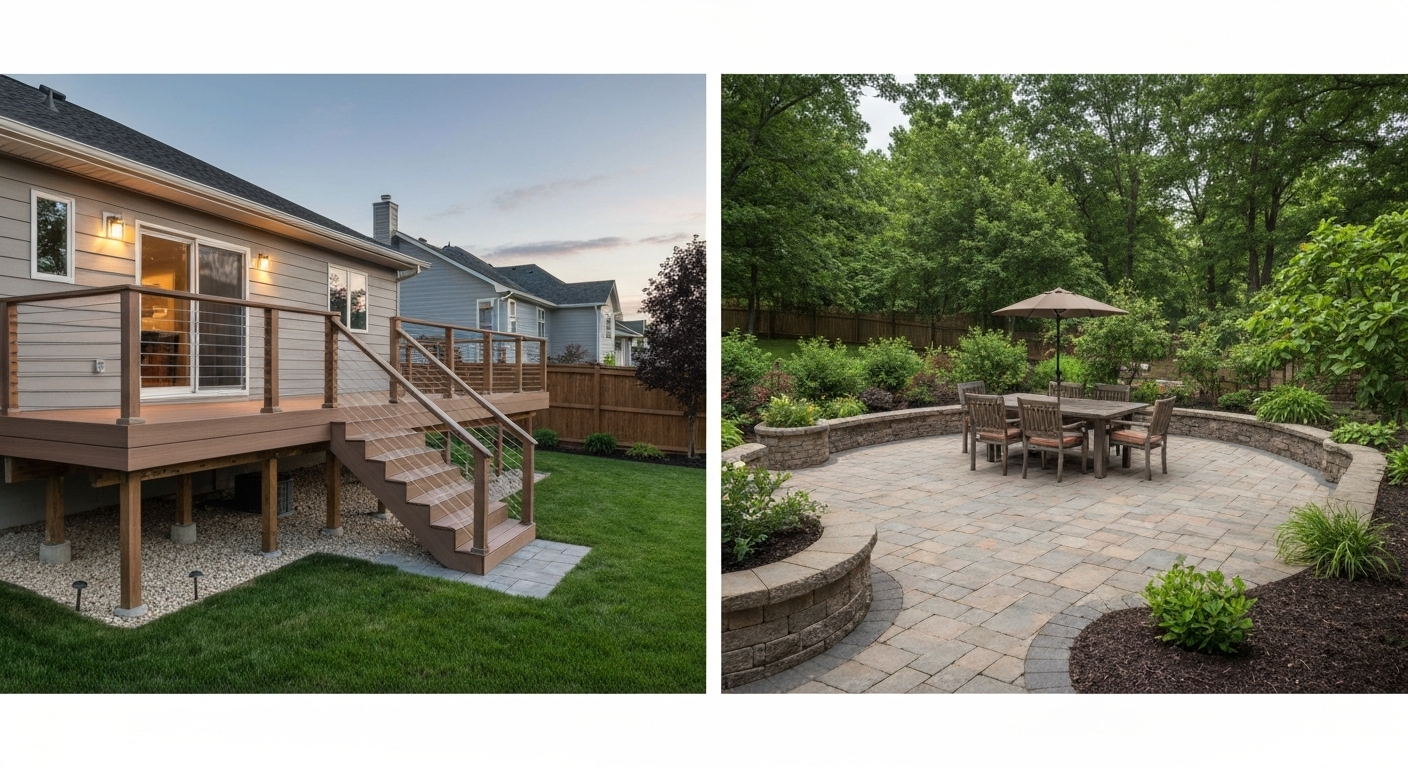
For most homeowners in 2021, a patio costs less to build and less to maintain, while a deck gives you more flexibility on sloped or elevated lots and tends to appeal slightly more to buyers in certain markets. Neither is universally better. The right choice depends on your yard's grade, your climate, how you plan to use the space, and what you can realistically spend. This guide walks through every factor you need to make that call with confidence.
Deck vs Patio 2021: Homeowner Guide & Decision Checklist

Miles Hart
4 Aug 2026
What this guide covers and how to use it
The 'deck vs patio 2021' question comes up constantly in renovation planning, and it's worth treating as a real decision rather than a style preference. The year matters because 2021 brought updated IRC code requirements (Section R507 for wood-framed decks), a refreshed NAHB buyer survey, and revised cost data from HomeAdvisor and Angi that reflect post-pandemic material price shifts. This guide pulls all of that together in one place. Work through the sections in order if you're starting from scratch, or jump directly to cost, resale, climate, or enclosure sections if you already know the basics.
Decks, patios, porches, and covered systems: what each one actually is
These terms get used interchangeably in casual conversation, but they mean different things in building codes, real estate listings, and contractor bids. Getting the definitions straight before you price anything will save you a lot of confusion.
Deck
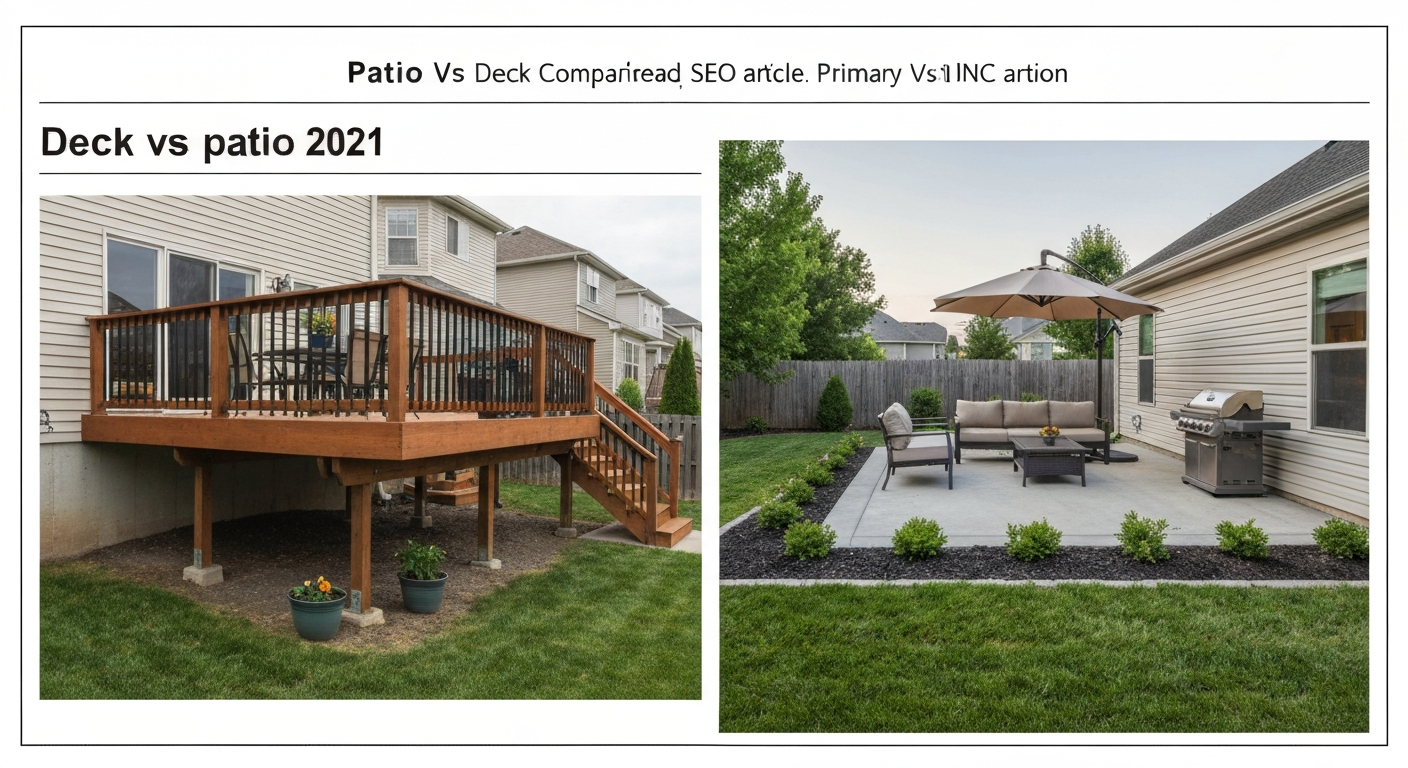
A deck is a raised, open-air platform framed in wood (or occasionally steel) and attached to or freestanding from the house. It sits above grade on posts and beams, which makes it the standard solution when your back door opens to a slope or a drop-off. Because a deck is a structural element, it requires a building permit virtually everywhere, must meet the 2021 IRC Section R507 prescriptive requirements (footing depth tied to local frost lines, ledger-to-rim-joist connections, corrosion-resistant fasteners, guards at 30 inches or more above grade), and must be inspected. The structural complexity is why decks cost more per square foot than most patios.
Patio
A patio is a ground-level outdoor surface, typically poured concrete, pavers, brick, flagstone, or gravel. It sits on or just above the existing grade and doesn't require framing or footings in the same way a deck does. Poured concrete patios commonly require a permit because they're treated as a permanent land improvement, while loose-material surfaces like pavers or gravel often don't. Even when a permit is needed, patio permit fees are typically modest, running $50 to $200 according to Angi's 2021 guidance, compared with the $350 to $1,800 range HomeAdvisor cites for deck and structural-cover permits.
Porch
A porch is a covered entry or outdoor living area that is structurally connected to the house and has a roof. Front porches and back porches both count. The key distinction is the roof: a porch has one, a deck or plain patio does not. That roof changes the building-permit picture significantly, adds structural cost, but also opens up the option to screen or enclose the space later.
Covered systems: pergolas, patio covers, screened porches, and sunrooms
These are add-ons or upgrades to an existing deck or patio that add overhead coverage without necessarily creating a full enclosed room. A pergola is an open lattice or beam structure that provides partial shade. A patio cover (sometimes called a shade structure or solid-roof cover) adds a weatherproof roof over a patio or deck. A screened porch encloses the sides of a covered space with insect screening. A sunroom or season room takes full enclosure further with glazed or insulated walls and, often, heating and cooling. Each of these sits on a different cost tier and requires different permits.
2021 cost comparison: what you'll actually spend
The cost gap between a deck and a patio is real, but it's driven almost entirely by materials and structural requirements, not by contractor markup. A basic ground-level poured concrete patio runs $3 to $8 per square foot installed (Angi, 2021), putting a 200-square-foot patio in the $600 to $1,600 range for the slab alone, with site prep (grading, drainage) potentially adding $500 to $1,000 more. A pressure-treated wood deck in the same footprint runs materially higher once you account for framing, footings, and labor: HomeAdvisor's 2021 deck guide puts the typical range at $4,000 to $10,500 for most new installations, with composite projects regularly exceeding $20,000. The Remodeling Magazine 2021 Cost vs. Value Report puts a wood deck addition at a national average job cost of $16,766, and a composite deck addition at $22,426.
| Option | Typical installed cost (per sq ft) | Sample 200 sq ft project | Sample 400 sq ft project |
|---|---|---|---|
| Poured concrete patio | $3–$8/sq ft | $600–$1,600 | $1,200–$3,200 |
| Brick/concrete pavers | $8–$25/sq ft | $1,600–$5,000 | $3,200–$10,000 |
| Natural stone / flagstone | $3–$35/sq ft | $600–$7,000 | $1,200–$14,000 |
| Gravel / loose material | $1–$4/sq ft | $200–$800 | $400–$1,600 |
| Pressure-treated wood deck | $2–$5/sq ft (boards) + framing/labor | $4,000–$8,000 (typical) | $8,000–$15,000+ |
| Cedar deck | $3–$7/sq ft (boards) + framing/labor | $5,000–$10,000+ | $10,000–$18,000+ |
| Composite deck (e.g., Trex) | $12–$22/sq ft (boards) + framing/labor | $8,000–$15,000+ | $15,000–$25,000+ |
| Raised/elevated patio | $10–$85/sq ft installed | $2,000–$17,000 | $4,000–$34,000 |
A few notes on those numbers. The per-square-foot board cost for a deck covers only the decking material, not the structural framing, footings, hardware, or labor. HomeAdvisor's 2021 guidance notes that labor often runs roughly equal to materials on a basic deck, so doubling the board cost is a reasonable starting budget estimate. Raised or elevated patios (built over a slope with retaining framing) cost $10 to $85 per square foot installed, which puts them in direct cost competition with entry-level decks. Site preparation costs matter too: Angi notes that difficult grading or drainage work can add up to $5,000 to any patio project.
Materials and maintenance: what you're committing to long-term
Upfront cost is only part of the picture. What you choose to build with determines what you'll be doing (and spending) every few years for the life of the structure.
Pressure-treated wood
Pressure-treated lumber is the lowest-cost entry point for a deck, at $2 to $5 per square foot for boards. The trade-off is ongoing maintenance: you should plan to clean, sand, and restain or reseal a PT wood deck every two to three years. HomeAdvisor's 2021 figures put a typical deck staining or refinishing job at $550 to $1,000, which becomes a meaningful recurring cost over a 20-year deck life. Without regular sealing, PT wood will crack, splinter, and gray within a few seasons. Properly maintained, a PT deck can last 15 to 25 years.
Cedar and redwood
Cedar runs $3 to $7 per square foot for decking boards and offers better natural rot and insect resistance than PT lumber. It still requires sealing every two to three years to maintain its appearance and longevity, but it tends to hold up better in damp climates without treatment than PT does. Expected lifespan with maintenance is 20 to 30 years.
Composite decking
Composite decking (wood fiber and plastic bound together) runs $12 to $22 per square foot for boards alone, pushing total installed project costs well above wood. The payoff is dramatically reduced maintenance. Trex, the leading manufacturer, markets its products as needing routine cleaning only, and the company states annual board-care costs can be as low as around $10 per year over the product's life. Trex documents warranties ranging from about 25 to 50 years across its product lines and states that routine board care can cost as little as roughly $10 per year over the product's life Trex documents 25–50 year warranties and cites about $10/year board‑care costs. Trex warranties run 25 to 50 years depending on the product line. You won't stain, sand, or seal composite boards, but you will pay a significant premium upfront. Composite is also heavier than wood, which can affect framing and footing requirements.
Poured concrete
Poured concrete is the most common patio surface and one of the most durable options at the lowest per-square-foot cost. It requires sealing every two to five years to resist staining and cracking, and in freeze-thaw climates, surface spalling is a real concern over time. A well-installed, sealed concrete patio can last 25 to 50 years. Repairs to cracked concrete slabs are straightforward and relatively cheap compared with replacing deck boards or framing.
Pavers (brick, concrete, and permeable)
Pavers cost more upfront than poured concrete, from $8 to $25 per square foot installed for standard brick or concrete pavers, and $10 to $30 for permeable types. The advantage is repairability: individual pavers can be lifted and reset if the base shifts, and they handle freeze-thaw movement better than a monolithic slab. Maintenance is mostly occasional weed control in joints (or polymeric sand resetting every several years) and periodic resealing for color-coated units. A properly installed paver patio easily lasts 25 to 30 years or more.
Natural stone and flagstone
Natural stone ranges from $3 to $35 per square foot installed, with wide variation based on stone type, region, and whether it's mortared or dry-laid. Dry-laid flagstone handles settlement and freeze-thaw cycles well. Mortared stone can crack at joints in harsh climates. Maintenance is minimal: occasional repointing or resetting, and sealing if desired. Lifespan is effectively indefinite for the stone itself.
| Material | Cost (installed, per sq ft) | Maintenance frequency | Expected lifespan |
|---|---|---|---|
| Pressure-treated wood | $2–$5 (boards) + framing | Stain/seal every 2–3 years | 15–25 years |
| Cedar / redwood | $3–$7 (boards) + framing | Seal every 2–3 years | 20–30 years |
| Composite (e.g., Trex) | $12–$22 (boards) + framing | Wash only, minimal | 25–50 years |
| Poured concrete | $3–$8 | Seal every 2–5 years | 25–50 years |
| Brick / concrete pavers | $8–$25 | Joint sand reset every few years | 25–30+ years |
| Permeable pavers | $10–$30 | Periodic joint maintenance | 25+ years |
| Natural stone / flagstone | $3–$35 | Repoint if mortared; seal optional | 30+ years (indefinite) |
Pros and cons by use-case and climate
The 'best' choice shifts depending on what you're building it for and where you live. Here's how the decision breaks down across the most common scenarios.
Entertaining and outdoor dining
Both decks and patios work well for entertaining. Patios offer a flat, stable surface that's wheelchair-accessible and easy to move furniture on. Decks can be built to any size and shape, and multi-level deck designs are popular for separating dining and lounging zones. If you're planning a large outdoor kitchen, a patio's ability to support heavy appliances without load calculations is an advantage, though a properly engineered deck can accommodate this too.
Grilling
Wood decks and grills require some care: most fire codes require keeping a grill a specific distance from the house and any combustible surface. Composite decking is generally more fire-resistant than wood but still not fireproof. A concrete or paver patio eliminates this concern entirely. If grilling is a primary use, a patio surface directly adjacent to a deck (or a built-in patio grill station) is a common and practical combination.
Pools and hot tubs
For pool surrounds, a patio (concrete, pavers, or natural stone) is the standard choice because it handles constant moisture and foot traffic without the rot risk that affects wood decks. For above-ground pools, a deck surround can be a practical solution. Hot tubs on decks require an engineer to verify that the framing can handle the wet weight, often 4,000 to 6,000 pounds for a full tub, which is a structural consideration many homeowners overlook.
Multi-level and sloped yards
This is where decks genuinely have no equal. If your yard drops three or four feet from the back door, a deck is often the only cost-effective way to create a usable outdoor living space at door level. A raised patio is an alternative, but at $10 to $85 per square foot installed it can approach or exceed deck costs for significant grade changes.
Cold climates and freeze-thaw zones
Freeze-thaw cycles are tough on outdoor structures. For decks, the 2021 IRC requires footings to extend below the local frost depth (Table R301.2 in the code), which can mean 36 to 48 inch deep footings in northern states. Skipping this is a common DIY mistake that leads to heaving and structural failure. For patios, poured concrete is vulnerable to surface spalling if water infiltrates and freezes. Pavers handle freeze-thaw better because each unit can move independently. In very cold climates, composite decking outperforms wood because it doesn't absorb moisture and won't crack from freeze-thaw cycling.
Hot and dry climates
In hot, sunny climates, dark composite decking can get uncomfortably hot underfoot. Lighter-colored concrete or natural stone patios stay cooler and are generally more comfortable barefoot. Wood decks fade and dry out faster in sun-intensive climates, requiring more frequent sealing. A covered structure (pergola or solid patio cover) becomes especially valuable in these regions.
Wet and humid climates
In consistently wet regions (Pacific Northwest, Gulf Coast, Southeast), wood rot is an accelerated risk. Composite or PVC decking is a significantly better choice than wood if you're in a high-moisture environment and don't want to maintain the surface aggressively. For patios, drainage is the critical design factor: a poured concrete patio needs a 1 to 2 percent slope away from the house, and a paver patio needs a properly compacted gravel base to avoid settling and pooling.
Resale value and home-value impact in 2021
Outdoor living improvements consistently add perceived value for buyers, but the return on investment is rarely dollar-for-dollar. For more on how patios compare to decks in homeowner returns, see our patio vs deck resale value analysis. For more on which option often boosts resale value most in different markets, see our guide on whether is a deck or patio better for resale. The 2021 Remodeling Magazine Cost vs. Value Report gives the clearest national picture: a wood deck addition has an average job cost of $16,766 and returns $11,038 at resale, recovering about 66 percent of cost. A composite deck addition averages $22,426 to build and returns $14,169, recovering about 63 percent. Neither is a full-value investment, but 63 to 66 percent cost recouped compares favorably to most other home renovation categories.
Patios don't have an equivalent line item in the Cost vs. Value Report, which makes direct comparison harder. However, the 2021 NAHB 'What Home Buyers Really Want' survey shows that 82 percent of buyers listed a patio as essential or desirable, versus 75 percent for a deck. This doesn't mean patios are more valuable, but it does suggest they appeal to a slightly broader pool of buyers. In markets where one-story living and accessibility matter more (retiree markets, warmer Sun Belt cities), patios often resonate more strongly. In markets with significant grade changes, wooded backyards, or a strong deck culture (upper Midwest, Pacific Northwest, New England), decks tend to read as the premium feature.
A few practical notes for anyone thinking about resale: an unpermitted deck is a red flag in any real estate transaction and can delay or kill a sale. Buyers and their inspectors will look for it. A permitted, well-maintained deck or patio adds clean curb appeal. A neglected, weathered wood deck can actually hurt your sale if buyers see it as an immediate repair expense. More detail on how each option affects sale price is covered in the site's dedicated resale value and deck vs patio home value pages.
Covered options and enclosure systems: porches, pergolas, screened porches, and sunrooms
Adding coverage to a deck or patio is one of the most impactful upgrades you can make to outdoor usability, especially if you live somewhere with strong sun, frequent rain, or significant insect pressure. Here's a realistic look at each category.
Pergolas
A pergola is an open overhead structure with beams and rafters, sometimes with a lattice top. It provides partial shade and a visual anchor for the outdoor space without blocking rain or providing full sun protection. Pergolas work over both decks and patios and are available as DIY kit systems or custom-built from wood, aluminum, or vinyl. Costs vary widely, from around $2,000 to $5,000 for a basic kit installation up to $10,000 or more for a custom timber frame. Permit requirements depend on size and whether it's attached to the house.
Patio covers
A solid patio cover (corrugated metal, polycarbonate panel, or solid roof tied into the house fascia) provides real rain and sun protection and is the most functional weather cover for a patio at a reasonable cost. Expect $3,000 to $10,000 for an attached solid patio cover depending on size and materials. These typically require a permit because they attach to the house structure.
Screened porches
A screened porch is one of the highest-ROI outdoor enclosures for areas with mosquito or insect pressure. If you already have a roofed deck or covered patio, screening it in typically costs $1,000 to $1,900 in materials and labor (HomeAdvisor, 2021) because the roof structure already exists. Building a screened porch from scratch (new framing, roof, and screening) is substantially more expensive, typically $8,000 to $25,000 depending on size and whether new framing is required. Screened porches scored highly in the 2021 NAHB survey as a desired feature.
Sunrooms and season rooms
A sunroom converts an outdoor enclosure into a near-interior space, with glazed or insulated panels, and often with heating and cooling. Costs start around $20,000 for a modest prefab sunroom addition and can exceed $75,000 for a custom-built, fully conditioned space. Sunrooms require building permits, often qualify as habitable square footage additions, and are regulated similarly to room additions. The payoff is year-round usability regardless of climate.
| Covered option | Typical cost range | Rain/sun protection | Insect protection | Year-round use | Permit usually required |
|---|---|---|---|---|---|
| Pergola (kit) | $2,000–$5,000 | Partial shade only | No | No | Sometimes |
| Pergola (custom) | $5,000–$10,000+ | Partial shade only | No | No | Often |
| Solid patio cover | $3,000–$10,000 | Yes (full) | No | No | Yes |
| Screen-in existing roof | $1,000–$1,900 | Yes (existing roof) | Yes | 3 seasons | Often |
| Screened porch (new) | $8,000–$25,000 | Yes | Yes | 3 seasons | Yes |
| Sunroom / season room | $20,000–$75,000+ | Yes | Yes | Yes (with HVAC) | Yes |
DIY vs. hiring a contractor: an honest breakdown
The DIY-vs-contractor decision isn't just about saving money. It's about whether the project is safe, code-compliant, and likely to hold up over time. Here's how to think through it honestly.
When DIY makes sense
Ground-level paver or gravel patios are the most DIY-friendly outdoor projects on this list. They don't require permits in most jurisdictions, the skills required are within reach of a motivated homeowner, and mistakes are largely correctable. A basic 200-square-foot paver patio can be completed over a weekend or two by an experienced DIYer. Deck staining and resealing is another strong DIY candidate: a $550 to $1,000 professional job can be done for the cost of materials ($150 to $300) if you're willing to do the prep work.
When to hire a professional
Any attached, elevated wood-framed deck should be permitted and inspected. The 2021 IRC Section R507 has specific requirements for ledger connections, footing depth relative to local frost lines (from NOAA's 1991-2020 climate normals and local amendments), fastener corrosion ratings, and guard heights. Getting these wrong doesn't just mean a failed inspection: it means a structural failure risk. If you're not comfortable reading a frost-depth table and sizing footings from it, hire a contractor. The same logic applies to any project involving electrical (outlets, lighting), plumbing (outdoor kitchen), or new roof framing.
Permit and inspection checklist
- Check with your local building department before starting any project: permit requirements vary by municipality, project type, and size
- Patio permits (if required): typically $50–$200; poured concrete usually requires one, loose pavers often do not
- Deck and structural cover permits: typically $350–$1,800 depending on scope and jurisdiction; always required for attached decks
- Submit plans showing footing locations, footing depth (must meet local frost depth), beam and joist sizing, ledger connection detail, and guard/handrail heights
- Schedule a footing inspection before pouring concrete for footings (required in most jurisdictions)
- Schedule a framing inspection after framing is complete but before decking is installed
- Schedule a final inspection after all work is complete; get a certificate of occupancy or final sign-off in writing
- Keep copies of all permits and inspection records: these matter at resale
Realistic timelines and cost tradeoffs
A professional crew can frame and deck a 200-square-foot pressure-treated deck in one to two days once materials are on-site and permits are in hand. Permit processing adds one to four weeks in most jurisdictions. A DIY build of the same project typically takes two to four weekends. A ground-level paver patio of similar size takes a professional crew one to two days, or a DIYer two to three weekends depending on site prep difficulty. Composite decking takes longer to install than wood because of hidden fastener systems and the need for precise spacing. For any project over 400 square feet or involving structural complexity (multi-level, elevated, hot tub support), the time and skill investment to DIY correctly starts to compete with the cost of hiring a professional.
Making the decision: a practical checklist
After going through everything above, here's a straightforward way to frame your final decision. Work through these questions in order.
- Is your yard flat or does it drop significantly from the back door? If flat: patio is likely cheaper and simpler. If sloped: deck is often the practical solution.
- What's your realistic budget? Under $5,000 strongly favors a basic concrete or paver patio. $5,000–$15,000 opens up a wood deck or upgraded patio. Above $15,000 gives you composite deck or a covered/enclosed option.
- How much ongoing maintenance are you willing to do? If the answer is 'as little as possible,' choose composite decking or pavers/concrete over wood.
- What climate do you live in? Freeze-thaw zones: avoid poured concrete patios without good drainage; wood decks need proper frost-depth footings. Hot/dry: lighter concrete or stone patios stay cooler than dark composite. Wet/humid: composite or PVC decks strongly outperform wood.
- Are you planning to sell within five years? Both add value, but ensure any deck is permitted and inspected. Unpermitted decks create real estate transaction problems.
- Do you want overhead coverage? If yes, factor enclosure costs in from the start. A deck with a pergola or a covered patio may be your real goal.
- Who's doing the work? Ground-level paver patio: strong DIY candidate. Attached, elevated deck: permit and professional contractor strongly recommended.
- Have you gotten at least three contractor quotes? Material costs vary regionally, and labor rates vary even more. The per-square-foot numbers in this guide are national averages; your local market may be 20–40% above or below them.
The deck vs. patio decision rarely has a single right answer, but it almost always has a right answer for your specific yard, budget, and lifestyle. Use the cost table in this guide to set a realistic budget range, decide on your material based on climate and maintenance tolerance, check your local permit requirements before committing, and get quotes from at least two or three local contractors before finalizing your plan. If you want to dig deeper into how each option performs at resale, or compare specific patio and deck costs in more detail, the site's dedicated cost comparison and home value impact pages cover both topics with additional breakdowns. For a side-by-side recommendation tailored to common yard layouts, budgets, and climates, see the guide “Deck or Patio: Which to Recommend.”. For firsthand homeowner perspectives, see discussions on Reddit comparing decks and patios for real-world pros, cons, and cost experiences. For a focused breakdown of installation and material costs, see our detailed deck vs patio price comparison.
FAQ
What’s the concise difference between a deck, a patio, a porch, and covered/enclosed systems (2021 context)?
Deck: an elevated platform typically built of wood or composite, attached or freestanding, framed above grade and requiring footings and structural framing (subject to IRC R507). Patio: a ground‑level outdoor surface usually of poured concrete, pavers, stone, or gravel; typically considered a permanent land improvement when poured concrete is used and sometimes requires permits. Porch: an attached covered platform directly outside an entry, usually with a roof and often integrated with the house roofline. Covered/enclosed systems: add-ons like pergolas, patio covers, screened porches, sunrooms, or fully glazed enclosures that provide shade, bug protection, or year‑round space; costs and code/permit impacts vary by scope.
What were typical 2021 installed cost ranges for decks and patios? (national averages and common ranges)
Decks (installed, 2021): - Basic pressure‑treated wood deck: roughly $4,000–$10,500 for small to medium jobs (HomeAdvisor). - Higher‑end cedar/treated wood: labor+materials often $8–$15/ft² installed. - Composite decking: $12–$22/ft² for boards; installed composite decks often $15–$35+/ft² depending on framing, railings, and complexity. Remodeling Magazine Cost vs. Value 2021 examples: - Wood deck addition (average job cost): $16,766 (resale value $11,038). - Composite deck addition (average job cost): $22,426 (resale value $14,169). Patios (installed, 2021): - Poured concrete: ~$3–$8/ft² installed (Angi). - Brick pavers: ~$8–$25/ft² installed. - Natural stone/flagstone: ~$10–$35/ft² installed (site dependent). - Gravel: ~$1–$4/ft². Site prep and grading commonly add $500–$1,000 (up to several thousand on difficult sites). Permit ranges: $50–$1,800 depending on local jurisdiction and scope.
Can you show a sample cost table (2021) for common small projects (per Angi/HomeAdvisor/Remodeling data)?
Sample installed cost ranges (2021, national typical ranges): - 10 ft × 10 ft (100 ft²) poured concrete patio: $300–$800 ($3–$8/ft²). - 100 ft² brick paver patio: $800–$2,500 ($8–$25/ft²). - 100 ft² small wood deck (pressure‑treated): $4,000–$7,500 (labor + materials; typical small elevated deck jobs). - 100 ft² composite deck (installed): $1,200–$3,500 for boards alone ($12–$22/ft²) — installed composite decks typically total $2,000–$5,000+ for small jobs after framing/railings. - Screened porch/roofed enclosure addition: $8,000–$25,000 for a basic built enclosure (HomeAdvisor). Notes: ranges reflect material choices, site prep, local labor rates, complexity, and permit fees. Remodeling Magazine 2021 shows full wood deck additions averaging ~$16.8k and composite ~$22.4k (used in resale analysis).
How do decks vs patios compare for resale value in 2021? Which buyers prefer which option?
Remodeling Magazine 2021 Cost vs. Value: wood deck additions had average job cost $16,766 and average resale value $11,038 (≈66% recouped); composite decks averaged $22,426 cost and $14,169 resale (≈63% recouped). NAHB 2021 buyer preferences: patios (≈82% listed as desirable/essential) and decks (≈75%) both rank highly. Practical takeaway: both add buyer appeal; patios often appeal broadly (low maintenance, universal accessibility) while decks can add perceived living space and architectural interest that appeals to buyers who value elevation/view and wood aesthetics. Local market matters: buyers in regions with year‑round outdoor living (Sun Belt) may value covered patios/sunrooms more; buyers in colder, snowier regions may prefer lower‑maintenance patios or enclosed porches.
What are the main pros and cons by use-case and climate?
Use-case pros/cons: - Entertaining/furniture/level access: patio often easier (level, stable surface). - Elevated views or sloped lots: deck preferred (adds usable space where ground is uneven). - Pool or hot tub adjacency: decks can integrate better for elevation; patios can be more durable (concrete/pavers). - Low maintenance desire: concrete/paver patios or composite decks win. Climate impacts: - Freeze–thaw and heavy snow regions: patios must use frost‑resistant detailing; decks must have frost footings and be designed to code. - High humidity/termite regions: choose rot‑resistant materials (composite, cedar, properly treated wood, or concrete). - Hot sunny climates: pergolas, covered patios, or sunrooms provide shade; dark composite boards can get hotter than concrete.
What are the materials and maintenance differences (wood, composite, concrete, pavers)?
Wood (pressure‑treated, cedar): - Upfront cost: moderate. - Maintenance: staining/sealing every 2–3 years; periodic boards replacement; susceptible to rot, insect damage. - Lifespan: 10–25 years depending on maintenance. Composite: - Upfront cost: higher ($12–$22/ft² material). - Maintenance: low (periodic cleaning); manufacturers cite long warranties (some up to 25+ years). - Lifespan: 25+ years typical. Concrete (poured): - Upfront cost: low–moderate ($3–$8/ft²) for basic; decorative stamped or colored concrete costs more. - Maintenance: low (sealant every few years recommended); can crack with poor base or freeze–thaw. - Lifespan: 30+ years if well installed. Pavers/natural stone: - Upfront cost: moderate–high ($8–$35+/ft²). - Maintenance: low to moderate (joint sand/top-up, occasional resetting). - Lifespan: 30+ years; easier to repair local damage than poured concrete. Budget note: labor often ~50% of project cost; wood decking maintenance staining jobs commonly $550–$1,000 (HomeAdvisor).
Next Article
Deck or Patio: Which to Recommend for Your Home Renovations
Deck or patio? A practical framework to choose by site, cost, maintenance, resale, and next steps.