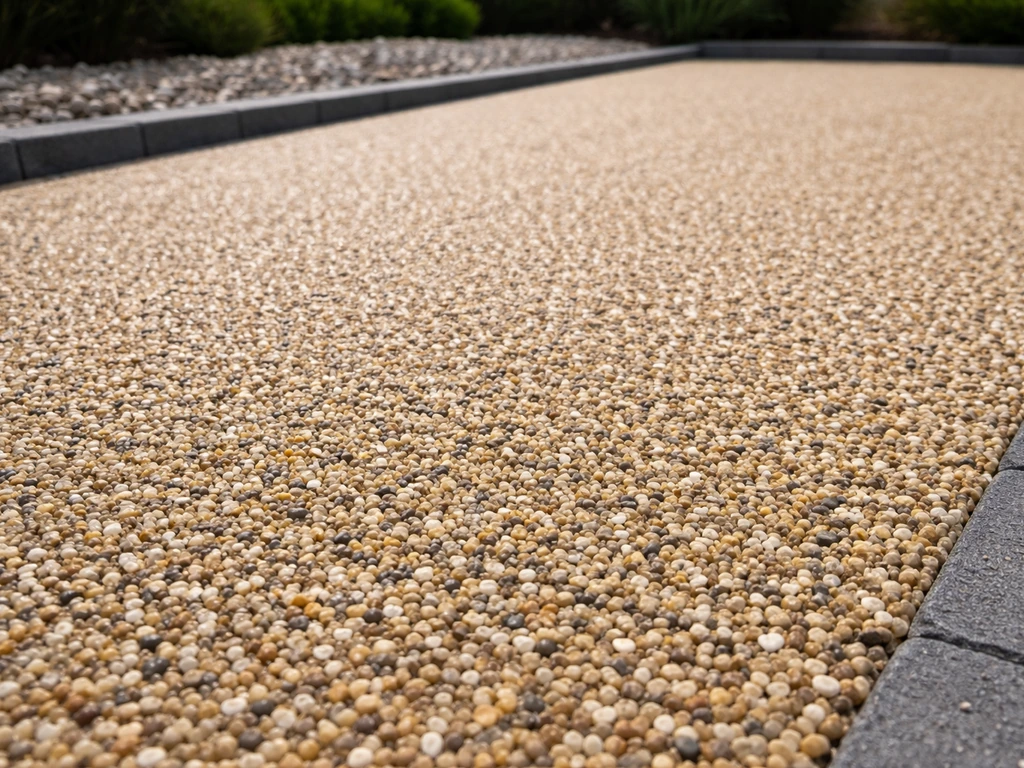
If your yard is relatively flat and you want the most budget-friendly option, a patio usually wins. If you need to bridge uneven ground, want a wood or composite surface underfoot, or simply prefer the raised feel of a deck, a low deck is the better fit even though it costs more and takes longer to build. Most homeowners spend $4 to $16 per square foot for a concrete patio, compared to roughly $15 to $50 per square foot installed for a low deck depending on materials. If you want a quick idea of patio vs decking cost, compare the typical $/sq-ft ranges and factor in site prep and installation time. The right answer really comes down to your site, your budget, and how you plan to use the space.
Low Deck vs Patio: Costs, Maintenance, and Best Choice

Miles Hart
4 Jun 2026
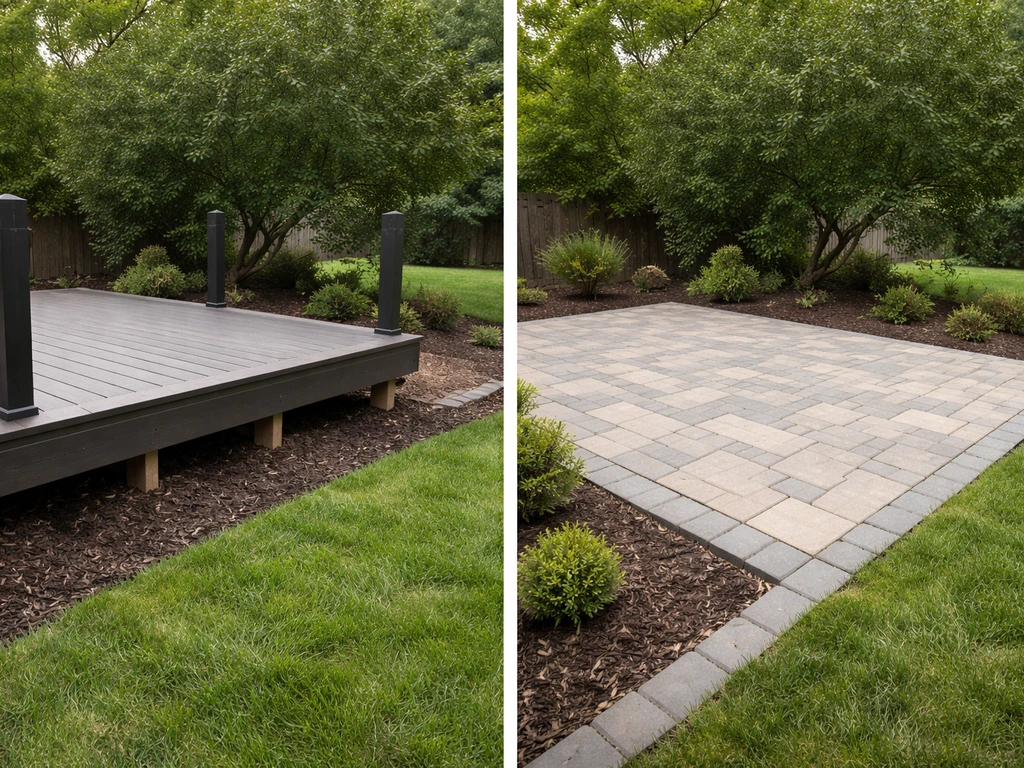
What each one actually is
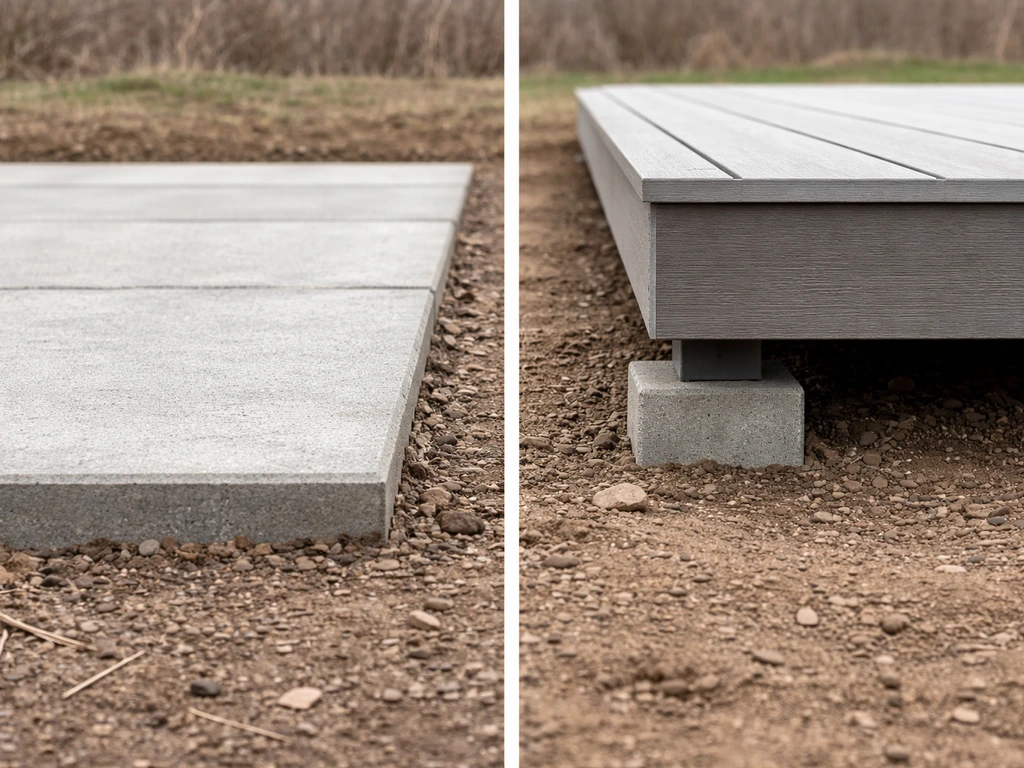
A patio is a ground-level hardscape surface, typically made from concrete, pavers, flagstone, or gravel, that sits directly on or just above the soil. There's no framing, no posts, no structural engineering. You're essentially creating a flat, solid surface that rests on a compacted gravel base. A typical patio sits just an inch or two above the surrounding grade once installed.
A low deck is a framed wood or composite platform that's elevated above the ground, usually somewhere between 6 inches and 24 to 30 inches. It uses posts, beams, joists, and decking boards, just like any other deck, but it's kept close to grade. This is an important distinction because once a deck surface gets above 30 inches from the ground, building codes in most jurisdictions (including the IRC and states like Minnesota) require guardrails of at least 36 inches in height. Staying under that 30-inch threshold is actually a strategic choice many homeowners make to simplify the permit and build process.
The practical difference in day-to-day life: you step out of your back door onto a patio and you're at ground level, which blends naturally into the lawn. With a low deck, there's a subtle elevation and a wooden or composite surface that feels more like an extension of the house itself.
What you'll realistically spend on each
Patios are almost always cheaper, both in materials and labor. Here's how the numbers break down by material type for patios. HomeAdvisor reports average installed costs for flagstone patios of about $15 to $30 per square foot, with figures varying by stone and installation method.
| Patio Material | Installed Cost (per sq ft) | Typical 200 sq ft Project |
|---|---|---|
| Concrete (plain) | $4 – $12 | $800 – $2,400 |
| Concrete (stamped/stained) | $8 – $30 | $1,600 – $6,000 |
| Pavers | $10 – $20 | $2,000 – $4,000 |
| Flagstone | $15 – $30 | $3,000 – $6,000 |
For a concrete patio, a 200-square-foot slab with 4-inch thickness typically runs about $2,400 to $4,000 all in. That's a real-world number from actual project data, not a back-of-napkin estimate. Paver patios cost more upfront but give you flexibility to swap individual pieces later if something shifts or cracks.
Low decks cost significantly more. A pressure-treated wood deck typically runs $15 to $25 per square foot installed, while composite decking jumps to $25 to $50 per square foot depending on the brand and labor in your area. HomeGuide puts composite deck labor alone at $24 to $48 per square foot, which is often more than an entire concrete patio project. A small 144-square-foot composite deck averages $2,200 to $4,600 just for the decking material and basic installation, and total project costs for a new deck commonly land between $4,000 and $16,000.
Permits and what they'll cost you

This is where the two options really diverge. Most patios at grade don't require a permit at all, especially if they're not attached to the house. Low decks are a different story. Many jurisdictions require a building permit for any deck surface more than 24 to 30 inches above grade, though some places (like Calgary) trigger permits at just 2 feet (0.6 m). Permit fees themselves are modest: Charlotte County, FL charges a flat $90 for a residential deck permit, Grandview, MO bundles deck permits in at $50, and Calgary lists a specific fee of $205.92. But the cost of the permit isn't the issue. It's the time for plan review, the required inspections, and the need to have drawings that meet code. Budget at least a few weeks and factor in potential re-inspection fees (often $50 to $75) if anything needs to be corrected.
Which one fits your lifestyle better
The right surface depends a lot on how you actually use outdoor space. Here's how the two compare across common scenarios.
| Use Case | Low Deck | Patio |
|---|---|---|
| Grilling and outdoor kitchen | Good: elevated platform keeps grill at comfortable height | Good: concrete or pavers handle heat and grease well |
| Entertaining and furniture layout | Great: defined platform creates a room-like space | Great: more flexible footprint, easier to expand later |
| Kids and pets | Good: splinter risk with some wood types; composite is better | Excellent: flat, no gaps, no splinters |
| Wheelchair/mobility access | Requires ramp if elevated; low height helps | Excellent: seamless grade-level access |
| Uneven or sloped yard | Excellent: framing bridges grade changes easily | Difficult: requires significant grading or retaining |
| Pool or spa surround | Possible but drainage is more complex | Excellent: pavers drain well and tolerate splash zones |
If someone in your household uses a wheelchair or has limited mobility, a patio is genuinely the more accessible option by default. You're not dealing with elevation changes or ramp requirements. For a sloped backyard, though, a low deck can actually be the simpler path because the framing spans the slope without you having to haul in fill dirt or build retaining walls.
For families with young kids, concrete or paver patios get high marks because there are no gaps between boards and no splinter risk. If you want a deck surface, composite materials solve the splinter problem but cost more. This is a good point to consider if you're also weighing the broader patio vs deck pros and cons for your household. If you want a quick comparison, review resin patio pros and cons and how resin surfaces stack up against deck materials for your specific climate and maintenance preferences patio vs deck pros and cons.
Build complexity and realistic timelines
Can you DIY it?
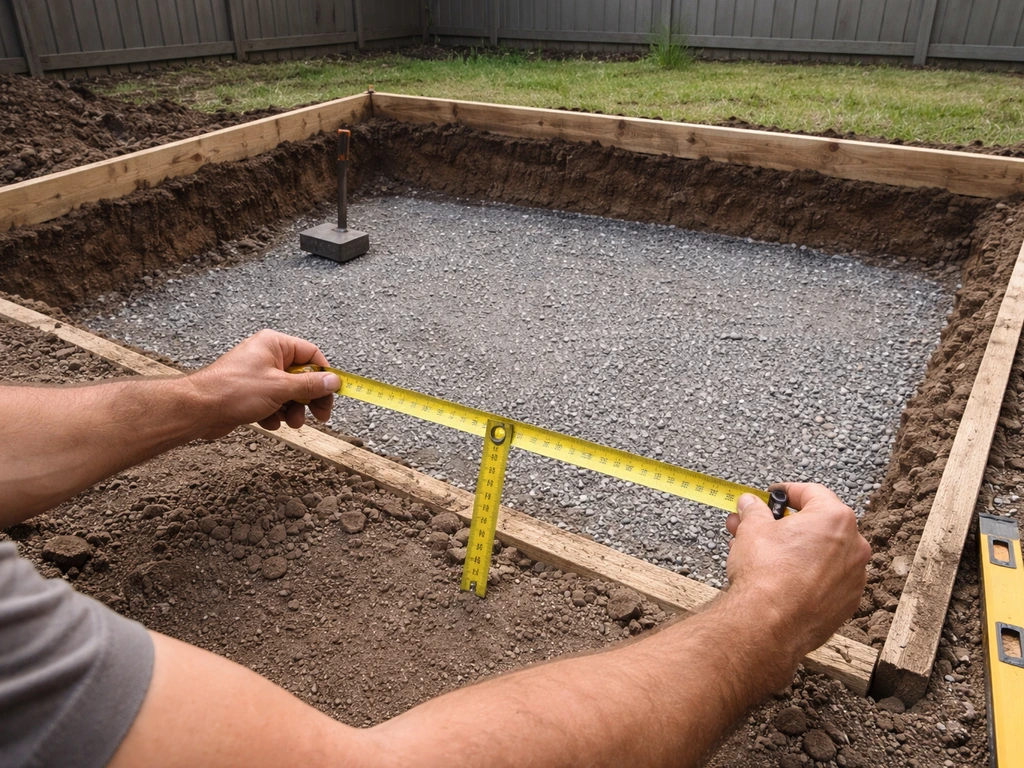
A concrete patio is doable as a DIY project if you have some experience, but it's not beginner-friendly. Properly building a concrete patio means excavating 8 to 10 inches of depth (accounting for the 4-inch slab plus a 4 to 6-inch compacted gravel base), setting forms, ordering and pouring ready-mix, and finishing the surface before it cures. SlabCalc also emphasizes that the proper base, such as 4 inches of compacted gravel, is important for patio performance compacted gravel base. Miss your window and the slab is ruined. A paver patio is more forgiving for DIYers: you compact the gravel base in 4 to 6-inch lifts, set a sand layer, lay pavers, and lock joints with polymeric sand. It takes time and physical effort but doesn't have the unforgiving timing pressure of concrete.
A low deck is a more complex DIY project. You're digging and setting footings (which may need to be below frost line depending on your region), framing with beams and joists, and installing decking boards. It's absolutely achievable for a confident DIYer with basic carpentry skills, but it involves more structural decisions and you'll need a permit in most areas. If you're going to hire out, a contractor can typically build a basic low deck in two to four days once materials are on site. A patio crew can often pour a concrete slab or lay pavers in one to two days for a standard backyard project.
What your site conditions change
Poor drainage, expansive clay soil, and freeze-thaw climates matter for both options but in different ways. For patios, poorly draining soil causes pavers to heave and shift as water freezes and expands underneath. The fix is proper base depth and a 1-inch-per-8-foot drainage slope away from the house. For low decks, the main site concern is footing depth. In cold climates, footings need to reach below the frost line to prevent the structure from moving seasonally. A deck on concrete piers that aren't deep enough will rock and crack connections over time.
Maintenance, durability, and weather performance
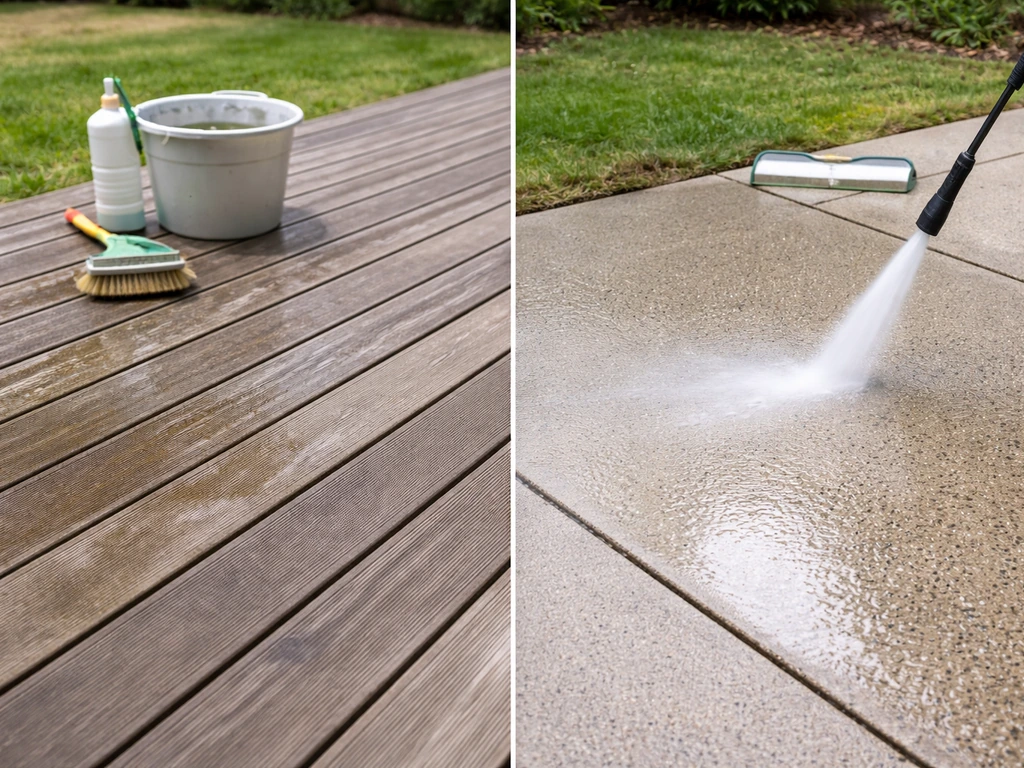
Patios generally need less ongoing maintenance than wood decks. A concrete patio needs occasional cleaning and, if it's stamped or colored, resealing every few years to protect the finish. Plain concrete can crack over time, especially in freeze-thaw climates, but hairline cracks are usually cosmetic. Paver patios need occasional releveling and joint sand replenishment, but individual pavers can be pulled up and replaced without touching the rest of the surface. That's a real advantage over concrete when something goes wrong.
Pressure-treated wood decks require more attention. The standard recommendation is cleaning and restaining or resealing every two years to keep the wood protected from moisture, UV, and rot. Skip that schedule and you'll see graying, cracking, and eventually rot at connection points. Composite decks are much lower maintenance (mostly just cleaning), which is why they cost more upfront. Either way, you need to check fasteners and framing annually for any soft spots, especially around ledger connections and post bases where moisture tends to collect.
For wet climates or shaded yards, wood decks also carry a real slip and mold risk. Composite decking with a grooved or textured surface performs much better in those conditions. On the patio side, smooth concrete can get slippery when wet. Textured finishes, exposed aggregate, or certain paver profiles handle wet conditions better than a troweled concrete surface.
| Factor | Low Deck (Wood) | Low Deck (Composite) | Patio (Concrete) | Patio (Pavers) |
|---|---|---|---|---|
| Annual maintenance effort | High (clean, stain, inspect) | Low (clean only) | Low | Low to medium |
| Freeze-thaw performance | Good with proper footings | Good with proper footings | Fair (can crack) | Good with proper base |
| Slip risk when wet | Moderate to high | Low (textured surface) | Moderate (depends on finish) | Low to moderate |
| Rot/decay risk | Yes (treat cut ends) | None | None | None |
| Repair ease | Moderate (replace boards) | Moderate | Difficult (concrete patches show) | Excellent (swap individual pavers) |
Home value, resale impact, and curb appeal
Neither option is a slam-dunk investment in pure dollar-for-dollar return, but decks tend to recover more at resale than patios do. The 2025 Remodeling Cost vs. Value data puts a wood deck addition at about 66.8% cost recovery and composite decks at around 62%. A backyard patio addition comes in lower, at roughly 46% cost recovery on a project that costs around $12,000. That gap matters if resale value is a priority.
That said, the right project for your specific market can outperform national averages. In areas where outdoor living is highly valued year-round (think the Southwest or Pacific Northwest), a well-built patio or deck can be a genuine differentiator. The broader takeaway is that neither a patio nor a deck is a reliable way to turn a profit on a remodel, but a deck tends to have slightly better resale optics, especially if it's well-maintained and done with quality materials.
Curb appeal cuts both ways. A deck attached to the back of the house reads as an extension of the living space, which buyers often respond to emotionally. A nicely designed paver patio with defined edges and good landscaping can look equally polished. A plain, cracked concrete slab, on the other hand, is an easy negative for buyers to spot. Whatever you build, quality of execution matters more than the material category.
How to decide: a step-by-step checklist
Work through these questions in order. By the time you get to the end, the right choice for your property should be clear.
- Check your yard's slope. Is the area where you want the outdoor space mostly flat (within 6 to 8 inches across the footprint), or does it slope noticeably? Flat yard leans toward patio. Sloped yard leans toward low deck.
- Set your budget ceiling. If you're working with under $5,000 for a 200-square-foot space, a concrete or paver patio is your realistic option. A low deck in that size will likely run $3,000 to $10,000 depending on material and labor costs in your area.
- Assess your soil and drainage. Do you have clay soil or a yard that holds water after rain? If yes, drainage planning is critical for both options. For patios, this means a deeper compacted gravel base and a proper slope. For decks, it means footings deep enough to handle frost and moisture.
- Think about who uses the space. Do you have young kids, pets, or household members with mobility challenges? Patios get an edge here for accessibility and safety. If you want a deck, budget for composite materials over wood.
- Check your local permit requirements. Search your city or county's building department website for deck permit thresholds. If your deck will be under 24 to 30 inches above grade (the threshold varies by jurisdiction), you may face a simpler permit process. Patios at grade often require no permit.
- Decide on DIY vs contractor. If you're a confident DIYer with basic tools, a paver patio is the most approachable self-build. A low deck is doable but requires more structural knowledge and almost always requires a permit and inspection.
- Think about the 10-year picture. Are you planning to sell in the next few years? A well-built wood or composite deck has stronger resale optics. Are you staying long-term and want low maintenance? A paver patio or composite deck surface both win there.
- Get at least two quotes before deciding. Material costs vary significantly by region and so does labor. A concrete contractor and a deck builder quoting the same 200-square-foot space in your specific ZIP code will tell you more than any national average.
Common scenarios mapped to the better choice
- Flat yard, tight budget ($3,000 to $5,000), wants low maintenance: concrete or paver patio wins clearly.
- Sloped backyard, wants to avoid grading work, has $8,000 to $15,000 budget: low pressure-treated or composite deck is the practical path.
- Family with young kids or pets, wants a splinter-free, gap-free surface: patio first, or composite deck if elevation is needed.
- Planning to sell within 3 to 5 years and wants the best resale optics: a well-built wood or composite deck typically recovers more at resale than a patio addition.
- Accessibility is a priority (wheelchair, walker, older adults): grade-level patio is the default choice; eliminates any elevation or ramp complication.
- Cold climate with heavy freeze-thaw cycles: both can work, but pavers with a proper deep gravel base handle frost movement better than concrete slabs, and deck footings must reach below frost depth.
The raised patio vs deck decision is a close sibling to this one, especially if your yard has a significant grade change that might push you toward an elevated hardscape solution instead of a framed structure. And if you're still weighing overall material differences, the broader patio vs decking cost comparison can help you get your arms around the full budget picture before you commit to either path.
FAQ
If my backyard is mostly flat, how do I choose between a patio and a low deck when both fit the grade?
Use your door-to-yard height and desired “flow.” If you step down from the back door or the yard already drops slightly, a low deck can feel safer and more level without hauling fill, but it will cost more and may trigger a permit. If the walking path is already accessible and you want the easiest maintenance, a patio is usually the better default. Measure the back door threshold to the finished patio or deck surface so you avoid awkward step-ups or step-downs.
Do I really avoid permits with a patio, and what’s the catch?
Often, detached patios at grade do not require a permit, but rules can change based on attachment to the house, size, and local zoning or design review. Even when permits are not required, you may still need to follow grading, drainage, and setbacks. The practical “catch” is plan approval for site work, especially if the patio affects how water drains toward property lines or toward the foundation.
What’s the main reason decks get delayed compared with patios?
Decks commonly need additional approval steps. In many jurisdictions, plan review and multiple inspections (footings, framing, final) can extend the timeline, even if the contractor can build quickly once materials are on site. Patios may be limited to inspections related to base thickness or compaction, and sometimes none at all, depending on local rules.
How should I think about drainage for patios versus low decks?
For patios, drainage is about preventing water from pooling under the base, which can cause heaving and shifting. For decks, drainage is about keeping water away from posts, beams, and ledger connections, so you avoid rot at joints. If your soil is clay-heavy or your yard has poor runoff, a patio with the right base and slope matters a lot, while a deck needs water management details like proper flashing and post-base protection.
Can I build a patio near an existing foundation without creating water problems?
Yes, but you need to manage water carefully. A patio should have a controlled slope away from the home and the right base build-up so water does not concentrate against the foundation. If you do not address this, you can end up with damp basements, foundation staining, or accelerated deterioration at the interface.
What’s the safe way to decide patio height relative to the door and steps?
Aim for continuity with existing thresholds. If your finished patio will be too high, you create a “bump” at the door that can be unsafe for kids, older adults, and anyone using mobility aids. If it’s too low, you may end up with a steeper step down than you intend. Plan the finished elevation after accounting for the compacted base and any bedding sand, not just the slab or paver thickness.
Are paver patios always easier to repair than concrete if something shifts?
They are typically easier to correct locally. If pavers heave or a section settles, you can lift and reset affected units without demolishing the whole slab. The key is that the underlying base and compaction still have to be correct. If water management is poor, repairs can keep recurring.
For a low deck in a freeze-thaw climate, what goes wrong first when footings are shallow?
The deck can start to rack or rock, and connection hardware can loosen over time. The earliest signs are slight movement at corners, tightened boards that later gap, and fasteners near post bases showing distress. Going deep enough to reach below the frost line is usually the difference between a deck that stays solid and one that needs repeated stabilization.
Which is better for slip resistance when it rains, a deck or a patio?
It depends on surface texture and maintenance. Patios can get slippery on smooth concrete, especially with algae or fine dust, while textured concrete finishes, stamped textures designed for traction, exposed aggregate, or certain paver profiles improve grip. For low decks, composite with a grooved or textured surface generally performs better than smoother or heavily worn boards.
Do decks always require guardrails, and does staying under 30 inches really eliminate the issue?
Staying below common guardrail thresholds often reduces the likelihood, but it does not guarantee it because some jurisdictions and design details can still require safety protection. Also, local code may treat stairs, landings, or unusual geometry differently. If you are near the threshold, confirm with your permit office or designer before you finalize framing height.
If I want low maintenance, what is the fastest way to compare ongoing costs between concrete, pavers, wood, and composite?
Break it into two buckets: surface protection and structural checkups. Concrete often means periodic cleaning and possible resealing for decorative finishes, pavers mean occasional joint sand replenishment and occasional releveling, wood decks require a cleaning plus reseal or restain schedule, and composite is mostly cleaning plus annual checks for fasteners and framing moisture at connections.
Does resale value favor one option consistently, or can a poorly built project hurt resale either way?
Resale benefits can exist for both, but workmanship matters more than category. A deck built with weak posts, poor flashing, or rot-prone detailing can lower buyer confidence, just like a patio with bad base prep or drainage can create visible cracking and unevenness. If resale is a priority, focus on solid installation and good surface condition, and treat drainage and safety details as part of curb appeal.
Next Article
Resin Patio Pros and Cons: Performance, Costs, and Alternatives
Real-world resin patio pros and cons: costs, drainage, slip resistance, durability, maintenance, and how it compares to