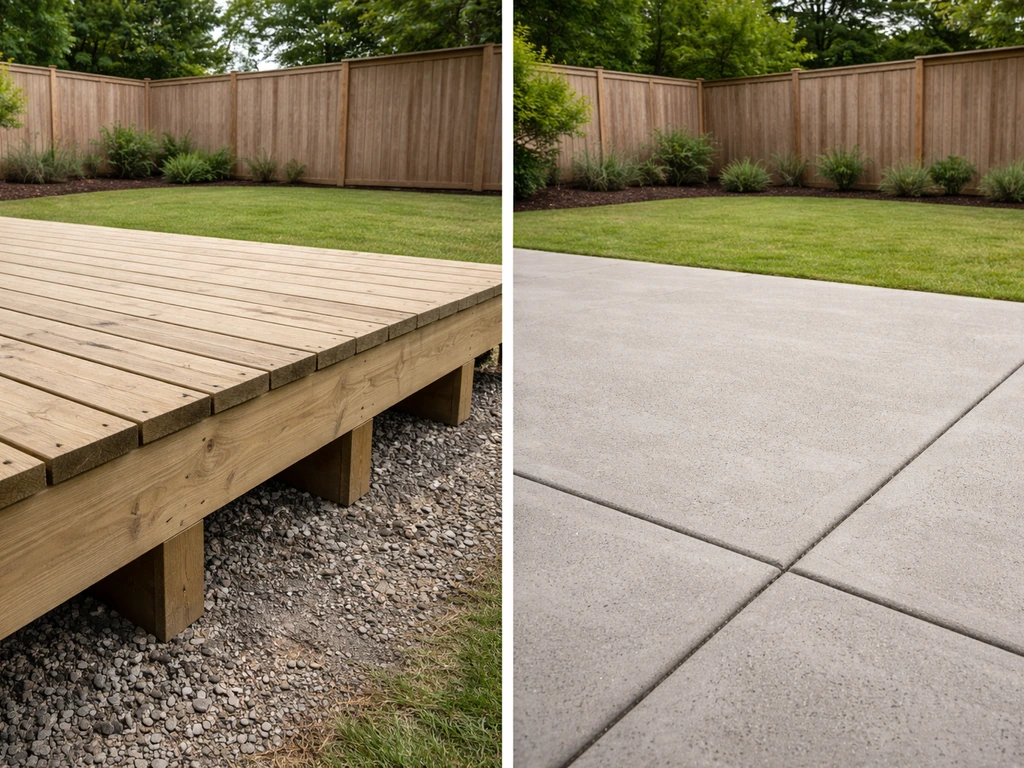
A ground level deck sits on framed joists and posts close to the ground, usually within 30 inches of grade, and is surfaced with wood or composite boards. A patio is a poured concrete (or laid masonry) surface that sits directly on a prepared gravel base at or just above ground level. To help you choose between the two, note that the deck surface usually ends up higher than the patio surface when they’re both built at ground level deck is higher than patio (grass is higher than patio). Both give you functional outdoor space, but they differ in how they're built, what they cost, how they hold up, and what they feel like underfoot on a hot July afternoon. For most homeowners working with a flat or gently sloping yard and a tight budget, a concrete patio is cheaper upfront. If you want a warmer surface, easier drainage on uneven ground, or a more finished look, a ground level deck earns its higher price tag.
Ground Level Deck vs Patio: Costs, Durability, and Fit

What each one actually is
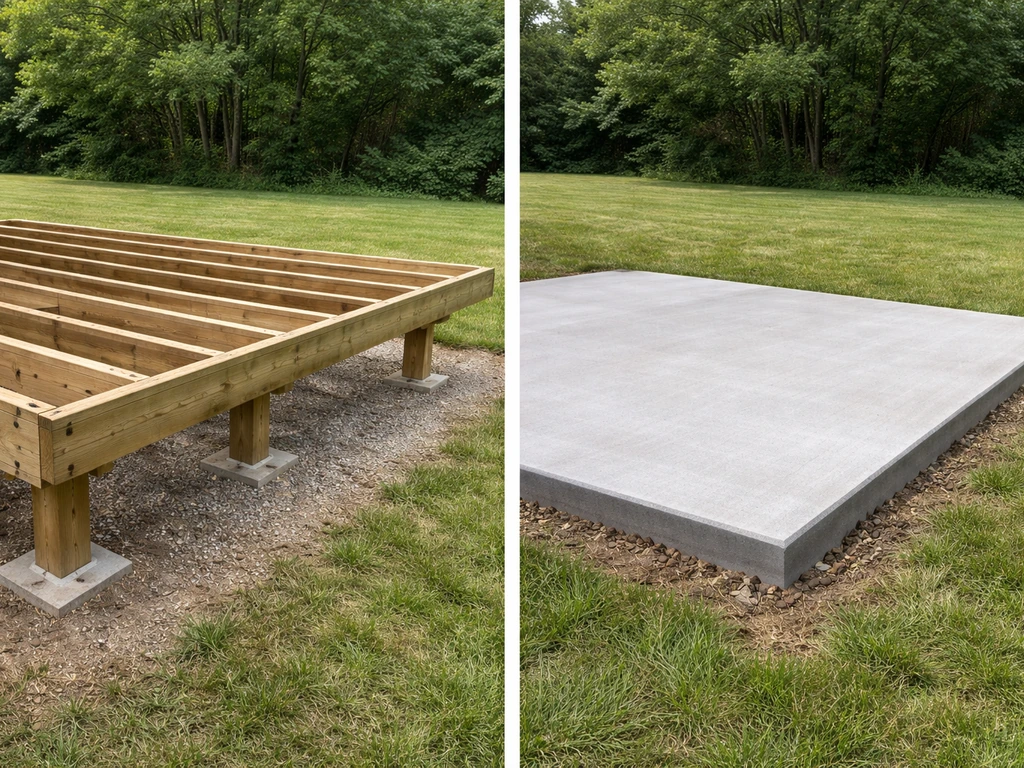
A ground level deck (sometimes called a floating deck or grade-level deck) is a framed structure made of posts, beams, and joists, topped with decking boards. "Ground level" generally means the deck surface sits within about 30 inches of the ground, which is significant because many jurisdictions don't require guardrails below that height. The framing is typically pressure-treated lumber, and the surface can be pressure-treated wood, cedar, redwood, or composite decking. Because it's framed off the ground rather than sitting on it, there's an air gap underneath.
A concrete patio is a slab of poured concrete, usually 4 inches thick, that rests on a compacted gravel base directly on or just slightly above the soil. It can be plain broom-finished, stamped, colored, or exposed aggregate. Some homeowners use the term "patio" more loosely to include pavers or flagstone, but for this comparison we're focusing on concrete since it's the most direct structural alternative to a deck. One thing to keep in mind: how your patio sits relative to your lawn grade matters a lot for drainage, and that's worth thinking through before you pour anything.
Cost comparison: what you'll actually spend
Concrete patios are almost always cheaper to build than a ground level deck. For plain concrete, expect to pay roughly $5 to $18 per square foot installed, with most straightforward residential pours coming in around $8 to $12 per square foot. A 20x20 foot patio (400 sq ft) typically runs about $3,200 to $7,200 installed, depending on your region, site prep needs, and finish. DeckMath's 2026 deck pricing guide puts pressure-treated deck pricing as a budget baseline in the range of about $25, $40 per sq ft DeckMath’s 2026 deck pricing guide. Decorative finishes like stamping, exposed aggregate, or coloring push that range higher, sometimes to $15 to $25 per square foot.
A ground level pressure-treated deck runs roughly $25 to $45 per square foot installed in 2026, and composite decking brings that up to about $40 to $75 per square foot installed. On the same 400 square foot footprint, you're looking at $10,000 to $18,000 for pressure-treated or $16,000 to $30,000 for composite. That's a meaningful gap. The deck costs more because you're paying for framing lumber, posts, footings, hardware, and skilled labor to assemble it, not just a pour and finish.
| Factor | Concrete Patio | Ground Level Deck (PT) | Ground Level Deck (Composite) |
|---|---|---|---|
| Cost per sq ft (installed) | $5–$18 | $25–$45 | $40–$75 |
| 400 sq ft total estimate | $3,200–$7,200 | $10,000–$18,000 | $16,000–$30,000 |
| Footings needed? | No (gravel base) | Yes (frost footings) | Yes (frost footings) |
| Typical extras | Drainage grading, sealer | Railings, stairs, hardware | Railings, stairs, hidden fasteners |
| DIY savings potential | Moderate | High (framing skills needed) | Moderate |
Don't forget to budget for extras on either side. A patio may need grading work, a drain, or a retaining edge if your yard slopes. A deck almost always needs concrete footings (more on that below), and if you want stairs or any kind of privacy screen, those add cost fast. Railings on a deck can easily add $1,000 to $4,000 depending on material and linear footage.
How they're built: the construction reality
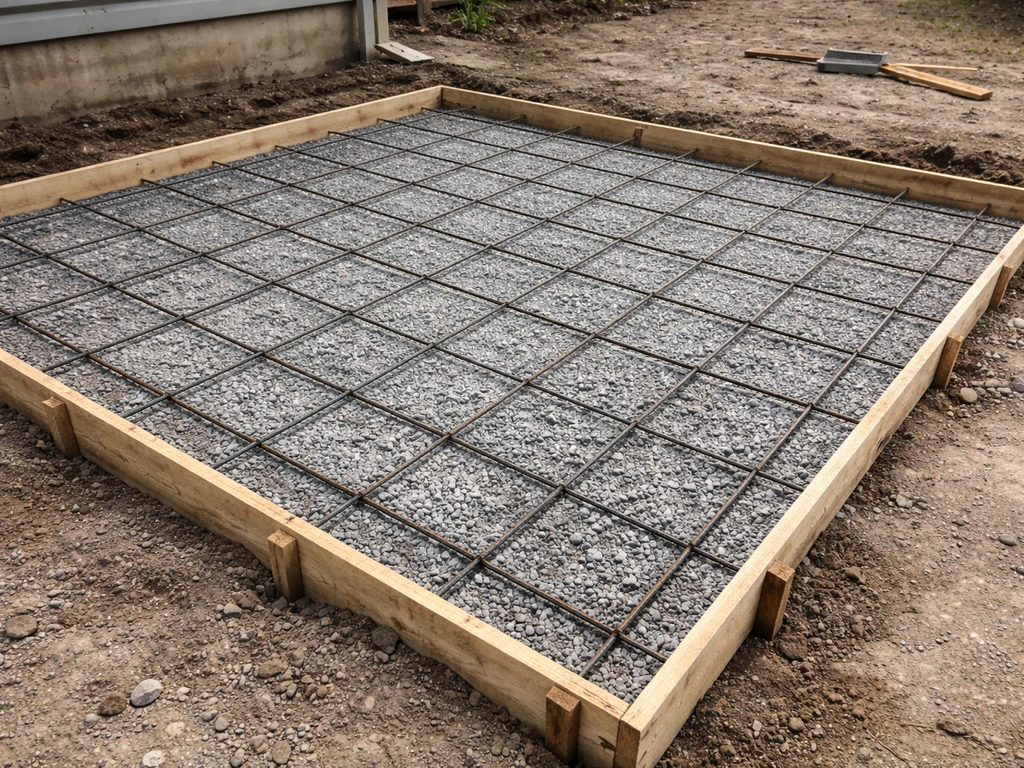
Pouring a concrete patio
Concrete patio construction starts with excavating the area, compacting the soil, and laying a gravel base (usually 4 to 6 inches of compacted gravel for drainage). Then a form is built from lumber around the perimeter to contain the pour. Reinforcement (rebar or wire mesh) gets laid inside the form to reduce cracking, concrete is poured and screeded level, and the surface is finished. The slab needs to cure for at least 28 days before it reaches full strength. The whole visible process can happen in a day or two, but you can't put furniture on it immediately.
One thing a lot of homeowners don't anticipate: site prep matters enormously for a patio. If the ground isn't properly graded before the pour, you'll end up with drainage problems later. The slab should slope very slightly away from your house, typically about 1/8 inch per foot. If your yard already has grade issues (like a lawn that sits higher than where the patio would go), that needs to be sorted before the concrete goes down.
Framing a ground level deck
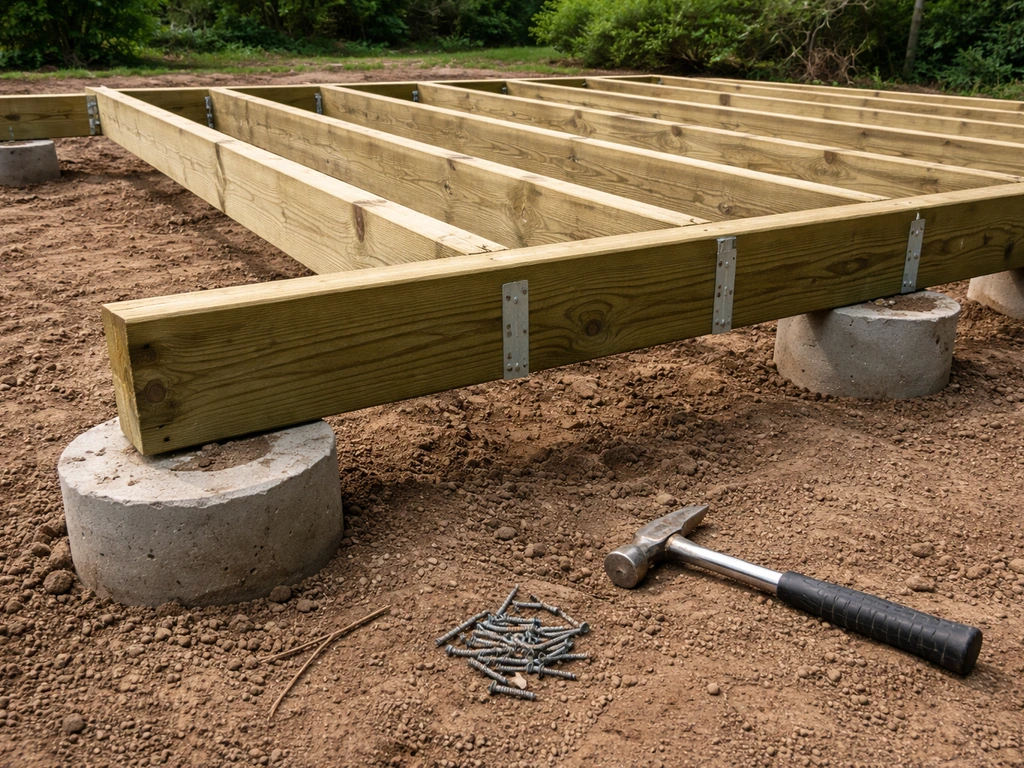
A ground level deck starts with footings: concrete piers poured into the ground below the frost line to prevent heaving. In cold climates, that might mean digging 36 to 48 inches down. The footings support posts, which support beams, which support joists, which finally support your decking boards. It's a proper framed structure, and every connection point needs to be engineered for the load. This is why ground level decks cost more per square foot than you might expect: you're building a small structure, not just a surface.
Some floating decks skip traditional footings and use surface-mount deck blocks or helical piers instead, which works well in mild climates or for smaller structures. But in freeze-thaw regions, skimping on footings leads to decks that heave and rack over time. If a contractor suggests skipping proper footings to save money in a cold climate, that's a red flag.
Durability and maintenance over time
Concrete is genuinely low maintenance in the day-to-day sense: sweep it, hose it off, done. But it has one persistent weakness: cracking. Concrete expands and contracts with temperature, and over time most slabs develop at least hairline cracks. Control joints cut into the slab during installation help direct where cracking happens, but they don't prevent it entirely. If a crack opens up and water gets in, freeze-thaw cycles can widen it. Sealing your concrete every 2 to 3 years dramatically reduces this risk and keeps the surface looking good. An unsealed decorative concrete patio can look tired and stained within 5 years.
Pressure-treated wood decks need regular maintenance to stay in good shape. Plan on cleaning and resealing or restaining every 1 to 3 years, depending on your climate and sun exposure. Without it, the wood grays, checks (develops surface cracks along the grain), and eventually starts to splinter or rot at the ends. Ground level decks are especially vulnerable because the air gap underneath, while better than resting on soil, can still accumulate moisture and trap leaves, creating conditions for mold and wood decay over time. Composite decking largely solves the rot and splinter problem, but it can still grow mildew on the surface in shaded or humid conditions and needs periodic cleaning.
| Maintenance Task | Concrete Patio | Pressure-Treated Deck | Composite Deck |
|---|---|---|---|
| Sealing/staining | Every 2–3 years | Every 1–3 years | Not required |
| Crack/split risk | Cracks over time | Checks and splits | Minimal |
| Mold/mildew risk | Moderate (low spots) | High (especially low-air-flow areas) | Moderate (surface only) |
| Rot risk | None | High if not maintained | None |
| Typical lifespan (maintained) | 30–50 years | 15–25 years | 25–30 years |
Day-to-day comfort and usability
Concrete gets brutally hot in direct sun. On a 90-degree day, an exposed south-facing concrete patio can surface-temp well above 110 degrees, which is uncomfortable barefoot and makes outdoor furniture sit in radiant heat. Wood decking stays significantly cooler, and composite runs somewhere in between depending on color (darker composites can get quite hot). If you live somewhere with serious summer heat and you're planning to use the space without shoes or with kids and pets, this matters.
Drainage is another real-world difference. A properly sloped concrete patio sheds water, but if there's any low spot, water pools and can seep toward your foundation. A deck with gaps between boards drains almost instantly, which is a genuine advantage in rainy climates or if the space sits near your house. That said, what drains through the deck has to go somewhere under it, and if the area under the deck doesn't drain well, you end up with a muddy, weedy mess. Some homeowners solve this by laying gravel or weed fabric under a ground level deck.
For privacy and shade, both options start as open spaces. Adding a pergola, shade sail, or privacy lattice works equally well on either surface. Steps and stairs are simpler to integrate with a deck since they're part of the framed structure. Concrete steps are absolutely doable but need to be poured and formed separately, adding cost and complexity. If your yard slopes and you need the outdoor space to transition to different grade levels, a deck is generally more flexible because you can adjust joist height. With concrete, you're committing to one fixed plane.
Permits, DIY feasibility, and home value
Permit requirements vary a lot by municipality, but as a general rule: concrete patios rarely require permits (they're considered non-structural), while decks almost always do, even at ground level. Many jurisdictions specifically require a permit for any deck over a certain square footage or height, typically 200 square feet or 30 inches off the ground. The permit process involves submitting plans, paying a fee (often $100 to $500), and scheduling inspections. Skipping a required deck permit can create real problems when you sell your home, since buyers' inspectors and title companies often flag unpermitted structures.
DIY feasibility depends on your skill level. A basic concrete patio is within reach for an experienced DIYer who's comfortable with formwork, concrete mixing or ordering ready-mix, and finishing. The window to work with concrete before it sets is unforgiving, so most homeowners doing a large pour still hire out the concrete work and just handle the prep. Framing a ground level deck is a more accessible DIY project than an elevated deck because you're not working at height and the structural stakes are lower, but you still need solid carpentry skills, the right tools, and a working understanding of joist spans and ledger attachment (if it's attached to the house). Composite decking adds cost but makes the finished surface much more DIY-friendly since it doesn't need ongoing finishing.
Both options add value to a home, but not equally in all markets. A well-built deck, especially composite, tends to recoup more of its cost in resale value in markets where outdoor living space is highly valued, like the Pacific Northwest or Northeast. Concrete patios add functional value and are seen as low-maintenance positives by buyers, but typically recoup a smaller percentage of their cost since they cost less to begin with. The Remodeling Cost vs. Value report historically shows decks recouping around 60 to 70 percent of project cost, though this varies significantly by region and market conditions.
Which one makes sense for your situation
Here's a practical way to think about it based on common homeowner scenarios:
- Flat yard, tight budget, low maintenance priority: Go concrete. It's cheaper to install, durable, and a good plain slab sealer is $30 at any home center.
- Sloped yard or uneven grade: A deck handles grade changes much more easily. Grading and filling for a level patio pour on a slope gets expensive fast.
- Hot climate, barefoot use, kids and pets: Pressure-treated or composite decking stays cooler than concrete and splinter-free composite won't roughen up over time.
- You want to DIY and have carpentry skills: A ground level deck is a genuinely satisfying DIY project with good YouTube and plan resources available.
- You want to DIY with minimal specialized skill: A small concrete patio (under 200 sq ft) with pre-mixed bags or a ready-mix order is accessible if you're methodical.
- Planning to sell in 5 years or less: Both add value, but a composite deck in good condition tends to photograph and show better than a plain concrete slab.
- Rainy climate or drainage concerns near the house: A deck with gaps between boards drains almost instantly and reduces moisture risk against your foundation.
Next steps before you commit to anything
Before you get quotes or buy materials, spend 30 minutes measuring and observing your space. Note where water flows after a rain (this tells you your natural drainage direction), whether the ground is level or slopes away from or toward the house, and how much sun the area gets in the afternoon. Also check whether your soil is sandy and draining or dense clay, because clay soil under a patio slab needs more gravel base and proper drainage planning.
When you talk to contractors, ask these specific questions: What's included in the per-square-foot price (materials, labor, grading, disposal)? What type of concrete mix and thickness are you using? What footing depth do you use for decks in this area? Do you pull the permit, or is that on me? Will you provide a written warranty on labor? Getting at least three quotes gives you a realistic market rate and quickly reveals which contractors are thorough and which are cutting corners.
If you're weighing related grade issues, like whether your patio surface should sit flush with or slightly above your lawn, or what to do if the lawn is already higher than where you want the patio, those grade decisions need to be sorted out before construction starts, not after. If your lawn is higher than your patio, you'll want to adjust the grade or plan drainage so water doesn't run the wrong way lawn is already higher than where you want the patio. That same rule applies when deciding whether the patio should be higher than the lawn, because the height affects how water will drain should patio be higher than lawn. Getting the elevation right from the beginning saves a lot of expensive rework later, regardless of whether you choose concrete or a deck.
FAQ
If my yard is mostly flat, can I build a patio and a deck at the same height so they blend together?
Yes, but you still need drainage control. A patio typically requires a slight slope away from the house, while a deck’s structure and board gaps handle runoff differently. To blend them, set the deck joist height and patio sub-base so the patio’s finished surface drains correctly (often around 1/8 inch per foot away from the home) without leaving a step that becomes a trip hazard.
Which is safer for long-term water management near my foundation?
A patio can be very safe if the entire slab drains away from the house and is supported by proper base prep. If there’s any low spot, pooled water can migrate toward footings. A deck drains quickly through board gaps, but the area under it can collect mud if you don’t slope or add drainage gravel, so the “water destination” still matters.
Do I need to worry about freeze-thaw more with a patio or a ground level deck?
Both, but in different ways. Patios crack and heave are usually tied to base compaction, thickness, and reinforcement placement. Decks are more vulnerable to structural movement if footings are shallow for your frost depth, which can cause the frame to rack over time. In cold climates, prioritize correct footing depth for decks and a properly compacted gravel base for patios.
What’s the biggest mistake people make when choosing between a ground level deck and a patio?
Choosing based only on initial appearance or price, then ignoring site drainage and elevation. Even at “ground level,” patio slabs must be pitched and decks need a plan for where water goes under the structure. The right choice often depends on which option lets you manage runoff without retrofitting expensive grading or drainage later.
Can I install pavers or flagstone and still call it a patio for this comparison?
You can, but performance depends on the base build-up. Pavers and flagstone are “patio-like,” yet they behave differently than a monolithic concrete slab, especially regarding leveling, weed growth, and settlement. If you want the closest structural analogy to the article’s concrete option, confirm the base thickness, compacted gravel specs, and the drainage plan with your contractor.
How do I decide whether the deck surface should be higher than the patio?
Pick a relationship that prevents water from running from the patio onto the deck framing or house. If your deck is higher, the patio often catches and sheds water away more predictably. If the patio is higher, you risk water pressing toward the deck posts and ledger area. A practical rule is to ensure any join or transition is detailed to direct water away from the structure.
Are there situations where a “floating” deck is a bad idea?
Yes, especially in freeze-thaw regions or on poor drainage soils. If a contractor proposes skipping proper foundation design, ask how they handle frost depth and lateral forces. Surface-mount deck blocks can work in mild climates and smaller footprints, but they are risky where ground movement is likely.
How often will I realistically need to maintain each option?
Concrete is low maintenance for cleaning, but it still needs periodic sealing (often every few years) to reduce staining and limit how freeze-thaw worsens cracks. Wood decks usually need cleaning and re-staining or re-sealing every 1 to 3 years depending on sun and climate. Composite reduces rot maintenance, but you still typically need periodic washing to prevent mildew buildup in shaded areas.
Can I put outdoor rugs, cushions, or planters directly on either surface?
For concrete patio slabs, allow for proper curing time before adding heavy items, and use pot feet or spacers for containers to avoid trapping moisture. On decks, planters can be placed directly, but avoid standing water that sits between boards, and ensure any container overflow doesn’t soak repeatedly into the deck surface or underframe.
Which option is better for barefoot use in summer?
A wood deck is generally more comfortable than concrete because it heats up less in direct sun. Composite varies by color, darker boards can get quite hot. If barefoot use is a priority, consider a lighter deck color, add shade (pergola or shade sail), and avoid highly reflective decorative concrete finishes on south-facing runs.
What should I ask to confirm the cost quote is apples-to-apples?
Ask for a line-item breakdown, not just a total per-square-foot number. Specifically request details on site grading scope, gravel base depth and compaction, reinforcement type for concrete patios, and for decks the footing type, spacing, beam size, fasteners, and whether rails or stairs are included. Also confirm warranty terms for labor, since installation quality is what prevents most premature failures.
Will either option be harder to repair if something goes wrong later?
Patio repairs can involve patching or resurfacing, but major base issues may require partial demolition. Deck repairs often involve localized board replacement or frame work, yet if the underlying structure has shifted due to footing problems, repairs can become more extensive. The “repair risk” is usually linked to how carefully the foundation and drainage were planned the first time.
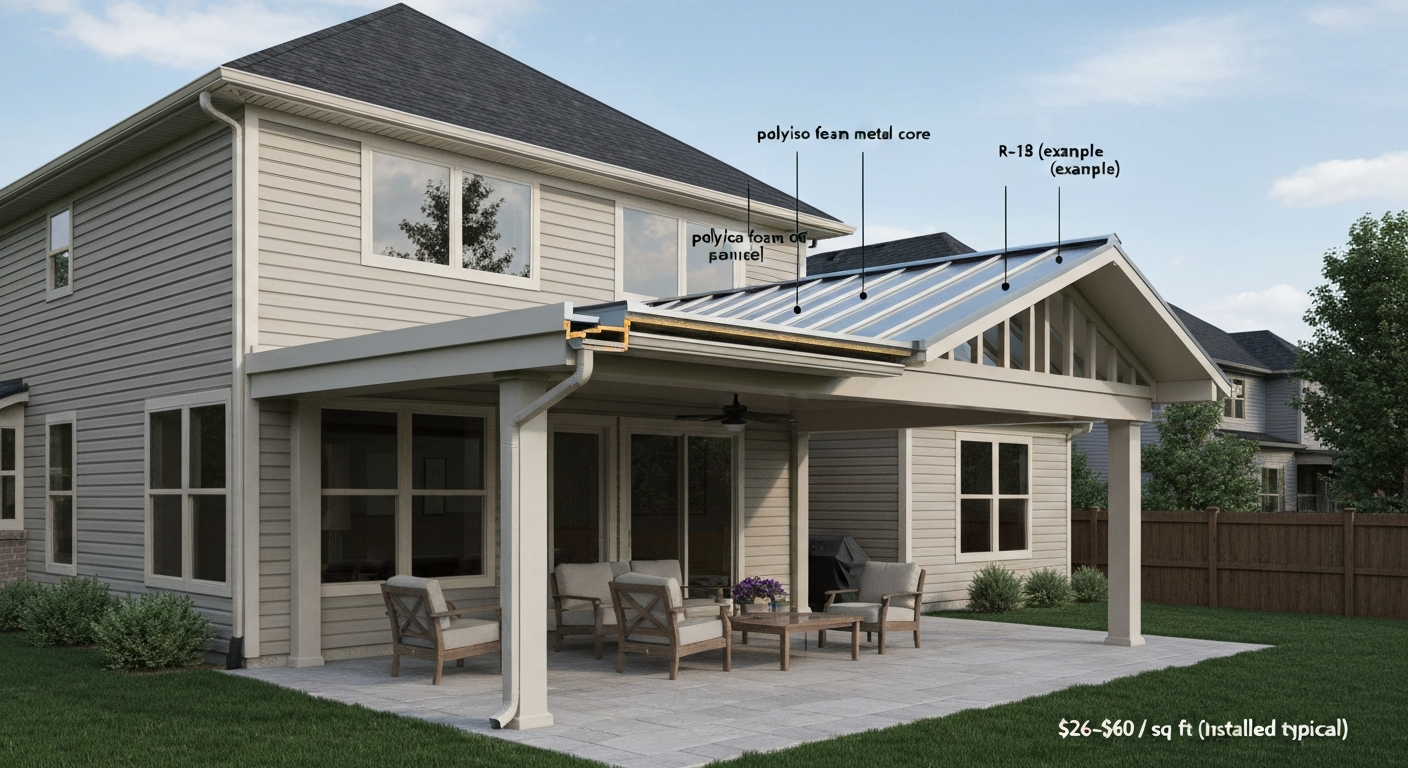
How Much Does an Insulated Patio Cover Cost: Real Costs
Insulated patio cover costs: per sq ft ranges, line‑item budgets, DIY vs pro, examples & contractor checklist.