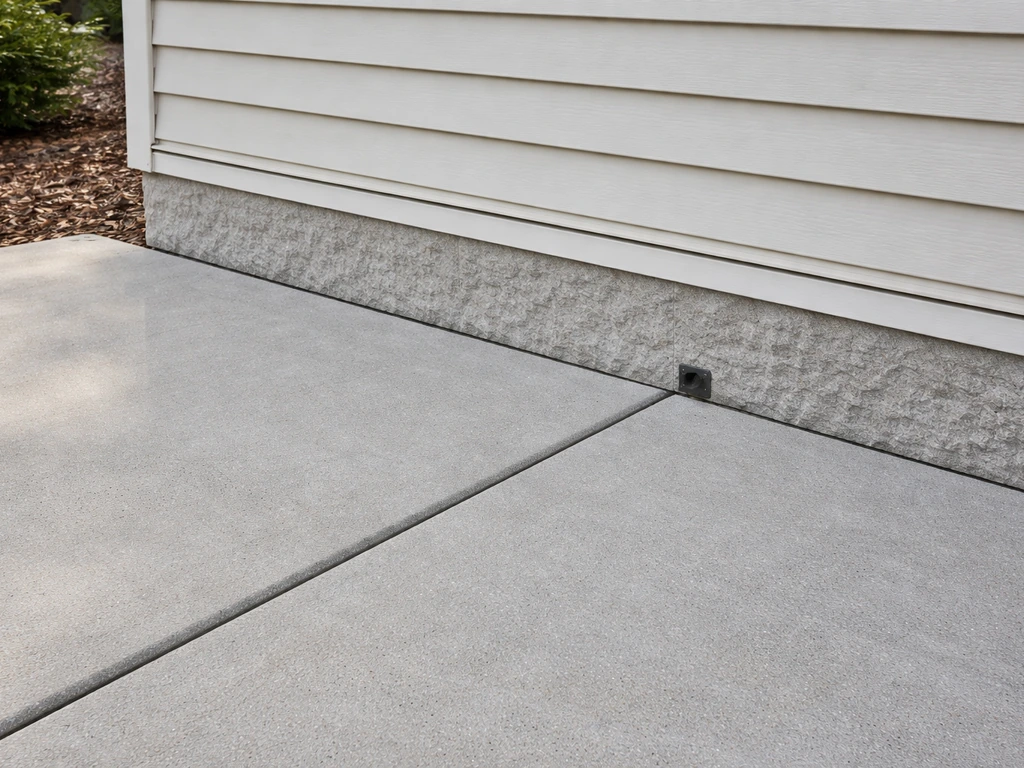
A patio should not slope toward the house. Water that runs toward your foundation is one of the most common causes of basement leaks, crawl space moisture, and long-term structural damage. The IRC building code (R401. 3) and EPA/Building America guidance both require impervious surfaces within 10 feet of your foundation to slope away from the building at a minimum of 2% (about 1/4 inch per foot).
Can a Patio Slope Toward the House? Fix Drainage Right

Miles Hart
1 Jul 2026
If your patio already pitches toward the house, that's a fixable problem, and this guide walks you through diagnosing it, measuring the slope, and correcting it yourself or knowing when to call someone. If you're thinking about a patio on an upper level, you also need to plan the drainage and waterproofing properly to prevent water from getting into the building below can a patio be on the second floor.
Why the slope direction actually matters
A flat or inward-sloping patio funnels rain and irrigation runoff directly against your foundation wall. Over time, that water pressure works through cracks, mortar joints, and porous concrete. Building Science Corporation puts it plainly: nothing near a house should be flat and level except the floor inside it. The whole point of sloping a patio away from the house is to keep surface water moving toward a yard, swale, or drainage point rather than pooling at your foundation.
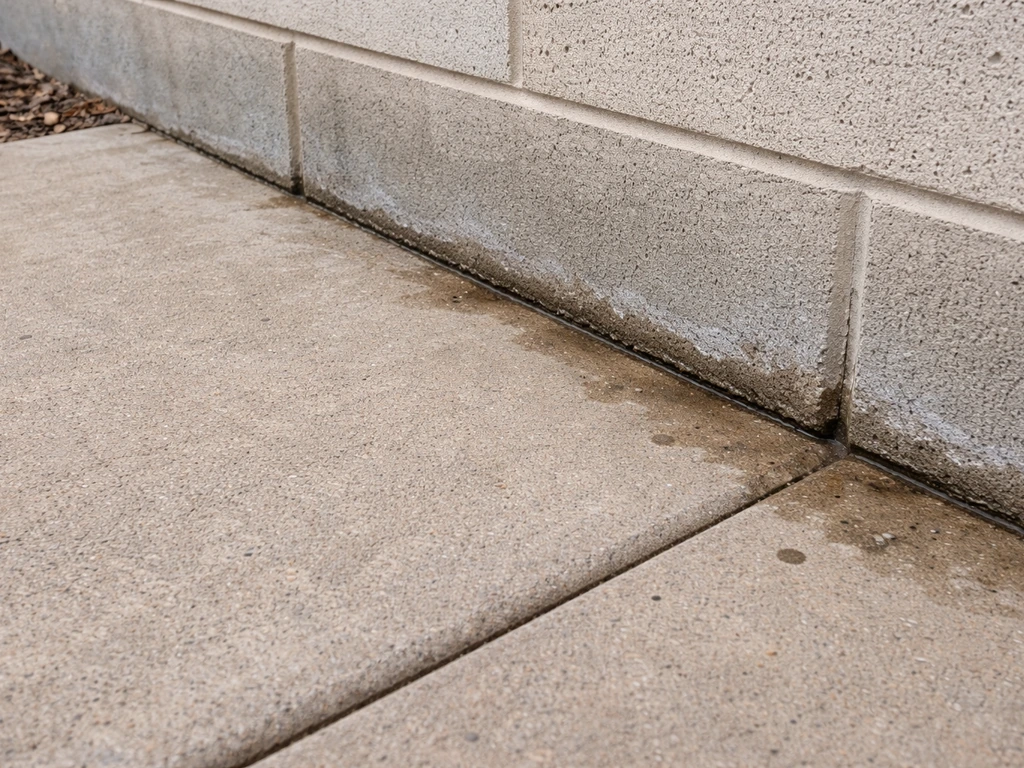
You might not notice the damage immediately. Early warning signs include efflorescence (white chalky deposits on foundation walls or concrete), dark staining at corners where the patio meets the house, and musty smells in basements or crawl spaces after rain. These are moisture migration signals worth taking seriously before they become waterproofing or structural repairs.
The right slope: how much is enough
The minimum you're aiming for is 2%, which works out to 1/4 inch of drop for every foot of patio length away from the house. That's the IRC R401.3 standard and what EPA/Building America recommends for all impervious surfaces within 10 feet of your foundation. In practice, most paver installers target 1/8 to 1/4 inch per foot (roughly 1% to 2%), with 1/4 inch per foot being the sweet spot that satisfies code and actually moves water efficiently.
QUIKRETE's concrete patio guidance uses 1/8 inch per foot as a working minimum for concrete flatwork, but the IRC's 2% (1/4 inch per foot) gives you more margin for settling and weather variation over time. If your slope exceeds 1 inch per foot, you're past the point of simple adjustment and likely need to regrade the underlying site before any surface work.
| Slope Standard | Inches per Foot | Percentage | Best For |
|---|---|---|---|
| IRC R401.3 (code minimum) | 1/4 in/ft | 2% | All impervious surfaces within 10 ft of foundation |
| QUIKRETE / industry working minimum | 1/8 in/ft | 1% | Concrete flatwork, basic paver installs |
| IBC 1804.4 (site grading) | ~0.6 in/ft | 5% | Ground/soil grading adjacent to foundation |
| Practical paver target range | 1/8 to 1/4 in/ft | 1%–2% | Paver patios, stepping stones, flagstone |
How to measure your current patio slope
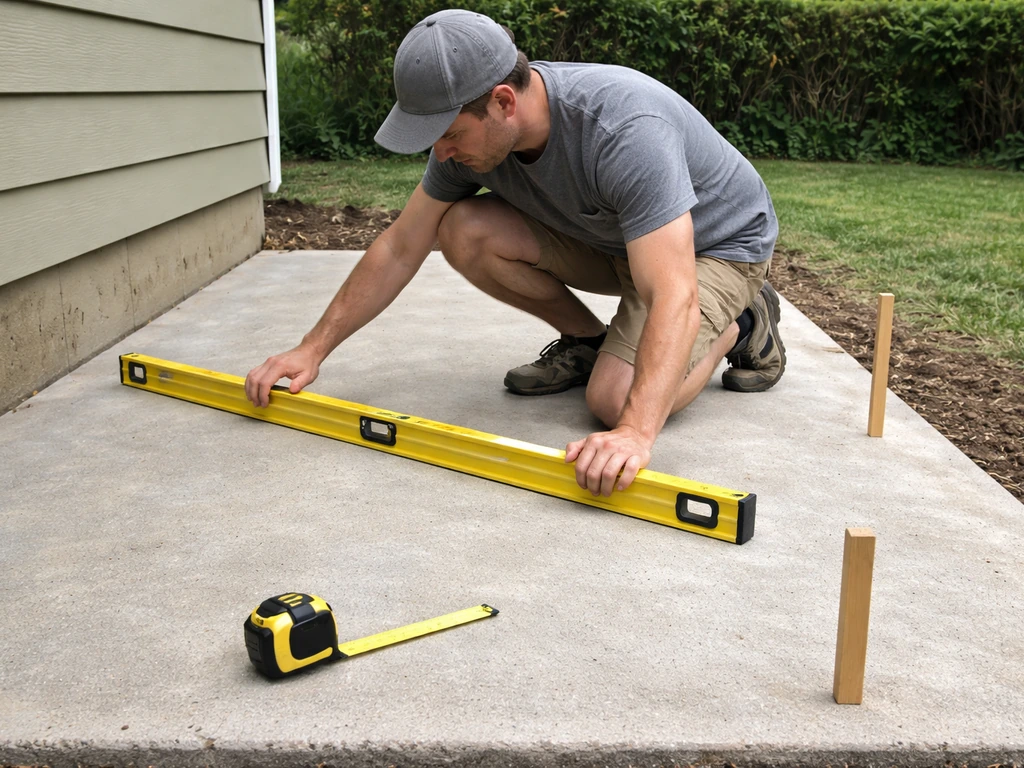
Before you touch anything, find out exactly what you're dealing with. You'll need a long carpenter's level (4-foot or longer), a tape measure, and optionally some stakes and mason's string. A laser level makes this easier and more accurate, but it's not required.
- Drive two stakes into the ground: one at the house end of the patio and one at the outer edge. Connect them with a taut string line.
- Use a line level or small bubble level on the string to make the string perfectly horizontal.
- Measure the vertical distance from the string down to the patio surface at the outer edge. That's your drop.
- Divide the drop (in inches) by the total length of the patio (in feet). If you get 0.25 or higher, you're at or above the 2% target.
- If the string has to go up at the outer end to stay level (meaning the patio surface is higher at the far edge than at the house), your patio is sloping toward the house.
For a quick example: a 12-foot-deep patio needs at least 3 inches of total drop from the house to the outer edge to hit the 2% minimum (12 ft x 0.25 in = 3 in). A hose test is also revealing: run water onto the patio near the house and watch where it flows. If it consistently heads toward the foundation, you have a drainage problem regardless of what the numbers say.
How to fix a patio that slopes toward the house
Your fix depends on whether you have a paver patio or a poured concrete slab. Pavers are much easier to re-slope because you can lift and relay them. Concrete is harder and usually means either living with an added drainage channel or replacing the slab entirely. Here's how to approach each. Whether you need a gap between the patio and the house depends on your drainage plan and how the surfaces meet over time gap between patio and house.
Re-sloping a paver patio
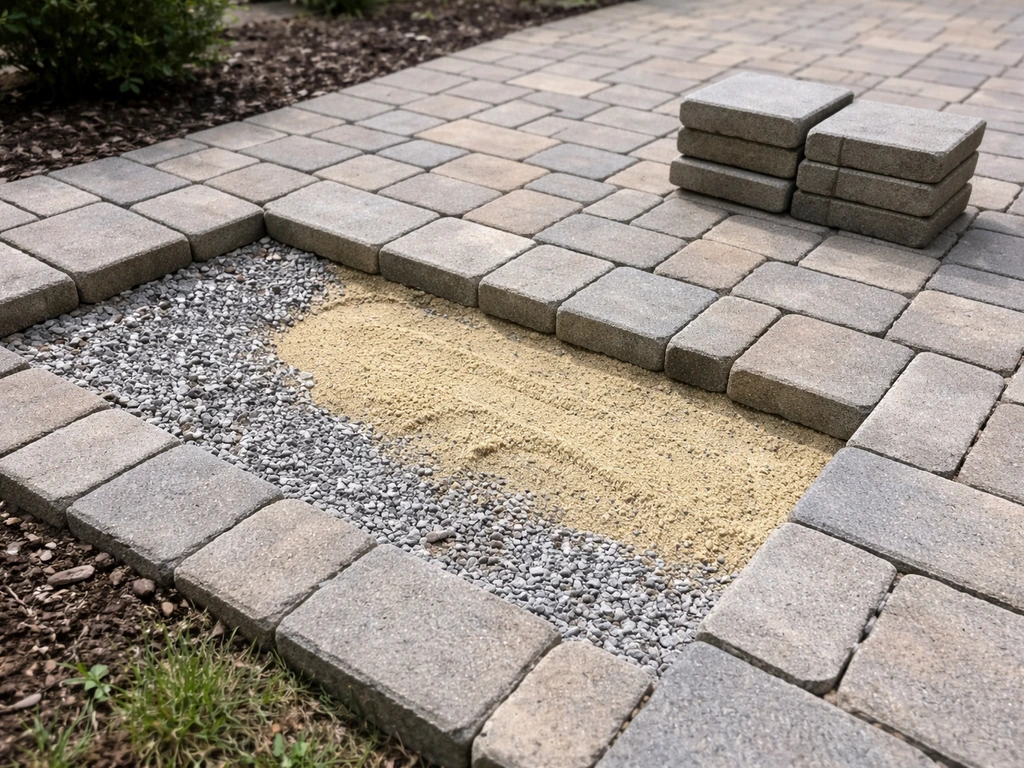
- Remove the pavers in the affected area and stack them safely nearby. Mark their layout if the pattern is complex.
- Pull up the bedding sand and inspect the compacted gravel base underneath. Check whether the base itself is causing the slope problem or if it's just the sand layer.
- If the base is tilted toward the house, you'll need to remove and re-grade it. Add or remove base material to create the correct slope, then compact it in 4- to 6-inch lifts using a plate compactor.
- Once the base is correctly sloped and compacted, screed a fresh 1- to 1.5-inch layer of bedding sand to the target grade. Use slope-set screed rails set to your calculated drop per foot.
- Relay the pavers, compact them with the plate compactor (use a rubber pad to protect paver faces), sweep polymeric sand into the joints, and compact once more.
- Check the finished slope with your string line or level before calling it done.
Fixing a concrete slab that drains toward the house
Concrete is less forgiving. If the slab is structurally sound with no active cracks or soft spots, you have two realistic options: grind the high side down (requires a concrete grinder, usually a rental or pro job), or install a linear drain channel at the base of the house wall to intercept water before it reaches the foundation. The channel approach is often more practical and less expensive than regrinding or demolishing a slab. Do not apply a resurfacing overlay to a slab with drainage problems, as it won't fix the underlying slope issue and the overlay will fail over time if the subgrade is unstable.
Adding a drainage channel as a supplemental fix
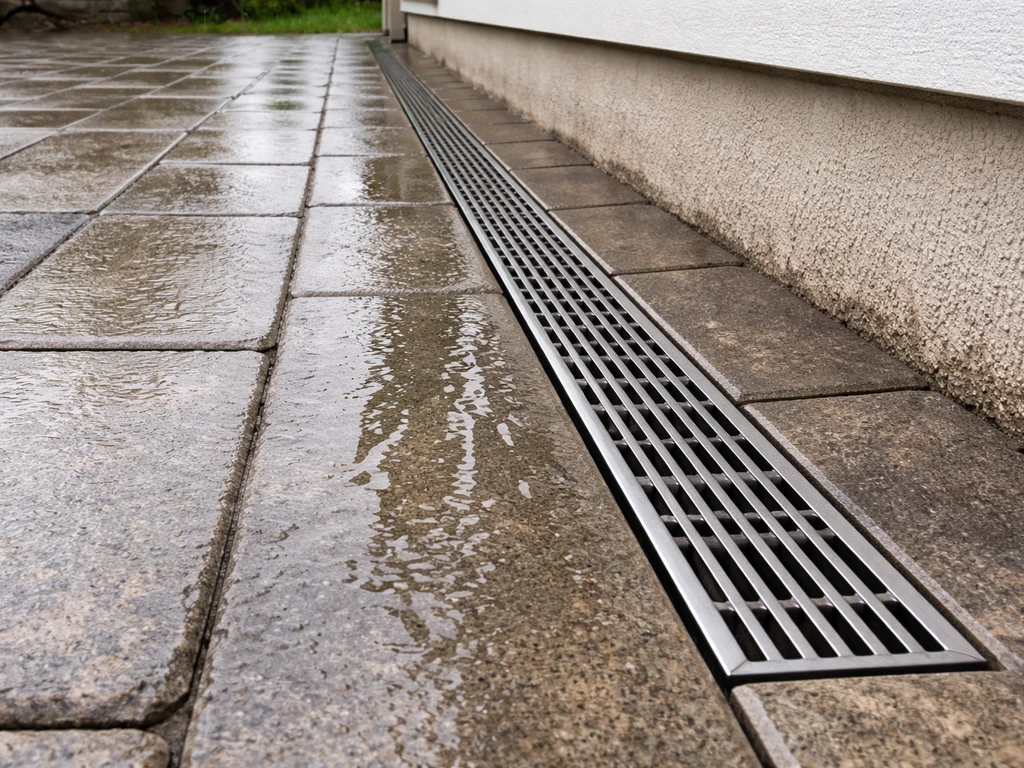
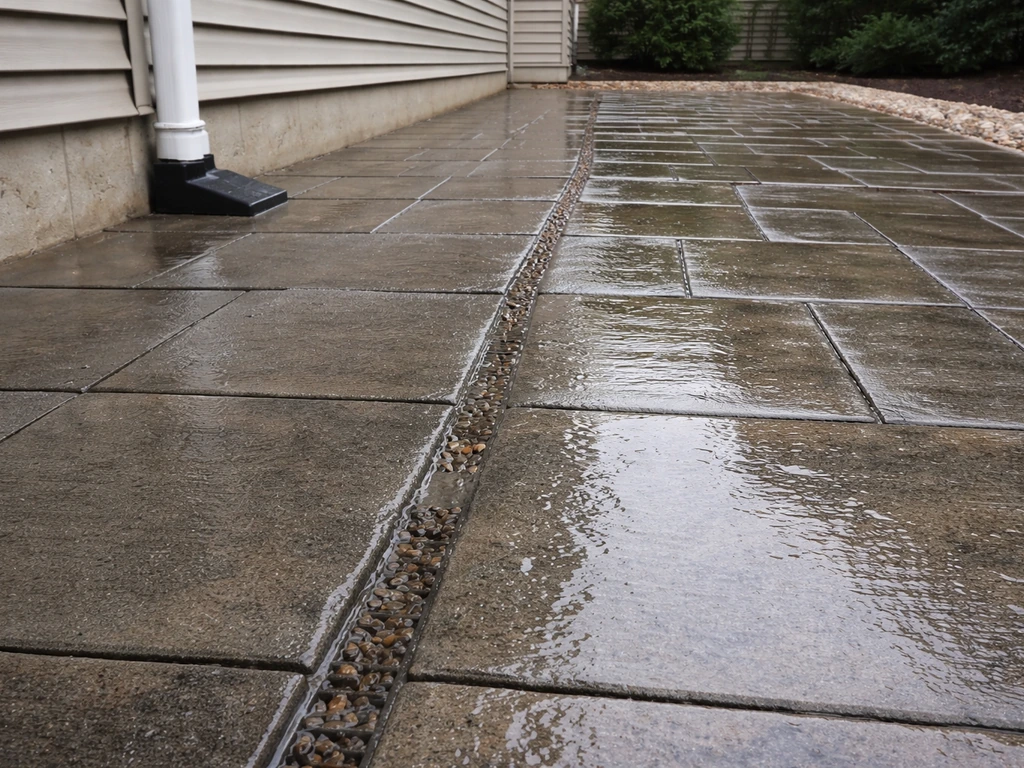
A slot drain or linear channel drain installed along the house-side edge of the patio catches water before it reaches the foundation. These are especially useful when a full slope correction isn't feasible. The drain connects to a pipe that routes water to a drywell, a storm sewer connection, or a discharge point in the yard. Make sure the discharge point actually has somewhere to go, because a drain that terminates against another obstruction just moves the problem.
Tools, materials, and base prep you'll need
Getting the slope right permanently depends almost entirely on what's underneath the pavers or slab. If Yolanda is building a patio in her backyard, plan the slope from day one so water runs away from the house instead of toward the foundation. A properly prepared base won't settle unevenly or shift the surface back toward the house over time. Many installers also recommend using blank" rel="noopener noreferrer">geotextile or equivalent filtration fabric beneath the base to help prevent contaminated subgrade soil from migrating into the paver base. PaverSupply.com’s installation instructions emphasize base preparation steps like using geotextile if needed and installing bedding sand over the prepared base, which supports proper paver drainage performance PaverSupply.com Installation Instructions.
- Plate compactor (rental, around $60–$100/day): essential for compacting base material in lifts; hand tamping is not adequate for a full re-do
- Crushed gravel base (typically 3/4-inch crushed stone): 6 to 8 inches deep for pedestrian patios, compacted in 4-inch lifts
- Coarse bedding sand (concrete sand or ASTM C33): 1 to 1.5 inches screeded to slope; do not use pea gravel or stone dust as a bedding layer
- Geotextile landscape fabric: placed between subgrade soil and gravel base to prevent soil migration into the base over time
- Edge restraints with steel spike anchors: lock pavers at the perimeter and prevent lateral spreading that can disrupt slope over time
- Mason's string and line level or laser level: for setting and verifying slope during installation
- Tape measure and chalk line: layout and measurement
- Polymeric jointing sand: final joint fill that resists washout and weed growth
Mistakes that send water toward your foundation
Most drainage problems with patios aren't random. They come from a handful of repeatable mistakes, and knowing them helps you avoid them the first time and recognize them in an existing patio.
- Insufficient slope: building the patio essentially flat (under 1%) because it 'looks level' to the eye. Water finds even tiny depressions and pools there. Always set slope by measurement, not by sight.
- Uneven base compaction: if one part of the base compacts more than another after installation (especially near the house edge where excavation is shallowest), pavers settle unevenly and the slope can reverse over time.
- No downstream discharge route: sloping the patio correctly but allowing water to pool against a fence, planter, or grade change at the far edge creates a backup. Water has to have somewhere to go.
- Contaminated base layers: soil migrating up through an unlined gravel base causes soft spots and uneven settlement. Geotextile fabric between the soil and gravel base prevents this.
- Blocked or missing gutters and downspouts: even a perfectly sloped patio gets overwhelmed if a downspout dumps 6 inches of roof runoff right next to the house. Downspout extensions that discharge at least 4 to 6 feet from the foundation are part of the drainage equation.
- Leaving edge restraints on unstable ground: if edge restraints aren't anchored into compacted base, they shift outward and the paver field loses its shape, which can tilt sections back toward the house.
When this is beyond a DIY fix
Re-sloping a paver patio is a legitimate weekend project for a handy homeowner. But some drainage situations are more complex and pushing through them without professional input can make things significantly worse or create code compliance issues.
Call a contractor or licensed drainage professional if you're dealing with any of the following: the surrounding yard grade is also directing water toward the house (a patio slope fix alone won't help if the whole lot drains inward), there's already visible water damage or efflorescence at the foundation wall, you need to install a footing drain or connect to a storm sewer (usually requires a permit and potentially a licensed plumber or civil contractor), or the site slope exceeds roughly 1 inch per foot (the whole site needs regrading before any patio work makes sense).
On the permit front: IRC R401. 3 and IBC 1804. 4 both set minimum slope requirements for surfaces near foundations. Many jurisdictions treat drainage-altering work as a regulated activity, especially if you're changing grade near the foundation or installing new drainage infrastructure.
Check with your local building department before starting, particularly if you're touching concrete or installing underground drainage. Related decisions about how your patio connects to the house, whether there should be a gap or a sealed joint, and whether the patio can be elevated off the ground on a second level all tie into the same drainage and code picture.
If you plan a carport with patio on top, use the same slope and drainage rules so runoff stays moving away from the foundation.
If your patio currently slopes toward the house and you've already noticed wet basement walls, persistent musty odors, or staining at the foundation, don't wait on a diagnosis. Those are signs that water has already been working its way in, and the patio slope fix is just one piece of a larger water management solution that likely needs a professional assessment. A garage with patio on top needs the same foundation drainage considerations, especially if the upper patio directs water downward toward the house.
FAQ
How can I tell if my patio slope is only slightly wrong or truly directs water into the foundation?
Don’t rely on the patio edge alone. Use a hose test by running water at several points near the house (corners and mid-span) and watch the flow path for 30 to 60 seconds. If water consistently migrates toward foundation joints, corners, or the wall base even when the patio “looks mostly flat,” treat it as a functional problem, not just a measurement issue.
Does a gap between the patio and the house prevent water from reaching the foundation?
A gap helps only if it is part of a deliberate drainage plan. If runoff can still move through the gap, or if the patio is pitched toward the house, the gap may simply channel water onto the foundation wall or into cracks. The joint detail must work with the slope and any drain interception at the base.
Can I fix a paver patio slope by just adding more sand or leveling the pavers?
Sometimes, but only if the base can support the needed total drop without creating instability. If the underlying base was compacted unevenly or shifted, adding sand often leads to new low spots or settling that reverses the slope again. If you see rocking pavers or recurring low areas after re-leveling, you likely need base correction.
What if my patio is already at the minimum 2% but the yard around it slopes toward the house?
In that case, the patio slope fix may not solve the root issue. Water coming from higher ground or inward yard grading can overwhelm the patio and push water back toward the foundation, even if the patio itself is pitched correctly. You may need to regrade the surrounding site, add a swale, or improve downspout and surface drainage.
Is it safe to rely on rain gutters and downspouts to handle the runoff instead of changing the patio slope?
Downspouts help, but they do not replace foundation-surface slope requirements. If the patio is pitched toward the house, water from irrigation, surface runoff, and gutter overflow during heavy storms can still reach the foundation. Ensure downspout discharge is routed away at a discharge point that truly has drainage capacity.
If my patio slopes toward the house, should I apply a resurfacing coating to stop water?
Not as a primary fix. Many coatings or overlays can fail if the underlying issue is drainage and the slab or base remains pitched toward the foundation, because water is still being driven under or through edges and joints. For poured concrete, consider grind-down on the high side or add a linear drain approach if structural changes are not feasible.
What does it mean if I see efflorescence but my basement is not actively leaking?
Efflorescence often indicates moisture migration through or around the foundation materials, even if the water level is low or intermittent. If the white deposits appear after rain or along the patio-facing wall, it’s a warning sign that surface water is getting involved, and the patio drainage correction should be treated as urgent even before a major leak shows up.
When is a linear drain channel at the base of the wall the better option than regrading the slab or redoing pavers?
A linear drain is often preferable when the total slope correction requires too much removal or when the slab is structurally sound with no major settlement. It is also useful when you cannot achieve the full required pitch due to site constraints. The key is routing the drain to a proper outlet, not just ending it near another obstruction.
How do I know when the slope issue is bigger than the patio and requires regrading the whole site?
If you measure the yard and see inward drainage toward the house, or if a hose test shows water moving toward the foundation from multiple directions, the patio may be only one symptom. Also consider calling for help if your overall site slope is steep enough that simple patio re-surfacing would require unrealistic thickness changes or would move the problem elsewhere.
Do I need a permit if I’m only fixing patio slope or adding a drain to manage runoff?
Often yes, especially when underground drainage, footing drains, or grade changes near the foundation are involved. Even small drainage-altering projects can be regulated locally. Before starting, check with your building department about permits for drain installation, connections to storm systems, and any work that changes grade.
How should I plan drainage for an elevated patio above a garage or second floor?
Elevated patios still require controlling where water goes after it rains. You need to ensure the upper waterproofing and penetrations are handled, then coordinate downspout discharge and any vertical drainage pathways so water does not end up landing against the foundation wall below. Use the same slope-away principle for any surfaces that can discharge runoff downward.
What are common mistakes that make a re-slope fail after a year or two?
The most frequent causes are an inadequate or inconsistent base, insufficient compaction leading to settling, and re-leveling only the surface layer without correcting the underlying pitch. Another mistake is discharging drainage to a point that fills up or redirects water back toward the foundation, so the “fixed” drainage path becomes blocked over time.
Next Article
Should There Be a Gap Between Patio and House?
Learn when to leave a patio-to-house gap, spacing ranges, flashing details, and factors like freeze-thaw and drainage.