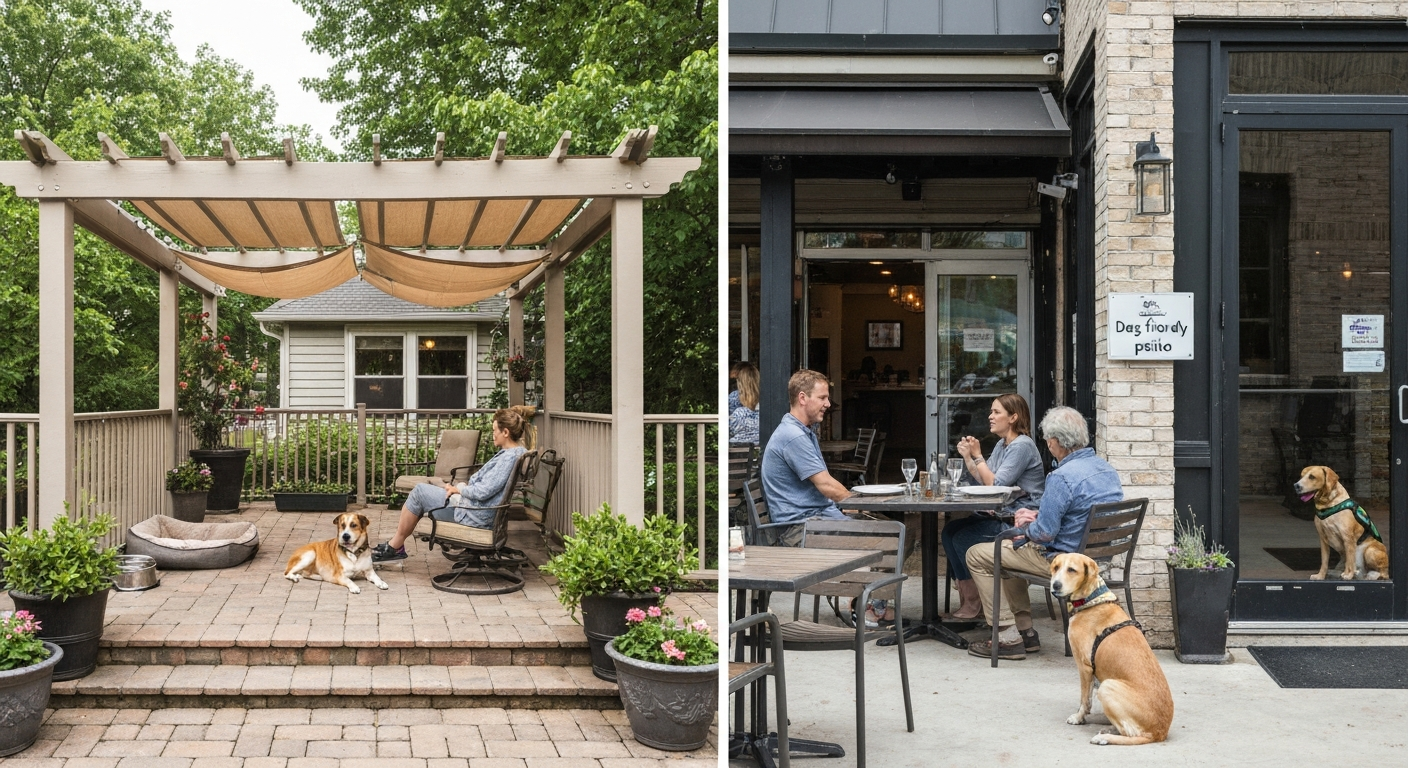
Yes, dogs are generally allowed on residential patios, and in most U.S. states they are also permitted on restaurant outdoor dining patios, provided the business follows local health department rules. The exact answer depends on four things: whether you own or rent, what your HOA or lease says, what your local health codes require, and whether the dog is a pet or a trained service animal. This article walks through every layer of that answer, from federal law down to the practical design and maintenance decisions that make a patio genuinely dog-friendly.
Are Dogs Allowed on Patios? Rules, Safety, Design & Tips

Miles Hart
29 Jul 2026
The legal picture at a glance: homeowners, renters and landlords
At the federal level, there is no blanket law that prohibits or specifically permits dogs on patios. What the federal government does regulate is the treatment of assistance animals in housing (under the Fair Housing Act) and the access rights of service animals in public spaces (under the ADA). Outside of those two frameworks, the rules come from state law, local ordinances, HOA covenants, and lease agreements.
For homeowners on their own private property, there is generally no restriction on having your dog on your patio beyond local ordinances covering noise, leash requirements, and waste. You are, however, still bound by any HOA covenants that apply to your property and by nuisance laws if your dog creates problems for neighbors.
For renters, the right to have a dog on a patio is shaped first by the lease, then by the building's pet policy, and finally by local landlord-tenant law. Landlords commonly use a signed pet addendum to permit or restrict pets, set weight or breed limits, and collect pet deposits or fees. See Rental Lease Agreement Guide (includes pet addendum examples), Zillow Rental Manager for sample lease and pet addendum language landlords commonly use Rental Lease Agreement Guide (includes pet addendum examples) — Zillow Rental Manager. A key federal carve-out: under HUD guidance interpreting the Fair Housing Act, landlords must waive pet fees and deposits for approved assistance animals, including emotional support animals, and may not apply breed or weight restrictions to those animals.
For landlords, the practical obligation is to have a clear written pet policy, process any assistance-animal accommodation request separately from standard pet applications, and document the decision either way. HUD issued detailed guidance on January 28, 2020 (and supporting fact sheets) reinforcing that assistance-animal requests must be evaluated on a case-by-case basis and that fees cannot be charged for approved assistance animals.
HOA rules and covenants: what your community documents actually say
Homeowners associations can and do regulate pets on patios, balconies, and common areas. The rules typically appear in the Declaration of Covenants, Conditions, and Restrictions (CC&Rs), in a separate pet policy resolution, or in the community's rules and regulations document. Common HOA restrictions include leash requirements within the community, limits on the number of pets per unit, breed or weight restrictions, requirements to clean up waste immediately, and prohibitions on leaving dogs unattended on patios or balconies.
Where HOA rules intersect with federal law, the FHA wins. An HOA cannot enforce a 'no pets' policy to deny a resident with a documented disability the right to keep an assistance animal. Industry guidance from the Community Associations Institute advises associations to engage the resident, document the accommodation process, and grant the request unless a specific undue burden or direct threat can be demonstrated. In California, the Davis-Stirling Civil Code framework reinforces this: blanket no-pet rules cannot be applied to qualifying assistance animals.
If you are buying into an HOA community with a dog, pull the CC&Rs before closing. Look specifically for language about patios and outdoor spaces, not just interior pet rules. Some HOAs restrict patio modifications such as adding a dog run, fencing, or a pet door, which matters a lot if you are planning any of the enclosure upgrades discussed later in this article.
Lease clauses, renter rights and negotiating pet permissions
A lease that says 'no pets' typically means no pets on the patio either, since the patio is part of the leased premises. Before assuming you cannot bring your dog outside, read the lease carefully: some leases prohibit pets in the unit but are silent about outdoor common areas or private patio spaces. That gap can sometimes be negotiated.
Negotiating pet permissions is more common than renters think. Landlords are often willing to add a pet addendum that specifies where the pet may be kept, requires renter's insurance covering pet liability, and sets a pet deposit or monthly pet fee. Many states cap how much a landlord can collect as a security deposit, and some distinguish refundable deposits from non-refundable pet fees, so check your state's landlord-tenant statutes before agreeing to terms.
For renters with an assistance animal: the FHA requires landlords to consider a reasonable accommodation request even in a no-pet building. You do not need to pay a pet deposit or fee for an approved assistance animal, and the landlord cannot reject the request simply because of a blanket no-pet policy. What a landlord can do is ask for documentation verifying the disability-related need when the disability is not obvious. They cannot require a specific form, demand medical records, or charge a fee for processing the request.
Local laws: leash rules, tethering limits, noise and public spaces
Even on your own patio, local ordinances apply. Most municipalities require dogs to be on a leash or in a contained space whenever they are not inside a structure. Some cities have tethering ordinances that restrict how long a dog can be tied up outside, the type of tether permitted, and minimum shade and water requirements. Many of these laws apply to patios just as they do to yards.
Noise ordinances are the most common source of neighbor complaints related to dogs on patios. If your dog barks persistently, most cities treat that as a nuisance, and complaints can result in warnings, fines, or even an order to keep the dog indoors. Some jurisdictions define excessive barking as more than 10 to 15 minutes of continuous barking or intermittent barking for more than 30 minutes.
For public spaces like parks with patio seating or outdoor event venues, dogs are generally permitted only if the space is explicitly designated as dog-friendly or if the venue has its own policy allowing them. Leash rules apply universally in public spaces unless you are in a marked off-leash area.
Restaurant patios: health codes, state rules and what managers need to know
This is where the rules get genuinely complicated, because they vary by state and even by county. The FDA's 2017 Food Code, which serves as a model that states and localities adopt, prohibits live animals on food-establishment premises with specific exceptions. Those exceptions include service animals, patrol dogs, and certain fish. Under the base model code, a customer's pet dog is not permitted on a restaurant patio.
However, many states have passed statutes or regulations that create a specific carve-out allowing restaurants to permit patron dogs in outdoor dining areas, provided the establishment meets conditions and often notifies or obtains approval from the local health authority. Texas, Maryland, Virginia, and Washington state are all examples of jurisdictions with explicit rules on this. Maryland's regulation (COMAR 10.15.03.23) requires the restaurant owner to notify the local health department and meet conditions covering cleaning procedures, physical separation from food prep areas, posted signage, and owner control of the dog. King County, Washington and Larimer County, Colorado publish application templates and plan requirements specifically for restaurants wanting to permit patron dogs on patios.
The practical checklist for a restaurant manager considering a dog-friendly patio policy looks like this:
- Check your state's food code adoption and whether a dog-on-patio carve-out exists at the state or county level.
- Contact your local health department before advertising a dog-friendly policy; some jurisdictions require a written application or plan approval.
- Ensure the outdoor dining area is physically separated from food preparation and storage areas.
- Create a written cleaning and sanitation protocol for the patio.
- Post clear signage indicating dogs are permitted and stating owner responsibilities (leash, behavior, waste).
- Train staff on the policy, including how to handle service animal questions separately.
- Verify your general liability insurance covers incidents involving patron animals.
ADA and service animals: rules every restaurant and property owner must follow
Under Titles II and III of the ADA, public accommodations, including restaurants, hotels, retail stores, and government buildings, must permit service animals to accompany people with disabilities in any area open to the public. This applies to patios. A restaurant that allows customers on its outdoor patio must permit a customer's service animal on that patio, even if the restaurant otherwise has a no-pets policy.
Staff may ask only two questions when it is not obvious what service the animal provides: (1) Is this a service animal required because of a disability? and (2) What work or task has the dog been trained to perform? They cannot ask about the nature or extent of the person's disability, require documentation or certification, or charge a deposit or surcharge. The DOJ has enforced this repeatedly, including cases where businesses moved customers with service animals to patios instead of seating them inside, which can itself constitute a violation if the motivation is to exclude or segregate. See the DOJ Settlement Agreement, When Pigs Fly Barbeque Pit (DOJ archive) documenting a case where the restaurant revised policies and trained staff after refusing indoor access and moving a customer with a service animal to a patio Settlement Agreement — When Pigs Fly Barbeque Pit (DOJ archive).
A business may exclude a service animal only if it is out of control and the handler does not take effective action to control it, or if the animal is not housebroken. Fear of animals or a patron's allergy is not sufficient grounds for exclusion, though staff can take steps to seat parties with and without service animals at a distance from each other.
For residential property owners and HOAs, the relevant law is the Fair Housing Act rather than the ADA. The FHA covers assistance animals more broadly than the ADA's narrower service-animal definition, and it includes emotional support animals. A housing provider must consider a reasonable accommodation request for an assistance animal on a case-by-case basis and cannot refuse based solely on a no-pet policy.
Safety and etiquette for dogs on patios
Supervision and behavior
- Never leave a dog unattended on an open or unfenced patio; most escape incidents and neighbor complaints happen when owners step inside briefly.
- Bring a water bowl and refresh it every 30 minutes in warm weather.
- Keep a leash attached even on a private patio if the space is not fully enclosed.
- Remove food scraps from the patio surface immediately to prevent food-guarding behavior toward other dogs or people.
Heat safety
- Concrete and pavers absorb and radiate heat; on a hot summer day a concrete patio surface can exceed 150°F, which is hot enough to burn paw pads in under 60 seconds.
- Test the surface with the back of your hand for 7 seconds before allowing your dog on it; if it is uncomfortable for your hand, it is dangerous for paws.
- Provide shade with a pergola, umbrella, or shade sail; direct sun raises a dog's core temperature much faster than shade.
- Limit time outside when the air temperature exceeds 85°F, especially for brachycephalic breeds (bulldogs, pugs, Boston terriers) and senior dogs.
Furniture and neighbor considerations
- Use furniture with washable, pet-resistant fabric such as Sunbrella or solution-dyed acrylic rather than standard outdoor cushion material.
- Place a dedicated dog mat or bed on the patio so the dog has a clear default spot that is not your seating.
- Be aware of barking noise, especially in the early morning and evening, which are peak noise-complaint windows in most municipalities.
- Pick up waste immediately; in most municipalities, failure to do so on shared or common-area patios carries a fine.
Liability and insurance: what homeowners, landlords and restaurants need to consider
If your dog bites or injures a person or another animal on your patio, you are likely liable under your state's dog bite statute or under general negligence law. Most states use either a strict liability standard (owner is liable regardless of prior knowledge of aggression) or a one-bite rule (owner is liable if they knew or should have known the dog was dangerous). Backyard and patio incidents are not treated differently from street incidents in most jurisdictions.
Homeowners insurance typically includes personal liability coverage that applies to dog bite incidents, but a significant number of policies exclude specific breeds such as pit bulls, Rottweilers, German shepherds, and Dobermans, or exclude dogs with a prior bite history. Review your policy declarations page and contact your insurer before assuming you are covered. Umbrella liability policies are a practical option for dog owners, typically adding $1 million in coverage for around $150 to $300 per year.
For landlords permitting dogs on rental patios, the risk is more complex. Landlord liability for tenant dog bites varies by state, but courts have found landlords liable when they knew a dog was dangerous and failed to act. A well-written pet addendum that documents the tenant's responsibility, requires renters insurance with pet liability coverage, and includes the right to revoke pet privileges with documented cause is strong risk management.
Restaurants permitting patron dogs face premises liability exposure if a dog injures another patron or an employee. General liability insurance for restaurants should be reviewed with the insurer before opening a dog-friendly patio, and the written policy and staff training records serve as documentation of reasonable precautions.
Designing a dog-friendly patio: layout, shade, drainage and furniture
A well-designed dog-friendly patio solves three problems at once: it keeps the dog safe and contained, it keeps the surface cleanable, and it keeps the space comfortable for humans too. The layout decisions matter more than the materials.
Start with shade. A pergola with a shade sail or a solid-roof patio cover over at least one-third of the space gives your dog a place to retreat from direct sun. Positioning a water station near the shaded zone makes it a natural rest area. For larger patios, a dedicated dog zone at one end with its own mat, water bowl, and toy basket keeps the dog from taking over the furniture.
Drainage is the second critical factor. Urine and rinse water need to flow off the surface quickly. A slight slope of at least 1/8 inch per foot toward a drainage edge or channel drain prevents pooling and reduces odor. Permeable paving options like gravel or permeable pavers handle drainage naturally. For enclosed or partially enclosed patios, a floor drain is worth the extra cost.
Furniture choices should favor materials that can be hosed down: powder-coated aluminum or steel frames with Sunbrella-type cushions, or teak and other dense hardwoods that resist moisture. Avoid wicker and rattan because they trap hair and are nearly impossible to sanitize. Keep cushions stored or elevated when the dog is outside unsupervised.
Patio surface comparison: which materials hold up to dogs
| Surface | Durability with Dogs | Heat Retention | Paw Safety | Cleanability | Cost (installed, per sq ft) | Notes |
|---|---|---|---|---|---|---|
| Concrete (brushed or broom finish) | High | Very high | Risk in summer heat; rough texture can abrade paws over time | Easy; hose down, enzymatic cleaner for odors | $6–$12 | Most affordable; seal every 2–3 years to resist urine staining |
| Concrete pavers | High | High | Same heat risk as poured concrete; smooth pavers can be slippery when wet | Easy; joints need periodic weed/odor treatment | $10–$20 | Individual pavers can be replaced if stained or cracked |
| Wood decking (pressure-treated or cedar) | Moderate | Low | Splinters and rough spots are a risk; soft wood scratches easily | Moderate; requires enzymatic cleaner; wood absorbs urine | $15–$25 | Needs sealing or staining annually; urine accelerates wood rot |
| Composite decking | High | Moderate | Smooth surface is generally safe; can get hot in direct sun | Easy; resists staining; hose down | $20–$40 | More UV- and moisture-resistant than wood; no splinters |
| Artificial turf | Moderate | Moderate-high | Soft on paws; excellent for play | Moderate; must rinse frequently; odor builds up without proper backing and drainage | $8–$20 | Infill type matters; antimicrobial infill reduces odor; requires drainage base |
| Natural stone (slate, travertine, flagstone) | Very high | High | Textured surfaces grip well; sharp edges on rough-cut stone can cut paws | Easy to wipe; grout lines trap odor | $15–$35 | Premium look; very durable; seal grout to resist urine penetration |
Deck vs. patio: which is better for dogs?
Both decks and patios can work well for dogs, but they have different trade-offs. A patio sits at or near ground level on a solid surface, which makes it naturally more stable for a dog to walk and run on, easier to drain and clean, and simpler to enclose with low fencing. A deck is elevated on a frame structure, which creates gaps between boards that small dogs can get a paw caught in, an open underside that can attract animals, and a surface that warms faster in sun but also cools faster in shade.
| Factor | Patio | Deck |
|---|---|---|
| Surface stability for dogs | Solid, no gaps | Board gaps risk small paw entrapment |
| Heat retention | Higher (concrete/stone holds heat) | Lower (air circulation underneath cools faster) |
| Cleanability | Easy; drain toward edge or floor drain | Moderate; liquids fall through but odors build in substructure |
| Containment/fencing | Straightforward; low fence on grade | Requires railing system; balusters must be spaced tightly (less than 4 inches) |
| Urine damage | Sealing protects concrete; pavers replaceable | Urine accelerates wood rot; composites resist better |
| Cost to make dog-safe | Lower | Higher (railings, baluster spacing, surface treatment) |
| Enclosure options | More flexible (screened rooms, gates, catio-style) | Possible but more complex structurally |
For most dog owners choosing between the two structures purely on pet suitability, a patio at grade level is the more practical starting point. That said, an elevated deck with a solid composite surface, tight baluster spacing, and a gated staircase can absolutely work. The deck vs. patio decision should also factor in your yard grade, budget, and intended use beyond just pet access.
Containment and enclosure options
Containing a dog on a patio without making the space feel like a prison is one of the more interesting design challenges in outdoor renovation. The options range from simple hardware to full screened enclosures, and the right choice depends on your dog's size, energy level, and tendency to bolt.
Gates and fencing
A freestanding or wall-mounted gate is the simplest solution. Pressure-mounted pet gates rated for large dogs (up to 200 lbs) run about $60 to $150 and work for calm dogs in lower-traffic spaces. For actual perimeter containment, a low fence of 3 to 4 feet works for most medium breeds; high-energy or larger breeds often need 5 to 6 feet. Aluminum or vinyl panel fencing is the most maintenance-friendly option for a patio perimeter. A coyote roller on top of the fence line discourages jumping without making the fence taller.
Pet doors
A pet door installed in a wall, sliding glass door panel, or screen panel gives your dog independent patio access. Electronic pet doors that respond to a chip or collar tag prevent other animals from entering, which is worth the extra $100 to $200 cost if you live in an area with wildlife. Standard panel pet door inserts for sliding doors run $50 to $200 and require no structural modification.
Screened enclosures and catio-style spaces
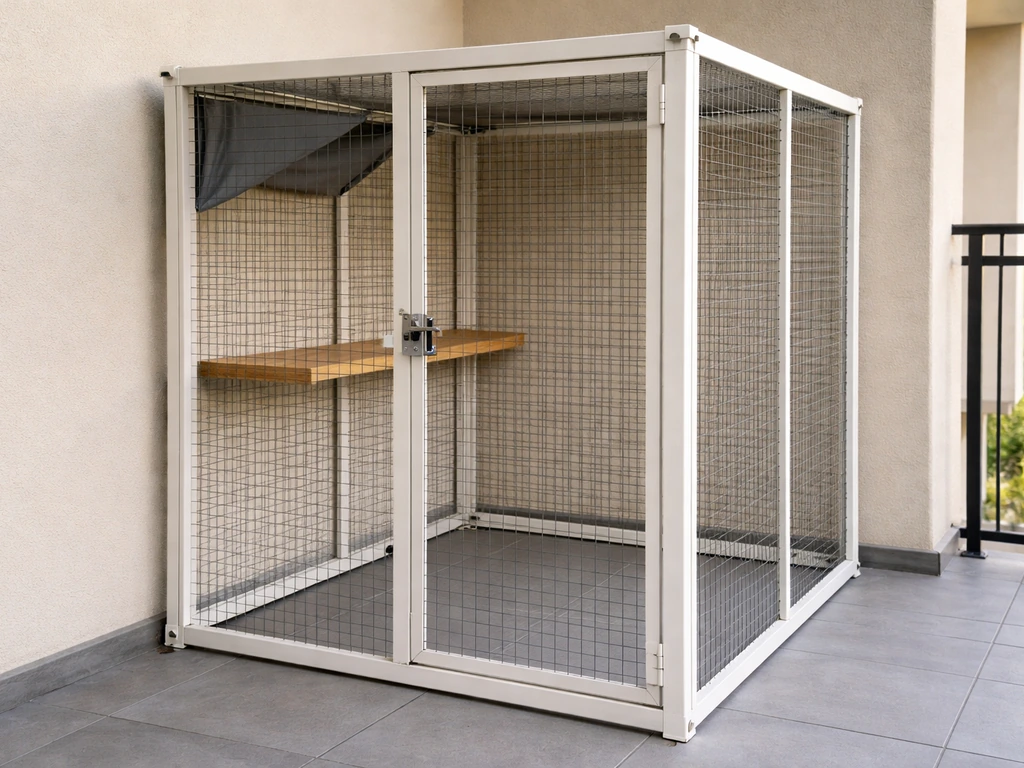
A fully screened patio enclosure eliminates both the escape and the pest problem simultaneously. Screen rooms using aluminum framing and heavy-gauge pet-resistant screen (at least 18x14 mesh, or a heavier pet-grade screen rated for scratching) can be installed on existing concrete patios for about $3,500 to $12,000 depending on size and roof style. These work equally well for dogs and cats, and the same design principles apply whether you are building a dog enclosure or a catio-style structure. For step-by-step cat-specific conversion tips, see how to turn your patio into a catio (fec99aec-4eb3-4e0d-bf8d-2613f57d7d00). For cat-specific guidance, see our guide on how to make your patio cat friendly (resource 04f8b5c6-3c72-4886-9a92-b40e17c6adb4). If you have cats in the mix, the related guides on how to build a catio on a patio and how to enclose a patio for cats cover the finer points of cat-specific containment design, much of which translates directly to multi-pet setups.
Containment examples: what DIY and pro installations look like
A common DIY setup for a standard 12x16 patio: pressure-treated 4x4 posts anchored at the four corners and along the long sides, 2x4 rails at mid-height and top, and welded wire livestock panel (16 gauge, 2x4 mesh openings) stretched between posts and secured with fence staples. Total materials cost runs about $300 to $500 for this size. Add a single gate with a spring latch and you have a contained dog space for under $600 in materials with a weekend's labor.
A mid-tier professional installation typically uses aluminum picket or panel fencing with a powder-coat finish, matching the patio's aesthetic. A 12x16 perimeter in aluminum picket runs about $1,800 to $3,200 installed. For a full screened enclosure, professional installation on a concrete slab adds $4,000 to $10,000 depending on the roof type (flat screen roof vs. insulated solid roof panel vs. polycarbonate).
Image suggestion: A photo of a mid-size dog in a fenced concrete patio enclosure with a shade umbrella, water bowl, and a dedicated dog mat in the corner would illustrate the basic contained-patio concept well here. A second image showing a screened patio room with an aluminum frame would work alongside the enclosure cost discussion.
Maintenance and cleaning: keeping a dog-friendly patio actually clean
Daily and weekly tasks
- Pick up waste immediately every time; do not leave it for a later sweep.
- Rinse the waste area with water after pickup to dilute urine concentration.
- Wipe down furniture surfaces the dog has contact with using a pet-safe cleaner (look for enzymatic formulas that break down urine proteins rather than just masking odor).
- Check for and remove any food scraps, bones, or chews left on the surface.
Monthly deep cleaning
- Scrub the patio surface with an enzymatic cleaner diluted per label directions; let it sit for 10 minutes before rinsing.
- Inspect joints between pavers or stone for odor buildup; apply a joint-safe enzymatic product and re-sand if needed.
- Wash removable furniture cushion covers on the hot cycle.
- Check the pet door seal and screen for damage.
Safe cleaner choices
- Enzymatic cleaners (Nature's Miracle, Rocco & Roxie): safe for sealed concrete, pavers, and composite; avoid on unsealed natural stone.
- Diluted white vinegar (1: 1 with water): effective on sealed concrete for routine rinse; do not use on natural stone as it etches the surface.
- Oxygen bleach (OxiClean powder, diluted): effective on stubborn organic stains on concrete; rinse thoroughly and keep pets off until dry.
- Avoid chlorine bleach near pets: fumes are irritating and residue on paws is a toxin risk.
Pest prevention
- Remove standing water within 30 minutes of rain or rinsing; mosquitoes can breed in small amounts of water in a water bowl left overnight.
- Store pet food inside, not on the patio.
- Apply food-grade diatomaceous earth around the perimeter base of fencing to deter fleas and ants without chemical toxicity risk to dogs.
- Treat the dog for fleas and ticks on the schedule your vet recommends; the patio is a primary exposure zone.
Cost breakdown and DIY upgrade options
| Budget Tier | What It Covers | Approximate Cost | DIY Feasibility |
|---|---|---|---|
| Low ($100–$500) | Pressure-mounted gate or freestanding pet panel fence, water bowl station, shade umbrella, enzymatic cleaner kit | $100–$500 | Fully DIY; no tools or permits required |
| Mid ($500–$3,000) | Welded wire or aluminum picket fence perimeter with gate, pet door insert in screen or slider, dedicated shade sail with anchor posts | $500–$3,000 | Mostly DIY; fence post setting and pet door install manageable for intermediate skill level |
| High ($3,000–$12,000+) | Full screened patio enclosure with aluminum framing and pet-grade screen or solid roof panels, floor drain addition, composite or paver resurfacing with slope correction | $3,000–$12,000+ | Professional install recommended for screened room framing and drainage; some surface prep is DIY-able |
Most homeowners start at the low tier with a gate and shade setup, find that works for a year or two, and then invest in permanent fencing when they realize containment is an ongoing issue. Jumping straight to the high tier makes more sense if you are doing a broader patio renovation anyway, since adding a drain and surface slope correction to a new concrete pour costs far less than retrofitting an existing slab.
Decision checklist and next steps
For homeowners
- Check your HOA's CC&Rs and pet policy for any restrictions on patio modifications or dog use of outdoor spaces.
- Review your homeowners insurance policy for dog breed exclusions and consider an umbrella policy.
- Check local ordinances for leash, tethering, noise, and waste rules specific to your municipality.
- Evaluate your current patio surface for heat risk and cleanability; plan surface improvements before warm weather.
- Decide on a containment level (gate, fence, or screened enclosure) based on your dog's size and behavior.
- If you are adding a fence or screened enclosure, check whether a permit is required (most municipalities require a permit for fences over 4–6 feet or enclosed structures over a certain square footage).
For renters
- Read your lease carefully for pet clauses covering outdoor spaces, not just interior units.
- Request a pet addendum in writing before bringing a dog onto the patio.
- If you have an assistance animal, submit a written reasonable accommodation request; you are not required to pay a pet deposit.
- Avoid permanent modifications (fence post holes, pet door cut-outs) without written landlord approval.
For restaurant managers
- Contact your local health department before advertising a dog-friendly patio.
- Obtain or document approval in writing; some jurisdictions require a formal plan review.
- Draft a written patio pet policy, post it at the entrance, and train all front-of-house staff.
- Review your general liability policy with your insurer.
- Train staff on the two-question ADA protocol for service animals.
Sample policy language and rules templates
HOA pet and patio policy (sample language)
"Residents may keep dogs on their private patio or balcony only when the resident or an authorized adult is present. Dogs must remain on a leash or within a secured fencing enclosure at all times while on the patio. Persistent barking that constitutes a nuisance under local ordinance is prohibited. Waste must be removed immediately. Patio fencing or enclosures must be approved by the Architectural Review Committee prior to installation and must not exceed [height] feet. Nothing in this policy limits the Association's obligation to consider reasonable accommodation requests for assistance animals under the Fair Housing Act."
Lease pet addendum (sample language)
"Tenant is permitted to keep one dog not exceeding [X] pounds at the premises, including the private patio area. Tenant agrees to: (1) keep the dog on a leash or in a secured area at all times on the patio; (2) clean up waste immediately; (3) maintain renter's insurance with no less than $100,000 in personal liability coverage naming the Landlord as an additional interested party; (4) pay a refundable pet deposit of $[X] and a monthly pet fee of $[X]. Tenant acknowledges that persistent noise, property damage, or complaints from neighbors may result in revocation of pet privileges with [X] days' notice. This addendum does not apply to assistance animals approved under a separate written accommodation request."
Restaurant dog-friendly patio policy (sample posted notice)
"Leashed, well-behaved dogs are welcome on our outdoor patio. Dogs must remain on a leash no longer than 6 feet at all times. Dogs may not be tied to furniture or left unattended. Owners are responsible for their dog's behavior and any damage caused. Dogs are not permitted inside the restaurant. Service animals are welcome in all areas. We reserve the right to ask any dog to leave if it poses a safety or disturbance risk to other guests or staff."
Image placement suggestions
- After the design section: overhead diagram or photo of a patio layout showing a shaded rest zone, water station, and defined dog area separate from seating.
- Alongside the surface comparison table: close-up photos of concrete, pavers, composite decking, and artificial turf showing texture and color for context.
- After the containment section: side-by-side images of a low-budget welded wire enclosure and a finished aluminum picket fence enclosure to show the visual range of DIY vs. pro installations.
- Near the ADA section: a clear, calm image of a service dog resting under a restaurant patio table to anchor the policy discussion visually.
Related guides for cat owners and multi-pet households
If your household includes cats as well as dogs, many of the enclosure and design principles in this article apply directly. Screened patio enclosures, in particular, work well for both species, though the mesh gauge and gap sizes matter more for cats. The guides on how to build a catio on a patio and how to enclose a patio for cats go deep on the structural and material specifics for feline containment. For apartment renters managing an outdoor space, the guide on how to build a cat enclosure on an apartment patio addresses the modification-limitation challenge that renters with any pet face. See the guide 'How to build a cat enclosure on an apartment patio' for renter-friendly, step-by-step options to enclose outdoor space without permanent alterations how to build a cat enclosure on apartment patio. And if you are starting from a completely open space, how to build a cat patio and how to make your patio cat friendly cover the layout and plant-safety decisions that cross over well to dog-friendly design. Finally, how to turn your patio into a catio walks through full conversion projects that can be adapted for mixed-pet households. For another relevant comparison, see how to build a catio on a patio.
Where to confirm local rules and get professional help
For homeowners and renters, the starting points are your local municipality's code enforcement office (for fence permit requirements and local ordinances) and your state's department of housing (for landlord-tenant rules on pet deposits and assistance animals). For restaurant owners and managers, the local health department is the single most important contact: call before you open a dog-friendly patio, not after a complaint.
For ADA and Fair Housing Act questions, ADA.gov and HUD.gov both publish free guidance documents and have technical assistance lines. If you receive or need to make a reasonable accommodation request for an assistance animal, an attorney who specializes in housing law can review the documentation requirements for your state, which vary more than the federal baseline suggests.
For design and construction, a local licensed contractor who does patio enclosures can pull permits, confirm setback requirements, and handle the drainage and framing work that is genuinely difficult to DIY. Getting two or three bids and asking specifically about pet-safe surface slopes and drainage is worth the time before you commit to a layout.
FAQ
Are dogs allowed on patios?
Short answer: It depends. For private patios (single‑family homes) homeowners can usually allow dogs. For rental units, HOAs, and public/commercial patios (restaurants, bars) the rules depend on leases, association rules, local health codes, and disability‑access law. Service animals and approved assistance animals have special protections that generally allow them in areas open to the public or used by tenants, even when pets are otherwise restricted.
What laws protect service animals and assistance animals on patios?
Service animals (trained to perform tasks for a person with a disability) are protected under the ADA and must be allowed in public accommodations, including areas open to customers; businesses generally may only ask two questions about the animal and may not charge a deposit. In housing, the Fair Housing Act (HUD) requires landlords and associations to consider reasonable‑accommodation requests for assistance animals and usually prohibits charging pet fees or deposits for them.
Can restaurants let customers bring dogs onto outdoor patios?
Many states/localities allow restaurants to permit customer dogs on outdoor dining patios if the establishment follows local public‑health requirements (separation from food prep, cleaning protocols, signage, and possibly prior approval). However, the FDA Food Code (and many jurisdictions that adopt it) forbids live animals on food‑establishment premises except for enumerated exceptions (service animals, service animals-in-training, display fish, patrol animals). Check your local health department rules before allowing dogs.
What should landlords and tenants know about dogs on rental patios?
Lease language and pet addenda control most renter situations. Landlords may permit or prohibit pets, set size/breed rules, and collect deposits/fees—but must process assistance‑animal requests under FHA rules and usually waive pet fees for approved assistance animals. Tenants should request reasonable accommodations in writing when an animal is for disability‑related need. Document approvals/conditions to avoid disputes.
How do HOAs and condo associations handle dogs on patios/balconies?
HOAs can set rules about pets, patio use, and balcony enclosures, but they must process assistance‑animal accommodation requests rather than applying blanket bans. Associations should follow a documented interactive process, allow reasonable accommodations unless there’s an undue burden or direct threat, and adopt clear written policies and signage for common‑area patios.
What safety and etiquette rules should businesses and homeowners follow for patio dogs?
Basic practices: require animals to be leashed/under control, vaccinated and non‑aggressive; maintain owner supervision; keep animals off serving counters and food‑prep areas; post clear signage; provide waste‑disposal stations and frequent cleaning; separate pet seating from kids’ play areas when possible. For businesses, train staff on handling animal incidents and ADA obligations.
Next Article
How to Build a Cat Enclosure on an Apartment Patio
Step-by-step guide to build an escape-proof patio catio: planning, anchoring, materials, weatherproofing, costs, and saf