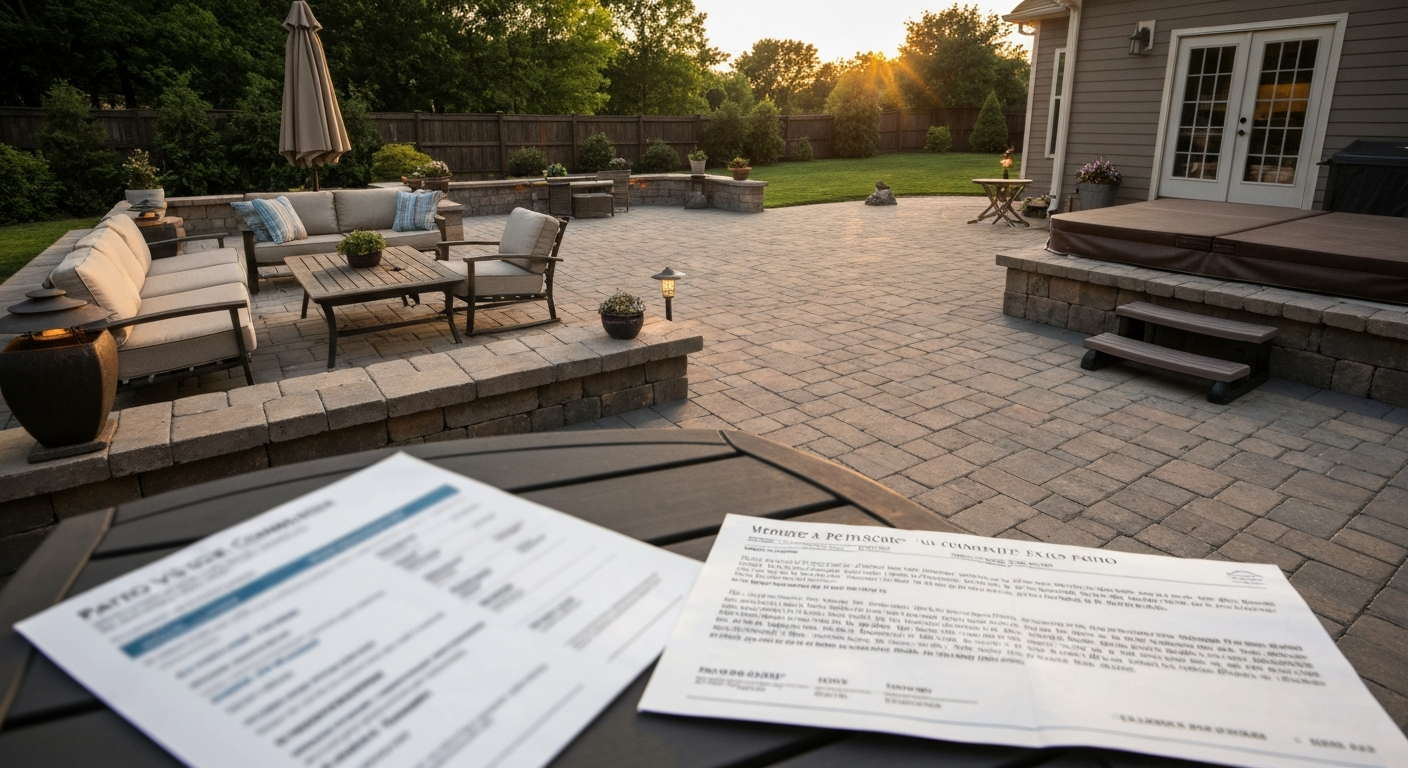
Most standard concrete patios can support a small to medium hot tub if the slab is at least 4 inches thick, properly reinforced, and sitting on a well-compacted base. The problem is that most homeowners have no idea what's under their patio, and a filled 6-person hot tub can weigh 5,000 pounds or more. Before you order a tub, you need to know your slab thickness, what's underneath it, and what the numbers actually say about load. This article walks you through the math, the inspection, and your realistic options if the patio doesn't pass the test.
Will My Patio Support a Hot Tub? Safe Checklist & Fixes

Miles Hart
21 Jul 2026
Quick answer and risk summary
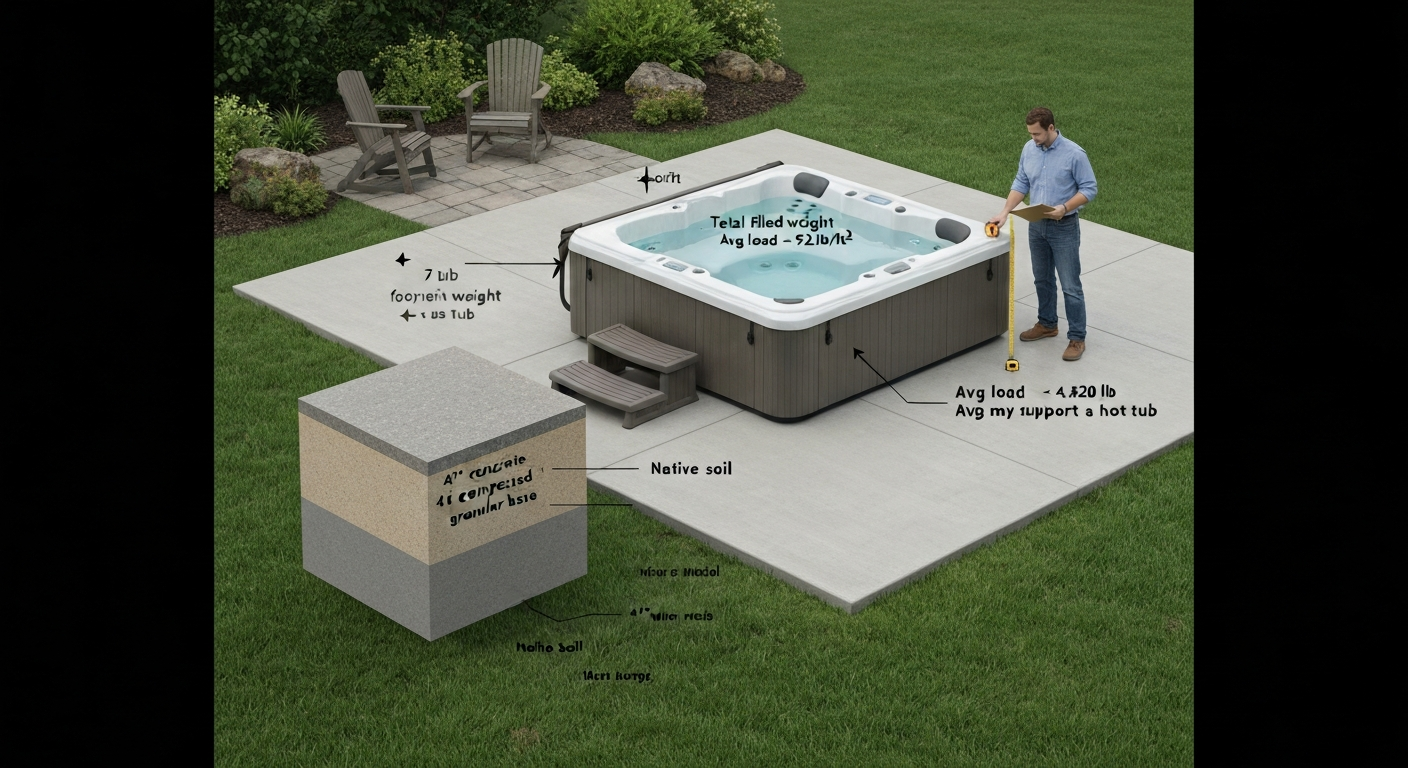
A concrete slab patio that is 4 inches thick with rebar or wire mesh reinforcement, sitting on 4 or more inches of compacted granular base, is generally adequate for a compact 2-3 person hot tub. Anything larger, heavier, or sitting on a questionable base pushes you into 'needs work' or 'get an engineer' territory fast. Pavers over a sand or gravel base, compacted gravel patios, and block or pier systems all carry real risk for a filled hot tub because none of them are structural slabs. The table below summarizes the risk picture by patio type before we get into the details.
| Patio Type | Typical Capacity | Hot Tub Risk Level | Professional Review Needed? |
|---|---|---|---|
| 4" reinforced concrete slab on compacted base | High (often 100+ psf) | Low to moderate | For tubs over 4,500 lb filled weight |
| 4" plain (unreinforced) concrete slab | Moderate | Moderate | Yes, for any large tub |
| Pavers over compacted aggregate base | Low to moderate | High | Yes, before any hot tub |
| Compacted gravel only | Low | Very high | Yes, always |
| Block or pier system | Variable, often unknown | High | Yes, always |
The single biggest risk isn't the slab cracking under static load. It's differential settlement, where one part of the patio sinks more than another because the base underneath wasn't compacted evenly or the soil beneath has varying bearing capacity. A hot tub is rigid. If the pad under it settles unevenly, the tub shell can crack, the plumbing can fail, and you can end up with a very expensive problem. That's the risk you're really managing here.
How hot tubs load a patio: weight, footprint, psf, and point loads
Hot tubs are heavy in a way that's different from patio furniture or a gas grill. The weight is large, concentrated, and permanent. To understand whether your patio can handle it, you need to think in terms of three numbers: total filled weight, footprint area, and pounds per square foot (psf).
Total filled weight is calculated as: (water capacity in gallons x 8.34 lb/gal) + dry tub weight + occupant weight. A 1 gallon of water weighs 8.34 pounds, so water alone in a 400-gallon tub weighs about 3,336 pounds before you add the shell, the equipment, or a single person. For typical tubs by size, the filled weight ranges are substantial:
| Tub Size | Typical Water Capacity | Approximate Filled Weight (tub + water + occupants) |
|---|---|---|
| 2-3 person compact | 150-250 gallons | 1,500-2,800 lb |
| 4 person | 250-350 gallons | 2,500-4,000 lb |
| 5-6 person | 350-450 gallons | 4,000-5,500 lb |
| 7-8 person large | 450-600+ gallons | 5,500-7,500+ lb |
The footprint is just the outer dimensions of the tub's base, typically expressed in square feet. Once you have total filled weight and footprint, you divide weight by area to get psf (pounds per square foot). This is the number you compare against your slab's capacity or published load ratings. Some hot tub manufacturers also publish a 'dead weight' figure in lb/ft2 directly on their spec sheets, which is exactly this number and makes the comparison straightforward. For reference, Hot Spring lists dead weight values of approximately 100-125 lb/ft2 for some models in their owner's manuals.
Point loads are a separate concern. Most hot tubs transfer their weight to the ground through a perimeter frame or base skirt rather than spreading it perfectly uniformly across the whole footprint. This means the actual pressure at the perimeter can be higher than the average psf number suggests. If the tub base concentrates load on four corner pads rather than a full flat perimeter, those corners can exert localized pressure two or three times the average. This is particularly important when placing a hot tub on pavers or gravel, where small contact areas can create pressure that far exceeds what the base can support.
Step-by-step measurements and calculations you can do at home
You don't need engineering software to get a useful ballpark number. Here's the process I'd walk through before buying any hot tub for an existing patio.
- Find your hot tub's spec sheet. Look up the model you're considering and locate the water capacity (gallons), dry weight (lb), and footprint dimensions (length x width in inches or feet). Most manufacturers publish this on their website or in the owner's manual PDF.
- Calculate water weight: multiply water capacity in gallons by 8.34 lb/gal.
- Calculate occupant weight: use 175 lb per person as a conservative estimate and multiply by maximum occupancy.
- Add all three: water weight + dry tub weight + occupant weight = total filled weight in pounds.
- Calculate footprint area: convert the tub's base dimensions to feet, then multiply length x width to get square feet.
- Divide total filled weight by footprint area to get average psf load.
- Compare that psf number against your slab's expected capacity. A standard 4-inch reinforced residential slab is generally accepted to handle 50-100+ psf for uniformly distributed loads, but this depends on base conditions and reinforcement. A local engineer can give you a precise number for your specific slab.
Worked example: the numbers for a 5-person hot tub
Let's run through a real calculation using a tub similar to the Hot Spring Rhythm model (a mid-size 5-person tub). The published specs list a water capacity of approximately 330 gallons, a dry weight of approximately 845 lb, and a filled weight of approximately 4,820 lb (not counting occupants). NIST Special Publication 811, Guide for the Use of the International System of Units (SI) (conversion tables) records that one pound‑force equals 4.4482216152605 newtons, so 1 lb ≈ 0.00444822 kN, which is useful when converting filled‑tub weights reported in pounds to kilonewtons NIST Special Publication 811 — Guide for the Use of the International System of Units (SI) (conversion tables). The footprint is roughly 7.25 ft x 7.25 ft, or about 52.6 square feet.
Step 1: Water weight = 330 gal x 8.34 lb/gal = 2,752 lb. Step 2: Add dry tub weight = 2,752 + 845 = 3,597 lb. Step 3: Add occupants (5 people x 175 lb) = 875 lb. Step 4: Total filled weight with occupants = 3,597 + 875 = 4,472 lb. (The manufacturer's listed filled weight of 4,820 lb is close, suggesting they use a slightly different occupant or water-volume assumption, so always use the manufacturer's published filled weight when available since it's the most conservative number.) Step 5: Average psf = 4,820 lb / 52.6 sq ft = approximately 92 psf.
92 psf is right at the edge of what a standard 4-inch residential concrete slab is typically expected to handle, and that's with uniform load distribution. If the tub's base contacts the slab only at the perimeter frame rather than the full footprint, the effective contact area might be closer to 20-25 sq ft, pushing the effective load to 190-240 psf or more at the contact points. That's beyond what most residential slabs are designed for without engineering evaluation. This example shows why the math matters and why you can't just eyeball it.
Construction details you need to collect before deciding
Before you do anything else, gather as much information as you can about how your patio was built. Some of this you can find yourself; some may require pulling old permits or talking to the original contractor.
- Slab thickness: drill a test hole at the edge or use a rebar locator (available at hardware stores). The standard for residential pedestrian patios is 4 inches; vehicle or heavy-load slabs are typically 6 inches. Thinner than 4 inches is a red flag for any hot tub use.
- Reinforcement type and placement: was the slab poured with welded wire mesh, rebar, or nothing at all? Wire mesh primarily controls crack width but doesn't significantly increase load capacity. Rebar at proper depth and spacing does improve flexural strength. A cover depth of 1-2 inches from the bottom of the slab is the standard placement target per ACI 302.1R guidance.
- Base material and compaction: what's beneath the slab? A properly compacted granular base (4 inches minimum for pedestrian slabs) is the standard. If the slab was poured directly on native soil or poorly compacted fill, settlement is a real concern. ICPI guidance for pavers targets approximately 95% of Modified Proctor density (ASTM D1557) for base compaction.
- Soil conditions: what kind of soil is underneath? Granular soils (sand, gravel) typically support 2,000-3,000 psf per IBC presumptive values; clays and silts often only support 1,500-2,000 psf and are more prone to movement with moisture changes.
- Frost depth: in northern climates, footings and slabs need to reach below the local frost line to prevent heave. Check your local building department for the adopted frost depth. Northern states commonly require 36-48 inches or more; southern coastal areas may be effectively zero.
- Drainage: how does water move away from the patio? Poor drainage accelerates base erosion, soil movement, and freeze-thaw damage. A hot tub adds frequent splash-out and periodic drainage events.
- Permit history: were permits pulled when the patio was built? Permitted work typically means inspected work, which means greater confidence in code-compliant construction.
Inspecting common patio types and what to look for
Concrete slab
A concrete slab is your best starting point for a hot tub. Walk the entire surface and look carefully for cracks, especially wide cracks (more than about 1/4 inch), stepped cracks where one side is higher than the other, or cracks that run through the middle of the slab rather than just at edges. Check for low spots where water pools, which can indicate settlement. Look at the edges: are they crumbling or have they separated from the house foundation? Press firmly at different spots with your foot to check for any flex or hollow sound, which can indicate a void in the base below. Residential concrete for exterior flatwork is typically specified at 3,000-4,000 psi compressive strength, which is adequate for hot tub loads if the slab geometry and base are right.
Pavers over a compacted aggregate base
Pavers are not a structural slab. They're individual units set in sand over a compacted gravel base, and they're designed to flex and shift slightly over time. The load capacity of a paver patio depends almost entirely on base compaction and depth, neither of which you can assess visually. Red flags include pavers that rock when you step on them, settled or sunken areas, sand washing out from between joints, and any visible waviness across the surface. For a hot tub, even a well-installed paver patio is a risky surface without modifications, primarily because the point loads from the tub's base can push individual pavers into the sand bed and cause uneven settling.
Compacted gravel
A gravel patio is a non-starter for most hot tubs without significant intervention. Gravel provides no rigid surface, and point loads from a tub's frame will simply push the stone aside over time. The only scenario where gravel works is if you install a properly designed rigid spa pad or pour a concrete pad within the gravel area specifically sized for the tub. Check whether the gravel is actually compacted crushed stone (angular, interlocking) or just decorative round pea gravel. Round gravel has almost no load-bearing stability under a concentrated load.
Block or pier systems
Patios built on patio blocks, concrete piers, or similar modular systems are highly variable in their capacity. The key questions are pier spacing, footing depth, and how the surface material spans between supports. Red flags include any visible wobble or movement in the surface, piers that appear to sit on surface soil without footings, and surface materials that span more than 24 inches between supports. These systems often lack the lateral stability and continuity that a hot tub requires, and they're very difficult to evaluate without knowing the original design.
Simple decision checklist: safe, needs work, or not recommended
Use this checklist as a starting point. Answering 'yes' to the questions in a category doesn't guarantee safety, but it tells you which conversation to have next, whether that's proceeding with installation, doing some reinforcement work, or calling a structural engineer.
| Condition | Safe to Proceed | Needs Work First | Not Recommended Without Engineer |
|---|---|---|---|
| Slab thickness 4+ inches, reinforced, no major cracks, small tub (under 3,000 lb filled) | Yes | ||
| Slab thickness 4+ inches, reinforced, tub filled weight 3,000-4,500 lb | Evaluate base; add spa pad | ||
| Slab thickness 4+ inches, tub filled weight over 4,500 lb | Yes | ||
| Slab under 4 inches thick, any tub size | Yes | ||
| Plain (unreinforced) concrete slab, any large tub | Yes | ||
| Pavers over aggregate base, any rigid hot tub | At minimum add a dedicated concrete pad | ||
| Pavers over aggregate base, large or heavy tub (4,000+ lb) | Yes | ||
| Compacted gravel surface, any hot tub | Yes | ||
| Block or pier system, any hot tub | Yes | ||
| Any slab with visible step cracks, settlement, or voids below | Yes | ||
| Poor drainage or high clay content soil | Fix drainage first |
Call a structural engineer any time the filled weight exceeds 4,500 lb, the slab is under 4 inches thick or unreinforced, the surface type is anything other than a reinforced concrete slab, you see evidence of settlement or cracking, or you're in a high frost-depth region and don't have documented footing depth information.
Reinforcement and repair options
If your existing patio doesn't pass the checklist, that doesn't necessarily mean the project is dead. Several options can bring the situation into an acceptable range, depending on your patio type, budget, and tub size.
New reinforced slab or dedicated spa pad
The most reliable solution is pouring a new reinforced concrete slab specifically sized for the hot tub. A typical spa pad is 6 inches thick (rather than the standard 4-inch patio thickness) with rebar on a 12-inch grid, sitting on 4-6 inches of compacted gravel base. ASTM D1557, Standard Test Methods for Laboratory Compaction Characteristics of Soil Using Modified Effort defines the Modified Proctor compaction test commonly used to specify and verify the compaction of granular bases for slabs ASTM D1557 — Standard Test Methods for Laboratory Compaction Characteristics of Soil Using Modified Effort (ASTM webstore summary). The pad can be poured adjacent to or in place of the existing patio surface. Costs typically run $500-$1,500 depending on size and region. Pros: engineered, predictable, long-lasting, and satisfies most permit and insurance requirements. Cons: you're essentially doing new concrete work, which takes time, requires form-setting, and adds cost. In freeze-thaw climates, the pad may also need to extend below frost depth or be adequately isolated from heave forces, which can require thickened edges or footings.
Concrete piers
If the concern is bearing capacity of the soil rather than slab strength, concrete piers drilled down to bearing soil or below frost depth can transfer load past problematic near-surface conditions. Piers are then connected to a grade beam or surface pad. This is a more involved and expensive solution, typically $1,500-$4,000 or more depending on depth, diameter, and quantity. Pros: addresses poor soil conditions and frost depth issues definitively. Cons: expensive, requires excavation and formwork, and almost always requires a permit and engineering input. This is not a DIY solution.
Screw piles (helical piers)
Screw piles are steel helical anchors installed by machine into the ground without excavation. They're increasingly used for deck footings and can work for hot tub support in frost-prone areas. Capacity depends on soil type, helix diameter, and installation depth. Pros: fast installation, no concrete curing time, can reach well below frost line, minimal site disturbance. Cons: requires specialized equipment and a contractor, costs typically $200-$500 per pile plus contractor markup, and you still need a rigid surface connecting the pile heads. Not a DIY option.
Spa pads and load-spreading panels
For situations where the existing slab is in good shape but you want to distribute the hot tub's load more evenly, prefabricated spa pads or structural composite panels are a practical and affordable option. These are typically interlocking plastic or composite panels that spread the tub's point loads over a larger area of the slab. They run roughly $150-$600 depending on size and material. Pros: no concrete work, fast installation, can be moved if needed, protects the slab surface from staining. Cons: they do not add structural capacity to a failing slab and they won't fix a bad base. They're a complement to an adequate slab, not a replacement for one. They're also the most appropriate solution for putting an inflatable hot tub on a patio where the concern is surface protection rather than structural load.
Overlay or slab apron reinforcement
In some cases where a slab is thin but the base is sound, a bonded concrete overlay of 2-3 inches can increase effective thickness. However, bonded overlays require careful surface preparation (shot-blasting or scarifying), proper bonding agents, and realistic assessment of whether the existing slab has any ongoing movement. If the slab has active cracks, an overlay will reflect those cracks quickly. Pros: less expensive than full replacement. Cons: technically demanding, not always reliable long-term, and requires the existing slab to be stable.
| Solution | Best For | Approximate Cost | DIY Possible? | Engineer Needed? |
|---|---|---|---|---|
| New 6" reinforced spa pad | Most situations; paver or gravel patios; any tub over 4,000 lb | $500-$1,500 | Experienced DIYers only | Recommended for large tubs |
| Concrete piers with grade beam | Poor soil; high clay; high frost depth | $1,500-$4,000+ | No | Yes |
| Screw piles | Frost-prone areas; poor near-surface soil | $200-$500/pile + labor | No | Yes |
| Prefab spa pad / load-spreading panels | Good existing slab needing load distribution; inflatable spas | $150-$600 | Yes | No, for small tubs |
| Bonded concrete overlay | Thin but stable slab with sound base | $400-$1,200 | No | Recommended |
Permits, electrical, drainage, and safety requirements
Structural capacity is only one part of the approval picture. Before you finalize a hot tub installation, check these additional requirements with your local building department, since rules vary significantly by jurisdiction.
- Building permit: most jurisdictions require a permit for a permanently installed hot tub. Some treat inflatable or portable tubs differently, but when in doubt, call your building department before installation, not after.
- Electrical: hot tubs typically require a dedicated 240V/50A GFCI-protected circuit installed by a licensed electrician. The National Electrical Code (NEC) specifies setback distances between the tub and any electrical outlets or fixtures (typically a 5-foot zone around the water). This is not a DIY electrical job in most jurisdictions.
- Setbacks: most building codes require hot tubs to be set back a minimum distance from property lines, easements, and structures. Common residential setbacks are 5-10 feet from property lines, but check your local zoning ordinance.
- Drainage: you need a plan for where water goes when you drain the tub (typically 300-500 gallons at a time). In many municipalities, draining directly to the storm sewer is not allowed. Draining to a lawn or landscaped area away from the foundation is the common residential approach, but high-chlorine water should be neutralized first.
- Barrier/fencing: most jurisdictions require a fence or barrier around hot tubs that meets the same requirements as pool fencing, typically a 48-inch minimum height with a self-closing, self-latching gate. Check local requirements as they differ.
- Homeowner's insurance: notify your insurer before installation. Some policies require notification, and some require specific safety measures (barriers, covers) for coverage to apply.
How this compares to other heavy patio uses
If you're thinking through your patio's limits more broadly, it's worth knowing how hot tubs compare to a few related scenarios. If you're wondering “can I put a pool on my patio,” similar structural and drainage considerations apply, so evaluate slab capacity, base compaction, and point loads before proceeding. An above-ground pool is similar in some ways to a hot tub but often much larger, which means even lower psf but much higher total load and more critical drainage and soil considerations. Inflatable pools and inflatable hot tubs are lighter than rigid spas, but a Coleman SaluSpa filled with water and occupants can still reach 2,100 lb or more, which means even an inflatable is not trivially light. For specific guidance on whether you can put an inflatable pool on a patio, see our guide titled Can you put inflatable pool on patio. Sheds are a different kind of load: the shed itself may be light, but heavy contents (riding mowers, equipment) can add up quickly, and the concern shifts more toward long-term moisture and base erosion. Trampolines are generally much lighter than any filled spa and are less of a structural concern on a solid slab, though the bouncing forces introduce dynamic loads that pavers and gravel bases don't handle well. For another relevant comparison, see can you put a trampoline on a patio.
Paying for patio upgrades or the hot tub itself
If your patio needs reinforcement work, that adds real cost on top of the tub purchase. A dedicated spa pad plus electrical work can easily run $2,000-$4,000 before the tub itself, which ranges from roughly $3,000 for a basic entry-level rigid spa to $15,000 or more for a large premium model. Financing options worth exploring include home equity lines of credit (HELOCs), personal loans through banks or credit unions, and sometimes point-of-sale financing offered directly by hot tub dealers. Dealer financing often comes with promotional zero-percent periods, but read the deferred-interest terms carefully. For the structural work specifically, some contractors offer payment plans, and the concrete or masonry portion may qualify as a home improvement under a renovation loan depending on your lender. For more information on loan and financing options for patio work specifically, see can you finance a patio.
FAQ
Quick answer: will my patio support a hot tub?
Short answer: maybe. You must compare the hot tub's filled weight (water + tub + users) and footprint to the patio's load capacity (psf) and soil bearing capacity. Many small 2–3 person tubs (1,500–2,800 lb filled) can sit on a standard well‑built 4"–6" concrete patio on good compacted base and soil, but larger 5–7+ person tubs (4,000–7,500+ lb) often require a reinforced slab, apron, or isolated foundations. Use conservative numbers and follow the step‑by‑step checks below; call a structural engineer if any uncertainty, visible damage, or soil/frost issues exist.
Risk summary: what can go wrong if the patio is undersized?
Risks include slab cracking and spalling, settlement or tilting of the tub, concentrated edge failures, damage to house foundations (if adjacent), plumbing/electrical failures, personal injury, and voided warranties or insurance claims. Worst‑case: progressive collapse of patio sections and a sinking, tilting, or ruptured spa—especially where point loads occur near edges or over weak subgrade.
Measurements to collect before you calculate loads
Collect: 1) Hot tub specs — dry weight, water capacity (gallons), filled/operating weight (manufacturer's filled weight if available), overall footprint (length × width) and approximate shell bearing area; 2) Patio details — slab thickness, slab material and compressive strength (psi), presence/type of reinforcement (mesh/rebar), edge and joint condition, base type and thickness (compacted aggregate depth), and subgrade (soil type/observed drainage); 3) Site details — proximity to house, slope, and local frost depth.
Step‑by‑step measurement and calculation procedure
1) Confirm tub filled weight: use manufacturer's filled weight or calculate: filled weight (lb) = gallons × 8.34 lb/gal + dry tub weight + estimated occupant weight. 2) Compute footprint area (ft²). 3) Compute average load (psf) = filled weight ÷ footprint area. 4) Check for point loads: if tub has small feet or concentrated supports, estimate local contact area and compute contact pressure (lb/ft² or psf). 5) Compare average psf to typical slab and soil values (conservative slab capacity: many patios safely carry 40–150 psf; soil bearing commonly 1,500–3,000 psf per code presumptive tables). 6) Evaluate slab thickness/reinforcement and base — thin (≤4") unreinforced slabs on poor bases likely need upgrade even for moderate tubs. 7) Inspect for red flags (see next).
Worked example calculation (conservative, step‑by‑step)
Example: 4‑person tub: water capacity = 300 gal; dry weight = 900 lb; occupants = 4 × 175 lb = 700 lb. Filled weight = 300 × 8.34 + 900 + 700 = 2,502 + 1,600 = 4,102 lb. Footprint = 7' × 7' = 49 ft². Average load = 4,102 ÷ 49 ≈ 83.7 lb/ft². If the tub sits on four corner pads each approximating 1 ft² contact area, corner point load = ~4,102 ÷ 4 = 1,025 lb per pad → local pressure ≈ 1,025 psf on each pad. Interpretation: 83.7 psf average is within typical slab dead/live load ranges, but 1,025 psf concentrated at pads is high for thin/unreinforced slabs or pavers over poor base — you need either a continuous reinforced slab or load‑spreading pads/footings under the concentrated points.
How to inspect common patio types and what to look for
Concrete slab: measure thickness (typical is 4" pedestrian, 6" heavy). Check for large cracks, spalling, uneven settlement, exposed rebar, or joint failures. Pavers over compacted aggregate: confirm base compaction (evidence of sinking, pooled water, shifting pavers), edge restraints, and base depth (≥4" compacted for pedestrian; more for heavy loads). Compacted gravel: look for rutting, sinkage under kicks, or lack of defined surface — typically not recommended without reinforcement. Concrete block/pier systems: verify pier size, spacing, connection detail to slab or cap — many small piers are insufficient for heavy spa point loads. Visible red flags: >1/4" wide active cracks, sagging or ponding, recent settlement next to trees or drainage channels, soft or wet subgrade, crumbling edges, or a slab less than 4" thick with no reinforcement.
Next Article
Can You Finance a Patio? Costs, Options, Loads & Permits
Can you finance a patio? Yes, compare costs, loans, permits, load limits, ROI & next steps to fund or reinforce yours.