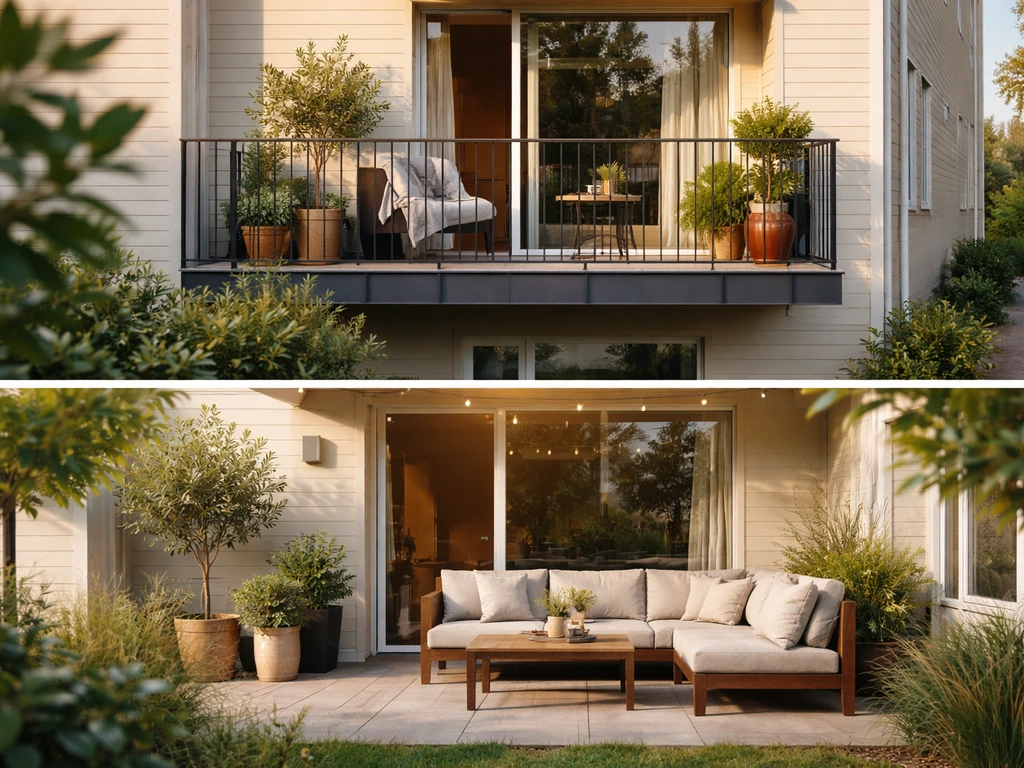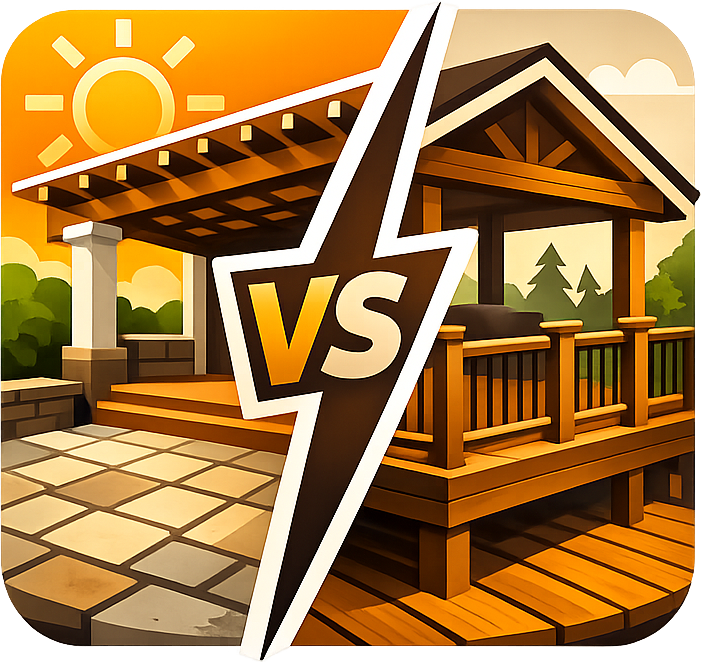
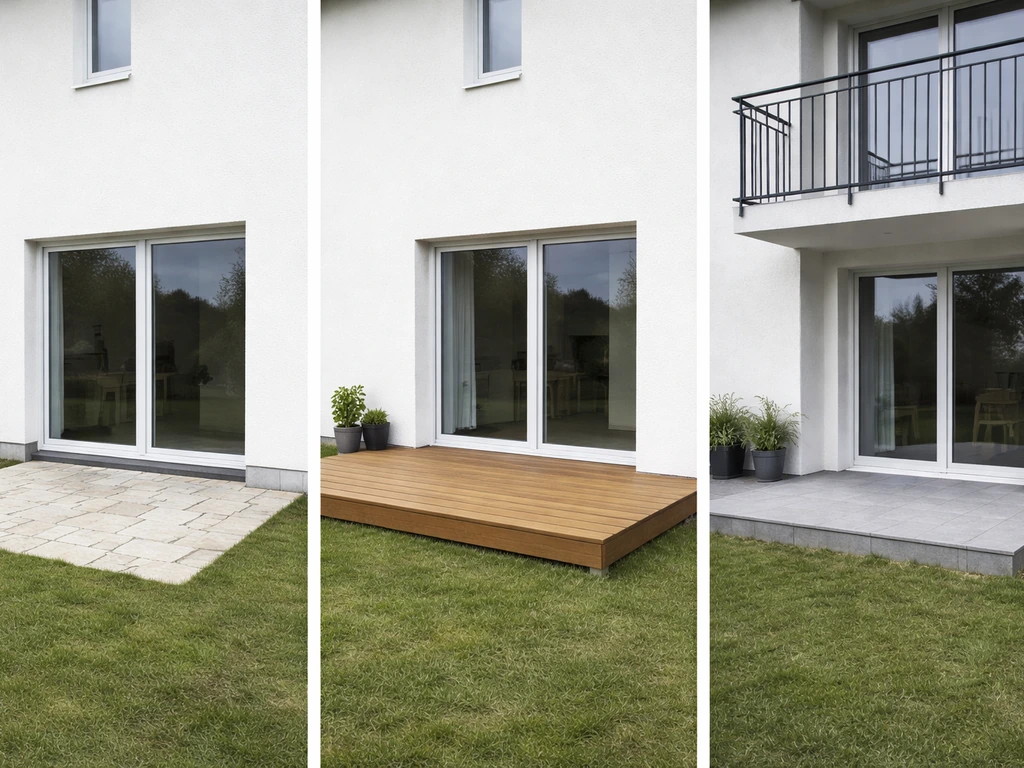
A patio sits at ground level, a terrace is a raised or elevated flat area (sometimes on a roof), and a balcony projects from an upper floor wall. Those three distinctions settle most of the confusion. The wider mess comes from regional language: in the UK a terrace often means what Americans call a patio, and a veranda is a roofed porch that some people call a deck. Once you pin down height, attachment, and roofing, the right choice for your home becomes a lot clearer.
Terrace vs Balcony vs Patio: Plus Veranda and Porch Guide

Miles Hart
6 May 2026
What each one actually is (and where it sits)
Let's start with the basics before getting into comparisons, because the terminology really does vary by country, by contractor, and even by city zoning document.
Patio
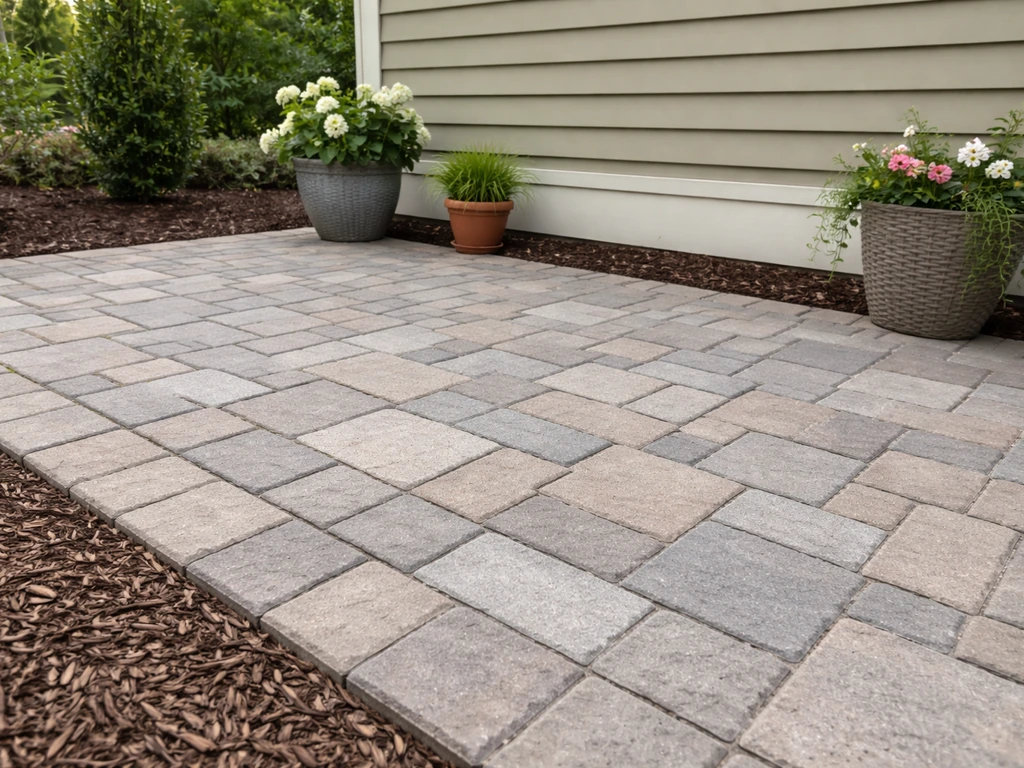
A patio is a ground-level outdoor surface, typically paved or hardscaped, adjacent to the house. It has no structural connection to the building frame, no roof required, and no elevation above grade. You're building on the ground, which keeps permitting straightforward and costs relatively low. Concrete, pavers, and natural stone are the most common materials.
Terrace
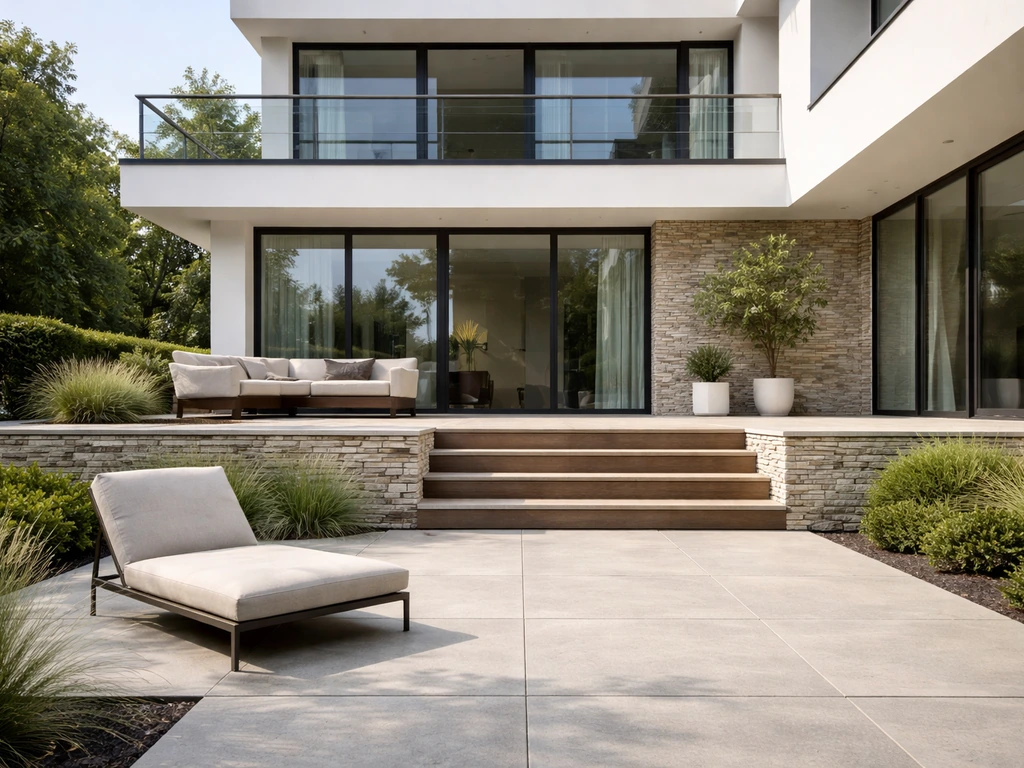
A terrace is a raised, open, flat outdoor area. It can be at ground level but built up from a slope, elevated partway off the ground on a hillside lot, or a roof terrace on top of a flat-roofed building. What defines a terrace is the platform and the open-air exposure, not a specific height. In the US, some homeowners use the word loosely to mean a fancy patio; in the UK, terrace is almost synonymous with patio. Fort Worth's historic district planning glossary describes it as an elevated, non-visible platform area, which is about as official as definitions get.
Balcony
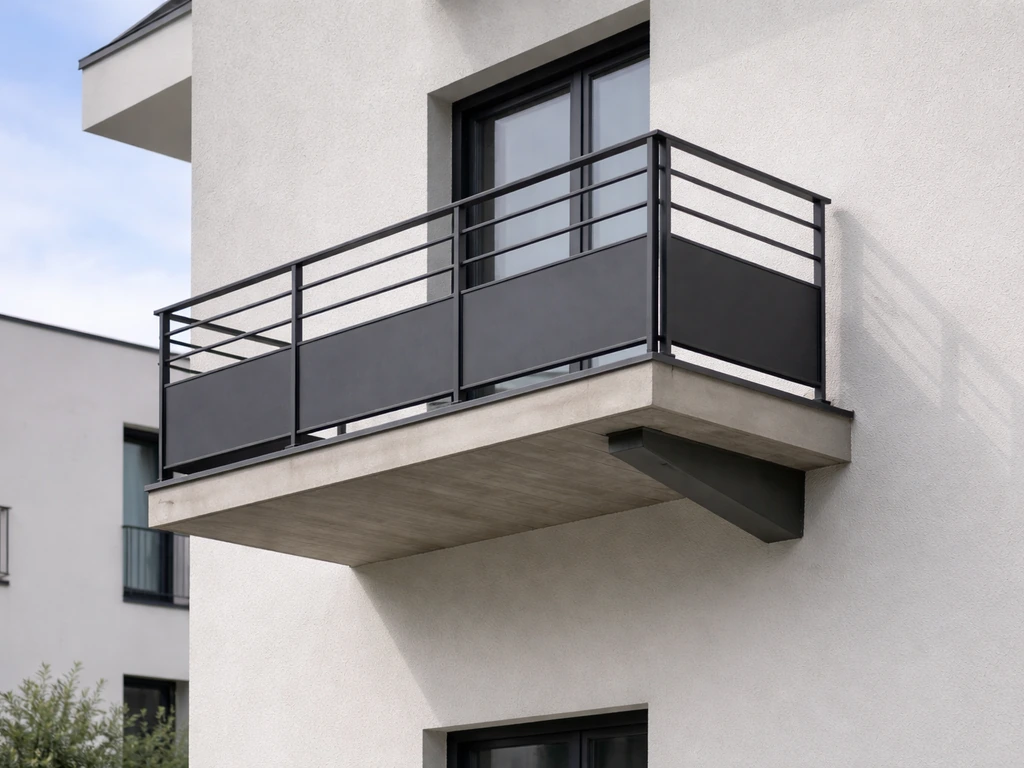
A balcony projects from an upper-floor exterior wall, supported by brackets or columns, and enclosed with a balustrade or railing. The defining traits are: it's above ground level (typically second floor or higher), it's attached to the building structure, and it's open to the sky unless a separate canopy or overhang has been added. Per the IRC, any open-sided walking surface more than 30 inches above grade requires a guard rail at least 36 inches high, so balconies almost always involve railing work.
Veranda
A veranda is a roofed, open-air gallery attached to the outside of a building, usually running along one or more sides. The roof is what separates it from a terrace. It can be at ground level or wrap around a second story. Think of a deep, covered walkway you can sit in. UK and Australian usage treats veranda as a distinct category; in the US, most people just call it a covered porch.
Porch
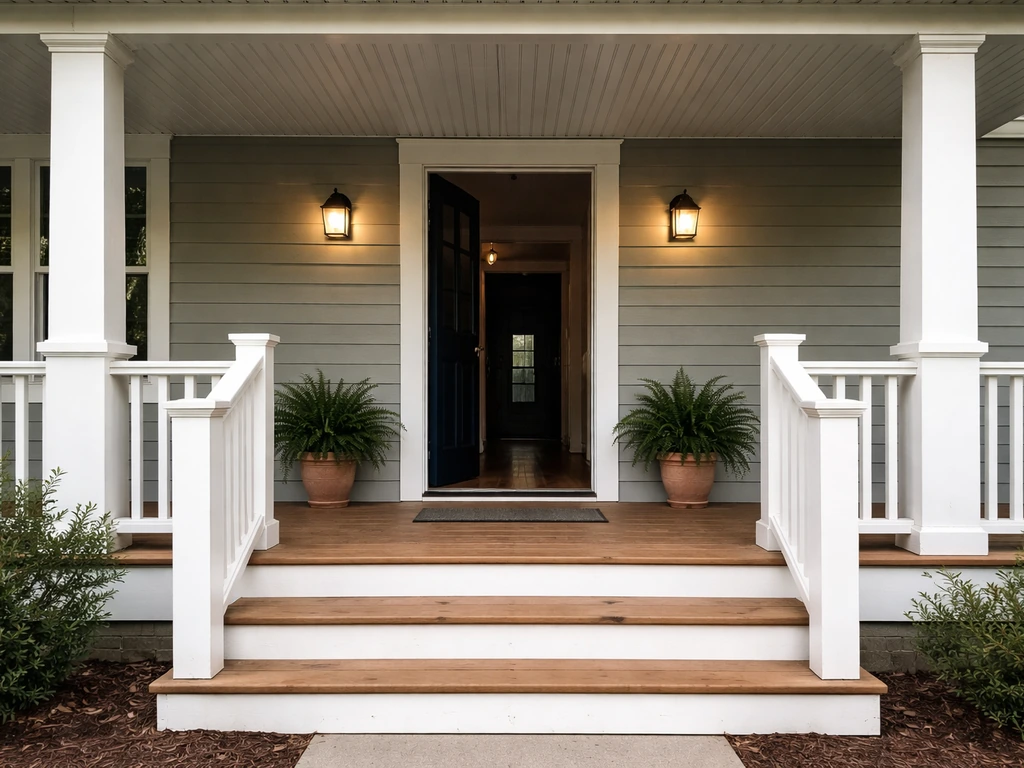
A porch is a covered projection from the main wall of the building, typically at the entry. The Philadelphia building code frames it as a covered but unenclosed projection, which is a useful working definition. Porches can be screened, glassed in, or fully open. They're primarily entry-focused spaces, though a deep side porch absolutely functions as an outdoor living room.
Deck
A deck is an elevated platform, almost always made of wood or composite, attached to the house. It's structurally connected via a ledger board to the building frame, which is why waterproofing and flashing at that joint is such a big deal (and a common inspection failure point). Decks can be at grade or raised, covered or uncovered.
Terrace vs balcony vs patio: side-by-side
| Feature | Patio | Terrace | Balcony |
|---|---|---|---|
| Height / level | Ground level | Raised or elevated (including rooftop) | Upper floor, projects from wall |
| Structural attachment | Freestanding on grade | May be freestanding or built into slope/roof | Structurally attached to building wall |
| Roof / cover | None by definition (add a pergola or cover separately) | None by definition (open-air) | None by definition (open-air) |
| Railing required? | No (at grade) | Sometimes (depends on height) | Yes — IRC requires guards over 30" above grade |
| Typical size | 150–600 sq ft common | Varies widely; roof terraces can be large | Small to medium (50–200 sq ft typical) |
| Access from | Back door, side door | Interior staircase, rooftop hatch, or slope | Bedroom, living room, or hallway door |
| Privacy | Low to moderate (neighbors can see in) | Variable; rooftop terraces can be very private | Moderate (elevated gives some visual separation) |
| Best use | Dining, grilling, lounging | Views, entertaining, rooftop gardens | Morning coffee, fresh air, sleeping porch feel |
| Typical cost range | $6–$30/sq ft (concrete or pavers) | Wide range; rooftop work is expensive | $15,000–$40,000+ depending on structure needed |
The biggest practical difference between a patio and a terrace is whether you're working with grade or elevation. A patio is almost always the simpler, cheaper build. A balcony's cost and complexity spike because you're either adding a structural projection to an existing building or enclosing an existing Juliet-style opening, both of which require engineering review in most jurisdictions. A balcony can be a good alternative to a patio when you want elevation and views, but you will usually pay more for attachment and railing balcony vs patio.
Veranda vs porch vs patio vs terrace: roofing, entry role, and purpose
Roofing is the fastest way to separate these four. If you are stuck choosing between a deck vs patio vs porch, start with how each one is roofed and whether it connects to the building roofing. A patio and terrace are open to the sky. A veranda and porch have permanent overhead cover. That one distinction drives cost, permit complexity, and how you actually use the space day to day.
| Space | Roofed? | Entry-facing? | Primary role | Typical attachment |
|---|---|---|---|---|
| Patio | No | Rarely | Outdoor dining, relaxing | Adjacent to house, not structurally tied |
| Terrace | No | No | Views, entertaining, open-air sitting | Raised platform, may be independent or roof-mounted |
| Porch | Yes | Usually yes | Entry/arrival, sitting, greeting visitors | Attached to building front or side |
| Veranda | Yes | Sometimes | Sheltered sitting, wraparound outdoor living | Attached to building, often multi-sided |
The entry role matters for curb appeal and day-to-day use. A porch faces the street and signals welcome; a terrace or patio is typically a private backyard retreat. Verandas occupy a middle ground, especially the classic Southern wraparound style that covers both the front entry and sides of the house. If your goal is weather protection without full enclosure, a veranda or porch beats a patio or terrace every time. If your goal is maximum light and open-sky feel, a terrace or patio wins.
Porch vs patio is one of the most common comparison searches, and the short answer is this: if you want cover and an entry presence, go porch; if you want a ground-level hardscape you can extend cheaply, go patio. If you are comparing options like lanai vs patio, note that lanai usually adds screening or enclosure, while a patio stays an open, ground-level hardscape. Lanai is another term that comes up, especially in Florida and Hawaii, and it essentially describes a screened or glass-enclosed porch or veranda.
Where decks fit in (and when someone says 'deck' but means something else)
Decks are where the terminology gets most muddled in contractor conversations. Technically, a deck is an elevated wood or composite platform attached to the house via a ledger board. But plenty of homeowners call any backyard platform a deck, including freestanding ground-level platforms that are technically patios. Here's the practical difference: if a contractor says 'deck,' they almost certainly mean a structure that attaches to your house frame.
Those definitions are also the key to understanding the difference between porch and patio and deck when contractors mix terms practical difference. That ledger-board connection is load-bearing and requires proper flashing and waterproofing. When that flashing fails, water gets behind the rim joist and into your wall framing, which becomes a rot and structural problem that home inspectors flag constantly.
A deck vs terrace comparison usually comes down to material and attachment. Decks are wood or composite; terraces are typically masonry, concrete, or tile. Decks are attached to the building; terraces may or may not be. A rooftop terrace on a flat-roofed home is sometimes called a roof deck, and in that case the terms genuinely overlap. For most homeowners with a sloped rear yard and a wood-frame house, the realistic choice is between a ground-level patio, an attached deck, or a raised terrace built into the slope.
Composite decking has become extremely popular because it eliminates most of the maintenance of pressure-treated wood (no staining, less warping, better moisture resistance). The trade-off is cost: composite decks typically run $25–$70+ per square foot installed, compared to $15–$35 for pressure-treated wood.
What things actually cost to build or renovate
Here's where things get real. Costs vary by region, material, size, and how much structural work is involved. The ranges below are installed costs (materials plus labor) for typical US residential projects as of 2025-2026.
Patio
- Plain poured concrete: $4–$12 per sq ft installed
- Decorative/stamped concrete: $8–$30 per sq ft installed
- Pavers (brick, concrete, or natural stone): $10–$30 per sq ft installed
- Example 400 sq ft project: concrete runs $2,400–$7,200; pavers run $4,800–$16,000
Deck
- Pressure-treated wood: $15–$35 per sq ft installed
- Composite (Trex, TimberTech, etc.): $25–$70+ per sq ft installed
- Railing labor alone: roughly $30 per linear foot (varies by height and rail type)
- Permits: typically $200–$1,500 depending on size and municipality
Balcony (adding or rebuilding)
Adding a new balcony to an existing home is the most expensive option on this list. You're either cantilevering from the floor framing, adding support columns, or both, and in most cases you need a structural engineer's stamp. Ballpark: $15,000–$40,000+ for a modest second-floor balcony addition, not including any interior work. Rebuilding or resurfacing an existing balcony is cheaper, often $5,000–$15,000 depending on scope.
Terrace and veranda
A ground-level or slope-cut terrace in masonry or pavers will cost similarly to a patio ($10–$30 per sq ft), with added grading and retaining-wall costs if the site has significant slope. Rooftop terraces are expensive because of waterproofing requirements, structural loading checks, and access: budget $30,000–$80,000+ for a serious rooftop terrace on a flat-roofed home. A veranda or covered porch addition typically runs $15,000–$50,000 depending on roof complexity, columns, and whether the existing structure needs reinforcement.
What actually drives price
- Material choice: the single biggest variable. Concrete pavers vs stamped concrete vs natural stone can double the cost for the same square footage.
- Size: obvious, but most cost estimates assume a baseline of around 300–400 sq ft. Larger projects get some economies of scale.
- Elevation and structural support: anything that leaves the ground needs footings, posts, ledger connections, or retaining walls. Each adds cost.
- Roofing: adding a permanent roof over any of these spaces adds $8,000–$25,000+ and usually triggers a permit.
- Railings and guards: required by code when height exceeds 30 inches. Rail labor runs about $30 per linear foot.
- Permits: almost every attached structure, deck, balcony, or covered addition requires a permit. Skipping it creates problems at resale.
- Site access and existing conditions: a contractor dragging materials through a narrow side yard charges more than one with open access.
Home value, privacy, and day-to-day usability
Return on investment
Decks tend to return more at resale than patios in most US markets. In high-cost markets like the Bay Area, wood decks have returned roughly 62–95% of cost, composite decks 60–90%, while patios come in around 40–50%. That doesn't mean patios are a bad investment; they're just cheaper to build in the first place, so the lower ROI percentage often still makes financial sense. A balcony addition is harder to quantify because it also depends on views and whether it adds usable square footage.
Privacy
Ground-level patios and terraces are the most exposed. Anyone walking by the yard can see the whole space. Elevated decks, terraces, and balconies offer visual separation from grade-level neighbors but can expose you to second-floor neighbors or nearby buildings. Rooftop terraces can be the most private space on the property, especially on urban lots. Verandas and porches are inherently visible from the street, which is great for curb appeal but not for backyard privacy.
Day-to-day usability tradeoffs
| Space | Rainy-day usability | Accessibility (mobility) | Entertaining capacity | Maintenance load |
|---|---|---|---|---|
| Patio | Low (exposed) | Excellent (flat, at grade) | High (can be very large) | Low to moderate |
| Terrace | Low (exposed) | Moderate (stairs or ramp needed if elevated) | High if large enough | Moderate (depends on material) |
| Balcony | Low (usually exposed) | Low (stairs or elevator required) | Low (typically small) | Moderate |
| Porch | High (covered) | Good (front entry, typically at grade or one step) | Moderate | Moderate to high (roof maintenance) |
| Veranda | High (covered) | Good to moderate | High if wraparound | Moderate to high |
| Deck | Low unless covered | Moderate (elevated, stairs needed) | High | Moderate to high (wood staining, flashing checks) |
If someone in your household has mobility considerations, a ground-level patio is almost always the most accessible option. It requires no steps, no rails, and can be widened at low cost. Everything else involves at least one step up or a significant elevation change.
How to choose: the questions that actually matter
Before you call a contractor or pull a permit application, work through these questions. The answers will narrow your options fast.
- Where does your home sit on the lot? Flat backyard with a rear door at grade points toward a patio or ground-level deck. A sloped lot with a walkout basement or elevated rear entry points toward a raised deck or terrace. A flat-roofed urban home may make a roof terrace the only realistic outdoor space.
- Are you on the first floor or upper floor? If your main living space is on the second floor (common in townhomes and row houses), a balcony or elevated deck is the natural outdoor extension. Ground-floor living almost always means patio, deck, or terrace.
- Do you need weather protection? If yes, you need a roof, which means porch or veranda. A pergola adds partial shade but isn't a substitute for a real roof in rain.
- How much space do you actually have? Measure the usable zone before you design anything. A balcony might realistically be 8 feet deep by 12 feet wide (96 sq ft). A patio can stretch to 400+ sq ft on a normal suburban lot.
- What's your budget ceiling? Patios start under $3,000 for a basic concrete slab. Balcony additions and rooftop terraces can hit $40,000–$80,000. Knowing your ceiling eliminates options fast.
- What does your zoning allow? Setback rules, impervious surface limits, and height restrictions vary by municipality. Some zones limit how close a structure can be to a property line; others cap total hardscape coverage as a percentage of the lot.
- Do you want to DIY any of it? A concrete patio or basic paver patio is genuinely DIY-friendly for a capable homeowner. A deck attached to the house frame, a balcony addition, or any roofed structure is contractor territory in most cases.
Your next-step checklist
- Measure your available space. Use a tape measure or a free app like Magicplan. Note the distance from the house to the property line and any grade changes.
- Check your local zoning code online. Search '[your city/county] + zoning + accessory structure setback.' Look for impervious surface rules, height limits, and whether you're in a historic district.
- Call your building department and ask: 'What permit do I need for a [patio/deck/covered porch] of X square feet attached to a single-family home?' Get the answer in writing if possible.
- Get at least three contractor bids. Ask each one to specify: material specs, footing/foundation approach, how they handle ledger flashing on attached structures, and what permits they'll pull (and who pays for them).
- Ask about flashing and waterproofing specifically if you're building an attached deck or elevated structure. Failed ledger flashing is one of the top causes of structural rot and is a consistent home-inspection red flag.
- Request a cost-per-square-foot breakdown, not just a total. It makes comparing bids easier and lets you adjust scope if the total is over budget.
- If you're on a sloped lot or considering a rooftop terrace, budget for a structural engineer consultation ($300–$700 in most markets) before finalizing any design.
The comparison between a terrace, balcony, and patio ultimately comes down to where you live in your home (ground floor vs upper), what your lot looks like, and how much you want to spend. For most single-family homeowners with ground-floor rear access, the patio or attached deck is the practical starting point. If you're in an urban townhome or condo with upper-floor living, a balcony or elevated terrace is often the only realistic option. And if weather protection is the priority, a covered porch or veranda changes the usability equation entirely, especially in climates with real rain or sun.
FAQ
Can I use the words terrace, patio, and deck interchangeably when talking to contractors?
You can, but it often causes scope mistakes. Better practice is to specify the build facts, for example, “ground-level paved area next to the house,” “raised platform attached to the framing with ledger flashing,” or “roofed projection off the main wall at the entry.” If a contractor hears “deck” and you meant “paver patio,” you could end up with different waterproofing and drainage details than you expected.
What should I confirm to avoid permit problems when building a patio or terrace on a slope?
Ask how they handle grade changes and water flow, not just the surface materials. On sloped sites, you may need retaining walls, regrading, and engineered drainage plans, even if the structure is “only flat.” Also confirm setbacks and whether the “elevated partway off the ground” terrace definition triggers additional requirements.
Do balconies and terraces both require guard rails?
Often yes when height triggers safety rules, but the exact trigger depends on local code language. The article notes a common 30-inch above-grade walking surface threshold for requiring guards. For your estimate, ask whether your balcony will be open on all sides, include a roof over part of it, or be treated as a “platform” versus “walking surface,” since that can change guard requirements.
Is a roof terrace the same thing as a deck?
They overlap in name, but the waterproofing and access issues drive the real difference. A “roof deck” usually means a terrace on a flat roof, so you should confirm roof membrane protection, load-bearing checks, and how they will flash penetrations. A traditional wood deck may not address the same level of roof-system complexity.
If my veranda is partially enclosed, does it become a porch or something else like a lanai?
It depends on how much is enclosed and whether screening or glazing is involved. The article notes lanai commonly refers to screened or glass-enclosed versions of a covered porch or veranda. Ask whether the plan includes full-height glazing, operable screens, or partial screening, because those choices can affect ventilation, permits, and how the space functions seasonally.
What’s the most common mistake homeowners make when budgeting for a deck attached to the house?
Underestimating the ledger-board waterproofing and flashing work at the house connection. That joint is structurally critical and is also where hidden water intrusion can start. When you get bids, request a line item describing flashing method, waterproofing at the ledger, rim-joist protection, and drainage away from the wall.
How do I choose between an attached deck and a patio when I want the cheapest option?
Start with whether you truly need the “attached to the building” feature. A patio is usually a simpler, lower-cost ground-level hardscape, while a deck requires the ledger connection and associated waterproofing. If your goal is just outdoor seating at grade, treat the deck as an upgrade only if you want elevation, a certain material look, or a railing requirement.
Is a ground-level patio always best for accessibility and aging in place?
It is usually the most accessible because it can be built without steps or guard requirements. But still confirm that the surface is stable and slip-resistant, and plan for door thresholds and turning radius. If you use pavers, ask about leveling tolerances and whether they recommend polymeric sand or another method that reduces movement over time.
Which option tends to be more private in a neighborhood with close second-floor visibility?
Elevated spaces can reduce yard-level foot traffic but still expose you to second-floor views, especially balconies and upper terraces. The article highlights rooftop terraces as often the most private on urban lots. When privacy matters, ask about railing heights, the potential for adjacent building sightlines, and whether partial screening is allowed.
What should I ask a contractor if I’m considering a second-floor balcony addition?
Ask about structural approach and engineering requirements, including whether they will cantilever from framing, add columns, or both. Also ask what interior impacts are included, because bids for “balcony only” may exclude interior repairs around the opening or ledger area. Request confirmation of how they will handle railing attachment, guard code compliance, and any required stamped drawings.
Do resale impacts differ if I choose a patio versus a deck in my market?
Yes, but it’s often influenced by your buyer pool and how the space “feels” to local homeowners. The article notes decks tend to return more than patios in many US markets. Before deciding, ask real estate agents or appraisers what they see as common buyer preferences in your neighborhood, especially whether composite decks, rail styles, and maintenance expectations affect perceived value.
Next Article
Balcony vs Patio: Which Outdoor Space Fits Your Home?
Compare balcony vs patio for cost, privacy, safety, weather, codes, and resale, then choose the right outdoor fit.