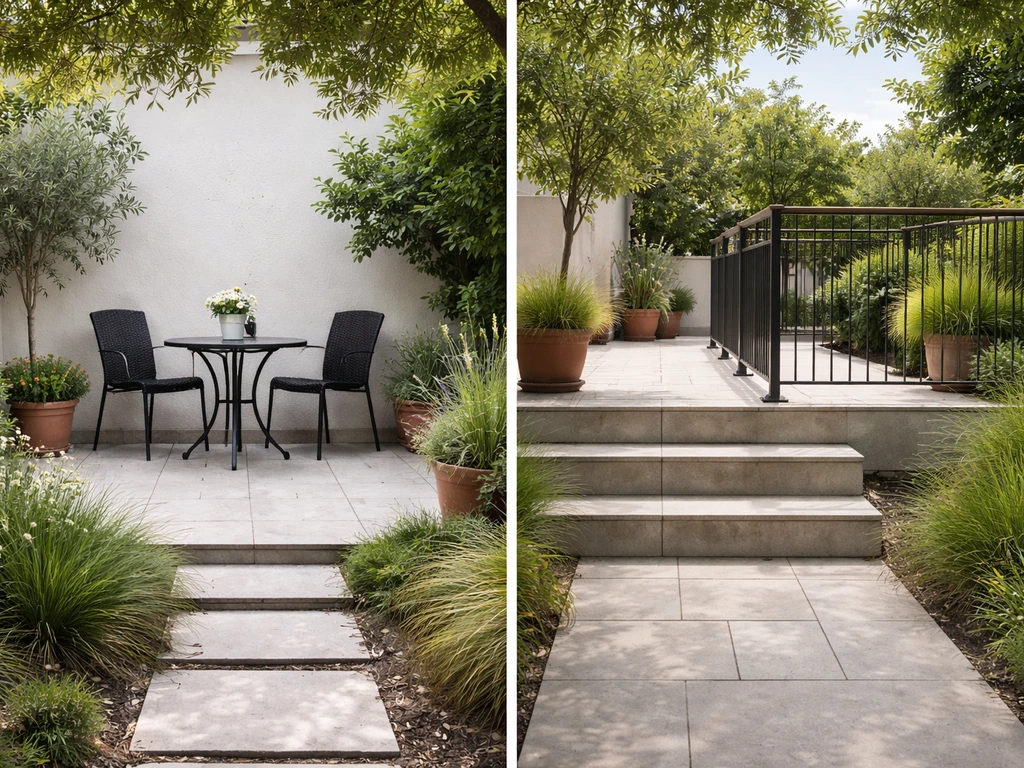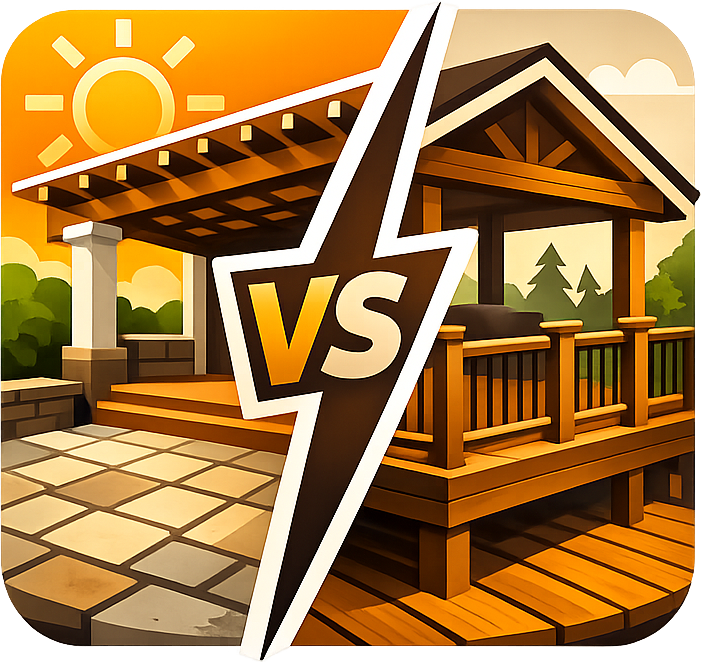
A deck is a raised platform (almost always wood or composite) attached to the back of your house. A patio is a ground-level outdoor surface, usually concrete, pavers, or stone, that sits in your yard or just outside a door. A porch is a covered structure attached to the house, typically framing an entry point. Those three differences, raised vs. ground-level, covered vs. open, and entry-focused vs. living-space-focused, drive almost every decision about cost, permits, maintenance, and how the finished space actually feels to use.
Deck vs Patio vs Porch: How to Choose for Your Home

Miles Hart
28 Apr 2026
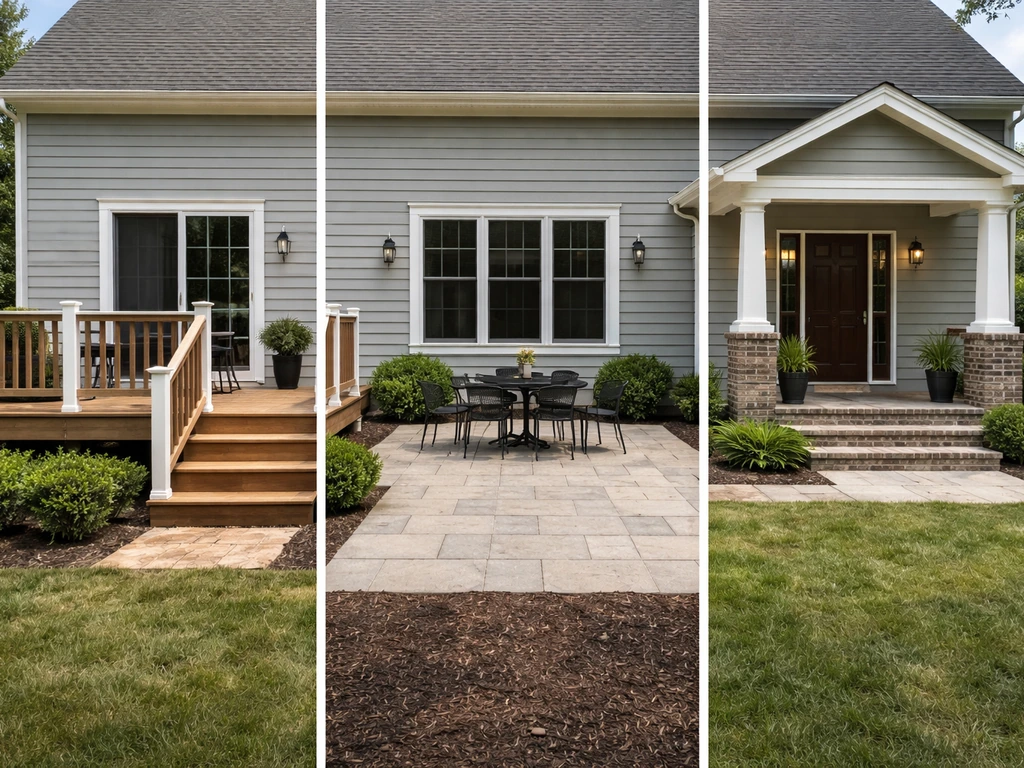
What each one actually looks like (and how they differ structurally)
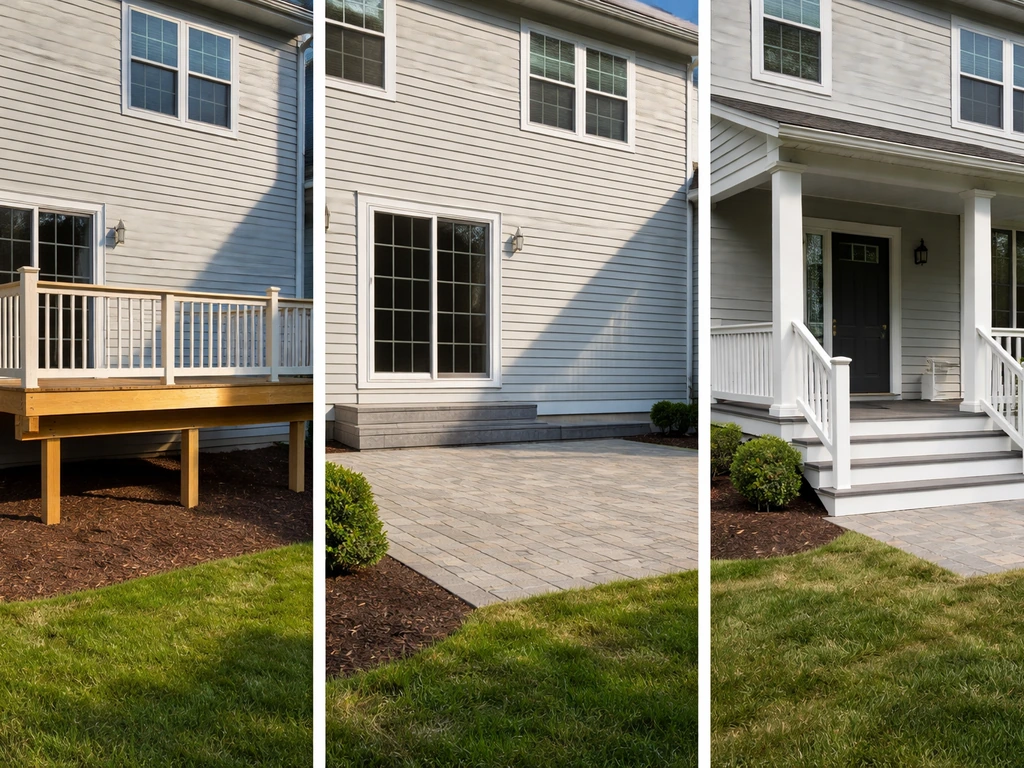
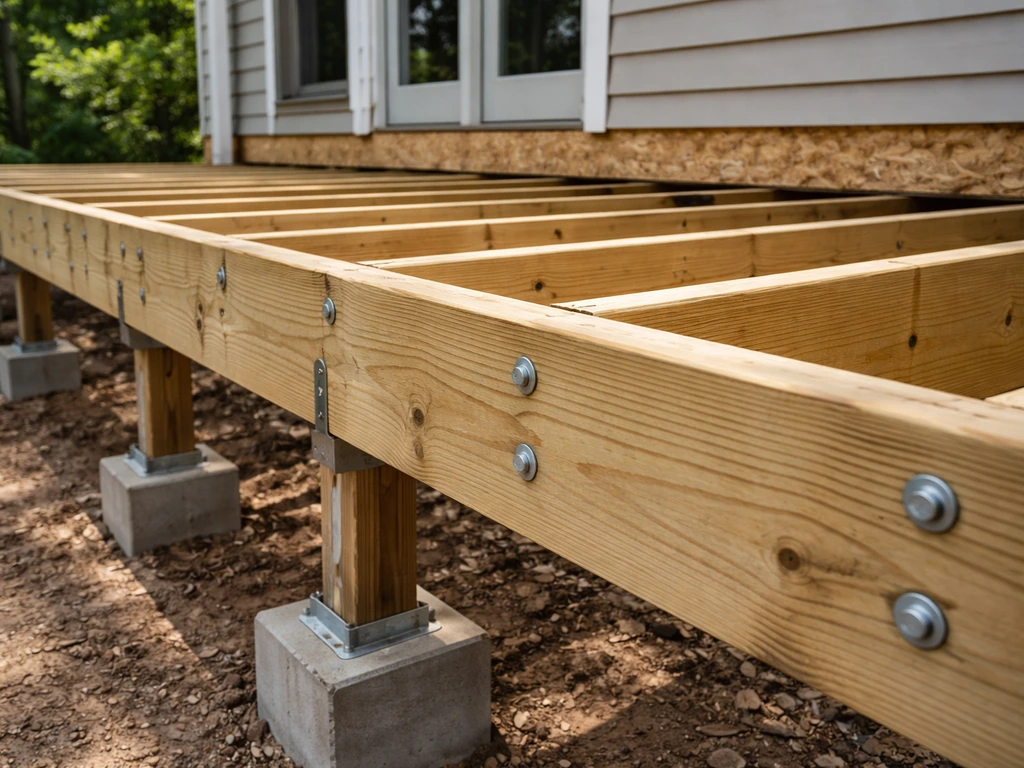
If you walked up to a house and saw a wood platform elevated off the ground behind it, attached to the home with a ledger board bolted through the siding, that is a deck. It sits above grade, sometimes by just a foot or two, sometimes by eight feet on a sloped lot. It has framing, posts, and usually railings once it gets above 30 inches off the ground. The attachment to the house is a structural detail that requires flashing and waterproofing around the ledger to prevent moisture getting behind your siding.
A patio sits at or very near ground level. It does not attach to the house structurally. You dig out a base, compact aggregate, add a sand layer, and set your surface material (concrete slab, pavers, brick, natural stone). There is no framing, no ledger, and typically no permit in many jurisdictions for a simple ground-level installation. It can butt right up against the foundation or sit further out in the yard.
A porch is defined by two things: it is covered (has a roof or roof-like structure) and it is attached to the house, almost always framing a door. Front porches are the classic version, a covered entry platform that sets the tone for your home's curb appeal. Back or side porches serve as sheltered outdoor rooms. Screened porches add insect protection while keeping the open-air feel. Because a porch typically shares structural elements with the house (roof loads, columns, footings), it is usually the most complex of the three to build or modify.
| Feature | Deck | Patio | Porch |
|---|---|---|---|
| Height | Raised above grade | At or near ground level | Typically at entry grade, but can be raised |
| Cover/roof | Usually uncovered (but can add pergola) | Usually uncovered (but can add pergola or shade sail) | Always covered, with a full or partial roof |
| Structural attachment | Attached to house via ledger | Freestanding/independent | Attached to house; shares roof structure |
| Primary material | Wood or composite decking | Concrete, pavers, brick, stone | Wood framing, concrete/wood floor, varied finish |
| Entry function | Rarely | Rarely | Almost always |
| Typical permit trigger | Nearly always required | Often not required (ground-level) | Nearly always required |
| Railing requirement | Required at 30"+ above grade | Not applicable (ground-level) | Required at 30"+ above grade |
The distinction between a porch and a covered patio can trip people up. A covered patio is basically a patio slab with a pergola, awning, or freestanding roof structure over it. A porch is specifically attached to the house at an entry point and shares the home's roofline in some way. If you are comparing those two closely, the difference between a porch and a patio (covered or otherwise) comes down to whether the structure is functionally tied to the home's entry and roofline. If you are trying to decide patio vs porch, the key difference is how the structure is tied to the house and your main entry experience.
Which one fits your lifestyle and property best
Go with a deck if...
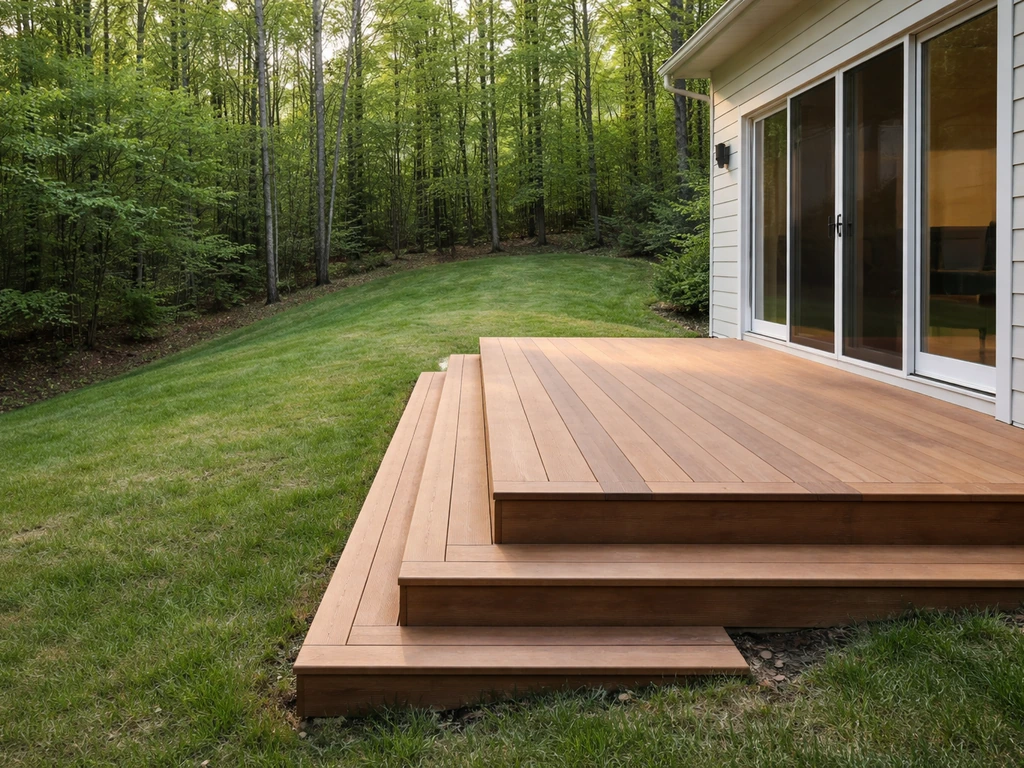
- Your yard slopes away from the house and a ground-level surface would require significant grading or retaining walls
- You want the space to flow directly from interior living areas (living room, kitchen) at the same height
- You plan to grill, entertain, and put out furniture for regular outdoor living behind the house
- You are comfortable with an annual or biennial maintenance routine (sealing, staining, or inspecting composite boards)
Go with a patio if...
- Your yard is mostly flat and a ground-level surface works without much grading
- You want the lowest upfront cost and the most flexibility to DIY portions of the work
- You prefer stone, brick, or pavers aesthetically and want a surface that blends into a garden landscape
- You want a low-maintenance surface (concrete pavers sealed every 4 to 5 years, no risk of rot or splinters)
- You are adding a firepit area, outdoor kitchen, or other built-in features that work best at grade
Go with a porch if...
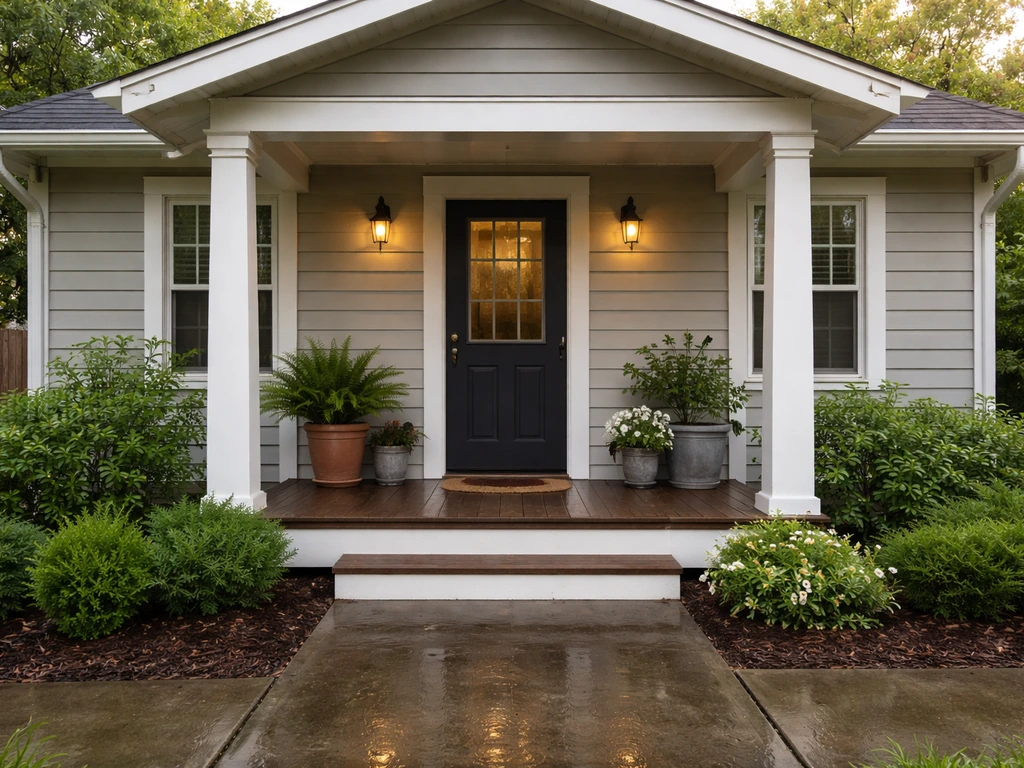
- Curb appeal and the look of the home from the street are a primary goal
- You want a sheltered outdoor space you can use in rain or harsh sun without a separate pergola build
- Accessibility matters, especially a flat covered entry with no steps or minimal steps
- You want an outdoor space that feels like a real room extension of the house, not just a surface outside
- You live in a climate with high humidity, frequent rain, or intense sun where shade and shelter matter most
One common scenario worth calling out: a sloped backyard with a walkout basement. Here a deck almost always wins because it lets you step out of the main floor at grade height. Building a patio in that situation means significant grading and a retaining wall, which can cost more than the deck itself. Building a patio in a sloped backyard often means grading and a retaining wall, so if you prefer less site work you may find a porch vs patio approach works better for your layout patio vs porch. Conversely, a flat suburban lot where the back door opens directly to grade is an ideal patio setup. You can skip the structural complexity, save money, and still get a great outdoor living area.
What these things actually cost
Patios are typically the cheapest option to build at a basic level. A concrete patio runs roughly $8 to $20 per square foot installed. Concrete pavers come in around $8 to $15 per square foot installed. Natural stone and brick run higher. For a 400-square-foot patio, you are looking at $3,200 to $8,000 on the lower end of materials. That said, add a pergola or covered structure and costs can jump dramatically, sometimes into the $40,000 to $125,000 range for a fully designed outdoor room with roofing.
Decks land in the middle of the range. Pressure-treated wood decks cost roughly $15 to $25 per square foot installed, which is the entry-level option. Higher-end composite decking (Trex, TimberTech, and similar) pushes the range up toward $30 to $60 per square foot once you account for framing, footings, stairs, and railings. A 300-square-foot PT wood deck might run $4,500 to $7,500 in materials and labor. Go composite on a similar deck and you could be looking at $9,000 to $18,000. The higher upfront cost on composite buys you less maintenance over time. Trex reports that estimated composite deck material costs typically run from about $10 to $27 per square foot, depending on complexity and product line less maintenance over time..
Porches are generally the most expensive option because of the roofing involved. Expect a wide range: roughly $25 to $150 per square foot, with a mid-range around $75 per square foot, depending on materials, roof complexity, and local labor. A screened porch addition on an existing covered area could be at the lower end (around $4 to $60 per square foot just for screening), while a full new porch addition with its own roof structure and finished flooring is closer to the upper range. Regional labor costs vary significantly, so always get multiple quotes.
| Structure | Typical Cost Range (installed) | Key cost drivers |
|---|---|---|
| Patio (concrete) | $8–$20/sq ft | Site prep, concrete thickness, finish type |
| Patio (pavers) | $8–$15/sq ft | Paver type, base depth, pattern complexity |
| Deck (pressure-treated wood) | $15–$25/sq ft | Height, footings, stairs, railings |
| Deck (composite) | $30–$60/sq ft | Composite brand, framing material, accessories |
| Porch (basic screened addition) | $4–$60/sq ft | Whether roof exists, screen type, size |
| Porch (new full build) | $25–$150/sq ft | Roof structure, roofing material, finish level |
Home value, maintenance, durability, and weather
Return on investment
Decks have a strong ROI track record. Remodeling magazine's 2025 Cost vs. Value Report (as reported by Realtor.com) pegs a wood deck at roughly 95% ROI, which is among the highest of any home improvement project. Composite decks also rank well. Patios offer solid buyer appeal because they are low-maintenance and visually read as an outdoor living investment. Porches, especially front porches, add significant curb appeal that is hard to put a precise number on but clearly affects first impressions and perceived home value. In all three cases, quality of construction and materials matters more than which category you choose.
Maintenance reality
Wood decks need the most consistent attention. Plan on an annual inspection and at least a biennial staining or sealing cycle, with oil-based penetrating sealers needing reapplication every one to two years and film-forming finishes every one to three years. You are also watching for soft spots, rot at post bases, and any movement around the ledger. Composite decking dramatically reduces that schedule but it is not zero-maintenance. It needs periodic cleaning to prevent mold and mildew buildup in the grooves.
Concrete patios need crack monitoring and periodic sealing to protect against moisture intrusion, especially in freeze-thaw climates where de-icing salts can cause surface scaling and spalling. Paver patios are low-effort overall. Resealing every four to five years keeps them protected. The main nuisance with pavers is weed intrusion in the joints, which polymeric jointing sand significantly reduces by hardening into the joints and limiting growth. The tradeoff is that pavers can shift or settle over time if the base was not properly compacted.
Porches need attention around the roof-to-wall connection and where the floor meets the house. Screened porches require mold and mildew management since debris tends to accumulate at the screen base. Keeping leaves and organic material from piling up against the screens and base trim reduces mold growth significantly. Wood porch floors need the same sealing attention as decks.
Climate considerations
In wet climates (Pacific Northwest, Southeast), wood rot risk is real on decks and open porches. Composite decking and hardwood species like ipe resist moisture better but cost more. Covered porches are naturally more protected from rain. In freeze-thaw climates (upper Midwest, Northeast), concrete patios are susceptible to cracking and spalling if the slab was not properly reinforced or if de-icing salts are used. Pavers handle freeze-thaw better because the individual units can move slightly without cracking. In hot, sunny climates (Southwest, Southern California), composite decking can get very hot underfoot, and a shaded porch or pergola-covered patio is often more comfortable than an open deck in peak summer.
Permits, code, and what you can realistically DIY
When a permit is required
Almost any deck attached to a house requires a permit. The structural attachment (ledger bolted to your floor framing), footings, live-load requirements (typically 40 psf live load plus 10 psf dead load per IRC R301.5), and guardrail requirements all make decks a code-regulated structure in virtually every jurisdiction. Porches are similar. They attach to the house, they often alter the roofline, and they require permits. Ground-level patios, especially simple paver or concrete installations below a certain size, often do not require a permit in many municipalities, though you should always check locally.
The guardrail rule most people encounter is this: any walking surface (deck, porch, balcony) that is more than 30 inches above the adjacent grade requires guards, per IRC R312.1.2. Guards must be at least 36 inches high on most residential applications. Stair handrails are required when you have four or more risers. Guard openings cannot allow a 4-inch sphere to pass through. These requirements get enforced at permit inspection, which is another reason to pull permits on decks and porches.
What you can DIY vs. what needs a pro
Paver patios are the most accessible DIY project of the three. The steps (excavate, compact a gravel base, screed a sand layer, set pavers, add polymeric sand) are labor-intensive but do not require specialized skills. A 200-square-foot patio on a flat lot is a realistic weekend project for a capable homeowner. Concrete slabs, however, are not great DIY candidates unless you have experience with finishing and forming, because mistakes are permanent and expensive to fix.
Decks fall in the middle. A simple ground-level or low-elevated deck with a freestanding design (not attached to the house) is manageable for an experienced DIYer. The moment you attach a ledger to the house, the project gets technically demanding. Proper ledger flashing (removing siding, installing compatible flashing membrane, and waterproofing the bolt penetrations) is one of the most error-prone details in residential construction. Getting it wrong causes rot and, in serious cases, deck collapse. If you are not confident in that detail, hire a pro for at least the ledger and footing work.
Porches are generally a hire-a-pro project. They involve roofing, structural connections to the house, and often electrical work for lighting and outlets. Unless you have significant carpentry and framing experience, the complexity and code scrutiny make professional installation the right call for most homeowners.
How to choose: a step-by-step decision checklist
Work through these steps in order and you will have a clear direction before you talk to a single contractor.
- Measure your yard and note the grade. Walk to the back or side door and measure how far the ground drops (or rises) away from the house within the first 10 to 20 feet. If the ground drops more than 18 inches within 10 feet, a deck is almost certainly the right fit. If it is flat or drops less than 6 inches, a patio is likely easier and cheaper.
- Identify your primary use case. Write down the top two or three things you actually plan to do on this space: morning coffee, grilling, kids' play area, entertaining groups, reading alone, etc. Covered and sheltered functions (rain use, intense sun) point toward a porch. Open-air dining and grilling are well served by either a deck or patio.
- Set a realistic budget range. Pull the cost ranges from this article and multiply by your intended square footage. A 300-square-foot PT deck runs roughly $4,500 to $7,500 installed. A 300-square-foot paver patio is roughly $2,400 to $4,500. A 150-square-foot screened porch addition is harder to estimate without a quote, but budget $5,000 to $15,000 as a starting range for a basic add-on.
- Check your local permit office. Before finalizing your choice, look up your city or county's permit threshold for each structure type. Ask specifically: Does a ground-level patio under X square feet require a permit? What are the setback requirements from property lines? This single step can change which option is practical on your specific lot.
- Evaluate your maintenance tolerance honestly. If you will not stain or seal wood every one to two years, either choose composite decking or go with pavers. Be honest here. A neglected PT wood deck deteriorates fast and creates safety hazards.
- Think about how the space connects to the house. Stand inside at the door that will access this space. Is it a kitchen door at floor height? A deck matches that perfectly. Is it a front entry where curb appeal matters? A porch is the answer. Is the door three steps above grade? A patio with a landing works.
- Get at least two contractor quotes and ask the right questions. Ask each contractor: What type of footings are required for this project on my lot? Will this require a permit and who pulls it? What is included in the warranty on materials and labor? Can I see a reference project I can visit? For patios, ask specifically about base depth and compaction specs, because that is where most patio failures start.
- Decide on one option and lock your design priorities. Once you have chosen deck, patio, or porch, list your must-haves (size, material type, built-in features like benches or a bar, lighting, access points) and your nice-to-haves. Give that list to every contractor so you are comparing apples to apples on quotes.
If you are still torn between two options after running through that checklist, here is a practical tiebreaker: patios age best with the least effort, decks give you the most flexibility on sloped lots and the best documented ROI, and porches deliver the most year-round usability in climates with rain or extreme heat. Pick the one that solves your specific site challenge first, then optimize for aesthetics and features second.
FAQ
If my deck is only one or two feet off the ground, do I still need guards and likely a permit?
Often yes. Many jurisdictions use a height threshold (commonly 30 inches above adjacent grade) to trigger guard requirements, even for low decks. Being close to the limit can still require permits if the structure is attached to the house with a ledger or involves footings, so confirm with your local building department before building or before inspections.
What’s the most common mistake when building a deck that’s attached to the house?
Improper ledger flashing and waterproofing. The failure mode is usually moisture getting behind siding through bolt penetrations or gaps at the ledger, leading to rot over time. If you DIY, treat flashing details as the critical step, and consider hiring a pro specifically for the ledger, flashing membrane, and bolt penetrations.
Can I build a covered patio without it becoming a porch (and requiring more permits)?
It depends on how it’s connected. If the roof or structural elements are functionally tied into the home at an entry and share roofline or structural load paths, inspectors may classify it closer to a porch. If you want “covered patio” classification, avoid structural connections that look like extensions of the main roof and have footings calculated for the cover separately.
Do ground-level patios need slope for drainage?
Yes. Even though patios sit near grade, you still want controlled drainage away from the foundation and toward a predictable outlet. A common approach is sloping the surface slightly (often around 1/8 inch per foot), plus ensuring the base is compacted so water doesn’t pool and undermine pavers or concrete.
Which option is best if I want a lot of privacy from neighbors?
A deck or porch usually lets you add solid wind screens, planters, or higher privacy panels more easily because you’re building a framed boundary around a defined perimeter. Patios can be privacy-friendly too, but you often end up needing separate fences, pergolas, or trellises, which adds cost and planning beyond the patio slab itself.
What’s the maintenance difference between composite decking and wood decking in real life?
Composite reduces the need for staining or sealing, but it still needs regular cleaning to prevent mildew buildup in grooves and on textured surfaces. Plan on periodic rinsing or scrubbing, plus checking for loose fasteners or damaged boards after freeze-thaw seasons or heavy storms.
For paver patios, how do I prevent weeds without redoing the whole base?
Weed prevention starts before pavers go down. Use a properly compacted base, include edging to stop lateral movement, and use polymeric jointing sand correctly so it hardens in the joints. After that, periodic joint refresh and keeping organic debris out of cracks is usually enough to prevent recurring weed problems.
If I live in freeze-thaw weather, should I choose pavers over concrete?
Many homeowners choose pavers because individual units can tolerate small movements without a single slab crack propagating. Concrete can still work well if it’s properly reinforced, built with correct thickness, and sealed appropriately, but freeze-thaw performance is more sensitive to slab design and contractor quality.
How do stairs change the decision between deck vs patio?
Stairs and grade changes strongly affect cost and complexity. On sloped sites, a deck can align the walking surface with a main-floor exit and reduce earthwork, but you may still need compliant stairs and railings. With a patio, you may end up grading and building retaining features to get usable elevations, which often increases site-work spend.
What should I ask contractors to estimate to get apples-to-apples quotes?
Ask for scope breakdowns: site prep and excavation, footings or base design, material brand and thickness (especially for composite boards or paver thickness), drainage plan, railings or screens, and whether lighting or electrical is included for porch roofs. Also ask about permit handling and inspection responsibilities, since permit requirements differ by attachment and height.
Next Article
Terrace vs Patio Difference: Key Uses, Costs, Materials
Terrace vs patio difference explained: uses, placement, materials, drainage, maintenance, and costs to choose right outd