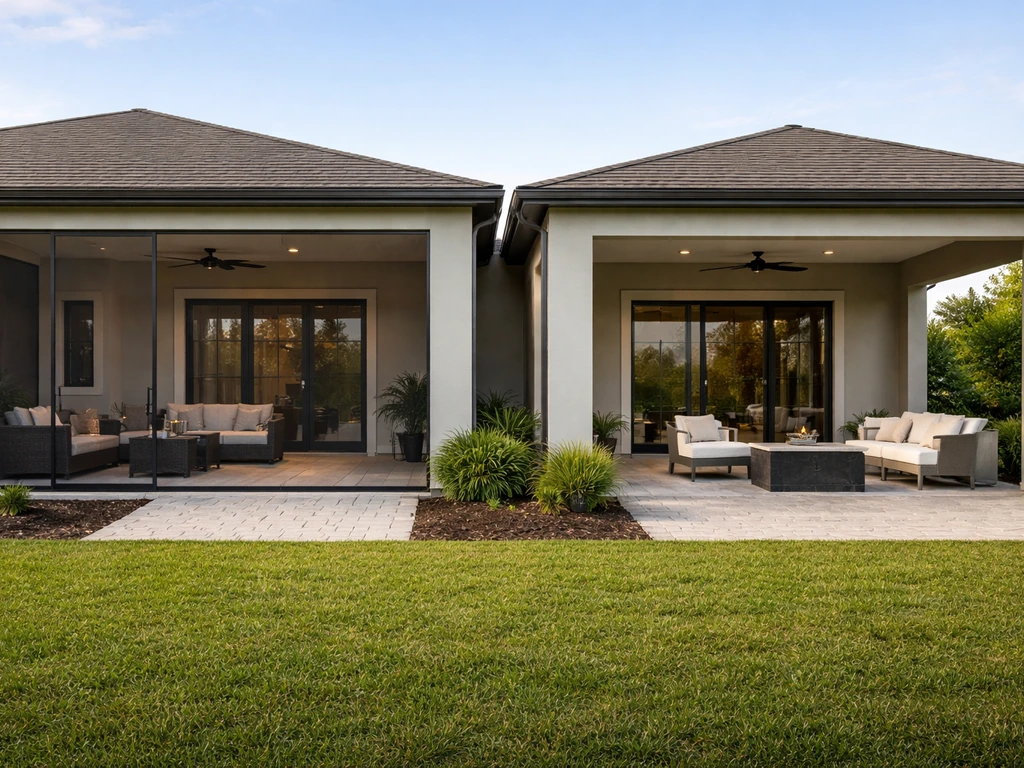
A balcony is an elevated platform that projects from your building's exterior wall, always above grade, always requiring a railing, and never touching the ground. A patio is a ground-level improved surface, typically concrete, pavers, or stone, that sits directly on grade in your yard or just outside a door. That single difference, elevation vs ground contact, drives almost every other difference in cost, safety requirements, what you can build, and how you'll actually use the space.
Balcony vs Patio: Which Outdoor Space Fits Your Home?

Miles Hart
28 Apr 2026
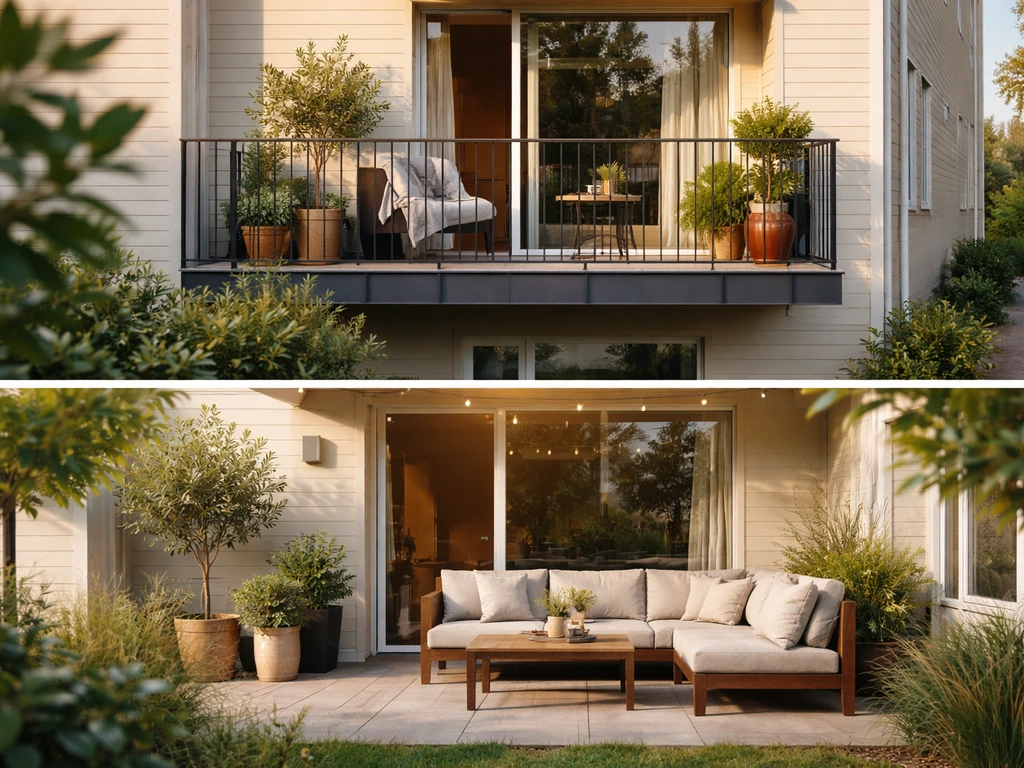
Quick definitions and what actually separates the two
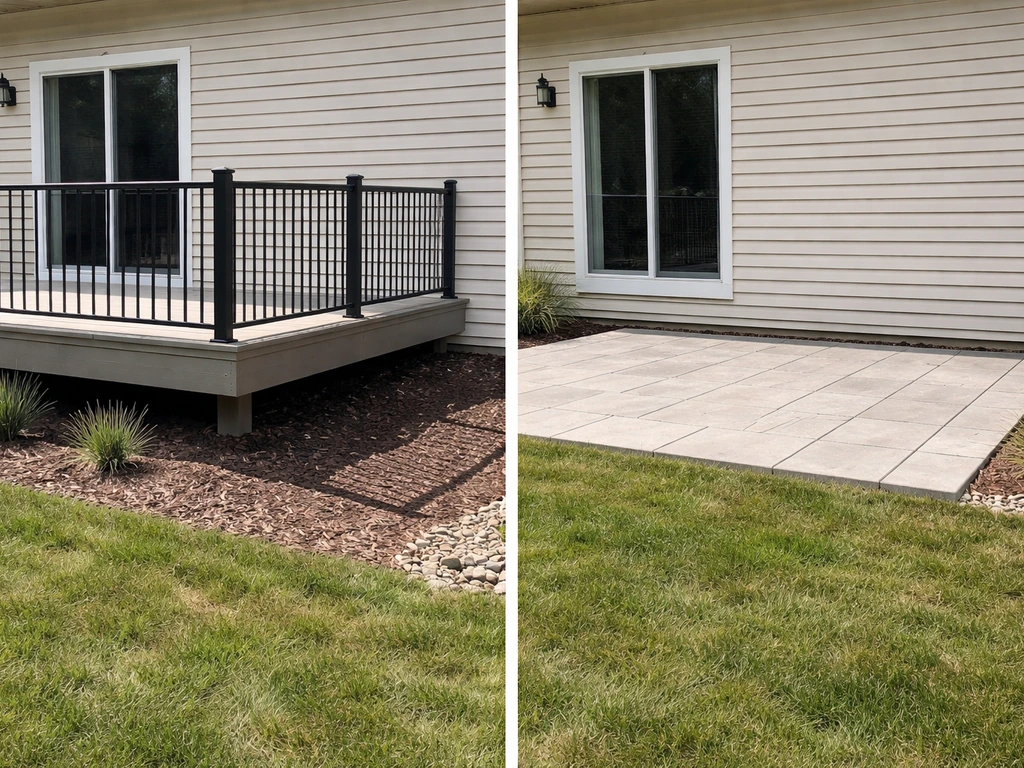
Most building codes draw the line at 24 inches above grade. The City of Hamburg, MI defines a balcony as a platform elevated more than 24 inches where no part is attached to the ground, which lines up with how most jurisdictions treat it. Architecturally, a balcony projects outward from the building facade, is supported by structural elements like columns or console brackets, and is enclosed with a balustrade or railing. A patio, by contrast, is an improved recreation area at grade, typically poured concrete, dry-laid pavers, or natural stone.
The confusion usually comes from elevated decks, which are structurally similar to balconies but often attached via a ledger board to the house rather than projecting outward from the facade. For this comparison, the core distinction is simple: if you're stepping out above the ground floor and need a railing to be safe, it's a balcony (or elevated deck). If you're walking straight out to grade level, it's a patio. That difference cascades into every other decision you'll make.
If you're comparing a broader set of outdoor space types, including porches, decks, lanais, and terraces, those distinctions are covered in related comparisons. If you are also considering a lanai, treat it as an adjacent option and compare how “at grade” living stacks up against “elevated platform” use, much like lanai vs patio.
If you're deciding between a terrace and a patio, focus on whether the surface is at grade and how closely the space connects to your home terrace vs patio. If you are deciding between adjacent terrace and patio layouts, the “at grade vs elevated platform” distinction is the fastest way to separate them, similar to terrace vs patio.
To help you choose confidently, compare patio vs porch based on elevation, roof coverage, and how you’ll access the space from your home porches, decks, lanais, and terraces. If you are weighing a porch versus patio versus deck, start with how elevation and roof coverage affect how the space feels and functions patios, decks, lanais, and terraces.
If you're also considering a deck versus a porch, compare elevation, railing needs, and whether you want roof coverage or open-air access patio vs porch. If you are also weighing a deck, a patio, or a porch, the same elevation and roof-coverage tradeoffs can help narrow the choice quickly deck vs patio vs porch. But for balcony vs patio specifically, the elevation question is the starting point for everything else.
Space, layout, and how you'll actually access each one
Patios are the more flexible option by a wide margin. You can install one almost anywhere on your property that has reasonably level ground, suitable drainage, and enough clearance from setbacks. The footprint is limited mostly by your lot and your budget. You can make a patio 200 square feet or 2,000 square feet. You can wrap it around the back of the house. You can add a pergola, an outdoor kitchen, a fire pit area, and a separate seating zone. Access is just a sliding door or French door at grade.
Balconies are constrained by the building itself. They have to project from an exterior wall, which means your placement options are limited to where the structure can support the load and where there's an existing or planned door opening at the right height. The footprint is typically smaller, often 40 to 100 square feet for residential builds, because the structural engineering gets more expensive as size increases. Access requires either a door at the upper level (common in two-story homes) or stairs from below, which adds both cost and footprint to your lot.
One layout consideration that surprises homeowners: the door swing. When a door opens outward onto a balcony or landing, building codes have specific requirements about whether the door can swing over the stair landing. Getting that detail wrong at the design stage can mean redesigning the stairs or the door placement before you can pass inspection. With a patio, door swing is rarely a code concern since you're stepping out onto grade.
What each one costs to build, maintain, and upgrade
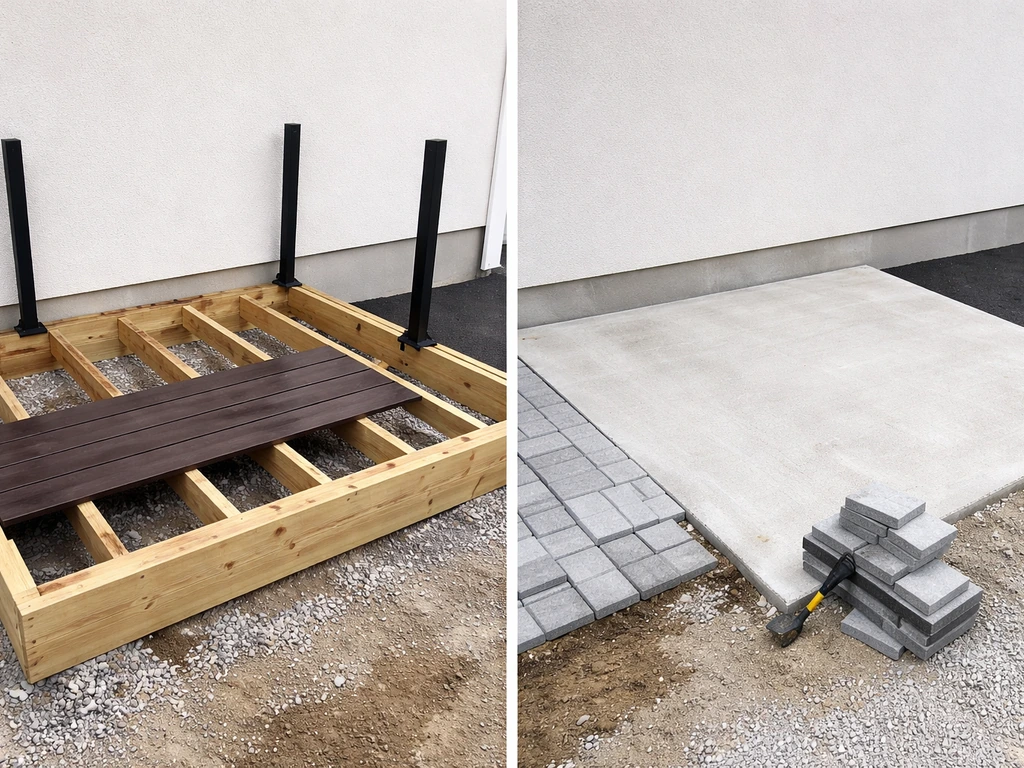
Build costs
Balconies run $30 to $90 per square foot installed, with most mid-size residential projects landing in the $8,000 to $25,000 range. A roughly 120-square-foot balcony with a standard railing and basic composite decking typically lands around $14,000. The big cost drivers are the support structure (columns, brackets, or a cantilevered framing system), the railing system, any stair access, and the decking material itself. If you're adding stairs, budget $50 to $150 per step, which adds up fast on a two-story build.
Patios cost considerably less for the base slab or surface, typically $8 to $40 per square foot depending on material and complexity. A basic poured concrete patio runs on the lower end. Pavers, natural stone, and stamped concrete push toward the middle and top of that range. Where patio costs can rival or exceed balcony costs is when you add a roof structure. A covered patio with a solid insulated roof runs $30 to $60 per square foot installed, and a full outdoor room with electrical, screens, and an outdoor kitchen can jump to $40,000 to $125,000 for a high-end build.
| Feature | Balcony | Patio |
|---|---|---|
| Base build cost (per sq ft) | $30–$90 | $8–$40 |
| Typical total project range | $8,000–$25,000+ | $3,000–$40,000+ (open); $40,000–$125,000 (fully covered/outfitted) |
| Railing/guard required | Yes, always | Not typically at grade |
| Stairs required | Often | Rarely |
| Covered roof add-on | Possible but complex | $16–$60+/sq ft |
| Outdoor kitchen add-on | Rarely practical (weight, space) | $5,000–$22,000 |
| Electrical wiring (if not present) | $2,000–$4,900 | $2,000–$4,900 |
| Privacy screen add-on | Smaller scale, $200–$1,000 | $200–$1,000+ |
Ongoing maintenance
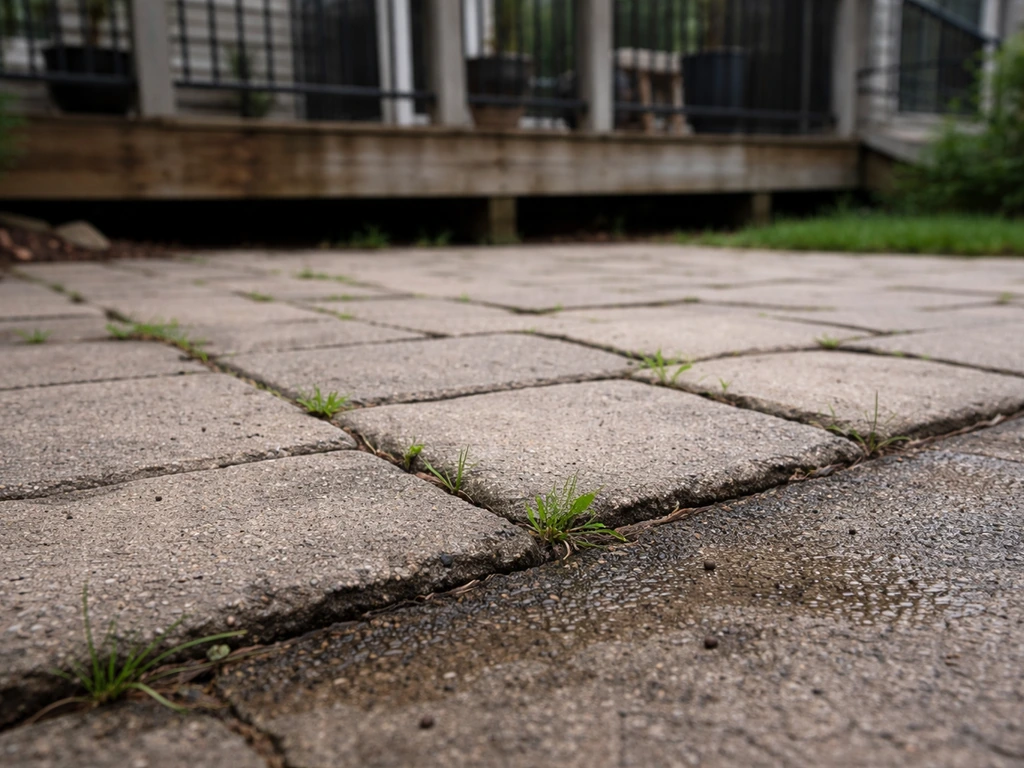
Patios made of concrete or pavers are relatively low-maintenance. You'll deal with weeds in paver joints, occasional re-leveling if frost heave affects your region, and resealing every few years for concrete. Balconies have more to manage: the decking surface, the railing system, and critically, the waterproofing at the ledger connection where the balcony meets the house. That ledger-to-house interface is the most failure-prone spot on any elevated platform. Water gets behind flashing, works into the structure, and can cause rot or even structural failure if ignored. Building science resources consistently flag this as the number one maintenance point for any elevated outdoor structure.
In California and some other states, elevated balconies on multifamily buildings are subject to mandatory inspection laws (blank" rel="noopener noreferrer">California's SB 721 and SB 326 require inspections at least once every nine years by a licensed professional). California SB 721 and SB 326 balcony inspection requirements include an initial inspection by January 1 and then periodic reinspections (for example, every nine years for SB 326 condominium-related guidance) by a licensed professional blank" rel="noopener noreferrer">mandatory inspection laws (California's SB 721 and SB 326 require inspections at least once every nine years by a licensed professional). Even on single-family homes, planning for periodic professional inspection of balcony connections is smart ownership, not optional.
Privacy, views, safety, and how they hold up in different weather
Balconies give you elevation, which means better views and more separation from neighbors at grade. If you're on the second floor, you're naturally above fence lines and hedges, which can feel more private in some settings and more exposed in others (neighbors across the street can see right onto a front balcony, for example). The safety requirement is non-negotiable: guards are required by the IRC when the floor is more than 30 inches above grade or the floor below. Residential guards are typically 36 inches high; commercial or IBC-governed applications use 42 inches. You can't skip this, and you shouldn't want to.
Patios sit at ground level, so privacy depends heavily on fencing, plantings, and the surrounding landscape. An open patio in a dense neighborhood can feel very exposed. The upside is that you have total control over the screening: a 6-foot privacy fence, tall hedges, a pergola with curtains, or lattice panels with vines. You're not working within a railing height constraint, so you can build privacy infrastructure as tall as your local codes allow.
Weather protection is a significant practical difference. Balconies are usually open to the elements unless you add an awning or a canopy, and their smaller footprint limits how much shade structure you can add. A patio, with more square footage and ground-level engineering flexibility, is much easier to roof, screen, or fully enclose into a three-season room. In hot climates, a covered patio becomes the obvious choice for usability. In windy or rainy climates, the balcony's elevation means more exposure with fewer shelter options.
Home value, resale, and the permit/code reality
Both outdoor spaces add perceived value, and the data broadly supports it. A 2025 industry survey found that 98% of outdoor living experts agreed that an updated outdoor space impacts home value, and about 85% of households already have some form of outdoor living area, making it a baseline buyer expectation in most markets. The ROI varies by project quality, climate, and market, but covered, functional outdoor spaces consistently help homes sell faster and support higher asking prices in regions where outdoor living is part of the lifestyle.
For resale specifically, a large covered patio with good finishes tends to photograph better and appeal to a broader buyer pool than a small balcony, simply because of usable square footage and furniture-placement flexibility. That said, a well-designed balcony off a master bedroom or a rooftop terrace can be a genuine differentiator in urban markets where outdoor space is scarce.
On the permit side, both projects almost always require a permit, and balconies face more scrutiny because of the structural and safety stakes. Expect your permit application for a balcony to include stamped engineering drawings, details on the ledger connection and waterproofing, railing specs, and stair design if applicable. A patio permit is simpler: typically a site plan showing setbacks, drainage direction, and dimensions. Some jurisdictions skip patio permits for simple ground-level surfaces under a certain size, but always check locally before assuming you're exempt. The IRC's drainage requirements (R401.3) also require that grade around structures slope away from the foundation, which affects where and how you place a patio slab.
Which one fits your lifestyle
Here's how to think about it practically, based on the most common homeowner scenarios:
- You have a two-story home, a great view from the upper floor, and a small yard: A balcony off the master bedroom or a second-floor living area makes the most sense. You get usable outdoor space without sacrificing the yard.
- You have a single-story home with a big backyard: A patio is almost always the better choice. You have the footprint, the grade access, and the flexibility to grow the space over time.
- You entertain frequently or want to cook outside: A patio wins. An outdoor kitchen needs structure, utilities, and counter space that a small balcony simply can't accommodate economically.
- You're in a dense urban neighborhood or a condo/townhouse: You may not have a choice. If you're on an upper floor, a balcony is what the building offers. If you have a private outdoor ground-level area, a patio-style build is what makes sense.
- You want to maximize usability in a hot, rainy, or windy climate: A covered patio beats a balcony almost every time, because you can engineer a full roof structure, add screens, and run electrical in a way that's simply not practical on a projecting balcony.
- You want the best views and a sense of separation from the yard: A balcony delivers that, especially in hilly or wooded settings where the elevation gives you a genuinely different perspective.
DIY vs hiring a pro, and how long each project takes
Patios are the more DIY-friendly project of the two, especially for poured concrete or dry-laid pavers. A motivated homeowner with some experience can lay a basic paver patio over a properly prepared gravel base in a weekend or two. The tools are accessible, the skills are learnable, and the safety stakes are low compared to elevated work. Where patio projects require a pro: anything involving a structural roof cover (especially with new footings and permits), electrical work for lighting or an outdoor kitchen, or custom drainage solutions. A simple pergola kit on an existing concrete pad might run $1,800 to $3,500 installed by a pro. A custom pergola with new footings, permits, and electrical can run $6,000 to $15,000.
Balconies are not realistic DIY projects for most homeowners. The structural connection to the house, the engineering required for load calculations, the railing system that must pass inspection, and the critical waterproofing at the ledger all require licensed contractors and, in most jurisdictions, stamped drawings from an engineer or architect. Attempting to cut corners on any of these components creates real safety risk. The building inspection process for a balcony is also more involved than for a patio, and inspectors will check railing height, connection details, and drainage at multiple stages.
On timelines: a straightforward patio installation takes 1 to 3 days for a concrete pour (plus cure time of about a week before full use) or 2 to 5 days for pavers. Covered patio additions with permits typically take 4 to 10 weeks from permit approval to completion, depending on contractor availability and scope. A balcony build runs longer: from permit submission to final inspection, plan on 8 to 20 weeks for most residential projects, with the permit and engineering review phase alone taking several weeks in many jurisdictions.
How to make your decision with confidence
Start with what your property actually allows. A quick way to avoid headaches is to understand the difference between a porch, a patio, and a deck before you commit to design and permits difference between porch and patio and deck. If you're on a single-story home at grade, a balcony isn't really on the table without a major structural project. If you're on the second floor of a two-story home with no usable yard, a balcony may be your best (or only) outdoor option. Once you've established what's structurally possible, run through these four questions:
- How much usable outdoor space do you actually need? If you want to entertain groups, cook outside, or have multiple functional zones, the ground-level footprint of a patio is the only option that scales affordably.
- What's your realistic budget? A basic patio starts around $3,000 to $5,000 for a modest concrete slab. A balcony rarely comes in under $8,000 and frequently exceeds $15,000 when stairs and railings are included. Be honest about what you can spend before falling in love with a design.
- How important is weather protection? If you're in a climate where you need shade, a roof, or screen walls to use outdoor space comfortably, the covered patio path is easier and more cost-effective to execute than adding weatherproofing to a projecting balcony.
- Are you comfortable with ongoing structural maintenance? A balcony requires periodic inspection of the connection point to the house and the railing system. If you're a low-maintenance homeowner or planning to sell in a few years, that obligation matters.
If the answers point in different directions depending on the question, weight them by what you'll actually use the space for most. The best outdoor space is the one that gets used. A well-built covered patio that becomes a daily hangout spot adds more value to your life (and likely your resale price) than a balcony that sits empty because it's too hot, too exposed, or too small to set up the way you want.
FAQ
Can a patio still count as a patio if it’s raised slightly above grade?
Yes, but it hinges on contact and code classification. If any portion is supported as an above-grade platform with a guard/railing expectation, inspectors may treat it like an elevated deck or balcony, especially once it exceeds local thresholds (often around 24 inches). If you want the patio benefits, plan for it to sit on grade with proper drainage and no platform-style railing requirement.
Do I need a railing on a balcony, and can a low railing ever be approved?
For true elevated platforms, railing height is typically mandated by code when the walking surface is high enough above grade (IRC commonly triggers guard requirements around 30 inches). A “custom” or lower railing is usually not acceptable unless a qualified designer proves an alternate compliant method, such as redesigned geometry, baluster spacing, or guard construction that meets height and opening rules.
What’s the biggest balcony leak point besides the flooring?
Most balcony failures start at the ledger and waterproofing interface (where the structure meets the house). Look for whether the design includes continuous flashing, a properly detailed membrane system, and reliable water shedding. Maintenance access also matters, because even a good detail can fail if it cannot be inspected and serviced.
How do snow and freeze-thaw affect a patio versus a balcony?
Patios made of concrete can be vulnerable to frost heave if the base is not built and compacted correctly, and paver joints can shift as the subgrade moves. Balconies face a different risk pattern, since moisture management at the structure-to-house connection matters more than freeze-only surface damage. Either way, correct drainage and substructure design are key in cold climates.
If I add a roof to a patio, does it start behaving like a balcony in permits and design risk?
Not automatically, but it can change your permit scope and structural engineering needs. A covered patio with new footings, beams, or electrical usually becomes a higher-review project than a simple slab. Also, a roof can alter water runoff paths, so you may need additional roof drains or guidance on how runoff impacts adjacent walls and foundations.
Can I convert an existing balcony into a patio later if I want more usability?
Sometimes, but it is rarely a simple retrofit. A balcony is an engineered cantilever or supported platform off a building facade, while a patio at grade requires excavation, base preparation, and new drainage decisions. You may also need to address what happens to the old ledger waterproofing and how the new work ties into the foundation wall.
What’s the smart way to plan patio drainage so it doesn’t damage my foundation?
Design the site so the surface slopes away from the house, and keep runoff from concentrating near the foundation. For paved or paver patios, confirm the base thickness and bedding layer drainage, and consider a slight pitch with controlled edges. If you are near a basement wall or have known grading issues, consult a pro before pouring so you do not create chronic seepage.
Is a balcony more private than a patio, even if neighbors can look down or across?
It can be more private in some setups because height can clear fences and hedges, but it can also be more exposed if you face another property. Privacy planning should include sightlines from neighboring windows, street-facing angles, and how your railing balusters will affect views. For balconies, privacy screens may be limited by code and wind loads, so confirm feasibility before buying materials.
Does DIY effort differ for paver patios versus poured concrete patios?
Yes. Poured concrete is less forgiving to errors in formwork and curing, but it is straightforward if the base and forms are correct. Paver patios are more DIY-friendly for many homeowners because you can re-level individual sections, but weeds and movement become issues if the base is not properly compacted or if joint sand is not maintained.
What should I ask a contractor specifically for a balcony to avoid hidden problems?
Ask for a waterproofing and flashing plan for the ledger connection, confirmation of railing compliance details (height and opening constraints), and whether any stair or door swing constraints are already accounted for. Request stamped structural drawings if required, and ask how they will protect the connection area during construction to prevent trapped moisture.
Next Article
Lanai vs Patio: Key Differences, Costs, and How to Choose
Lanai vs patio explained with key differences, costs, design tips, and how to choose for comfort, privacy, and value.