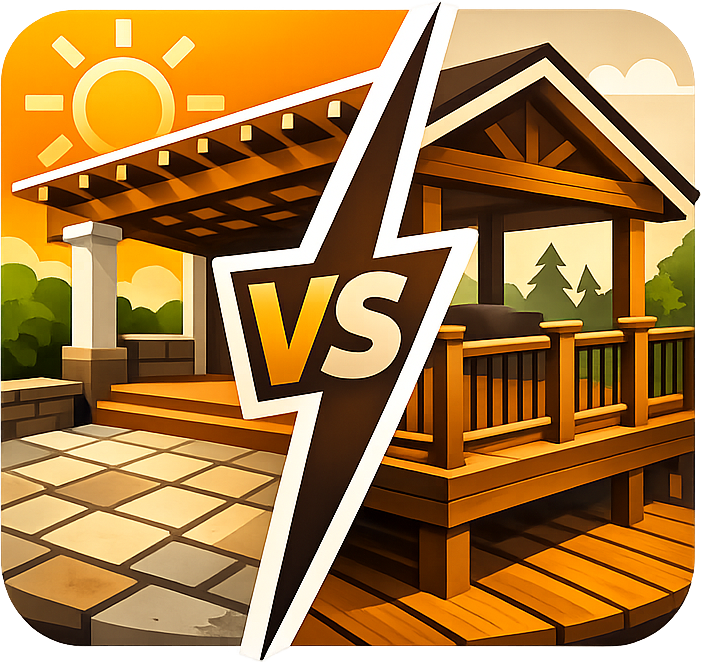
A patio is a ground-level hard surface sitting directly on or just above grade, while a porch is a covered, roofed structure attached to the front, side, or rear of the house. Those two differences, ground level versus attached-and-covered, explain almost every practical distinction between them. Decks sit above grade on a frame, and balconies hang off an upper floor. Knowing which category fits your yard, your home's layout, and how you actually spend time outside narrows the decision fast.
Patio vs Porch: Differences, Costs, and Which to Build

Miles Hart
28 Apr 2026
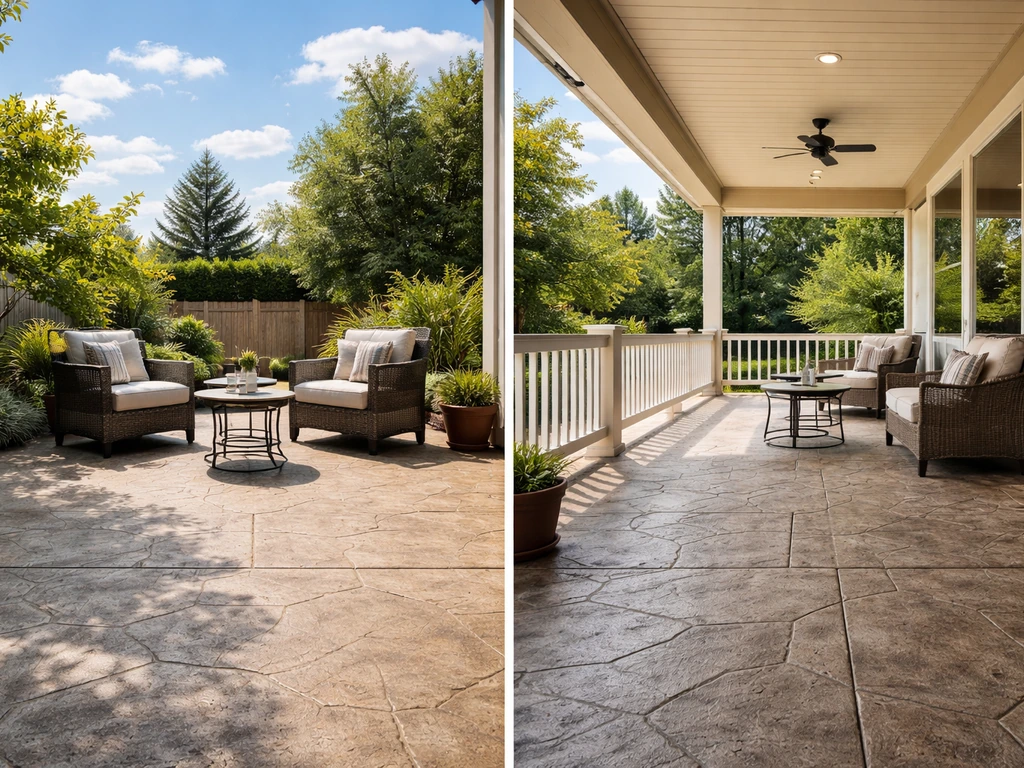
Definitions and quick visual differences
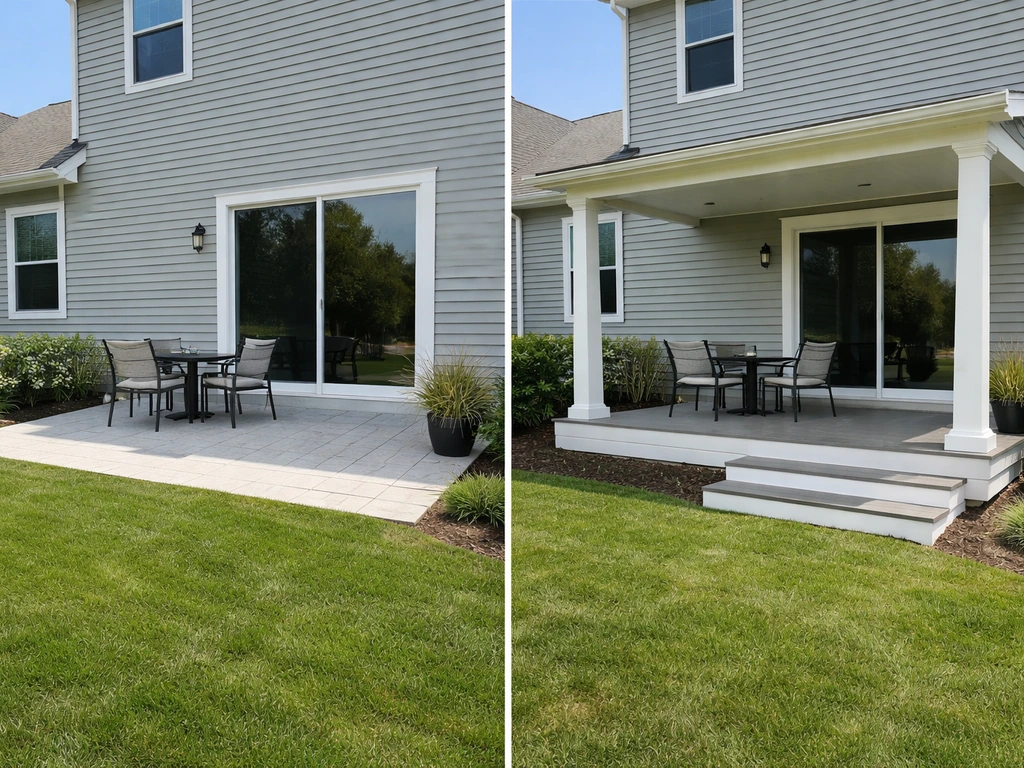
These four terms get mixed up constantly, often because homes blend features from more than one category. Here's how to separate them cleanly.
Patio
A patio is a hard-surface outdoor floor installed at or very close to ground level, typically within 6 inches of grade. It can abut the house or sit freestanding in the yard. It has no structural roof, though you can add a pergola, shade sail, or patio cover later. Common materials include concrete, pavers, natural stone, and brick. Because it sits on the ground, no ledger board attaches to the house framing, which keeps construction simpler and usually means fewer permit requirements.
Porch
A porch is a covered outdoor platform attached directly to the house, with its roof tied into or supported by the main structure. Most porches sit at or near the entry level of the home, though rear porches exist too. The defining feature is the overhead roof, which is part of the home's architecture rather than an add-on. Screened porches and three-season rooms are extensions of this idea. Because the roof connects to the house framing, construction is more involved and permits are almost always required.
Deck
A deck is an elevated platform built on a structural frame, usually wood or composite, that attaches to the house via a ledger board. It can be ground-adjacent or several feet in the air. Decks are typically uncovered, though adding a roof converts them closer to porch territory. The key distinction from a patio is that a deck is raised and framed rather than set on grade. A quick rule of thumb is that lanai-style spaces are typically closer to patio territory when they sit at or near grade and are open by default.
Balcony
A balcony projects from an upper floor of the home, cantilevered or supported by posts, with a railing on the open sides. It's always elevated, typically accessed through a door on the second floor or higher, and is smaller than a deck or patio because the structural load requirements get more demanding at height. Comparing a terrace, balcony, and patio side by side can make it easier to pick the best fit for how you plan to use the space smaller than a deck or patio. The comparison between balconies and patios comes up most often in multi-story homes and condos.
| Feature | Patio | Porch | Deck | Balcony |
|---|---|---|---|---|
| Height | At grade (under 6 in.) | At entry level | Raised/framed | Upper floor |
| Roof/cover | None (add-on optional) | Integral roof | Usually none | Usually none |
| Attachment to house | None required | Structurally attached | Ledger-attached | Cantilevered/supported |
| Typical access | Any door or yard | Front/rear entry door | Rear door | Upper-floor door |
| Railing required | No | Sometimes | Yes if elevated | Yes (always) |
How each space actually gets used day-to-day
The structure you build shapes the activities it supports. A large patio handles a dining table, grill, and firepit without any awkward level changes. A covered porch works year-round in rainy climates because you stay dry, but the footprint is usually tighter. A deck gives you elevated sightlines and often better airflow in humid areas. A balcony is mostly about the view and a morning coffee spot rather than a party venue.
Patio: best for open entertaining and flexible layouts
Patios are the most layout-flexible option. You can zone them with rugs and furniture into distinct dining, lounge, and cooking areas. They work especially well in dry climates where sun is the bigger problem than rain. Adding a freestanding pergola or a patio cover later (covered under the IRC's Appendix H for patio cover construction) lets you get shade without committing to a full roofed structure upfront. If you like rearranging furniture seasonally or want room for large gatherings, a patio gives you the most open canvas.
Porch: best for curb appeal, year-round use, and covered relaxation
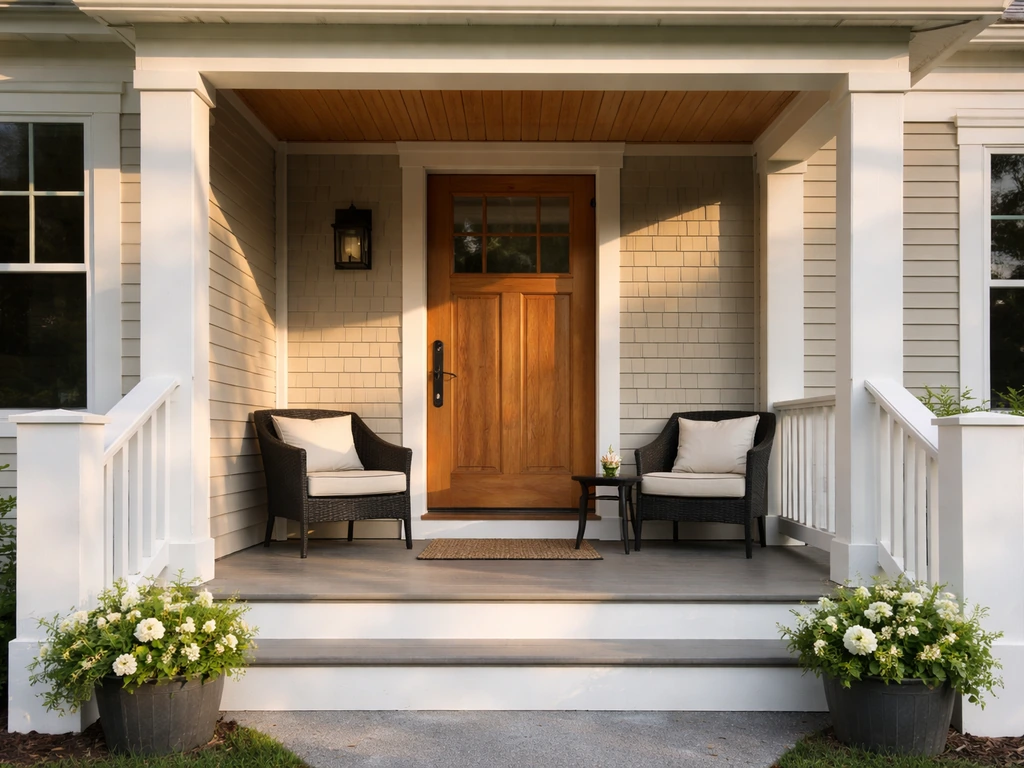
A front porch is fundamentally about the entry experience and street presence of your home. A rear porch works well for morning coffee or evening reading in weather that would otherwise push you inside. Screened porches extend the season in bug-heavy climates dramatically. The trade-off is that the roof limits direct sunlight and the footprint tends to be narrower, so a porch rarely doubles as a dining and entertaining hub unless it's generously sized.
Deck: best for sloped lots and elevated views
If your backyard drops away from the house, a deck is often the only way to create usable flat space at the same level as your door. Decks also ventilate well underneath, which matters in humid regions. The material choice, pressure-treated lumber, composite, or hardwood, affects maintenance commitment significantly. A composite deck at $50 to $75 per square foot installed will outlast treated pine with almost no upkeep, but the upfront cost is considerably higher.
Balcony: best for views and private retreats
Balconies suit two-story homes where the main outdoor living happens one floor up, or properties with a view worth framing. They're intimate spaces, typically 40 to 80 square feet, so they work best as solo or couple retreats rather than gathering spots. If you're in a multi-story home and the yard below isn't usable for a patio, a balcony can be the only viable outdoor space.
Placement, construction, and coverage basics
Where each structure sits on your property and how it connects to your home determines both what's possible and what the building process looks like.
Site and attachment
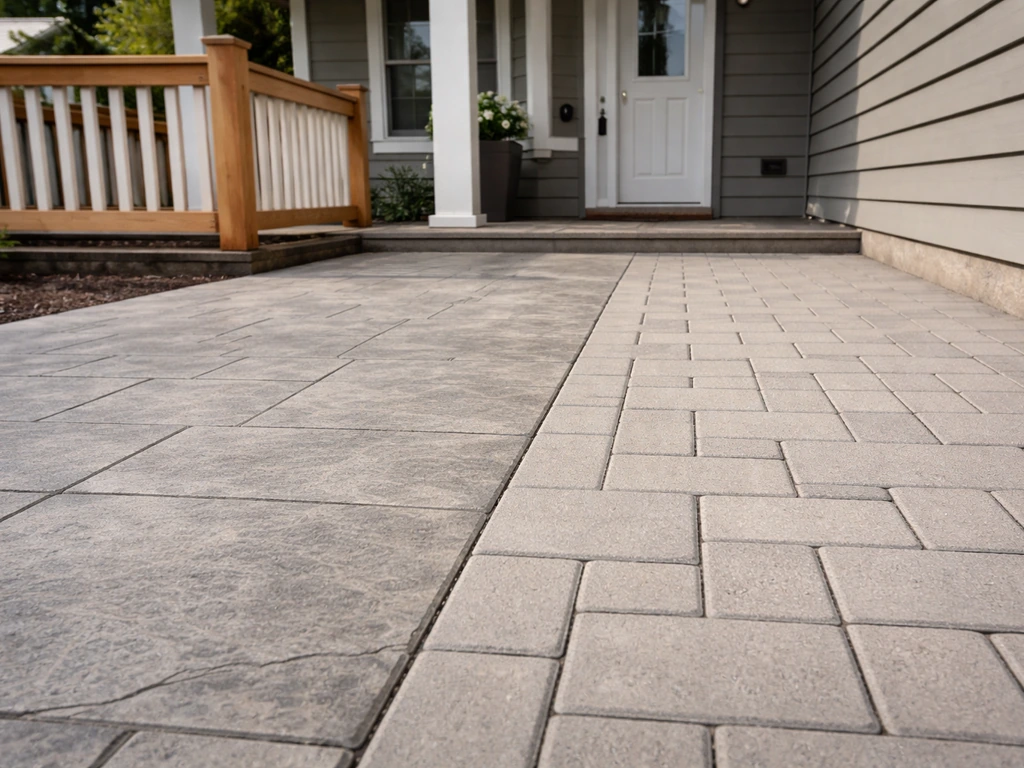
Patios need reasonably level ground or minor grading. They should slope away from the foundation at about 1/8 inch per foot to handle drainage. A typical municipal code treats a patio as a ground-level surface no more than 6 inches above grade, and it can sit within 12 inches of the house without being classified as a structure, which is why many patio projects skip the permit process. Porches attach structurally to the house wall and usually require that the existing foundation and framing can support the added load. Decks attach via a ledger bolted to the rim joist of the house, and that connection point must be flashed carefully to prevent water intrusion. Balconies on existing homes often require a structural engineer review because you're adding load to an upper-floor framing assembly.
Flooring materials
Patios use concrete (poured or stamped), pavers, flagstone, or brick, all sitting directly on a prepared base of compacted gravel. Porches typically match the home's exterior style and use wood, composite decking, or concrete. Decks use wood or composite boards over the framing. Balconies often use composite or wood decking, though some use tile over a waterproof membrane when they're above conditioned space. Material choice affects both initial cost and long-term maintenance, and it should match the drainage requirements of each location.
Covering and roof options
Patios are open by default, but you can add a freestanding pergola ($3,000 to $10,000 for a basic kit) or commission a proper attached patio cover that follows the IRC's Appendix H guidelines for structural loading. Porches have a permanent roof that ties to the home, typically matching the main roof pitch and material. Adding a roof to a deck converts it from a simple deck project into a porch-like covered structure, which usually bumps it into a higher permit category. If year-round weather protection matters most, build the roof into the original design rather than adding it later.
Cost comparison and home value impact
Costs vary widely by region, materials, and scope, but the ranges below reflect typical installed prices across the U.S. in 2025 and 2026. These are starting points, not guarantees, and getting two or three local bids is always worth the time.
| Structure | Typical installed cost range | Average size | Estimated ROI at resale |
|---|---|---|---|
| Concrete patio | $6–$20 per sq ft | 200–400 sq ft | ~60–70% |
| Paver patio | $15–$35 per sq ft | 200–400 sq ft | ~60–75% |
| Wood/composite deck | $30–$75 per sq ft | 200–500 sq ft | ~65–75% |
| Front porch addition | $20,000–$60,000 total | 100–200 sq ft | ~50–70% |
| Screened porch | $25,000–$75,000 total | 150–300 sq ft | ~50–65% |
| Balcony addition | $15,000–$35,000 total | 40–80 sq ft | ~50–60% |
Patios consistently offer the lowest entry cost for outdoor living space. A basic concrete patio at 300 square feet runs $1,800 to $6,000 installed, making it the most accessible starting point for most homeowners. A paver patio at the same size might cost $4,500 to $10,500 but looks more premium and holds up better in freeze-thaw climates. Decks fall in the middle to upper range depending heavily on material choice. A porch addition or screened porch is a significant project that approaches a small room addition in cost, which is why the value return tends to be lower on a percentage basis even though it adds real living quality.
On the ROI side, all outdoor living additions return less than 100 cents on the dollar at resale, but they make the home more marketable and enjoyable while you own it. In markets where outdoor living is heavily valued, such as the Sun Belt, a well-done patio or deck can help a home sell faster even if the financial return on paper looks modest. A front porch has strong curb appeal value that's harder to quantify in ROI terms but genuinely moves the needle on first impressions.
Planning and permits: what to check before you start
Permit requirements vary by municipality, but the general rule is this: the more a structure attaches to your home and the more elevated it is, the more likely a permit is required. Many jurisdictions allow a simple ground-level patio to proceed without a permit because it sits under the height threshold and isn't structurally attached. Anything that attaches to the house, adds a roof, or is elevated above grade almost always needs a permit and often needs approved plans first.
New York City is a useful example of the typical workflow: deck and porch construction cannot begin until the Department of Buildings approves plans and issues a permit. That process can take weeks or months depending on the project and municipality. Building without a permit risks fines, forced removal, and complications at resale when a home inspector finds unpermitted work.
Key things to check before designing anything
- Local zoning setbacks: how close to the property line and house foundation can the structure sit?
- HOA rules: many HOAs restrict materials, colors, structure types, and even whether you can screen a porch
- Drainage: does your yard drain away from the house, or will a patio or deck trap water against the foundation?
- Utility lines: call 811 before any digging for patio bases, footings, or posts
- Load capacity for porches and balconies: the existing foundation and framing must be able to handle the new weight
- Railing requirements: decks and balconies above 30 inches typically require code-compliant railings with specific height and baluster spacing rules
- Impervious surface limits: some municipalities cap the percentage of your lot that can be covered by hard surfaces, which affects patio size
For porches and balconies especially, hiring a structural engineer for a one-time review is worth $400 to $800. They'll confirm whether the existing framing supports the addition and flag anything that needs reinforcement before a contractor touches a single board.
DIY vs. hiring a contractor
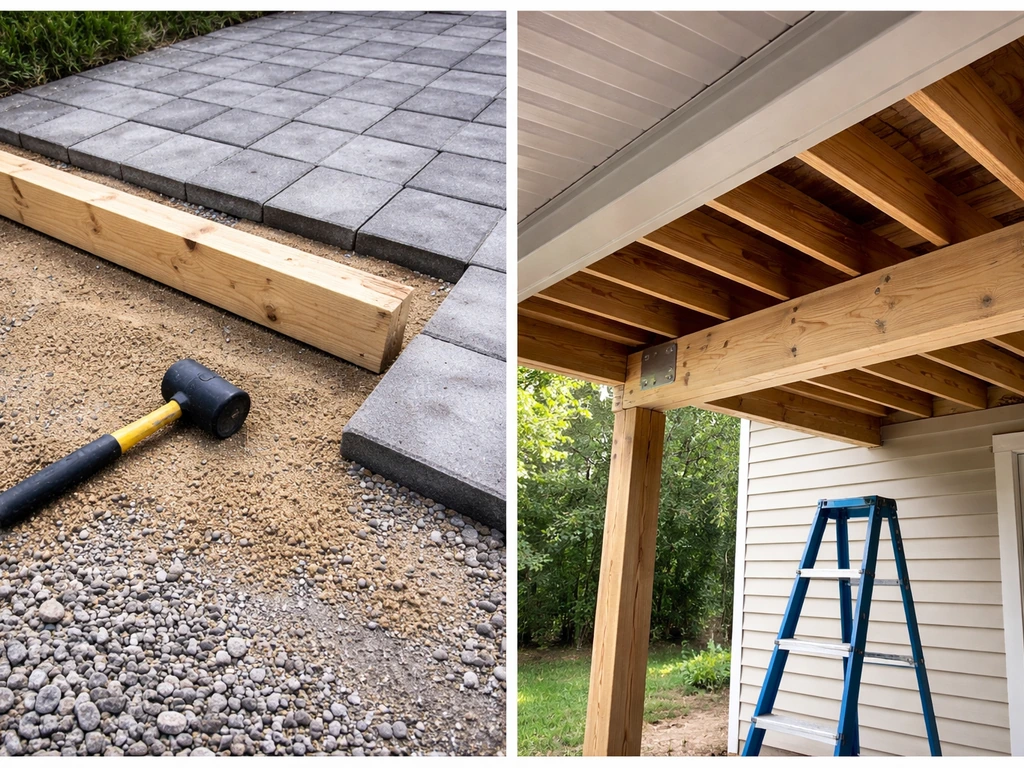
The honest answer is that patios are the most DIY-friendly outdoor project, decks are intermediate, and porches and balconies are generally contractor territory unless you have real construction experience.
What most homeowners can DIY
A paver patio on a prepared gravel base is one of the most popular and achievable DIY outdoor projects. The skills required are basic: excavate 6 to 8 inches, compact a gravel base, add sand, lay pavers, and sweep polymeric sand into the joints. A weekend project for an intermediate DIYer on a 200-square-foot area is realistic. Poured concrete is harder to DIY because timing is critical and mistakes are permanent. A simple concrete slab is doable if you've poured before, but most first-timers should hire a concrete contractor for anything over 100 square feet.
Where a contractor makes sense
Decks require accurate footing placement, proper ledger attachment with correct hardware and flashing, and joist sizing for spans. If you build it wrong, it fails inspection or, worse, fails structurally. Many homeowners with some carpentry experience can frame a ground-level deck, but anything elevated more than 2 feet is better handled by a licensed contractor who knows local code requirements. Porches are almost always contractor work: tying into the existing roof structure, ensuring the framing meets load requirements, and integrating the new structure with the home's exterior all require skills and tools that go beyond typical DIY scope. Balconies always need a contractor and likely a structural engineer.
| Project | DIY feasibility | Key skill needed | Typical savings vs. contractor |
|---|---|---|---|
| Paver patio | High | Basic grading and leveling | 40–60% |
| Poured concrete patio | Medium | Concrete forming and finishing | 30–50% |
| Ground-level wood deck | Medium | Framing carpentry | 30–40% |
| Elevated deck | Low | Structural framing, code compliance | 20–30% (risky without experience) |
| Porch addition | Very low | Roofing, structural work | Not recommended for DIY |
| Balcony addition | Not recommended | Structural engineering required | N/A |
Common confusion cases and how to decide fast
Several real-world scenarios blur the lines between these structures. Here's how to call it in each case.
"My backyard slopes, patio or deck?"
If the grade drops more than 12 to 18 inches within the first 10 feet of your door, a patio gets expensive fast because you're either regrading a large area or building a retaining wall. If your backyard slopes, compare the patio setup with a deck instead, since a deck often becomes more cost-effective once the grade demands fill or retaining walls patio or deck. A deck becomes more cost-effective once the slope requires significant fill or wall construction. If your yard drops 2 feet or more, build the deck.
"I want coverage but not a full porch project"
Build a patio and add a freestanding pergola or an attached patio cover. A patio cover that follows the IRC's Appendix H requirements gives you structural overhead coverage without the complexity of integrating a new roof into your home. It reads visually like a porch from the yard but is a much simpler project. This is a popular middle-ground solution that many homeowners land on.
"Is my existing slab a patio or a porch?"
If it has a roof that connects to the house, it's a porch, even if the floor is concrete. If it's under a freestanding pergola, it's still a patio. The roof attachment to the home's structure is what makes something a porch architecturally and legally in most codes.
"I live in a humid, buggy climate, which wins?"
A screened porch wins for day-to-day livability in hot, humid, bug-heavy regions like the Southeast. A patio with a pergola becomes unusable from May through September in those areas unless you're willing to fight mosquitoes constantly. The upfront cost of a screened porch is higher, but the usable hours per year justify it for people in those climates.
"I want street presence, patio or porch?"
A front porch is the only option that addresses street presence directly. A patio can be placed in front of the home, but without the roof and columns, it doesn't deliver the classic curb appeal that a porch does. If you want the home to read as inviting from the street, a front porch is the structure for that job.
Quick decision guide
- Flat yard, budget-conscious, flexible entertaining: build a patio
- Sloped yard, elevated views needed, humid climate: build a deck
- Year-round use, covered space, curb appeal, buggy climate: build a porch
- Two-story home, upper-floor outdoor access, view property: add a balcony
- Want coverage without a full porch project: patio plus pergola or patio cover
- Can't decide between deck and patio on a near-flat lot: if within 6 inches of grade, a patio is simpler and cheaper
If you're still on the fence after running through that list, the most useful next step is to sketch out your lot on paper, note where the sun hits different times of day, identify the doors you'd access the space from, and get two contractor bids for the top two options you're considering. Real numbers from your actual site narrow the decision faster than any comparison article can.
FAQ
If my porch floor is concrete instead of wood, does it still count as a porch?
Yes, but the details matter. If the “porch” floor is concrete yet it is structurally tied to the house and carries a roof integrated with the home’s structure, it functions as a porch. If it is only a roofless ground slab, it is still typically classified as a patio, even if it looks similar visually.
If I add shade to a patio, when does it become a porch-like project that needs permits?
A freestanding pergola or a shade sail usually does not trigger the same approval pathway as a roof tied into the house. If you later add posts and a roof that is engineered and treated as a patio cover, you may need permits depending on height, size, and attachment rules. When in doubt, ask your local building department whether “non-attached overhead cover” is treated differently than “attached roof.”
How should drainage work differently for a patio versus a porch?
For patios, the usual red flag is standing water. Ensure the surface slopes away from the foundation (the article mentions about 1/8 inch per foot) and keep the patio edge lower than adjacent door thresholds. A porch, by contrast, often has a roof that sheds water, so the drainage plan focuses on how gutters and roof runoff land near the structure.
What if the platform is elevated, but it is not a full deck, is it still a patio?
If the space is elevated but has no structural deck frame, it can still be treated differently than a deck depending on how it is supported. Many “terrace” or “lanai” spaces are near grade and open, but once you have a raised framed platform with ledger attachment, you are in deck territory. Use this practical check: is it built as a structural frame on posts/footings with joists, or is it a slab on grade with landscaping-style support?
Is a screened porch really worth it compared with a patio plus pergola in hot climates?
Screened porches and enclosures can be more expensive upfront, but the key decision is usable comfort. In humid, bug-heavy areas, screening often beats adding a pergola over a patio because it removes both insects and wind-driven rain, extending the season. If your main goal is sun shade only, a pergola over a patio is usually a more cost-effective first step than screening.
Does building a porch or balcony affect resale more than a patio if something goes wrong with waterproofing or permits?
Yes, attached roofs can complicate resale even when the addition is beautiful. Buyers and inspectors pay attention to how the new structure integrates with existing framing, flashing, and waterproofing at the house connection. If a porch or balcony was built without the required approvals, you may see issues during inspection even if it “looks done.”
What are the most common waterproofing mistakes when transitioning from the house to these outdoor spaces?
Look for how the space meets the building envelope. A deck, porch, or balcony that ties into the house needs proper flashing at connection points to prevent water intrusion, while a patio mainly relies on grade, slope, and surface drainage. If your design includes steps from the interior to the outdoor surface, also confirm the threshold height and weatherproofing details.
When does an uneven yard make a patio the wrong choice even if patio construction is simpler?
Patios are often the easiest to match existing landscaping because they can be freestanding and built on a prepared base. However, if your yard grade is uneven, you may still need grading or retaining work to keep the patio usable. A deck can be the better option when you need a new flat level right outside a door without extensive regrading.
What maintenance should I expect to differ the most between paver patios, concrete patios, and porches?
You typically still need to plan for cleaning and maintenance even for “low maintenance” materials. Pavers and natural stone require periodic joint replenishment and weed control, and concrete can crack and need sealing in freeze-thaw regions. Screened porches need maintenance around screens, caulking at trim, and roof drainage paths.
How do I explain my goals to contractors so they recommend the right option (patio vs porch)?
A good rule for choosing your first contractor conversations is to specify the “function,” then let them map it to a structure. For example, if you want a covered space that stays usable during rain, ask specifically about porch-type roof integration, and if you want open-air flexibility for furniture layouts, ask about patio zoning and whether a freestanding cover is sufficient. This prevents contractors from steering you toward what’s easiest for them instead of what matches your goals.
If I DIY a patio, what parts are most likely to cause long-term problems?
Yes. Even though patios are often considered more DIY-friendly, DIY mistakes most commonly involve base preparation and drainage, not just laying the pavers. The “buying materials” part is straightforward, but the success depends on correct excavation depth, compaction, and sloped layout so water does not undermine the base or settle unevenly.
How do I determine permit likelihood without relying on labels like patio or porch?
If the plan includes a roof that is connected to the house, expect a higher likelihood of a formal permit process. If the plan stays truly freestanding, for example a pergola not tied into the main structure, approvals may be simpler, but not universal. The safest approach is to ask for the permit classification by describing attachment points, not just the name “porch” or “patio.”