An EP Henry paver patio typically runs between $18 and $42 per square foot installed, with most mid-Atlantic homeowners landing somewhere in the $25–$34 range for a straightforward project. On a 400 square foot patio, that works out to roughly $7,200 on the low end, around $12,000 for a typical mid-grade install, and $16,000 or more for premium paver styles, complex patterns, or difficult sites. EP Henry products themselves are a branded line of concrete pavers sold through dealers in the Northeast and Mid-Atlantic, so your material cost is baked into that installed number, but labor, site prep, and add-ons are where budgets most often surprise people.
How Much Does an EP Henry Patio Cost? Price Ranges & Budgets

Miles Hart
30 Jul 2026
Typical EP Henry patio costs at a glance
Before getting into the details, here is a quick snapshot of what you should expect to budget based on project size and scope. These figures reflect contractor-installed work in the Mid-Atlantic and Northeast markets where EP Henry products are most widely available, using mid-grade paver selections and standard site conditions.
| Patio Size | Low Estimate | Typical Estimate | High Estimate |
|---|---|---|---|
| 144 sq ft (12×12) | $2,600 | $4,300 | $6,000 |
| 320 sq ft (16×20) | $5,800 | $9,600 | $13,400 |
| 400 sq ft (20×20) | $7,200 | $12,000 | $16,800 |
| 400 sq ft (general) | $7,200 | $11,600 | $16,800 |
Per square foot, the national installed range for pavers runs about $14–$33 in typical residential markets, with coastal metros like San Diego commonly hitting $21–$52 per square foot and Los Angeles showing a wide band of $9–$28 depending on material tier and installer. In Northern Virginia and the broader Mid-Atlantic corridor where EP Henry is a dominant brand, reputable contractors commonly quote $18–$42 per square foot, with everyday project centers clustering around $28–$34. If someone quotes you $12 per square foot for a fully installed EP Henry patio, the base prep is almost certainly being cut short.
What actually drives the price of an EP Henry paver patio
The installed cost of any paver patio is shaped by five main variables: the paver product you choose, the pattern complexity, the patio size, site preparation requirements, and local labor rates. Understanding each one helps you evaluate quotes and make smarter trade-offs.
Paver product selection
EP Henry offers a wide product range, from thinner, simpler concrete pavers to thick architectural slabs and natural-look products like DevonStone and Coventry Brick Stone. Material costs vary meaningfully across the line. Dealer pricing is not publicly listed, but contractors typically pay per cube and convert that to a per-square-foot material cost. As a reference point, EP Henry's catalog lists coverage data like 'SF per cube' for each product, DevonStone saw-cut sizes range from 88 to 176 SF per cube depending on piece size, while Coventry Brick Stone is roughly 120 SF per cube. Once you know dealer cube pricing in your area, you can back-calculate material cost per square foot. In practice, EP Henry paver material alone tends to cost $3.50–$9.00 per square foot before installation.
Pattern complexity and cuts
A simple running-bond or stack-bond pattern in a rectangular space costs less to install than a herringbone, basketweave, or multi-piece modular pattern. More cuts mean more labor time and more material waste. EP Henry's Three-Piece Modular system, for example, creates a natural, varied look but involves multiple paver sizes that need to be sequenced correctly. Expect pattern complexity to add $2–$5 per square foot to labor costs compared to a basic single-size grid install.
Size and shape of the patio
Larger patios generally cost less per square foot than small ones because mobilization, setup, and base-prep equipment costs are spread across more area. An irregular shape with many angles and curves increases cut waste and labor time, pushing per-square-foot costs up. A clean 20x20 rectangle almost always prices out better per square foot than a winding 400-square-foot freeform space.
Site preparation and soil conditions
This is the single biggest hidden cost variable. ICPI best practices call for 4 inches of compacted bedding plus 4–6 inches of compacted dense-graded aggregate base (crusher run) for a standard pedestrian patio. Poor soils, clay-heavy lots, or any area with drainage problems require deeper excavation and potentially geotextile fabric (EP Henry's installation guide specifically calls out Mirafi 500x for separation between subgrade and base). If you have a sloped yard or wet site, your base costs can easily double. Contractors who skip this step to win a bid are setting you up for settled pavers in three to five years.
Labor rates in your market
Labor typically accounts for 30–50% of the installed cost. In lower-cost rural or Midwest markets, labor rates are lower and installed totals may approach the $14–$18 per square foot floor. In metro areas, Northern Virginia, Philadelphia, New Jersey (all core EP Henry markets), Boston, or any coastal city, labor rates are higher and $25–$40 per square foot is routine. Always get at least three quotes from installers who have experience with EP Henry products specifically, as product familiarity affects installation speed.
Detailed cost breakdown: line by line
Every EP Henry patio quote should be buildable from the same core line items. Here is what each one covers and what it typically costs in 2026.
| Line Item | Typical Unit Cost | Notes |
|---|---|---|
| Excavation / demolition | $1.50–$4.00/sq ft | Deeper digs, hard soil, or removing existing concrete add cost |
| Compacted aggregate base (crusher run) | $3.00–$5.50/sq ft | Crusher run delivered nationally runs ~$20–$45/yd³; depth drives quantity |
| Geotextile fabric (Mirafi 500x) | $0.30–$0.75/sq ft | EP Henry recommends for separation on poor subgrades |
| Bedding sand | $0.50–$1.00/sq ft | Typically 1 in compacted layer under pavers |
| EP Henry paver material | $3.50–$9.00/sq ft | Varies by product line; thicker architectural pavers toward high end |
| Edge restraint (Snap Edge) | $1.00–$2.50/ln ft | Required at all free edges to prevent spread |
| Cutting and fitting | $1.50–$4.00/sq ft | More complex patterns and curved edges cost more |
| Polymeric jointing sand (Techni-Seal) | $2.00–$5.00/sq ft | Material + install; retail bag pricing ~$25–$60/bag for quality products |
| Labor / finish / cleanup | $6.00–$14.00/sq ft | Largest single variable by market |
| Paver sealer (optional but recommended) | $1.50–$4.00/sq ft | Material cost; sealing service typically $2–$4/sq ft installed |
| Drainage / French drain (if needed) | $25–$100/ln ft | Site-specific; not all projects need this |
| Permits (where required) | $50–$500+ | Varies by municipality; some jurisdictions require for any hardscape |
Adding these up for a standard project: on a 400 sq ft patio with average soil conditions, a mid-grade EP Henry paver, and a running-bond pattern, you would typically see excavation and base at $1,800–$3,800, paver material at $1,400–$3,600, labor at $2,400–$5,600, and finishing items (polymeric sand, sealer, edge restraint) at $1,200–$2,800. Polymeric jointing sand retail pricing (2026) commonly ranges $13–$85 per 40–50 lb bag (typical pro-grade retail $25–$60/bag), and professional installers often budget roughly $2–$5 per sq ft for installed polymeric sand (material + install). That gets you to a realistic all-in range of $6,800–$15,800 before any add-ons. EP Henry's installation guide strongly recommends Techni-Seal polymeric sands and sealers as part of a complete install, skipping the sealer is a personal choice, but skipping the polymeric joint sand is not recommended.
Regional and site-specific cost drivers
Where you live and what your specific lot looks like both push costs in meaningful ways. The same 400 square foot patio can cost dramatically different amounts depending on these factors.
- Soil type: Sandy, well-draining soil is cheapest to excavate and build on. Heavy clay or expansive soils require deeper bases and sometimes geotextile fabric, adding $1–$3 per square foot to base costs.
- Slope: A flat lot is the easiest and cheapest case. A sloped yard often requires cut-and-fill grading, retaining walls, or step systems — all of which add cost quickly. A retaining wall to level a patio area can add $5,000–$15,000+ depending on height and length.
- Access: If a skid steer or mini excavator cannot reach the work area (a tight side yard, a fenced backyard with a narrow gate), all material must be moved by wheelbarrow and hand. That adds labor hours and cost.
- Demolition: Removing an existing concrete patio or old paver system costs $1–$3 per square foot for the demo itself, plus disposal fees that vary by region.
- Climate: Freeze-thaw climates (common in the Northeast and Mid-Atlantic where EP Henry operates) require properly deep bases to prevent frost heave. Contractors who under-build in these markets create failure. Deeper required bases mean more crusher run and more excavation cost.
- Local labor rates: A homeowner in suburban New Jersey will pay more per hour for the same skill level than one in rural Pennsylvania. Metro premiums of 20–40% over regional averages are common in major cities.
- Proximity to EP Henry dealers: EP Henry products are distributed through regional dealers, mostly in PA, NJ, DE, MD, VA, and the broader Northeast. If your contractor needs to ship product farther, delivery costs rise.
Example budgets for common patio sizes
Here are realistic budget ranges for four common patio sizes. Low estimates assume flat sites, easy access, standard pavers, and simple patterns. High estimates reflect premium paver selections, complex patterns, moderate site challenges, and coastal or metro labor rates. These are all-in installed costs including base, labor, polymeric sand, and edge restraint, but excluding add-ons like steps, walls, or drainage systems.
| Size | Square Footage | Low | Typical / Mid | High |
|---|---|---|---|---|
| 12 × 12 ft | 144 sq ft | $2,600 | $4,300 | $6,000 |
| 16 × 20 ft | 320 sq ft | $5,800 | $9,600 | $13,400 |
| 20 × 20 ft | 400 sq ft | $7,200 | $12,000 | $16,800 |
| 20 × 20 ft (premium add-ons) | 400 sq ft | $12,000 | $16,000 | $22,000+ |
The 12x12 patio is a good benchmark: it is roughly the minimum size for a usable outdoor dining space for two, and at 144 square feet, contractor mobilization costs make the per-square-foot rate higher than on larger projects. Do not be surprised if a 12x12 quotes at $30–$42 per square foot even when a 20x20 by the same contractor comes in at $25–$34. The fixed costs of getting equipment to your site are spread across fewer square feet.
Upgrades and add-ons: what they cost and whether they are worth it
Most EP Henry patio projects include at least one or two add-ons. Here is what each one typically costs and what you are actually getting.
Decorative borders and soldier courses
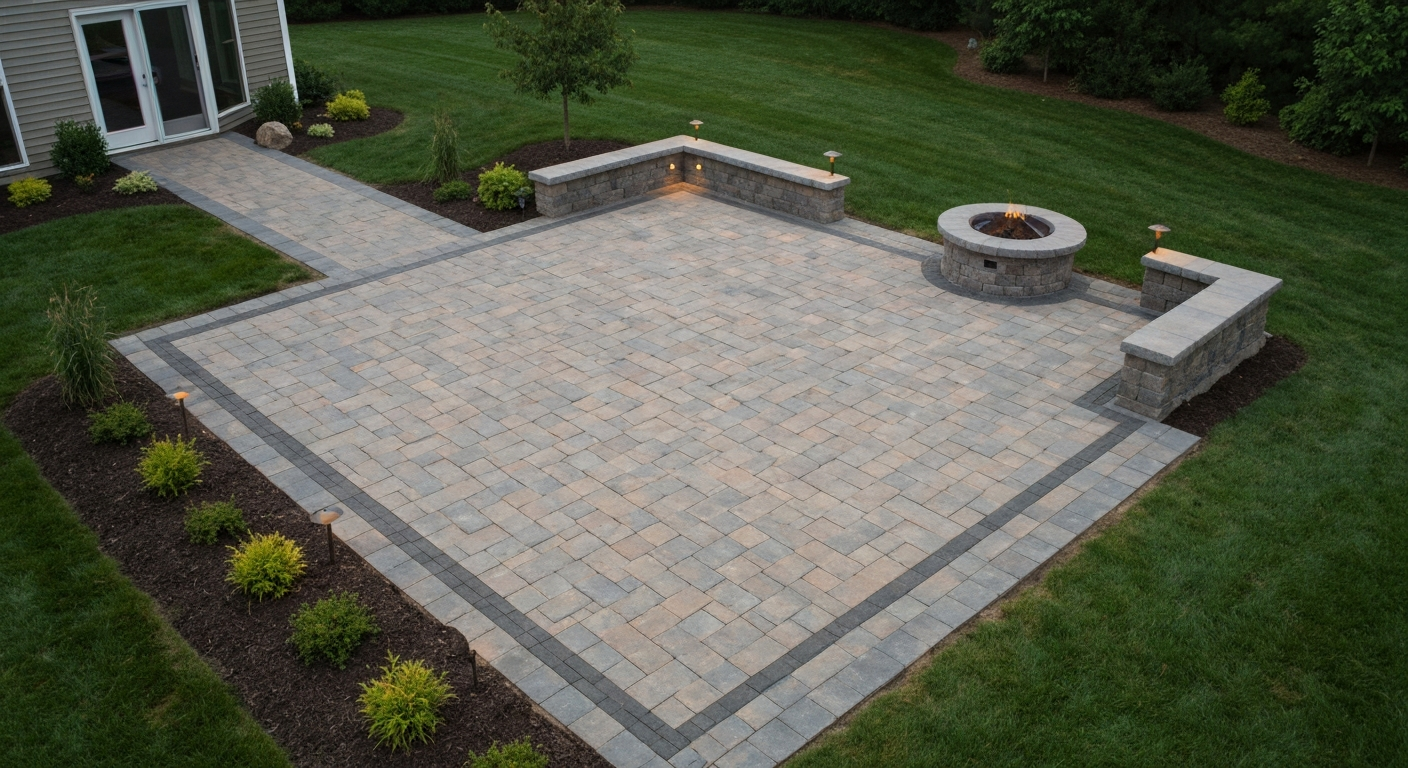
A contrasting paver border framing the patio perimeter is a popular upgrade. Expect to pay $25–$50 per linear foot for a single-course border. On a 20x20 patio (80 linear feet of perimeter), that adds $2,000–$4,000. It looks sharp, defines the space cleanly, and is worth it if the budget allows, but it is purely aesthetic.
Steps
If your patio is elevated from the yard or connects to a door threshold, EP Henry wall block or bullnose step pavers are commonly used. Steps typically run $75–$200 per linear foot or per step depending on width, material, and the number of risers. A single wide landing step on a 6-foot-wide opening might cost $600–$1,200. A full three-step entry sequence could run $2,000–$5,000 depending on width and material.
Integrated lighting
Low-voltage in-paver or border lighting adds ambiance and safety, but it adds meaningful cost. Recessed paver lights typically run $100–$300 per fixture installed, including wire runs. A modest lighting scheme for a 400 sq ft patio (eight to twelve fixtures) can add $1,500–$4,000 to the project. The electrical conduit needs to be stubbed in before the base goes down, so lighting decisions need to be made at the design stage, not after.
Fire pits
A built-in paver fire pit using EP Henry wall block or matching paver material typically costs $1,500–$5,000+ depending on size, whether it is gas or wood-burning, and whether a gas line needs to be run. A gas fire pit requiring a new gas line run from the house adds another $500–$1,500 for the plumbing and permits. Prefabricated insert fire pits in a custom paver surround are a middle-ground option that often costs $2,000–$3,500 installed.
Retaining walls
If your lot is sloped, a retaining wall may not be optional, it may be what makes the patio viable. EP Henry produces wall block systems designed to work alongside their paver products. Retaining wall costs vary enormously by height, length, and engineering requirements. Simple gravity walls under 3 feet typically run $25–$50 per square face foot. Taller walls requiring geogrid reinforcement, engineered footings, or permits can reach $50–$100+ per square face foot. A 30-foot-long wall at 2 feet of exposed height is a meaningfully different project than one at 4 feet, always ask your contractor to separate the wall quote from the patio quote.
Seating walls
Low seating walls (typically 18–24 inches high) built from EP Henry wall block with a capped top create permanent bench seating around a patio or fire pit. These run $50–$120 per linear foot installed. A 20-foot seating wall adds $1,000–$2,400, which is competitive with quality outdoor furniture while being permanent and maintenance-free.
Patio rooms, patio extensions, and enclosures: how the pricing shifts
A lot of homeowners start researching EP Henry patios and then start wondering whether they should extend an existing patio, enclose it, or convert it into a full patio room or sunroom. These are genuinely different projects with different cost structures, so it is worth understanding how they compare.
Patio extensions
Extending an existing paver or concrete patio follows the same per-square-foot logic as a new patio, excavation, base, pavers, labor. If you are matching an existing EP Henry paver pattern, you need to source the same product and batch (color variation between batches can be noticeable), which is easier if you have leftover pavers stored or if the product is still in production. A simple square-footage extension onto a flat, accessible area typically costs $18–$35 per square foot installed using matching materials, similar to a new standalone patio at the same tier. For a quick estimate of how much for patio extension, see our patio extension cost guide for typical per-square-foot ranges and example budgets. The complication is matching existing grading and drainage, which can add 10–20% to cost if the original patio was not graded with future extension in mind.
Patio rooms (framed, roofed structures)
A patio room is a covered outdoor structure built over or adjacent to an existing patio, think a pergola with walls, a solid-roof addition, or a four-season room built on a paver or concrete slab. The framing and roofing component alone typically runs $150–$450 per square foot for a professionally installed insulated patio room or prefab enclosure system, which is dramatically more than the paver surface underneath it. A 200 square foot patio room can cost $30,000–$90,000 depending on finish level, insulation, HVAC, windows, and whether it is attached to the house structure. This is a very different budget conversation from a $10,000 paver patio.
Sunroom conversions and screened enclosures
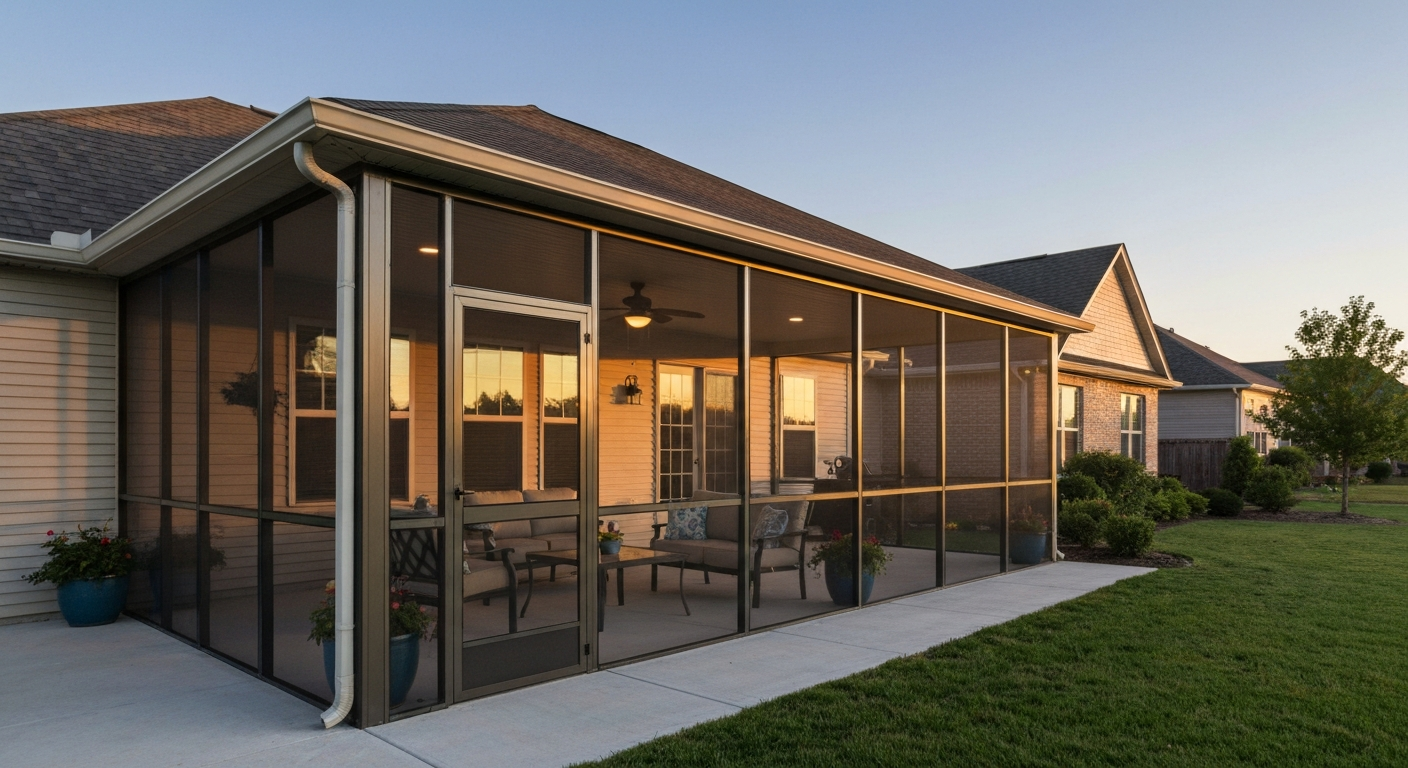
Enclosing an existing patio with screens, glass, or a full four-season sunroom conversion involves construction well beyond what a paver contractor typically handles. Screened patio enclosures generally run $4,000–$14,000 for a basic aluminum-framed screen room on an existing slab, with costs climbing sharply for larger footprints or structural modifications to the house. For detailed pricing and scope, see our guide on how much to enclose a patio with screen which breaks down typical costs, materials, and installation factors. Converting a patio to a three-season or four-season sunroom involves permits, foundation work, framing, glazing, electrical, and often HVAC, putting costs in the $30,000–$100,000+ range for a proper installation. These are adjacent decisions worth researching separately once you have decided your paver patio scope.
How to choose: paver patio, extension, screened enclosure, or patio room
These four options serve different needs and come at very different price points. Here is a practical way to think through the decision.
| Option | Typical Cost Range | Best For | Key Trade-Off |
|---|---|---|---|
| EP Henry paver patio | $18–$42/sq ft installed | Outdoor entertaining, dining, open-air living | No weather protection; needs maintenance over time |
| Patio extension | $18–$35/sq ft installed | Expanding an existing space that feels too small | Matching existing materials and grading can complicate pricing |
| Screened enclosure | $4,000–$14,000 total | Bug and UV protection without full enclosure cost | No weatherproofing; not usable in cold/rain |
| Patio room / sunroom | $30,000–$100,000+ | Year-round usable space, added living square footage | Highest cost; permitting, construction complexity |
If your primary goal is outdoor entertaining and you live in a climate where you can use the space 6–8 months of the year, a well-built EP Henry paver patio is almost always the best value. If bugs and sun are your main complaint, a screened enclosure at a fraction of a sunroom's cost makes sense. If you are genuinely adding living space and want something usable year-round, a patio room is the right direction but you need to budget accordingly. These are not competing options so much as different tools for different problems.
DIY vs. hiring a contractor
A determined DIYer can install EP Henry pavers, and the company provides installation documentation to support this. But there are some honest limitations to flag. The base preparation phase requires a plate compactor (rental typically $80–$150 per day), a way to bring in and spread crusher run, and careful attention to grade and drainage slope. Getting this wrong is the primary cause of paver failure, and it is hard to fix after the fact without lifting the entire surface. Paver cutting requires a wet saw or angle grinder with a diamond blade. If you can handle those requirements, material-only costs run roughly $5–$15 per square foot depending on your EP Henry product selection, meaning DIY saves you the $10–$20 per square foot in labor that contractors charge. On a 400 square foot patio, that is a potential savings of $4,000–$8,000. The trade-off is time (typically a full weekend or more for a competent DIYer on a 400 sq ft project), physical labor, and the risk that base work done incorrectly leads to costly re-installs.
Lifespan, maintenance, and home value impact
A properly installed EP Henry paver patio, built to ICPI specifications with a correct base depth for your climate zone, should last 25–50 years with normal maintenance. The biggest maintenance items are: re-applying polymeric joint sand every 5–10 years as joints wear, resealing every 3–5 years with a product like Techni-Seal, and resetting any individual pavers that settle (which is easy to do without disturbing the rest of the surface). Paver sealer (Techni‑Seal and comparable brands) retail: typical sealer coverage/pricing leads to roughly $1.50–$4.00 per sq ft in material cost (sealer per gallon $20–$60 depending on product and finish) and many pros price sealing services at roughly $2–$4 per sq ft installed Paver sealer (Techni‑Seal and comparable brands) retail: typical sealer coverage/pricing leads to roughly $1.50–$4.00 per sq ft in material cost (sealer per gallon $20–$60) and many pros price sealing services at roughly $2–$4 per sq ft installed.. Weeds growing in joints are the most common complaint and are almost always a sign that polymeric sand was applied incorrectly or is overdue for replacement. On home value, patio improvements generally return 50–70% of project cost at resale according to remodeling industry surveys, with the caveat that a well-designed, well-built outdoor living space in a desirable neighborhood can return more. A paver patio is also a more durable and visually distinctive upgrade than poured concrete, which can work in your favor at resale.
Practical tips to reduce cost without cutting corners
- Choose a rectangular or simple L-shape rather than curved or freeform: fewer cuts, less material waste, faster installation.
- Stick to a single paver size and a simple pattern like running bond for the field, and save the contrasting border for just the perimeter if you want visual interest.
- Get quotes in the off-season (October through February in the Northeast): many EP Henry installers discount work during slower months.
- Ask contractors to separate base prep as a line item in the quote — if it is buried in an overall number, you cannot tell if it is being done correctly.
- Handle your own permit application where the process is straightforward: municipalities typically allow homeowners to pull their own permits, which saves the contractor's markup.
- If drainage is an issue, address it before the patio install rather than after — a French drain installed during the project costs far less than ripping up finished pavers to fix a drainage problem later.
- Source your own sealer: EP Henry installers often mark up Techni-Seal products. Purchasing a sealed unit separately and having it applied adds negligible cost complexity while reducing markup.
Permits and timeline: what to expect
Permit requirements for paver patios vary widely by municipality. In many jurisdictions, a ground-level paver patio that does not attach to the house structure does not require a permit. In others, any hardscape over a certain square footage (often 200–400 sq ft) does. If your patio includes walls over 18–24 inches, steps connecting to the house, or drainage work, the permit threshold is lower. Budget $50–$500 for permit fees if required, and add 2–4 weeks to the project timeline for permit approval. Timeline for installation itself: a straightforward 400 sq ft patio takes a crew of two to three experienced installers approximately 3–5 days from excavation to final compaction. Add 1–2 days if sealing is done after an initial cure period for polymeric sand (typically 24–48 hours after installation, weather permitting).
FAQ
How much does an EP Henry paver patio cost per square foot and total for common sizes?
Installed EP Henry paver patios typically range from about $14 to $42+ per sq ft depending on material, site work, and region. National/midrange examples: $18–$34/sq ft is a common contractor baseline; urban/coastal markets can be higher ($22–$52+/sq ft). Example total estimates: 200 sq ft: $2,800–$10,400; 400 sq ft: $5,600–$16,800; 600 sq ft: $8,400–$25,200. (Sources: HomeAdvisor, HomeGuide, regional contractor guides and industry estimator breakdowns.)
What are the main line‑item costs that make up an EP Henry patio quote?
Typical contractor line items: 1) Site demolition/excavation: ~$1.50–$4.00/sq ft; 2) Compacted aggregate base (crusher‑run/DGAB): ~$3.00–$5.50/sq ft (deeper for poor soils); 3) Bedding sand + paver material (EP Henry product): ~$3.50–$9.00/sq ft (material varies by style/finish); 4) Labor/installation (setting, cutting, compaction, cleanup): ~$6.00–$14.00/sq ft; 5) Polymeric joint sand & compaction: $2–$5/sq ft installed; 6) Edge restraint, cutting, small accessories: per project add. Add‑ons (seat walls, steps, borders) are separate. These bands produce typical installed ranges of ~$14–$33+/sq ft depending on choices and conditions (industry breakdowns, 2026).
How do material choices (EP Henry styles) change cost?
EP Henry product tiers matter: simple standard modular pavers are lower cost per sq ft; premium styles (natural‑look, large format, tumbled/antiqued finishes, multi‑color blends) cost more per cube and require more cutting and labor. EP Henry catalog includes 'SF per cube' and 'lbs per cube' to convert dealer cube pricing to $/sq ft — use the catalog cubing data to estimate material quantity and multiply by dealer cube price. Expect material+bedding swings of roughly $3.50 to $9+/sq ft for common to premium EP Henry selections. (Source: EP Henry catalog and local dealer pricing practices.)
How much should I budget for drainage and site‑specific work (French drains, grading)?
Minor regrading and basic slope correction often adds a few hundred dollars; discrete drainage features can add materially: French drains and catch basins commonly run $25–$100 per linear foot depending on depth/complexity. Difficult sites (bad soils, high water table, extensive root removal) can add thousands. Include a contingency of 10–25% for unexpected drainage/site fixes when getting bids. (Source: French drain cost guides and contractor notes.)
Do I need a geotextile, edge restraint, polymeric sand and sealer? How much do those add?
Yes — EP Henry’s technical guide recommends geotextile (e.g., Mirafi 500X) where required, Snap Edge or similar restraints, polymeric sands (Techni‑Seal or similar) and recommends sealing. Typical costs: geotextile and restraints are minor per‑sq‑ft additions but can be $100s per job; polymeric sand material and install ~$2–$5/sq ft; sealer material and application ~$1.50–$4.00/sq ft. Pros install these to meet warranty and durability expectations. (Source: EP Henry Technical Installation Guide; accessory pricing guides.)
What are realistic sample project budgets for common patio sizes using EP Henry pavers?
Conservative sample budgets (installed, inclusive of base, pavers, joint sand, edge, labor, basic grading): - Small 150 sq ft (bistro patio): $2,100–$6,300 - Typical 300 sq ft (family patio): $4,200–$10,200 - Large 600 sq ft (entertaining patio): $8,400–$20,400 Factor in add‑ons (walls, steps, lighting) separately — each can add $1,000s. Use the midrange bands ($18–$34/sq ft) to build a realistic local budget and adjust up for premium pavers or difficult site conditions. (Sources: aggregated contractor ranges and national estimator data.)},{
Next Article
How Much to Enclose a Patio with Screen: Cost Guide
How much to enclose a patio with screen: national $/sqft, DIY vs pro totals, material, permit & ROI guide