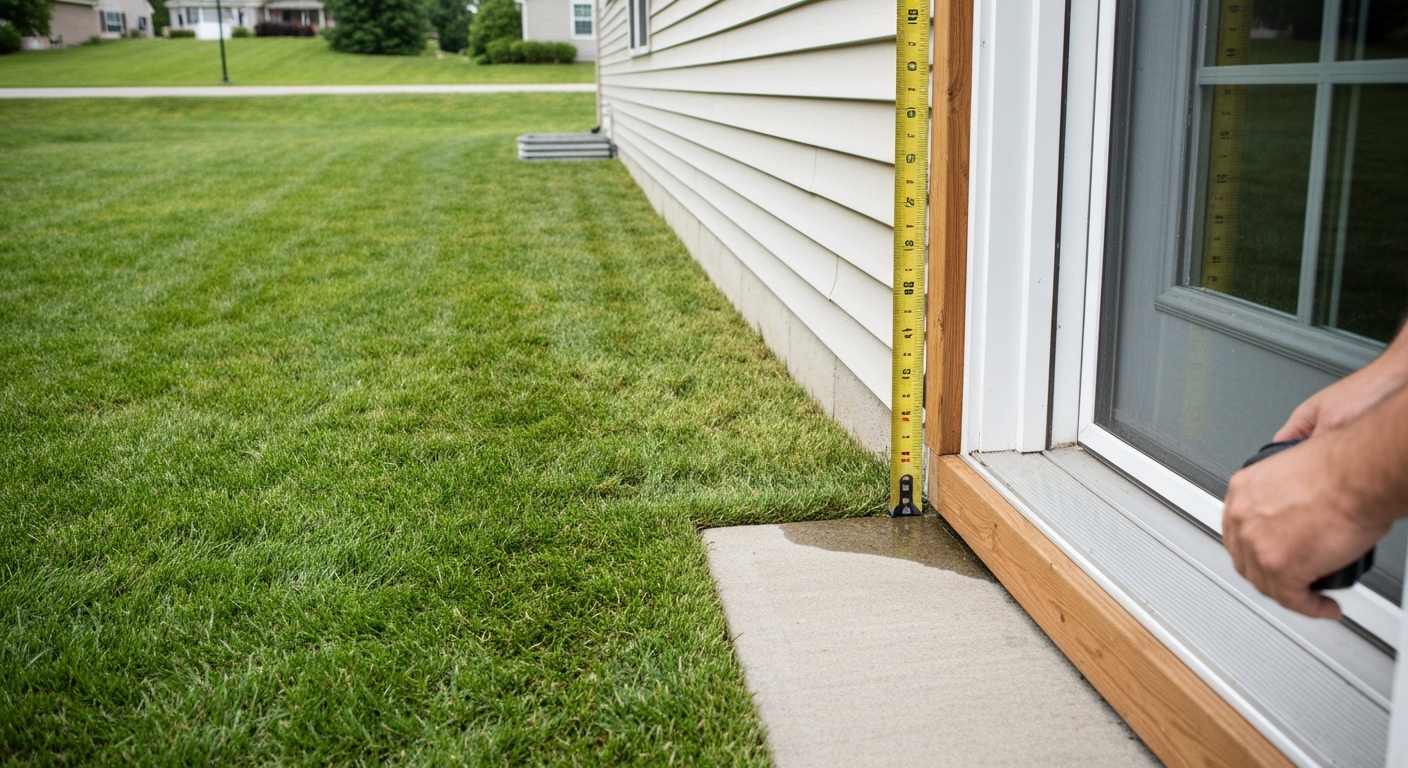
A wooden structure built over a patio is almost always called a patio cover. That's the term contractors use, permit offices recognize, and building codes define. If it's attached to your house and has a solid roof, some people call it a patio roof or porch roof instead. If it has an open, slatted top that lets light through, you're probably looking at a pergola.
What Do You Call a Wooden Patio Cover? Names and Options

Miles Hart
1 Jun 2026
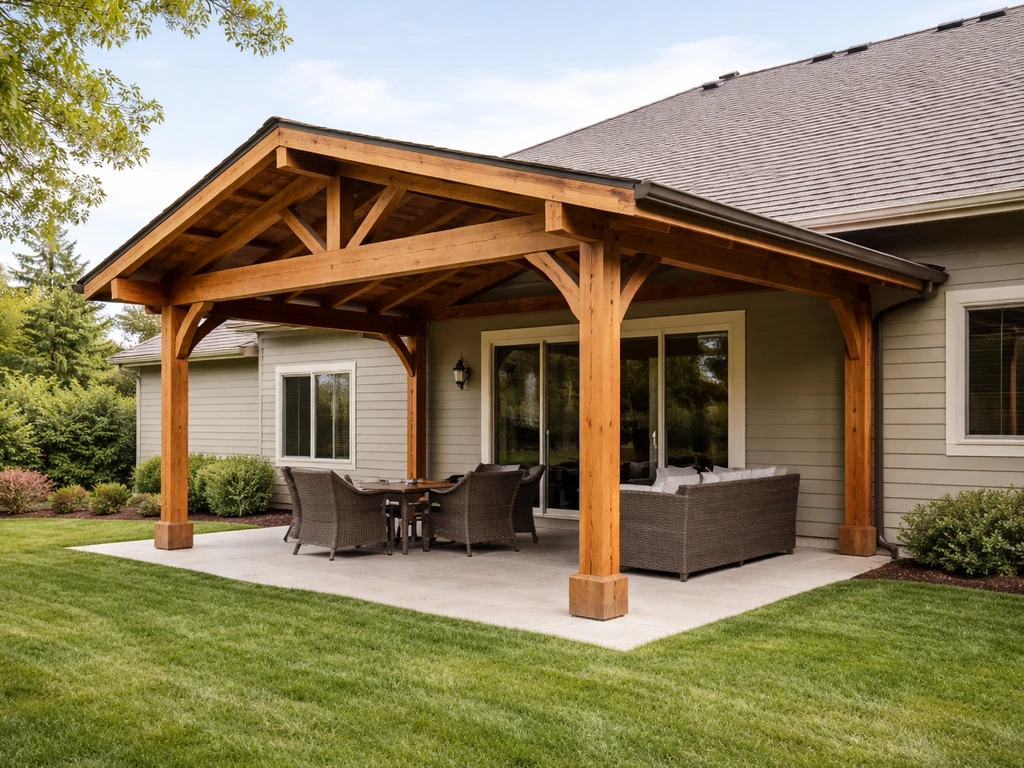
All of these names get used interchangeably in casual conversation, which causes real confusion when you're trying to search for one, get a quote, or pull a permit. Here's how to sort it out. Maple and ash patio vs dining room is usually about choosing the right wood species and finish so the new outdoor surface looks consistent with the rest of your home.
What people usually call it
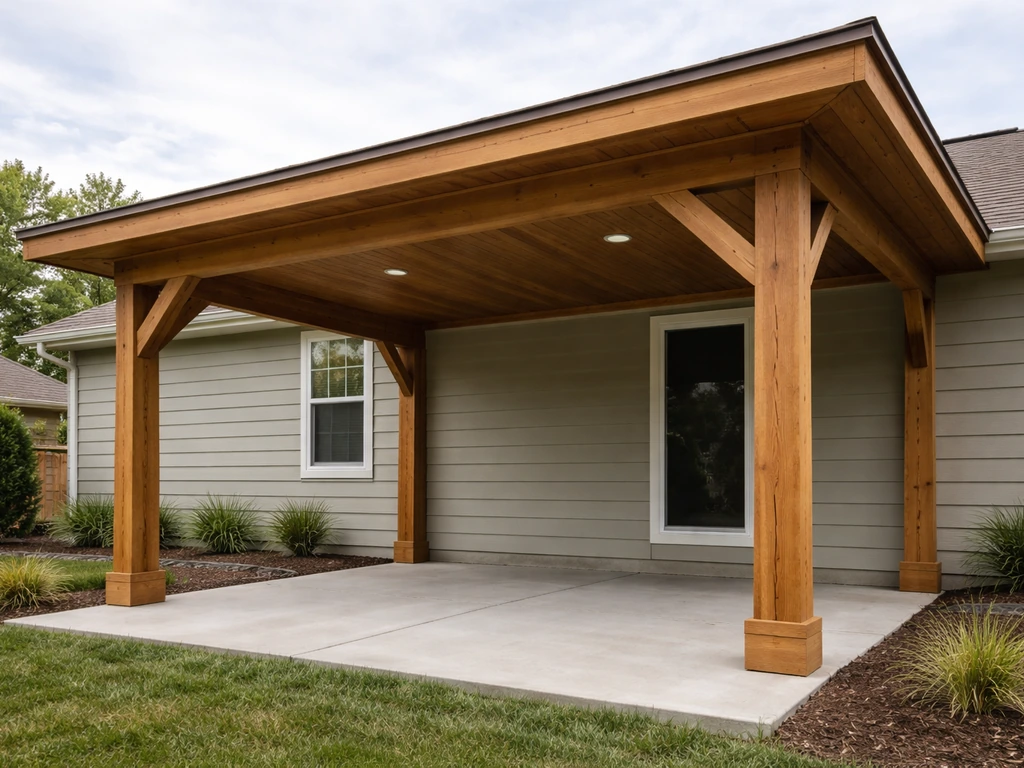
The most widely accepted term is patio cover. blank" rel="noopener noreferrer">Law Insider's building definition describes a patio cover as a one-story shade structure with a solid or open roof and structural supports, attached to or detached from the primary dwelling, used for recreational and outdoor living purposes. blank" rel="noopener noreferrer">The IRC's Appendix H uses exactly this term and explicitly states that patio covers can be either attached or detached from the house. The City of Chula Vista, like most California municipalities, defines a patio cover as a one-story roofed structure no more than 12 feet above grade used for recreational or outdoor living.
In everyday conversation, homeowners tend to swap in a few other names depending on what they're describing. If the structure is attached directly to the house and the roof ties into the home's roofline, people often say porch roof or porch cover. If it's a freestanding structure in the yard with posts and an open lattice top, most people say pergola. If it's attached and uses a retractable fabric panel instead of a fixed roof, it's an awning. None of these are wrong in a casual sense, but they matter a lot when you're searching online, talking to a contractor, or filing for a permit.
Wood patio cover vs pergola vs awning vs gazebo
These four structures serve overlapping goals but have real differences in how they're built, what they cost, and what they do for your outdoor space. Knowing which one you actually want saves you a lot of wasted time during the planning stage.
| Structure | Roof Type | Attachment | Shade/Rain Coverage | Typical Material |
|---|---|---|---|---|
| Patio Cover | Solid or open (fixed) | Attached or detached | Full rain protection (solid) or partial shade (open) | Wood, aluminum, Alumawood |
| Pergola | Open slats or lattice | Usually freestanding | Partial shade only, no rain protection | Wood, vinyl, metal |
| Awning | Fabric or metal panel | Attached to house wall | Moderate shade, limited rain coverage | Canvas, aluminum |
| Gazebo | Solid peaked roof | Freestanding | Full shade, partial rain protection | Wood, vinyl, metal |
The biggest practical difference is rain protection. A solid-roof patio cover keeps you dry during a shower. A pergola does not. If you live somewhere with regular rain or strong summer sun, that distinction matters more than aesthetics. A gazebo gives you a solid roof but it's freestanding and usually placed in the yard rather than right against the house, so it doesn't connect your indoor and outdoor living spaces the same way. Awnings are easier to install and often don't require a permit, but fabric models need maintenance and most aluminum awnings look noticeably utilitarian.
How to tell if it's a patio cover or a porch roof
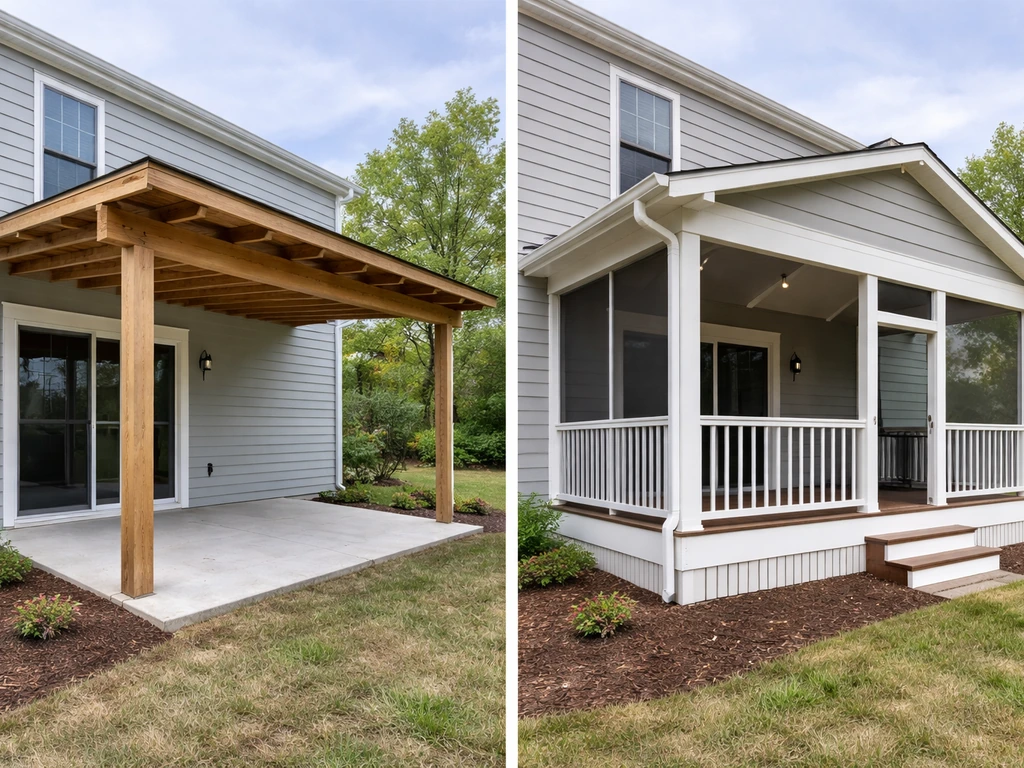
This one trips people up more than the pergola question. Here's a simple way to think about it: if the structure is attached to the house and sits over a ground-level concrete or stone patio, almost everyone will call it a patio cover. If it's attached to the house and sits over a raised, enclosed porch area, people tend to call it a porch roof or porch cover. In reality, the construction is often nearly identical, and permit offices typically treat both the same way.
The key distinction is the floor surface and enclosure underneath. A patio is an open, ground-level hardscape area, usually concrete, pavers, or flagstone. If you're specifically asking, can a patio be made of wood, the answer is usually no as a deck-style surface rather than a traditional patio hardscape. A porch typically implies a raised platform with some kind of railing or enclosure, often screened or partially walled.
The roof or cover over either one uses the same post, beam, and rafter structure, and both will require a permit in most jurisdictions. So if someone quotes you a porch roof and someone else quotes a patio cover, ask them to walk you through the actual structure, because the terminology might not reflect a real difference in what they're proposing to build.
What to search for and what details to specify
When you're searching online or calling contractors, start with "wood patio cover" plus your roof style. That gives you the most accurate results. If you want a solid roof, add "solid roof patio cover" or "lattice patio cover" if you want filtered light. If you already know you want something open and decorative, search "wood pergola" instead, because that's what contractors and material suppliers call it.
When you get to the planning stage, be ready to specify these details to get accurate quotes and order the right materials:
- Wood species: pressure-treated pine is the most common and affordable option for structural framing; cedar and redwood resist rot naturally and look better exposed; Douglas fir is a strong mid-range option for beams
- Roof type: solid sheathing with shingles or metal roofing panels, open lattice (2x4 or 2x6 slats), or corrugated polycarbonate panels that let diffused light through
- Attachment style: ledger-attached to the house wall, or freestanding with four or more posts
- Beam and joist sizing: 4x6 or 4x8 beams for most spans up to 12 feet; 2x6 or 2x8 rafters at 16-inch or 24-inch on center depending on load
- Post size and footing depth: 4x4 posts for smaller spans, 6x6 for longer spans or taller structures; footings typically need to reach below your frost line
- Finish: painted, stained, or left natural (cedar and redwood weather to a gray patina without finishing)
If you're comparing wood against alternatives, it's worth knowing that aluminum patio covers and Alumawood (a wood-textured aluminum product) have become popular alternatives specifically because they don't rot, warp, or need painting. A quick Alumawood vs wood patio comparison can help you decide whether the wood-textured aluminum option makes sense for your climate and maintenance goals aluminum patio covers. Wood still wins on aesthetics for many homeowners and it's often easier to customize on-site, but the maintenance trade-off is real.
Planning basics: permits, setbacks, and drainage
In most jurisdictions, a wood patio cover with posts set into the ground and a roof requires a building permit. Herriman, Utah, for example, explicitly lists a permit requirement for any roof cover over a patio, porch, or deck that has supporting posts going to the ground. Awnings that project more than 54 inches also require permits there. This is pretty representative of what you'll find across most cities and counties in the US.
Before you file for a permit or start designing, check these three things with your local planning or building department:
- Setback requirements: most municipalities require patio covers to sit a minimum distance from property lines, usually 5 to 10 feet from side and rear property lines. Some HOAs have additional restrictions on top of local code.
- Height limits: the California Building Code caps patio covers at 12 feet above grade, and many other jurisdictions use similar limits. If you're attaching to a two-story home, confirm the height of your ledger attachment point.
- Drainage and roof slope: a solid-roof patio cover needs a minimum slope (usually 1/4 inch per foot) to drain water away from the house. Make sure the drainage path doesn't direct water toward your foundation or a neighboring property.
If you're attaching the cover to your house with a ledger board, the permit process will also likely require a structural review to confirm the ledger connection is adequate. This is where having a set of simple drawings, even hand-drawn ones, helps the permit review go faster.
Cost ranges and DIY vs pro feasibility
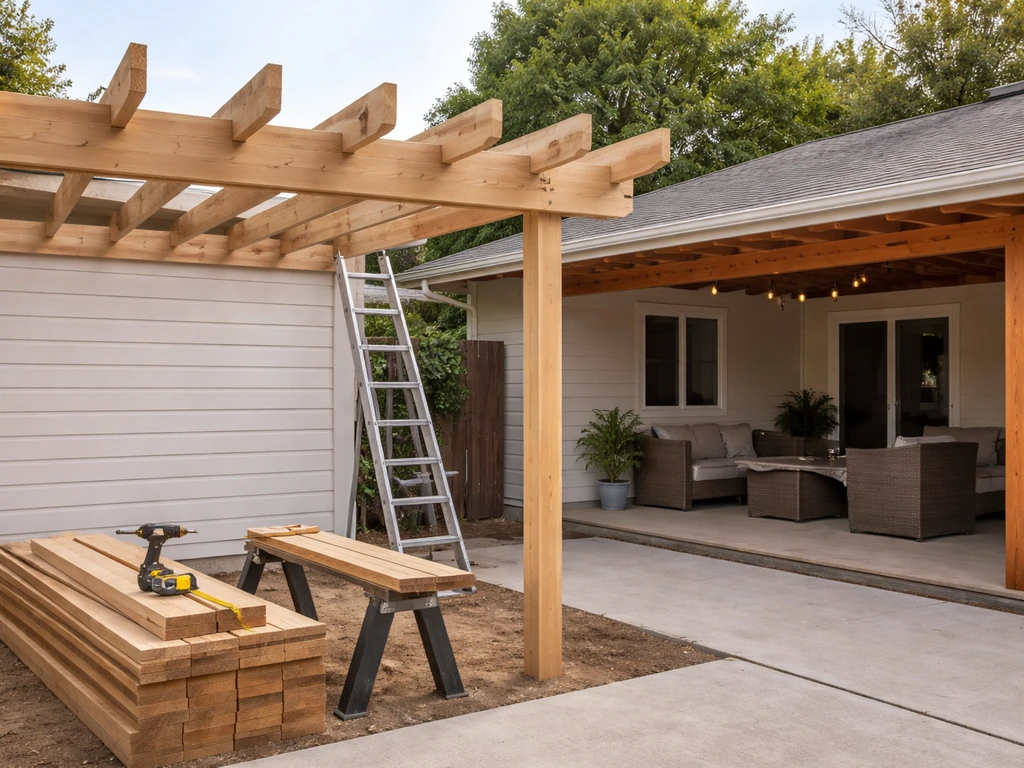
A basic wood patio cover typically runs between $3,000 and $10,000 installed by a contractor, depending on size, wood species, and roof type. A simple 10x12 foot attached cover with a lattice top and pressure-treated framing sits toward the low end of that range. For patio covers, pressure-treated wood is often recommended for framing because it resists rot and moisture exposure. A larger 16x20 foot solid-roof cover built with cedar and finished with metal roofing panels can easily reach $15,000 or more in higher-cost markets. Labor usually accounts for 40 to 50 percent of the total cost.
DIY is realistic for a moderately skilled homeowner, especially for a freestanding pergola-style structure. The main skills you need are setting posts plumb in concrete footings, making clean cuts on dimensional lumber, and understanding basic fastener and hardware requirements. A solid-roof cover attached to the house is more complex because it involves a ledger connection, flashing against the house, and a real roofing layer, all of which have to meet code. If you're comfortable with basic carpentry and willing to study the permit drawings, it's doable, but budget an extra weekend or two for the learning curve and inspections.
Material costs alone for a 12x16 foot wood patio cover typically range from $1,500 to $4,000 depending on wood species and roof type. Pressure-treated pine is the most affordable framing option. Cedar costs roughly 30 to 50 percent more but is worth it if the wood will be visible and you want a finished look without painting. If you're weighing wood against aluminum, keep in mind that aluminum requires almost no maintenance but costs more upfront and looks different, which matters for some homes more than others.
Quick checklist: choosing the right covered structure for your goal
Use this checklist to quickly narrow down which type of structure fits your situation before you start calling contractors or pulling permits.
- You want full rain protection and a permanent look: go with a solid-roof wood patio cover attached to the house
- You want partial shade and an open, garden-style feel: a wood pergola is the right choice, either attached or freestanding
- You want something low-commitment with no footings: a large retractable awning or a freestanding shade sail may be enough
- You want a covered outdoor room separate from the house: a freestanding gazebo gives you a defined space with a peaked solid roof
- You're in a high-moisture or high-sun climate and hate maintenance: consider Alumawood or aluminum patio cover instead of wood
- You're in a neighborhood with an HOA: check HOA rules before choosing any structure, because material and color restrictions are common
- You're on a tight budget and comfortable with tools: a DIY open-roof pergola is the most feasible self-build option at the lowest material cost
- You want to attach the cover to your house: confirm ledger attachment and flashing requirements with your building department before starting
- Your main goal is adding home value: a well-built attached solid-roof patio cover typically adds more perceived value than a freestanding pergola
FAQ
If someone says “porch cover” but it’s over a ground-level patio, should I assume it’s still a patio cover for permitting and quotes?
Often yes, because permitting is usually based on the attachment, roof type, and whether there are posts supporting a roof. Ask for the plan details (attached versus freestanding, solid versus open, roof height, and whether there is a ledger board) instead of relying on the homeowner nickname.
How do I tell the difference between a pergola and a patio cover when the top is partially open?
In most cases, contractors and building departments treat a structure with a solid roof layer (even if it’s a polycarbonate or metal sheet) as a patio cover. If it’s primarily rafters or slats with no weather-shedding roof membrane, it’s commonly categorized as a pergola. Ask whether the structure is being framed to hold an actual roof covering.
Does a retractable canopy or fabric roof count as an awning or as a patio cover for code purposes?
It depends on whether it functions like a permanent roof when open and how it’s engineered. Many places classify fixed fabric projections as awnings, while structures that effectively create a roofed enclosure area may be reviewed more like a patio cover. Confirm with your local department what size, attachment method, and wind rating apply.
If my patio cover is freestanding, do I still need a permit in most places?
Many jurisdictions still require permits for freestanding roof structures that are supported by posts and exceed certain dimensions or heights. The permit trigger is frequently the roof over an exterior area plus structural supports, not whether it’s attached to the house. Check the local rules for post-supported covers and any height or setback thresholds.
What information should I provide to contractors so their quote matches the exact structure I want, not just the label?
Provide a simple sketch or marked-up photo plus these specifics: attached or detached, solid roof or open/lattice, roof height above grade, approximate overall dimensions, the type of post foundation (posts set in concrete footings versus anchored), wood species, and whether you want gutters or ceiling boards. A label like “porch roof” is too ambiguous without these details.
Does pressure-treated wood automatically eliminate rot and maintenance issues for a patio cover?
It helps for framing, especially against moisture exposure, but it does not remove the need for good installation. You still want proper flashing at the house connection (if attached), correct water drainage, and ventilation where boards meet. Also confirm fasteners are rated for treated lumber to reduce corrosion.
For a roof attached with a ledger board, what’s the biggest failure risk I should watch for?
The ledger connection and flashing details at the house are the most critical. Poor flashing can cause hidden water intrusion behind siding or trim, and an undersized or improperly fastened ledger can fail under wind or snow loads. Ask if they will show the ledger attachment details and specify flashing and waterproofing layers.
What roof style and covering options can change how much rain protection I actually get?
A “solid roof” can still vary widely. Metal roofing panels typically shed water well, while partial coverings like lattice with gaps do not. If you want reliable rain protection, ask what the actual roof covering is (type of panel or sheeting), whether it includes a slope, and how runoff will be directed away from the patio and house.
If I want it for shade but not full rain coverage, can I reduce cost by choosing an open design?
Yes, open or lattice-style designs usually cost less and may reduce permit complexity in some areas, but you should not assume no permit. Many cities still treat any post-supported roofed structure as a covered exterior structure. Confirm your local thresholds before you commit to an open top.
Can “wood patio cover” mean a deck-style wood surface under it, and would that change terminology?
Yes, some people mix the terms because both involve wood. A wooden deck is a floor surface, while a patio cover is the roof and its supports. Clarify whether you need a roof structure only, a new deck surface, or both, because the costs and structural requirements are different.
What’s a common mistake that causes mismatched expectations during installation?
Assuming the terminology matches the weather protection. Two quotes for “wood patio cover” can still differ if one is truly solid-roof (rain-shedding) and the other is more like a decorative overhead with limited runoff. Require the contractor to state roof covering type, slope, and drainage in writing.
How can I sanity-check the stated project cost range before signing a contract?
Request a line-item breakdown by major components (posts and footings, framing, roof covering, ledger and flashing if attached, electrical if any, and finish). Then compare scope against your dimensions, since cost per square foot changes with roof type (solid versus open), materials (cedar versus treated pine), and site complexity (uneven yard, access, and any required structural review).
Next Article
Grass Is Higher Than Patio: Causes, Fixes & Deck vs Patio
Grass higher than patio? Causes, slope checks, repair options, lower lawn, raise patio, or build a deck, with costs & DIY