Yes, you can put a hot tub on your patio, and in most cases it works out just fine. Choosing the right items and layout depends on your patio surface, weight capacity, and whether you need proper electrical and ventilation hot tub. The real question is whether your specific patio surface can handle the weight, whether you have the electrical setup sorted, and whether you need a permit before you plug anything in. A filled hot tub can weigh anywhere from 3,500 to over 7,000 pounds depending on its size, and that concentrated load is what catches most homeowners off guard. Get those three things right (structure, electrical, permits) and the rest is mostly logistics.
Can I Put a Hot Tub on My Patio? Placement Checklist

Miles Hart
4 Jul 2026
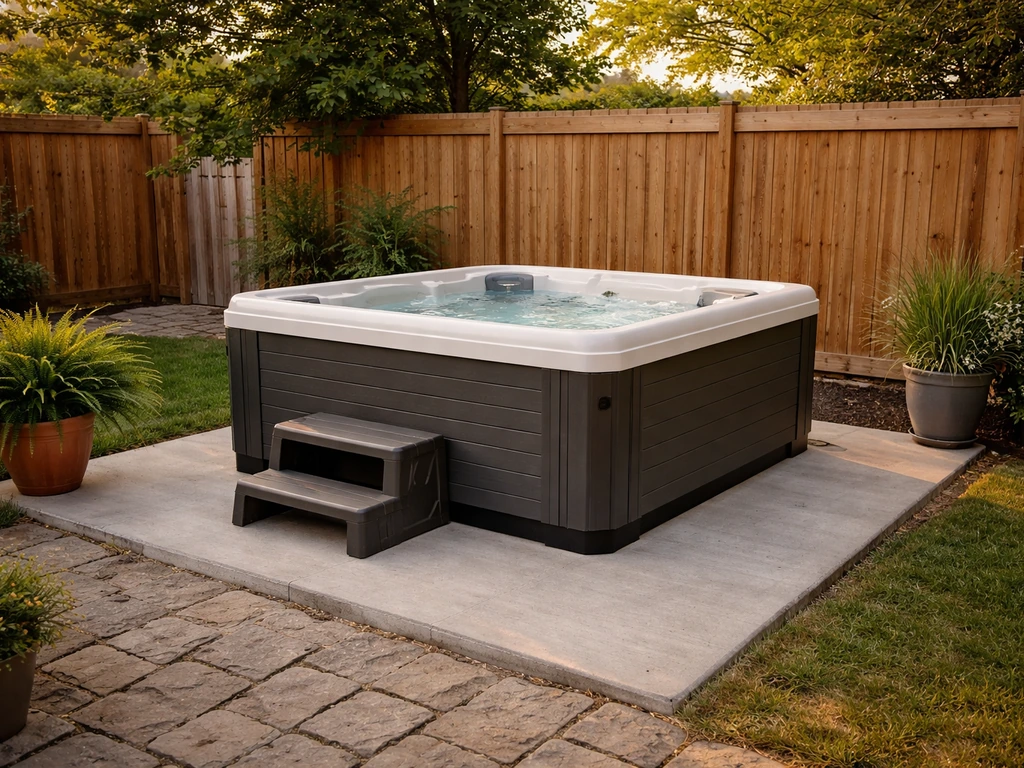
The quick answer and what actually decides it
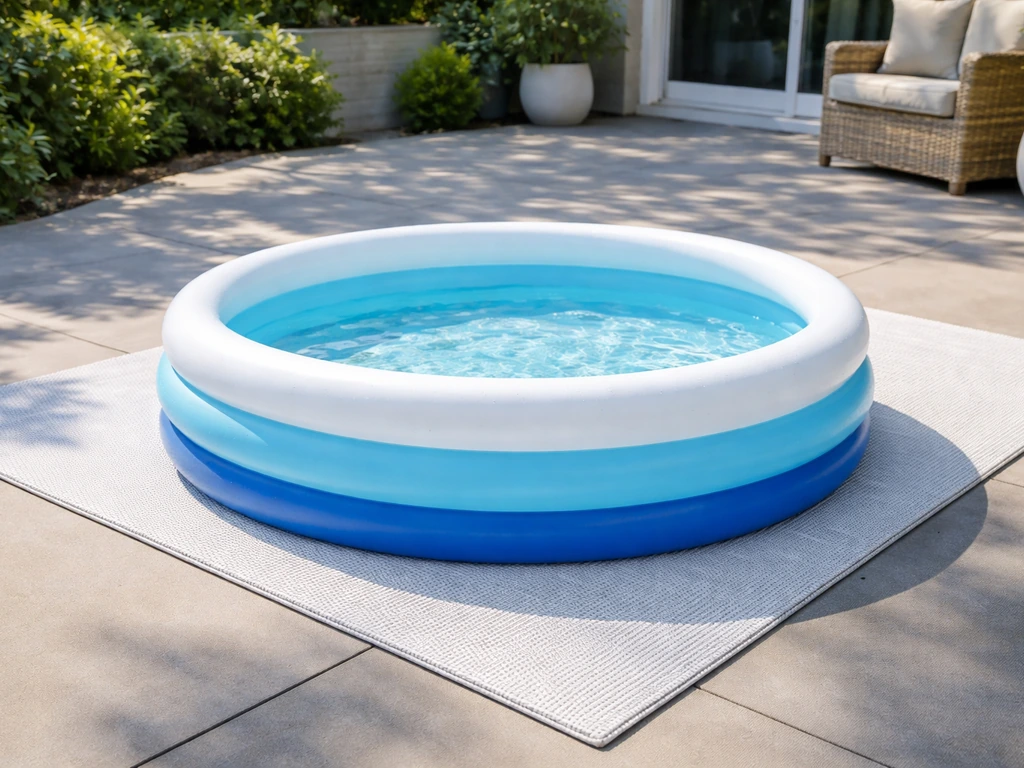
A ground-level concrete patio is almost always strong enough. If your goal is a smaller paddling pool, the same patio load and level-surface checks help you choose a safe placement spot paddling pool on patio. Concrete slabs distribute weight broadly, and a properly poured patio rarely has load issues. A raised wood deck is a different story and requires careful checking. If your patio is a poured concrete slab at ground level, your main concerns shift to electrical, drainage, and access clearance rather than structural capacity. If you're thinking about a covered patio specifically, you add roof clearance and ventilation to the checklist.
Three factors ultimately decide whether your patio is suitable: whether the surface can support the filled weight without cracking or settling, whether you can run proper 240V GFCI-protected wiring to it, and whether your local jurisdiction requires a permit. Most homeowners can check all three boxes with a bit of planning.
Patio suitability checklist: load, surface, and access
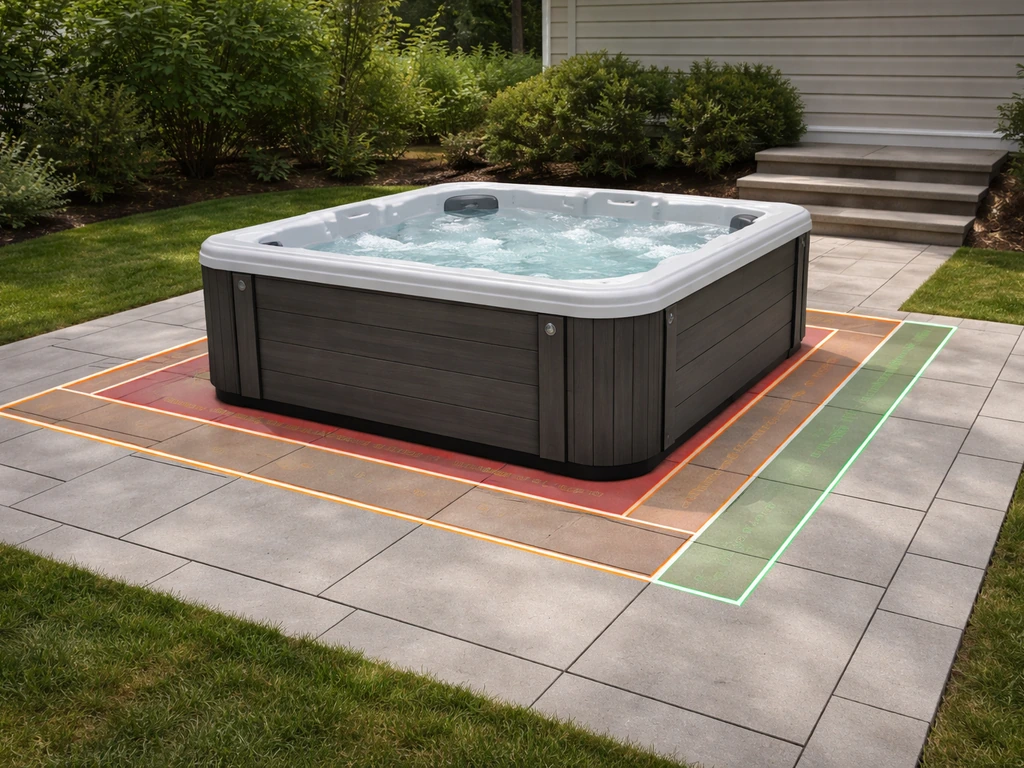
Before you commit to a placement spot, run through each of these. Skipping one is where projects go sideways.
Load capacity
A 4-person hot tub filled with water and bathers typically lands in the 3,500 to 4,500 pound range. Sundance Spas also explains that standard residential deck design loads (about 40 to 50 psf) are typically far lower than a hot tub’s filled weight, which is commonly around 4,000 to 8,000 lb depending on size and occupancy filled hot tub’s weight is commonly around 4,000 to 8,000 lb. An 8-person tub can reach 6,050 to 7,600 pounds. That weight gets concentrated into the tub's footprint, which on an 8-person model is roughly 7 by 9 feet. The load per square foot on a concrete ground slab is usually fine because the slab sits directly on compacted soil. Where it gets complicated is on a raised deck or an elevated patio slab: the IRC minimum design load for residential decks is about 40 psf, and a large filled hot tub can push well past that when you do the math. If your patio is a raised wood deck or an elevated slab with a void beneath it, that structure needs to be evaluated before you place a tub on it.
Surface requirements
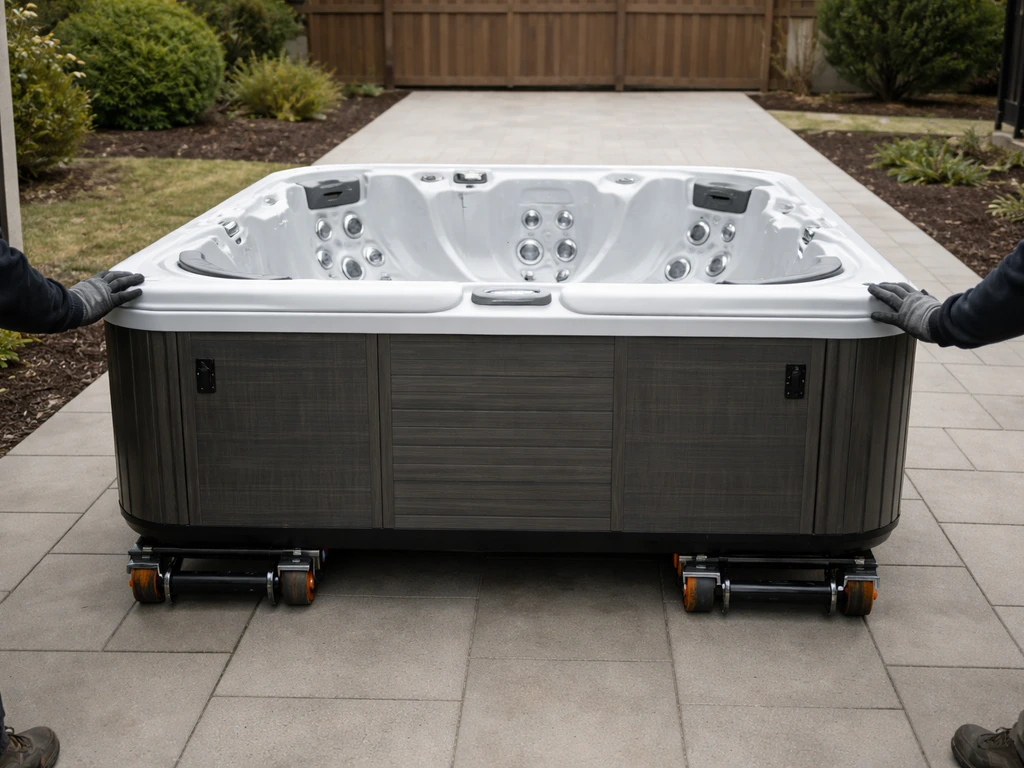
A concrete pad is the gold standard. Master Spas, for example, specifies a minimum four-inch concrete pad with steel reinforcement bars throughout. If you're pouring a new dedicated pad rather than using an existing patio, that 4-inch minimum with rebar is the spec to follow. The pad needs to be level (within about 1/8 inch across its surface), because an unlevel hot tub stresses the shell and jets over time. Drainage slope is a slightly competing factor: you want water to drain away from the tub's equipment, so a very gentle slope (typically around 1/8 inch per foot) away from the house is ideal. Pavers and loose stone surfaces are generally not recommended directly under the tub because they can shift and create uneven support. If you're set on a paver patio, the tub should sit on a concrete pad inset into the paver area, or on a modular pad system designed for the purpose.
Access for delivery and service
Hot tubs need a clear path for delivery (they're heavy and often moved with rollers or a crane) and ongoing service access around the equipment panels. In a real-world clearance discussion on Reddit, a homeowner describes manufacturer clearance requirements around a cover cradle and explains how insufficient rear clearance affected service and access planning manufacturer clearance around a cover cradle. Sundance recommends at least 24 inches of clear access on the service side of the tub, with roughly 30 inches for hatch access if the tub is recessed or surrounded by decking. Plan for someone to kneel down and reach inside those panels over the lifetime of the tub. If you're building a surround or deck around the tub, build in removable sections rather than boxing it in permanently.
Ground-level slab vs. raised structure
| Surface Type | Load Risk | What to Check | Permit Usually Needed? |
|---|---|---|---|
| Ground-level concrete slab | Low | Level, drainage, pad thickness (4" min with rebar) | Electrical only, in most areas |
| Raised wood deck | High | Engineer review of beam/joist capacity for point load | Building + electrical in most areas |
| Elevated patio slab (void below) | Medium-High | Structural assessment of support | Likely building + electrical |
| Pavers on compacted base | Medium | Settlement risk; add concrete pad under tub | Electrical only, typically |
| Modular composite pad (EZ Pad, etc.) | Low-Medium | Level, compacted base required | Electrical only, typically |
The short recommendation: ground-level concrete is the easiest and safest starting point. If you're on a raised deck, get a structural engineer involved before you buy the tub.
Covered patio specifics: clearance, ventilation, and moisture
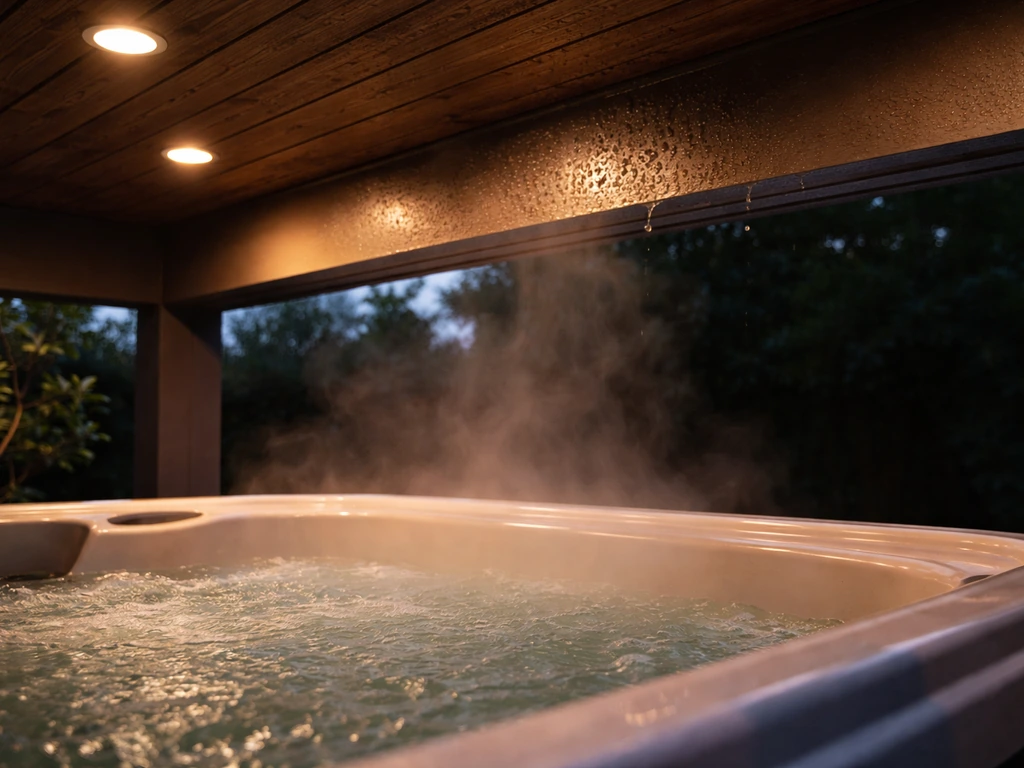
A covered patio adds a genuinely different set of concerns. Hot tubs produce a lot of steam and humidity, and trapping that under a roof can cause serious moisture damage to the structure, warp wood, peel paint, and create a slippery environment. This doesn't mean you can't do it, but you have to plan for it.
Overhead clearance
Jacuzzi and other manufacturers are explicit about planning for overhead clearance, and it's not just about steam. You need clearance to open the cover (most covers flip back and up), clearance for service technicians to work, and clearance that allows steam to escape rather than pool. A general working guideline is the width of the spa plus at least 2 inches for minimum equipment clearance, but practical overhead clearance for a cover that opens fully typically means you want at least 8 to 9 feet of vertical clearance above the tub's rim. Check your specific model's manual for the exact number.
Ventilation and moisture control
Steam rises, and in an enclosed or semi-enclosed covered patio it has nowhere to go unless you design for it. Open sides on the covered patio (a pergola-style structure rather than a fully enclosed room) generally handle this naturally. If the patio has walls on two or more sides, you need deliberate cross-ventilation, exhaust venting, or a ceiling fan rated for wet/damp locations to keep air moving. Condensation will collect on the roof structure and drip back into the tub area without proper airflow. If you're considering fully enclosing the patio as a sunroom or four-season room, you're moving into a different planning category entirely, with vapor barriers, drainage, and HVAC considerations beyond what this article covers.
Moisture-resistant materials
The patio ceiling, posts, and any surrounding structure should be built or treated for the constant humidity. Pressure-treated lumber, rot-resistant species like cedar or redwood, and powder-coated metal fasteners are worth the extra cost in this environment. If you're adding a hot tub to an existing covered patio that has untreated wood overhead, plan to seal or replace that wood.
Electrical access under a covered patio
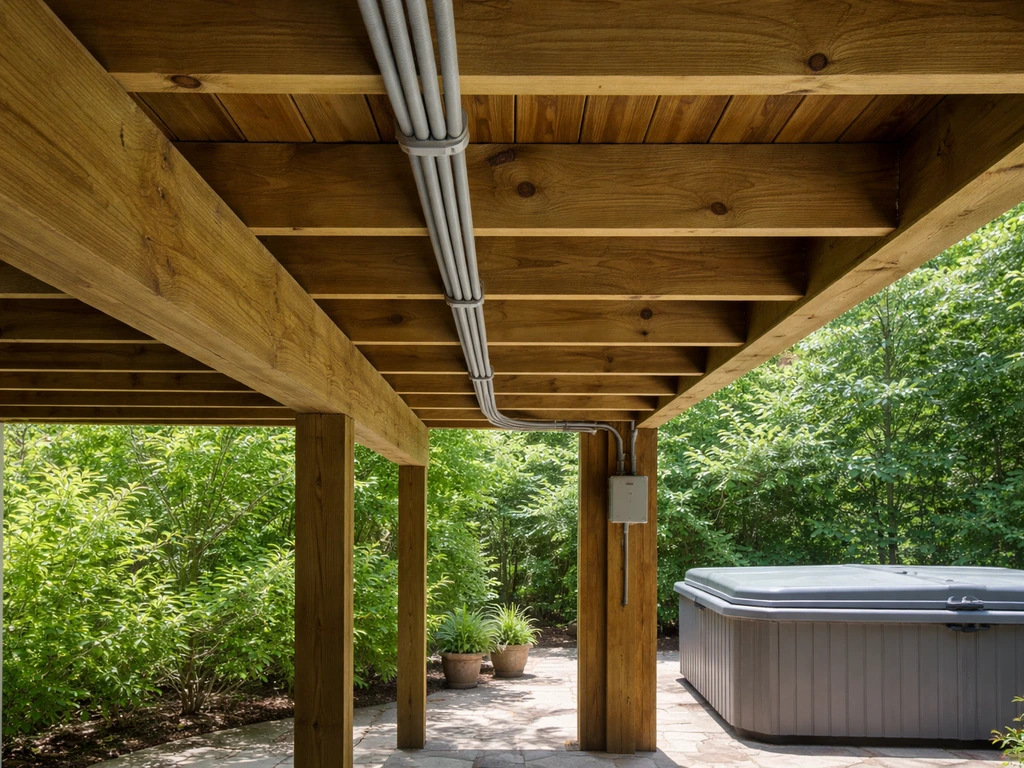
Running electrical under a covered structure is actually easier than running it across an open yard in many cases, since you can often route conduit along the overhead structure. The requirements are the same either way: the disconnect must be within sight of the tub and at least 5 feet away from the inside wall of the spa (NEC 680.41). What changes under a covered patio is that condensation on conduit and junction boxes is a real issue, so use weatherproof fittings rated for wet locations throughout.
Safety, permits, HOA, and code requirements
This is the section most homeowners want to skip and shouldn't. The electrical code for hot tubs is specific, and inspectors know what to look for.
Electrical requirements under NEC 680
- All hot tubs must be GFCI protected (NEC Article 680). This is non-negotiable.
- A dedicated disconnect must be installed within sight of the spa and at least 5 feet from the inside wall of the tub (NEC 680.12 and 680.41).
- The disconnect must interrupt all ungrounded conductors simultaneously.
- Receptacles within 5 feet of the tub must be GFCI protected.
- Bonding of all metal parts (jets, heater, pump, rails) is required to prevent stray current.
- All wiring must be run in appropriate conduit; aluminum wiring is not permitted for these circuits.
Most 240V hot tubs require a 50-amp, 4-wire dedicated circuit. Some smaller plug-and-play tubs use a standard 120V outlet, but these are underpowered and often not suitable for year-round use in cold climates. If you're wiring a 240V circuit, hire a licensed electrician. This isn't a DIY job unless you have real electrical experience, because the inspections are thorough and a missed bond or incorrectly sized breaker creates a genuine safety risk around water.
What permits you'll actually need
Permit requirements vary by jurisdiction, but a common pattern is: an electrical permit is almost always required for a hardwired hot tub. A structural or building permit is required when the tub goes on a deck or other raised structure. Some jurisdictions (like Montgomery County, MD) require a building permit for any permanent hardwired outdoor spa installation regardless of where it sits. Others (like Erie, CO) only trigger the structural review if it's on a deck. Check with your local building department before you purchase the tub. Typical required documents include a site plan showing setbacks from property lines and the house, the tub's weight specs and footprint, and electrical load calculations.
HOA rules
If you have an HOA, check the CC&Rs before doing anything else. Many HOAs regulate hot tub placement (setback from fence lines, screening requirements, noise restrictions on pump operation hours), and some require architectural review committee approval. Getting HOA sign-off before you pour a pad or buy a tub saves you from having to move or screen it later.
Setbacks and enclosure codes
Most municipalities have setback requirements for permanent spa/hot tub installations, typically requiring the tub to be a certain distance (often 5 to 10 feet) from property lines, fences, or utility easements. Some areas also require a fence or barrier around the spa similar to pool fencing rules, particularly if you have young children. Check these specifically for your city or county; a permit application from a town like Tolland, CT, for example, explicitly requires setback measurements as part of the application packet.
Placement options and common setups
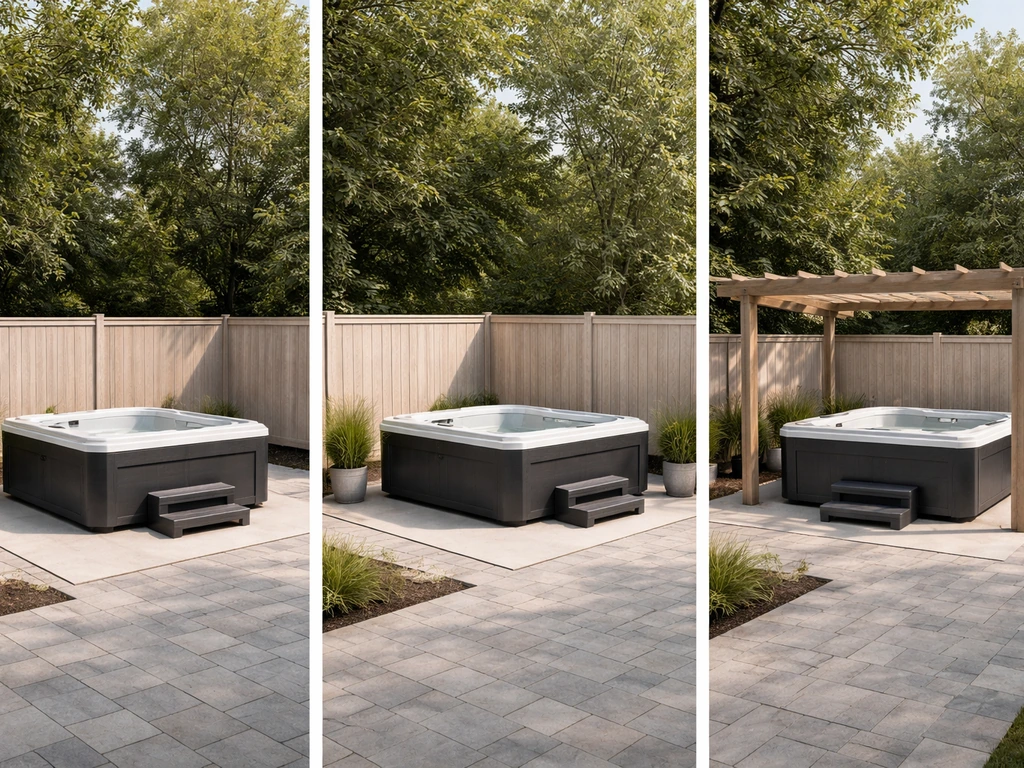
Where exactly you put the tub on your patio affects everything from how it looks to how easy it is to service. If you're wondering what you can put on your patio besides a hot tub, start by checking the same load, surface, and electrical needs so everything stays safe and stable put the tub on your patio. Here are the most common approaches.
Freestanding on a concrete pad
This is the most straightforward setup: pour a concrete pad (4 inches thick, rebar reinforced, slightly sloped for drainage), place the tub on top, run electrical, done. The pad can be the same pour as your existing patio slab or a separate adjoining pad. Master Spas' installation guides recommend this approach and specifically note that if the tub is in a recessed or enclosed location, a floor drain system should be added to manage water from draining or maintenance.
Corner placement
Placing the tub in a corner (where two walls or fence lines meet) maximizes usable patio space and gives a sense of privacy. The trade-off is service access: if you tuck the tub into a corner, two of the four sides have restricted access. Make sure the service panel side of the tub is not the side facing the wall. Most manufacturers label which side has the primary service panel; plan the corner orientation around that.
Surrounded by low-profile decking
Some homeowners build a low wood or composite deck surround around the tub so the rim is flush with the deck surface. This looks clean and makes it easier to step in and out. The structural requirement here is that the decking around the tub does not bear the tub's weight; the tub sits on its own concrete pad, and the decking fills in around it. Those surrounding deck sections need to include at least one removable panel or hatch per the service requirements above.
Under a pergola or covered patio
As covered above, this works well with open-sided structures and proper overhead clearance. It's actually a popular choice because the cover provides shade, keeps debris out of the water, and creates a more usable space year-round. The main planning work is ventilation and ensuring the roof material can handle condensation without rotting.
Cost, timeline, and DIY vs. pro considerations
A typical ground-level concrete pad installation runs $500 to $1,500 for the pad itself depending on size and your region, plus $800 to $2,500 for the electrical work (licensed electrician, new circuit, disconnect, GFCI, conduit). If you need to reinforce or build a new deck to support the tub, add $1,500 to $5,000 or more depending on the size and complexity. A structural engineer review, if required, typically costs $300 to $800 for a residential project.
Timeline-wise, a simple ground-level concrete pad needs about 7 to 10 days to cure fully before you put a loaded hot tub on it (28-day full cure, but most installers consider 7 days sufficient for load placement). Factor in permit wait times, which in most municipalities run 1 to 3 weeks for straightforward residential applications. From permit application to hot tub delivery, plan for 3 to 6 weeks total if everything goes smoothly.
What you can DIY vs. what to hire out
| Task | DIY Feasibility | Notes |
|---|---|---|
| Pouring the concrete pad | Yes, with experience | Leveling and rebar placement matter; rent a plate compactor for the base |
| 240V electrical wiring | Not recommended | NEC 680 requirements, permit inspections, and safety risk around water |
| Site planning and layout | Yes | Measure carefully, check manufacturer specs for clearances |
| Permit applications | Yes | You can pull your own permits; just know what documents are required |
| Deck structural reinforcement | No | Requires engineering review and permitted construction |
| Hot tub delivery and placement | Partial | Delivery teams handle the move; you prepare the site |
The honest take: the electrical work is the one place to hire a pro every time. Everything else, a reasonably handy homeowner can manage with research and preparation. But bad electrical work around a water feature is a serious hazard, and inspectors in most jurisdictions will require a licensed electrician's work to pass inspection anyway.
Your next steps: what to measure, what to gather, and what to do first
Here's a practical sequence to get from "I want a hot tub on my patio" to a tub that's installed, inspected, and ready to use. If you're also considering adding a treadmill to your outdoor patio space, you'll want to think about the same kind of surface stability, drainage, and weather exposure before you set it up can i put treadmill on patio.
- Measure your patio space and note the usable dimensions, including clearance from walls, fences, and the house. You'll need the tub's footprint plus at least 24 inches on the service side and room to walk around the other sides.
- Pull the specs on any tub you're considering before you buy it: filled weight, cabinet dimensions, which side has the service panel, required electrical load (amperage, voltage), and minimum clearances from the manufacturer's manual.
- Check your local building department's website for hot tub or spa permit requirements. Ask specifically: do I need an electrical permit, a building permit, or both? Do I need a site plan or engineer's letter?
- If your patio is a raised deck or elevated slab, call a structural engineer before proceeding. This is a one-time cost that protects your investment and is often required by code anyway.
- If you have an HOA, submit for approval before purchasing or starting any work. Include the tub's dimensions, placement on a site plan, and any screening you plan to add.
- Get quotes from at least two licensed electricians who have experience with NEC 680 installations specifically. Ask each one to walk you through what the inspection process looks like in your area.
- Decide on your pad approach: existing patio slab (have a contractor confirm it meets the 4-inch rebar-reinforced minimum), new adjoining pad, or a modular pad system if pouring concrete isn't feasible.
- Coordinate the timeline: permit approval, then pad preparation, then electrical rough-in, then tub delivery, then electrical final connection and inspection.
Common mistakes to avoid
- Placing the tub before confirming service access: once it's surrounded by decking or pushed into a corner, moving it is a major project.
- Skipping the permit on the electrical: a failed inspection or unpermitted work can create insurance and liability issues if something goes wrong.
- Underestimating the weight on a raised deck: standard deck design loads are often far below what a filled hot tub requires, and the failure mode is dramatic.
- Forgetting about drainage: you'll drain the tub 3 to 4 times a year for cleaning, and that's several hundred gallons of water that needs somewhere to go that won't erode your landscaping or flood a neighbor's yard.
- Buying a tub without checking if it can fit through your access path: delivery crews need a clear route that's wide enough for the tub's cabinet dimensions. Many residential yards have gates or side yards that are too narrow.
- Ignoring steam and moisture on a covered patio: this is the most common oversight for covered installations and leads to wood rot and ceiling damage within a few years if ventilation isn't planned.
- Not confirming the disconnect location before the electrician runs conduit: that disconnect must be within sight and at least 5 feet from the tub wall, and its exact location affects where conduit runs.
If you're also thinking about what else to add to your patio space around the hot tub, or comparing whether a full covered structure makes sense for your setup, those are related decisions worth thinking through at the same time. The patio surface and structural choices you make for the hot tub will affect how you use and furnish the rest of the space.
FAQ
Can I put a hot tub on an existing patio slab instead of pouring a new pad?
Yes, but only if the existing concrete is in good shape and thick enough at the exact location. Before buying the tub, inspect for cracks, hollow-sounding spots, or spalling, and confirm the patio thickness and any known load limits. If you are unsure, a concrete thickness check (or a contractor evaluation) is usually cheaper than relocating after delivery.
My patio is pavers, can I set the hot tub directly on them?
You generally should not place a hot tub directly on pavers, loose stone, or patio base layers because they can shift under a concentrated load. If you want a paver aesthetic, plan for a dedicated concrete pad set into the paver area (flush with the surrounding finish) or a purpose-built modular pad system designed to spread load evenly.
What if my ideal placement would block access to the hot tub’s equipment panels?
Most people need to plan for a proper service route even if the tub is “in the perfect spot” visually. Measure the service panel side and hatch side clearance in real terms (doorways, railings, fencing, and deck steps), and confirm a worker can reach controls and filters without fully moving the tub. If you cannot keep at least about 24 inches of access on the service side, rotate the tub or choose a different location.
I already have a 240V outlet outside, does that mean I can skip electrical work?
It can be, especially in cold climates, because hot tubs are hardwired appliances and “plug-in” convenience often applies only to certain models and indoor-safe outlets. Even if you have an outlet nearby, you still must verify the tub’s required voltage, circuit amperage, and whether the outlet is protected with the correct GFCI and sized for continuous outdoor load.
Will a covered patio change what permits or inspections I need?
Yes, because some jurisdictions treat enclosed areas differently. If the patio is roofed on multiple sides, you may trigger additional requirements for electrical routing, mechanical ventilation, and moisture control. Check the building department for whether your setup counts as a “covered porch,” “enclosure,” or “outdoor room,” then ask if any extra inspection points apply.
How important is drainage around the tub, and what mistakes cause issues?
Even if your patio is stable, drainage matters because maintenance water and condensation can accumulate around electrical components and the tub base. Look for a slight slope that carries water away from the tub equipment area, and if the tub is recessed, ask installers whether a small floor drain or maintenance drainage plan is needed for that specific enclosure.
If I build a pergola or covered patio, how do I confirm I have enough clearance for the cover to open?
Treat overhead clearance as a practical constraint, not just a steam issue. Verify your cover opening style (hinged, lift, or swing) and ensure the ceiling and any pergola beams do not prevent full opening and technician access. A common failure is buying the tub, then discovering the cover cannot open far enough or service access is blocked by a roof beam.
Can I build a deck surround around the tub so it looks flush with the patio?
Often yes, but you must separate responsibilities: the tub should rest on its own structural support (usually the concrete pad), while the surrounding deck or surround should not carry the tub load. Confirm with the installer that removable panels meet service access needs, and check that the deck material is rated for frequent moisture exposure.
What HOA rules should I check beyond setbacks and appearance?
HOAs frequently regulate more than just aesthetics. Before you submit anything, ask specifically about noise limits related to pump schedules, required screening or landscaping, setback distances from fences, and whether pre-approval is required before electrical work or construction. Getting written HOA approval before installation usually prevents delays and rework.
How do I make sure delivery and placement work with my patio layout?
Yes, and it is one of the most common planning oversights. Confirm the delivery method (rollers vs crane), the widest path for the tub dimensions, and turning clearance around corners and gates. If your patio has steps, a tight corner, or a raised deck, coordinate delivery planning early so the tub does not have to be lifted in a way that risks damage or delays.
If my patio is elevated or over a void, is it safe to assume the deck can handle a full hot tub?
You should avoid relying on “typical” assumptions about structural capacity for raised decks. Decks and elevated slabs have design live-load values and can include joist spacing, ledger details, and cantilevers that vary by construction. For any raised patio or deck with a void underneath, getting a structural engineer assessment before purchase is the safest route.
Next Article
Can You Put a Paddling Pool on a Patio? Safe Steps
Steps to safely place a paddling pool on a patio, including rules, weight and drainage checks, and setup to prevent dama