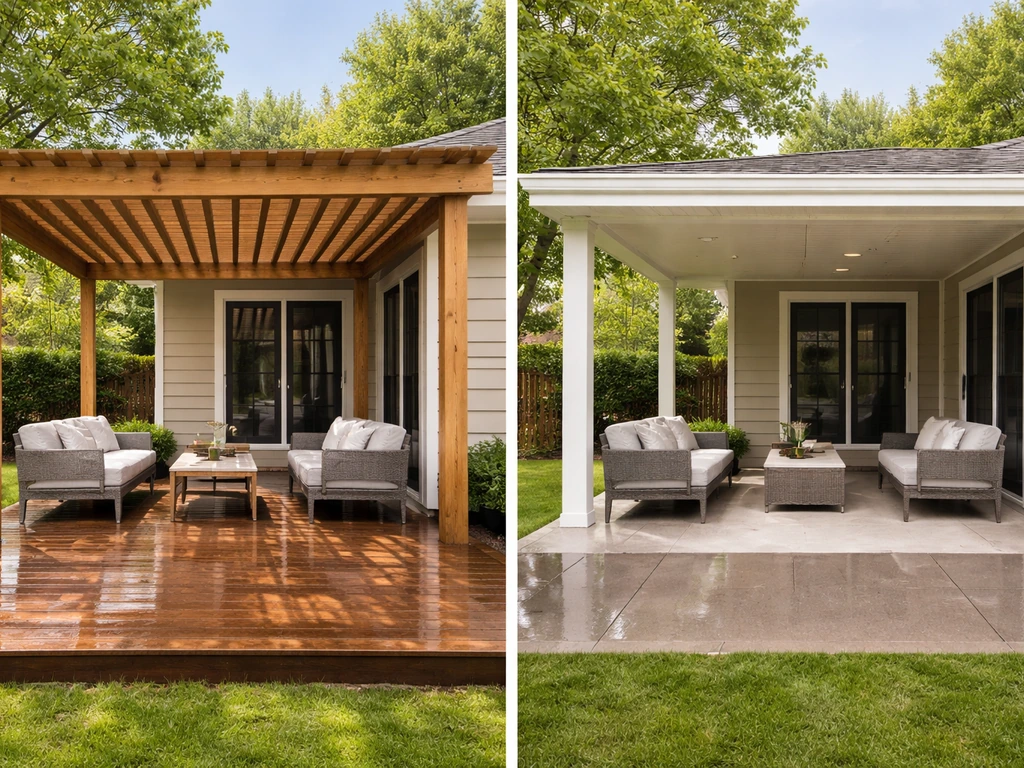
A patio cover gives you a solid roof over your outdoor space, blocking rain and sun completely, while a pergola is an open framework of beams and crossbeams that filters light but lets weather through. If you need dependable rain protection and full shade year-round, go with a patio cover. If you're unsure between options, compare a patio cover to a pergola vs covered patio setup to decide which one gives you the rain protection and shade you need. If you want a decorative structure with partial shade, airflow, and a garden feel, a pergola is the better fit. The decision comes down to one core question: do you want a room without walls, or a beautiful frame over your space?
Patio Cover vs Pergola: Costs, Coverage, Pros and Cons

Miles Hart
4 May 2026
What each structure actually is
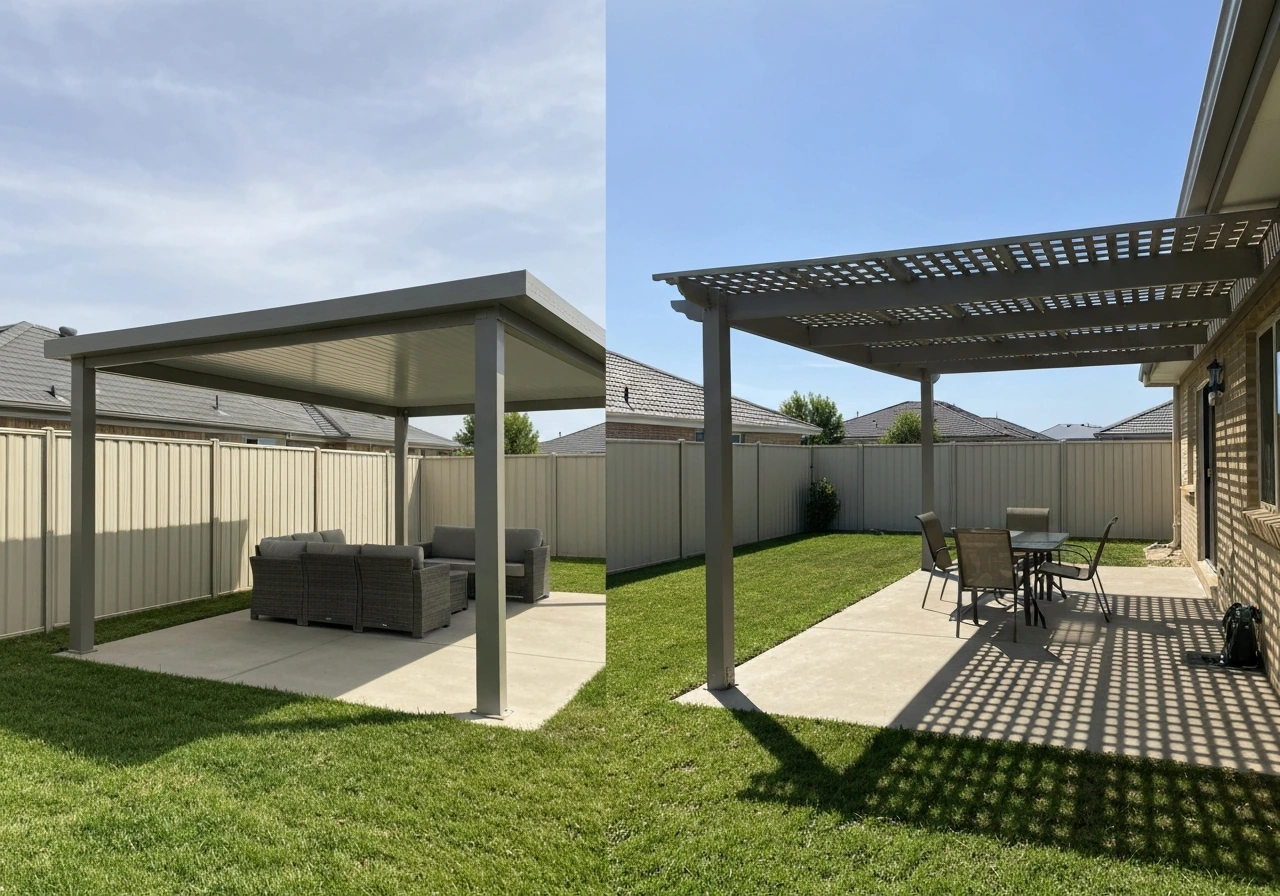
A patio cover is a roofed structure, plain and simple. It uses rafters, beams, and a ledger connection (when attached to the house) to support a solid roof covering, whether that's aluminum panels, polycarbonate sheeting, or conventional roofing materials. In residential building codes, patio covers are typically defined as one-story structures not exceeding 12 feet in height above the adjacent grade. They're engineered to handle roof live loads (a minimum of 10 psf per ICC-ES standards), wind uplift, and horizontal loads, just like any other roof on your home. For example, ICC-ES ESR-5317 includes design live load tables expressed in psf, such as 10 psf and higher, for roof-related patio cover applications roof live loads (a minimum of 10 psf per ICC-ES standards).
A pergola is a garden framework, historically used to support climbing vines and create shaded walkways. It has vertical posts or pillars holding up crossbeams and an open lattice overhead. There's no roof covering. Rain and direct sun both pass through to some degree, though the beams do create dappled shade underneath. Modern pergolas come in wood, aluminum, vinyl, and fiberglass, and some are dressed up with retractable canopies or motorized louver systems that blur the line between pergola and patio cover.
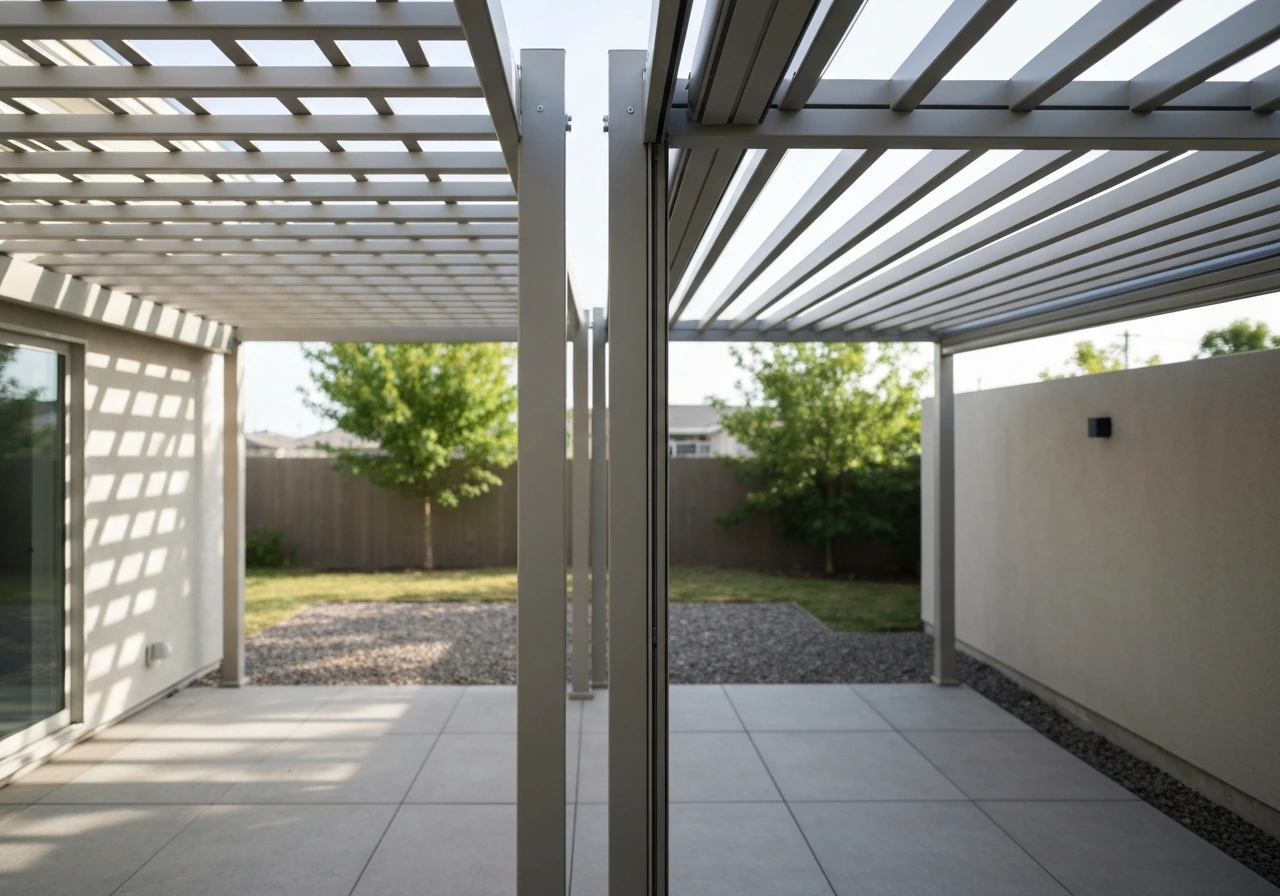
The louvered pergola is worth calling out specifically because it confuses a lot of people. It's technically a pergola in form (posts and overhead framing) but the roof blades rotate from open to nearly closed, giving you adjustable shade and partial rain shelter. It's not the same as a solid patio cover, but it's a meaningful middle ground if full enclosure feels like too much.
Side-by-side comparison
| Feature | Patio Cover | Pergola (Open Lattice) | Louvered Pergola |
|---|---|---|---|
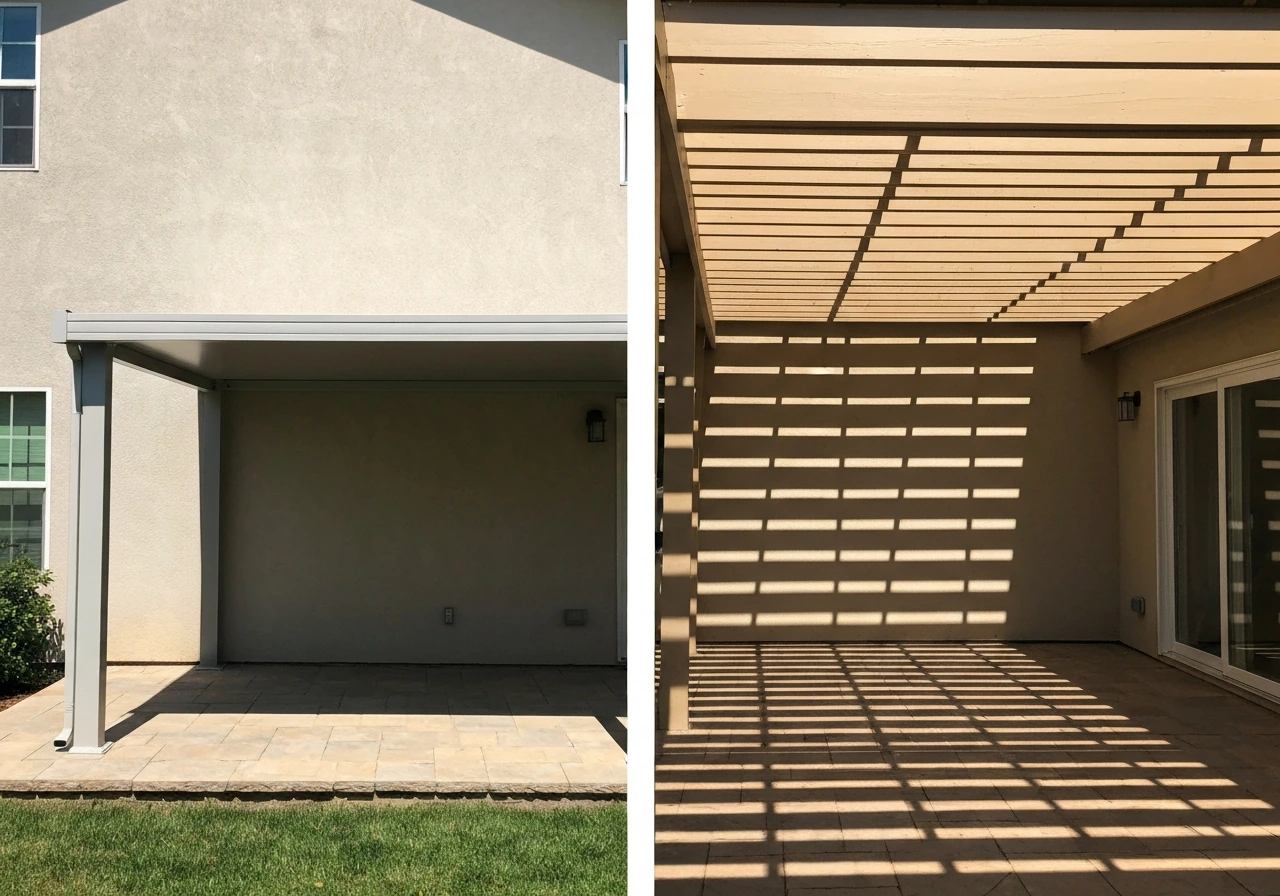
| Rain protection | Full, year-round | None to minimal | Good when blades closed, partial when open |
| Sun/shade | Full shade beneath | Dappled, shifting shade | Adjustable, full to partial |
| Airflow | Limited (open walls help) | Excellent | Adjustable with blade angle |
| Installed cost (per sq. ft.) | $20–$50 | $25–$55 (wood), $30–$60 (aluminum) | Higher end; often $50–$100+ |
| Structural engineering | Required (roof live load, wind uplift) | Less intensive, footing/post design | Required (wind/snow load ratings critical) |
| Permit required | Almost always | Often yes, varies by jurisdiction | Yes, especially for motorized systems |
| DIY feasibility | Moderate to difficult | Moderate | Low (motorized/engineered systems) |
| Best for | Full weather protection, outdoor dining room feel | Garden aesthetics, partial shade, vine support | Flexible shade and shelter, modern look |
What you'll actually spend
For a patio cover, budget roughly $20 to $50 per square foot installed. Aluminum solid-panel systems tend to come in at the lower end, around $20 to $35 per square foot. Wood-framed covers with conventional roofing materials push toward the top of that range or above it. A typical covered patio runs 150 to 350 square feet, which puts total project costs somewhere between $3,000 and $17,500 depending on size, materials, and your local labor market.
Pergolas land in a similar range on paper but cost more than most people expect once you factor in quality materials. If you're trying to weigh the cost of pergola vs patio cover for your exact size, the per-square-foot numbers and add-ons like electrical and gutters can make the difference Pergolas land in a similar range on paper. Wood pergolas typically run $25 to $55 per square foot installed. Aluminum pergolas are $30 to $60 per square foot. Fiberglass can go significantly higher. A louvered pergola system with motorized blades from a recognized manufacturer can easily hit $50 to $100-plus per square foot once you include installation, electrical work, and any drainage gutters built into the frame.
What drives costs up in both categories: going attached versus freestanding (attached requires ledger engineering and possibly flashing into your home's exterior wall), the size and complexity of the footprint, permit and inspection fees, site-specific footing requirements (soil conditions matter), and whether you need electrical for lighting or motorized components. Don't forget that engineered patio cover systems with ICC-ES evaluation reports sometimes cost more upfront but move through the permit process faster, which can save money on delays.
How much protection do you actually get?
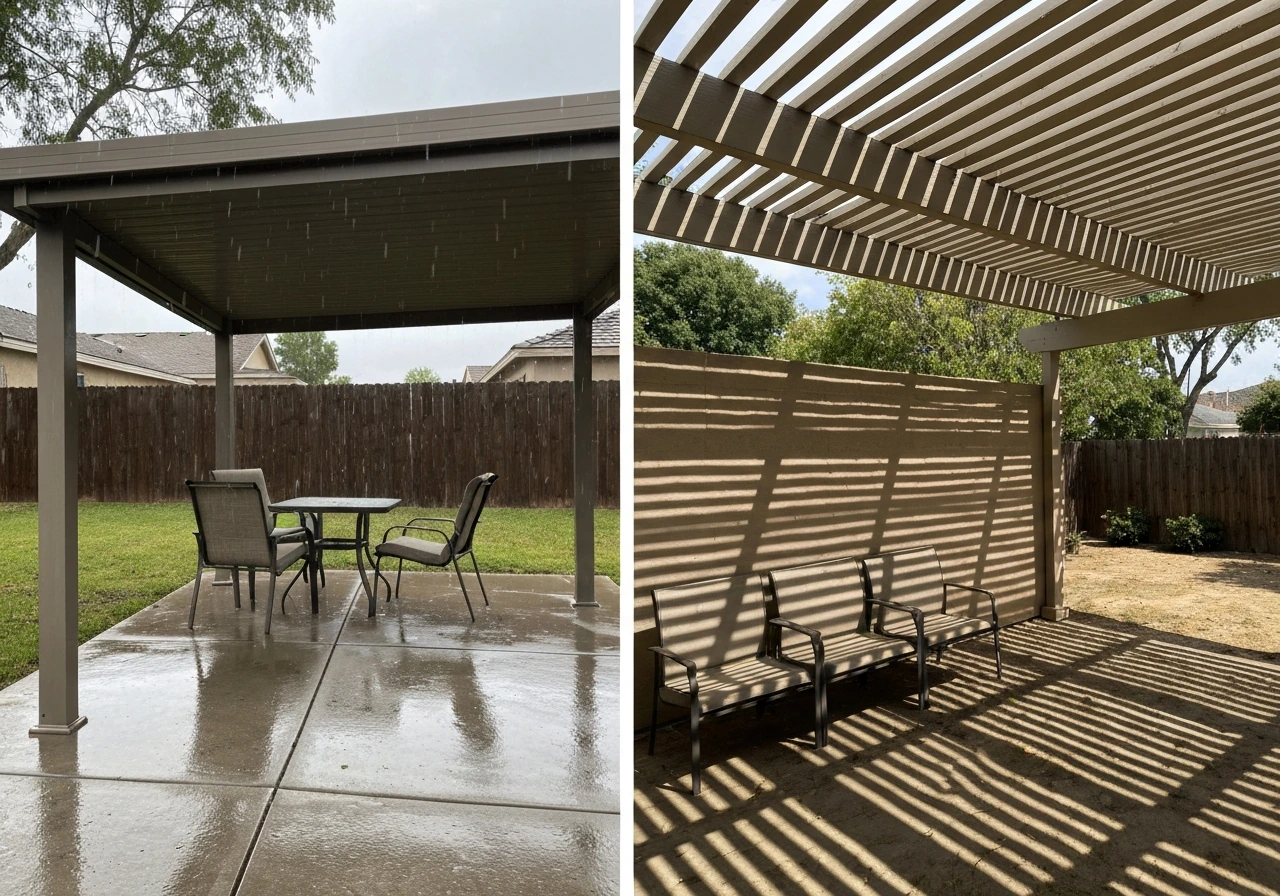
A solid patio cover works like a roof. When it's raining, you stay dry. When the sun is overhead, you're in shade. That's consistent, predictable, and genuinely useful for an outdoor dining area or a space you want to use 12 months a year. The trade-off is that it can feel heavier and darker underneath, especially if the cover is large and the surrounding yard is bright.
A standard open-lattice pergola gives you filtered light and some relief from direct sun, but rain comes right through. Depending on beam spacing, you might get 30 to 50 percent shade coverage, which is pleasant in moderate climates but not enough on a harsh summer afternoon. If rain forces you inside, the pergola isn't serving you as everyday shelter.
Louvered systems are genuinely useful when the louvers are properly closed. They're marketed as providing excellent shelter in that position, and a well-engineered product with built-in gutters does handle rain reasonably well. But they're not watertight the way a solid roof is, especially in wind-driven rain. The key is asking for certified load ratings and engineering documentation before you buy, because blade performance in high wind varies dramatically between products.
Design options worth knowing about
Attached vs. freestanding
Both patio covers and pergolas can be built attached to the house or freestanding in the yard. In many cases, you can build a pergola on an existing patio slab as long as the posts and connections are supported and approved for your site can a pergola be built on a patio. Attached structures connect to the home via a ledger board, which means the house wall provides one side of the support. This is typically the most common setup for a patio or deck cover because it uses less material and looks integrated. Freestanding versions need four posts and independent footings, which gives you more placement flexibility but usually costs more and requires its own foundation design. Local jurisdictions treat these differently too: attached covers often need ledger attachment details and connection hardware specs as part of the permit submittal, while freestanding structures need independent post and footing engineering.
Solid roof patio cover styles
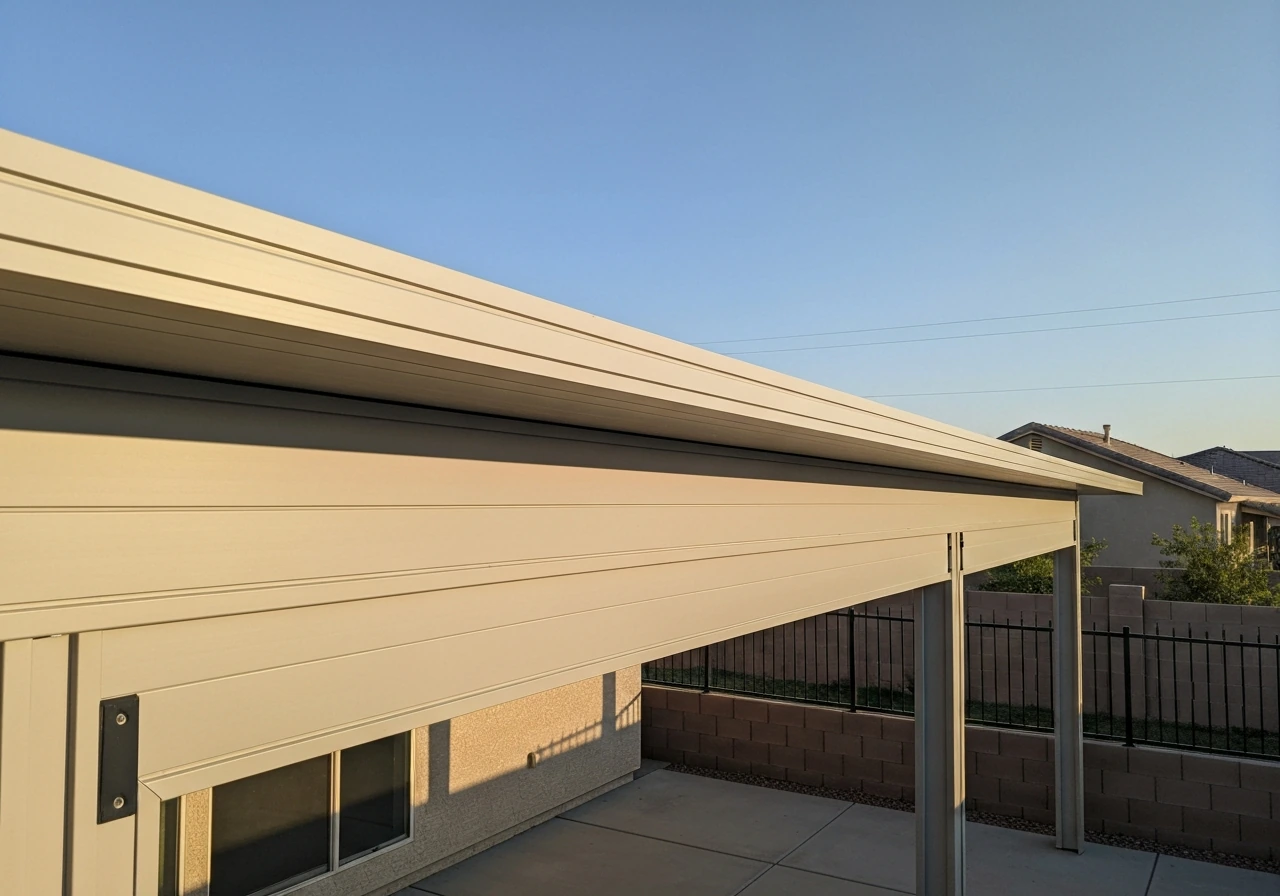
Solid patio covers come in aluminum panel systems (the most popular for their low maintenance and fast installation), wood-framed structures with asphalt shingles or metal roofing to match the house, and polycarbonate or glass panel systems that let diffused light through while still blocking rain. Aluminum systems are widely available as engineered kits with ICC-ES evaluation reports, which makes permitting more straightforward in many jurisdictions.
Pergola styles and upgrades
Open-lattice pergolas range from simple pressure-treated lumber frames to refined cedar, hardwood, or powder-coated aluminum structures. Style variations include traditional rectangle designs, hip-roof pergola shapes, and arched or curved beam profiles. The louvered pergola is the main upgrade path: motorized aluminum blades rotate to control light and rain, and many systems include integrated LED lighting, heating elements, and side screens or curtains. If you go that route, look for systems with independently certified wind and snow load ratings, not just manufacturer claims.
Permits, codes, and whether you can DIY this
Patio covers almost always require a building permit because they're treated as roof structures by most jurisdictions. What you'll typically need to submit includes a plot plan showing the structure's location relative to property lines, scaled framing plans with lumber species, sizes, and member spacing, ledger attachment details, footing sizes and spacing, and in some cases full structural calculations. Douglas County, Colorado requires all of this, as does San Diego. Some jurisdictions do exempt very small projected roof areas from the permit requirement, but don't assume yours does without checking.
Pergolas fall into a grayer area. Some jurisdictions treat them like accessory structures and require permits above a certain size; others are more lenient for open-lattice structures that don't have a solid roof. Louvered pergola systems, especially motorized ones, almost always need permits because they involve electrical work and engineered components with specific load requirements.
On DIY feasibility: a basic open-lattice pergola is one of the more accessible outdoor builds for a handy homeowner. You're setting posts, cutting beams, and assembling the frame. A solid patio cover is a step up in complexity because of the roofing work, flashing, and ledger attachment, but pre-engineered aluminum kit systems do make it more approachable than a site-built wood-framed structure. Motorized louvered systems are generally not DIY projects. They require precise installation for the motors and drainage to work correctly, and the manufacturer's warranty typically requires professional installation.
- Check your local jurisdiction's permit threshold before assuming exemption, even for small structures
- For attached covers, have a contractor or engineer confirm your ledger attachment method and connection hardware
- For louvered/motorized systems, request the product's ICC-ES or equivalent engineering report and confirm it's rated for your local wind zone
- Ask your contractor to show you the permit application before work starts, not after
Which one should you actually choose?
Here's how to map your situation to the right structure. Think about what you actually want to be doing under it on a Tuesday afternoon in August, and on a rainy Saturday in October.
| Your goal | Best choice | Why |
|---|---|---|
| Outdoor dining room you can use rain or shine | Solid patio cover | Full rain and sun protection, consistent shade |
| Partial shade over a garden seating area, like plants and airflow | Open-lattice pergola | Filtered light, airflow, decorative structure |
| Flexible shade control, modern look, higher budget | Louvered pergola | Adjustable blades balance shade and ventilation |
| Privacy from neighbors above (e.g., two-story homes nearby) | Solid patio cover or louvered with side screens | Overhead coverage limits sightlines from above |
| Support climbing vines or grow a living canopy | Open-lattice pergola | Classic use case, plants need airflow and light |
| Matching your home's roofline for a unified look | Attached solid patio cover with matching roofing | Integrated framing and material match |
| Lower budget, simpler build, DIY project | Open-lattice pergola (wood) | Lowest material cost, most accessible build process |
Practical next steps before you commit
Before you call a contractor or order materials, measure your patio area and note the orientation: which direction does the afternoon sun hit, and where does rain typically blow in from? Those two factors alone will tell you how much roof coverage you actually need and where to position the structure.
Then call your local building department (or check their website) and ask two questions: does a structure this size require a permit, and is it treated as a roofed structure or an accessory structure? The answer shapes what your contractor needs to provide and how long the permit process will take.
When you get contractor quotes, ask for the following: the material's ICC-ES report or engineer letter if it's a pre-engineered system, the ledger attachment detail if it's going on your house, and the footing design for your soil type. ICC-ES AC340 provides the approved acceptance criteria for patio covers, approved August 2018 and editorially revised August 2021 ICC-ES report or engineer letter. These aren't overly technical asks. Any contractor who regularly builds patio covers will have this documentation ready. If they can't produce it, that's useful information before you hand over a deposit.
If you're comparing costs in detail or still deciding between a pergola and a fully covered patio, the cost breakdown between these two options, as well as how a pergola sits on top of an existing patio slab, are worth exploring separately since the existing surface you're working with can significantly affect which structure makes the most practical and financial sense.
FAQ
Can I install a pergola or patio cover on top of an existing concrete patio slab?
Yes, but the key difference is how the structure handles water. A solid patio cover is designed to drain like a roof system, while an open-lattice pergola relies on runoff through gaps. If you mount on an existing slab, confirm the slab can take post loads (not just fastening into the concrete), then ask for a footing design and anchoring details that match your soil and local wind loads.
Are louvered pergolas good enough for real rain protection, or should I choose a solid patio cover?
If your primary goal is staying dry during storms, prioritize true roof panels or a fully enclosed top. Louvered pergolas can reduce rain exposure when louvers are closed, but they are still not watertight in wind-driven rain. Consider a hybrid only if you understand the weather patterns at your site (for example, prevailing storm direction) and confirm the system has engineering documentation for wind and drainage.
What should I ask about permits and ledger attachment if the patio cover attaches to my house?
Attached patio covers usually fail permitting when the ledger details are missing or generic. Ask your contractor for the exact ledger attachment method, flashing approach, and the member sizes and connection hardware specs that match the evaluation report or engineer letter. Also ask whether your jurisdiction requires separate inspection for the ledger or footings before roofing is installed.
Do I need a separate electrical permit if I add lights or motorized louvers?
For pergolas, electrics change the permitting and inspection pathway. If you plan to add LED lighting, outlets, heaters, or motorized louvers, ask whether the electrical design is included in the system package or needs a separate licensed electrician permit and inspection. For motorized blades, confirm wiring route, outdoor-rated components, and drainage provisions around the motor and blade mechanism.
Why do patio cover and pergola quotes vary so much beyond the per-square-foot price?
Budget for water management and code-driven details, not just the roof or frame. Many “similar price” quotes end up different once you include gutters/downspouts, slope toward drainage, scuppers or splash blocks, and weatherproofing at the house connection. If you go attached, ask whether the plan includes flashing into your exterior wall and how runoff will be directed away from foundations.
How do I estimate how much shade I will actually get under a pergola?
The safest rule is to treat “usable shade” like a range, not a guarantee. With an open pergola, shade can be pleasant midday in mild sun, but beam spacing and sun angle can still leave large patches exposed. Before ordering, ask for a shade projection or test visuals using the proposed orientation, and verify the expected percent shade for your specific blade spacing (especially for louvered systems).
What wind considerations should I check before choosing a pergola or louvered system?
Wind performance is where marketing claims often diverge from real outcomes. Ask for independently certified wind load ratings and the maximum wind speed for operation (for motorized louvers). Also confirm what the product requires for installation, blade position in high wind, and whether it includes edge flashing or gutters that prevent water buildup.
Is DIY realistic for a pergola, and what are common DIY mistakes to avoid?
DIY is more realistic for a basic open-lattice pergola, but even then you should plan for footing. The common mistake is assuming posts can be surface-anchored without proper post-to-footing design. If the area is small but wind exposure is high, ask for engineered post sizes and embed depth recommendations, and make sure your plan matches local footing requirements.
Next Article
Pergola vs Covered Patio: Costs, Comfort, and Best Fit
Compare pergola vs covered patio for shade, weather protection, cost, DIY ease, and home value to choose the best fit.