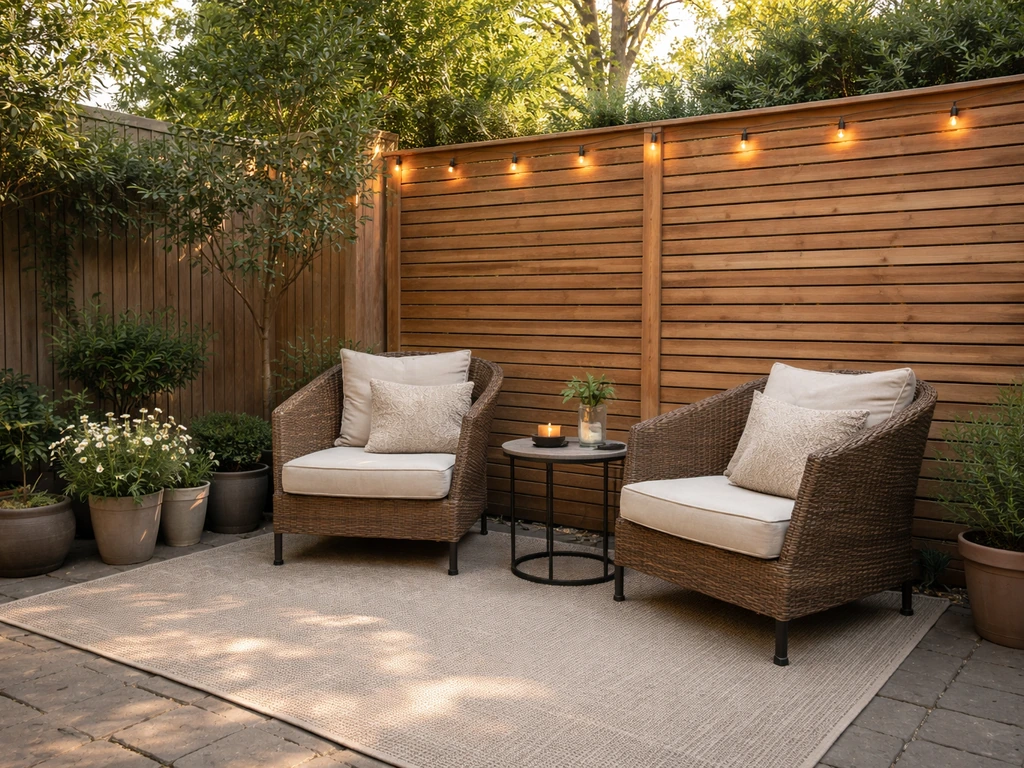
You can make an apartment patio meaningfully private without drilling a single hole or asking your landlord for permission. The fastest fixes are rearranging furniture to break direct sightlines, hanging a zip-tied privacy screen along your railing, and placing a few tall planters at the corners where neighbors look in. From there, you can layer in freestanding screens, curtain panels on tension rods, or a trellis with climbing plants for more coverage. The key is to assess your specific sightlines first, then match the solution to what your lease and building rules actually allow.
How to Make an Apartment Patio Private: Step-by-Step
Miles Hart
17 May 2026
Start here: assess your patio's privacy problem
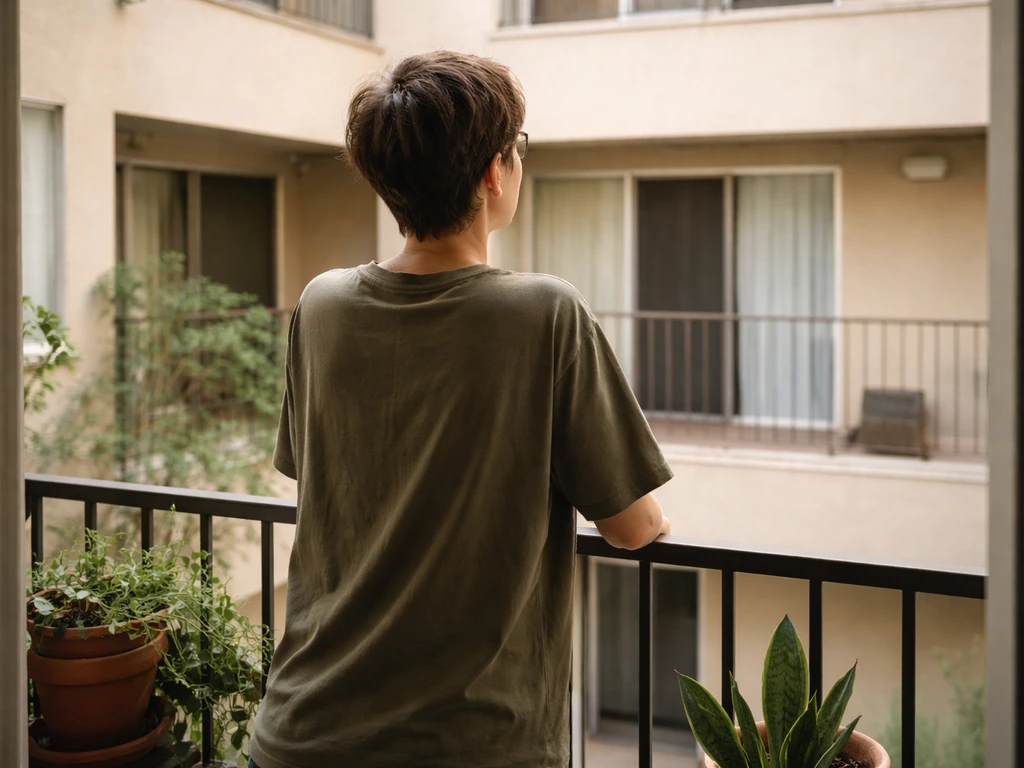
Before you buy anything, spend five minutes figuring out exactly where the privacy gaps are. Stand in the spot where you actually sit or hang out, then look around at eye level. Identify the two or three specific windows or balconies from which a neighbor could see you. Note whether those sightlines come from directly ahead, from above, from the side, or from an angle. A lot of people buy a railing screen and then realize their real problem is the neighbor one floor up, which a railing screen does nothing to address.
A few things to check during your assessment:
- Direction the patio faces: south-facing patios get strong afternoon light that can silhouette you clearly; north-facing ones may have less direct-view exposure but more diffuse visibility.
- Railing height: most residential guardrails meet the IRC baseline of 36 inches, though some jurisdictions require 42 inches. Measure yours, because that number tells you how tall your railing add-on needs to be to actually block a seated person.
- Sightlines at different times of day: check at the time you actually use the patio. Morning light from the east can reveal you to neighbors who are invisible to you at noon.
- Overhead exposure: if a neighbor is on a floor above you, a horizontal screen or shade sail is the only thing that helps, not a vertical panel.
- Which side matters most: often one or two specific windows account for 80% of the problem. Solving those precisely is cheaper and less cluttered than wrapping the entire patio.
Zoning and layout fixes that cost nothing
Rearranging your patio furniture is genuinely underrated as a privacy fix. If your seating faces directly toward a neighbor's window, rotating it 45 to 90 degrees reduces mutual sightlines significantly without adding anything to the space. Pull your seating away from the railing and closer to the building wall. This does two things: it takes you out of the most exposed zone near the rail, and it narrows the angle at which neighbors can see you. A small patio table positioned as a visual divider between your seating and the primary sightline also helps.
Think of this as zoning your patio the same way you would zone a room. If you create a defined seating area that is partially sheltered by the building wall or an existing structure, you have effectively built a private zone without spending anything. Add an outdoor rug to define that zone visually, and it starts to feel intentional rather than cramped. This alone will not solve a serious privacy problem, but it is always step one because it costs zero dollars and often reduces what you actually need to buy.
Privacy screens and coverings: DIY vs. pre-made options
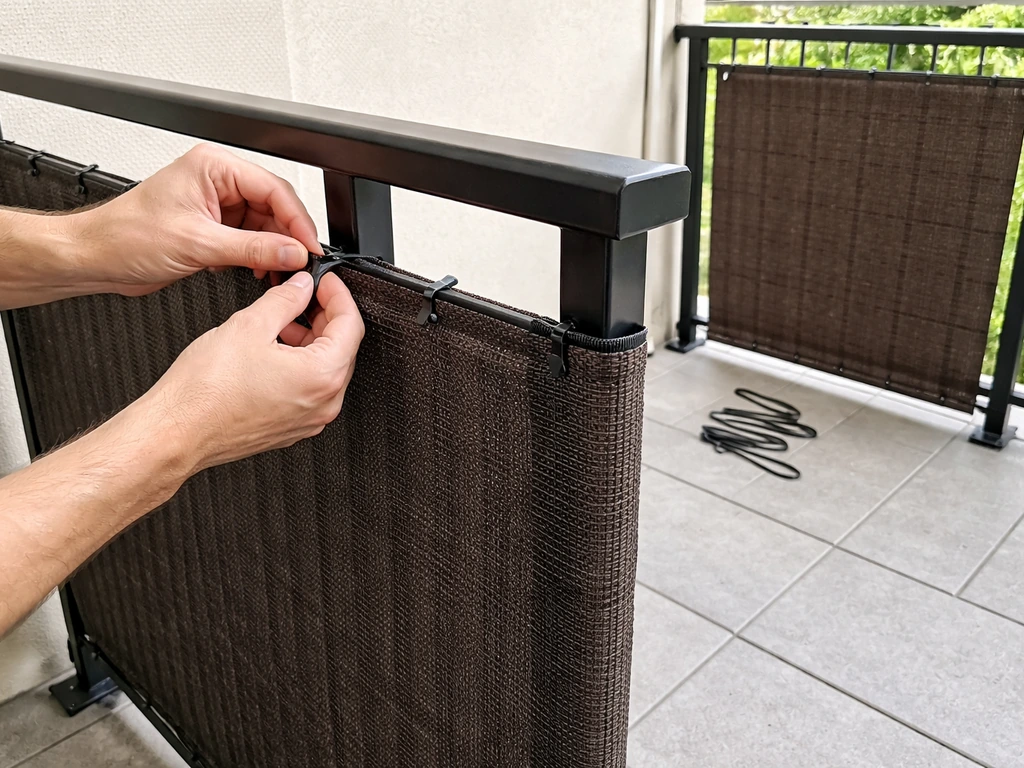
Railing-mounted privacy screens are the most popular apartment patio solution, and for good reason: they are inexpensive, renter-friendly, and take about 30 minutes to install. The standard approach uses zip ties or cable ties to attach a woven HDPE mesh screen directly to your existing railing. Home Depot, Amazon, and most outdoor retailers sell these panels in sizes from 4 feet by 8 feet up to 6 feet by 50 feet rolls. They block roughly 85 to 90 percent of visibility, handle typical patio wind reasonably well, and leave no permanent damage when removed.
When using zip ties, tighten them snugly but not over-tensioned. Over-tightening causes the grommets in the mesh to tear over time, especially in wind. Use stainless steel or UV-resistant plastic ties to avoid rust staining on your railing. For corners and edges, add an extra tie every 12 inches rather than spacing them out. One practical tip: start from the top rail first, get the screen level and taut, then work down to the bottom rail.
If you want something that looks more finished, outdoor curtain panels hung on a tension rod or a cable system give a softer, more intentional look. Tension rods require no hardware and work well between two walls or posts. Outdoor curtains in solution-dyed acrylic (Sunbrella-type fabric) will hold up to UV and rain far better than indoor curtains brought outside. The tradeoff is that curtains move in wind, which some people find annoying, and they require a structural span to hang from.
For a DIY option, you can build a simple lattice panel frame from cedar 2x4s and a sheet of lattice, then lean it against the railing or attach it with removable clamps. This costs roughly $40 to $80 in materials and can be taken with you when you move. Freestanding privacy screens are a pre-made version of this concept: they use weighted bases (some are planter-box combos where soil or gravel adds stability) and do not require any attachment to the building. These work well when your lease prohibits attaching anything to railings at all, but they are more vulnerable to wind because they depend entirely on base weight for stability.
| Option | Avg. Cost | Privacy Level | Installation | Renter-Friendly | Wind Resistance |
|---|---|---|---|---|---|
| HDPE mesh railing screen | $20–$80 | 85–90% | Zip ties, 30 min | Yes | Good (mesh reduces load vs. solid) |
| Outdoor curtain panels | $40–$150 | 60–80% | Tension rod or cable, 1 hr | Yes | Moderate (moves in wind) |
| Freestanding privacy screen | $80–$300 | 70–90% | No attachment needed, weighted base | Yes | Fair (depends on base weight) |
| Freestanding planter-screen combo | $100–$350 | 70–90% | Fill with soil/gravel for stability | Yes | Moderate (heavier = more stable) |
| DIY cedar lattice panel | $40–$80 materials | 50–70% | Clamp or lean, 2–3 hr | Yes (removable) | Fair (lean angle matters) |
| Removable balcony screen system (e.g., Bordene) | $150–$400 | Adjustable (0–100%) | Clips to railing, 1–2 hr | Yes | Good (tensioned design) |
Planters, trellises, and living privacy barriers
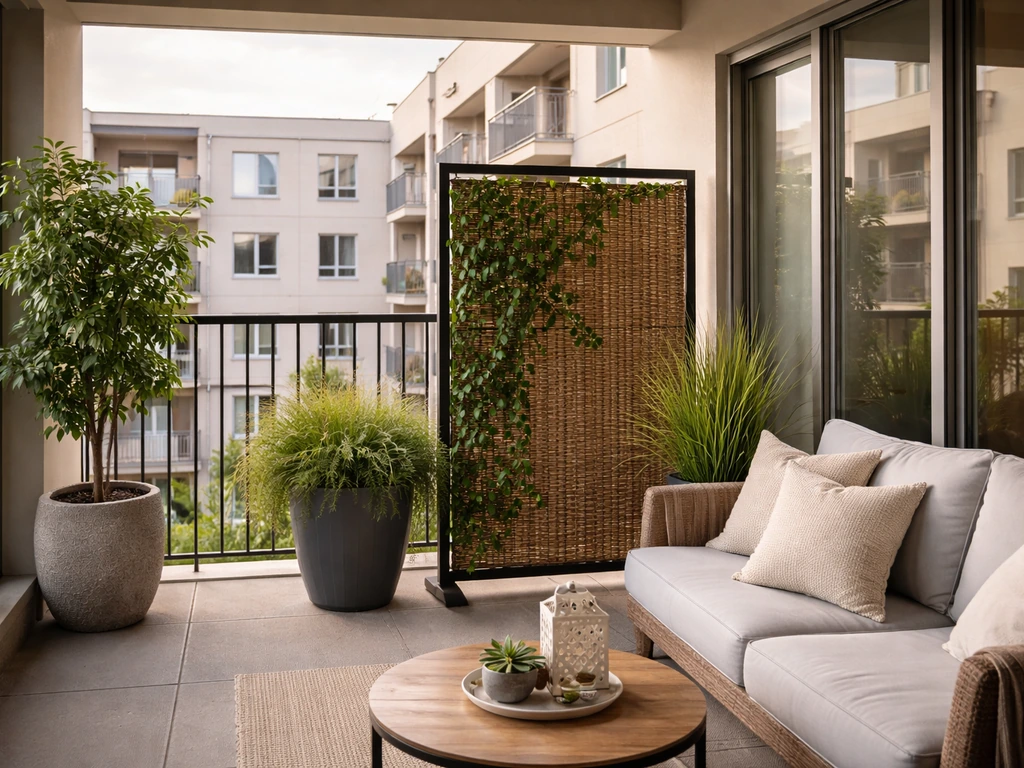
A row of tall planters along the railing is one of the most attractive and practical privacy solutions for an apartment patio, and it works well even in small spaces. The goal is height: a 24-inch planter with a 36-inch plant on top of a 36-inch railing puts foliage at roughly 8 feet, which blocks most neighbor sightlines. Bamboo in containers is the classic choice because it grows fast, stays vertical, and is dense enough to actually block views. Arborvitae, sky pencil holly, and ornamental grasses also work well in containers and tolerate being root-bound better than most shrubs.
The honest tradeoff with plants is weight. A large planter filled with wet soil can easily weigh 80 to 150 pounds or more, which matters on upper-floor balconies where structural load limits exist. Use lightweight potting mix (not garden soil), plastic or fiberglass pots instead of ceramic or concrete, and cluster planters against the building wall rather than the outer railing if weight is a concern. Check your lease or building documentation for any balcony load limits, because some buildings specify them explicitly.
Trellises combined with climbing plants give you vertical privacy coverage without the bulk of large containers. A freestanding trellis panel (about $30 to $100 at most garden centers) can stand in a planter or lean against the railing and support fast-growing vines like jasmine, black-eyed Susan vine, or climbing nasturtiums. For shadier patios, climbing hydrangea or sweet potato vine fill in quickly. The key realistic note: vines take one full growing season to provide meaningful coverage, so this is a spring investment with late-summer payoff, not an immediate fix.
For a combination approach, pair one or two tall planters at the primary sightline corners with a mesh railing screen in between. You get the immediate coverage from the screen and the aesthetic improvement from plants, without needing to fill the entire railing line with containers.
Privacy upgrades on the window and door side
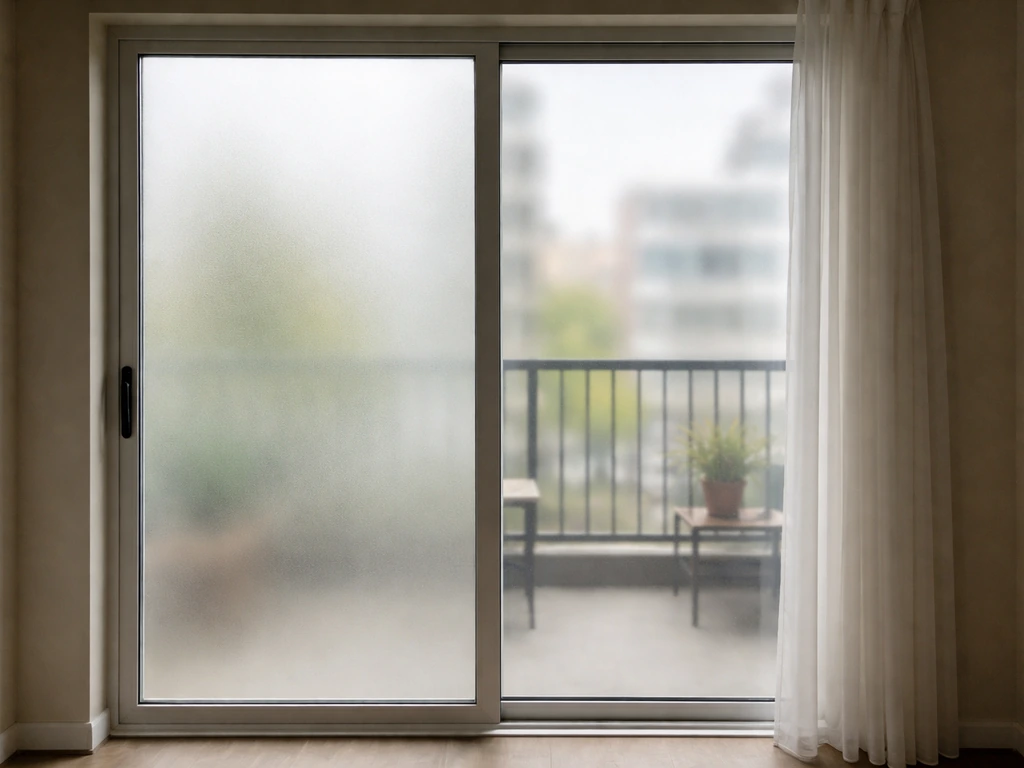
Most apartment patios connect to the unit through a sliding glass door or a large window, and that interior-facing side often gets ignored in privacy planning. But if neighbors can look in through your open door while you are sitting outside, or if you want to screen the transition zone between inside and out, there are a few clean options. Outdoor curtain panels hung on a tension rod just inside or just outside the door frame create a soft divider. Roman shades or bamboo roll-up shades on the exterior can work too, but check whether they are rated for outdoor use before buying.
If your patio has a railing and you are on an upper floor, the railing itself is usually your biggest exposure point. Adding a railing-mounted screen (as described above) is the most direct fix. If the railing is glass or open cable, a zip-tied screen still works, though you will need to thread ties through the cable gap or use clamp-style attachments instead. Some products are specifically designed for glass-panel railings using adhesive-backed hooks or clamp brackets that do not require drilling.
Awnings and shade sails address overhead exposure and can also provide side-angle privacy from above. A retractable awning mounted to the building wall requires a landlord or HOA conversation before installation, but a freestanding shade sail supported by weighted poles requires no permanent attachment. Shade sails are not primarily privacy screens, but a well-angled sail can block a neighbor one floor up from seeing directly onto your patio surface. Prices range from about $30 for a basic polyester triangle to $200 or more for UV-blocking HDPE versions that last multiple seasons.
Temporary vs. permanent: how to choose based on your situation
The core question for renters is almost always: how much should I invest in a space I might leave in a year or two? The honest answer is to start with reversible solutions and only upgrade to semi-permanent ones if you plan to stay for at least two seasons. Zip-tied mesh screens and freestanding panels are fully reversible and cost under $100 in most cases. They are the right starting point for almost every renter because they solve most of the privacy problem without any lease risk.
| Solution type | Cost range | Setup time | Privacy effectiveness | Requires permission | Removable |
|---|---|---|---|---|---|
| Zip-tied mesh railing screen | $20–$80 | 30 min | High (railing zone) | Usually no | Yes |
| Freestanding screen (weighted base) | $80–$300 | 15–30 min | Medium–high | No | Yes |
| Outdoor curtains on tension rod | $40–$150 | 30–60 min | Medium | No | Yes |
| Trellis with climbing plants | $60–$200 | 1–2 seasons to fill in | Medium (after growth) | Usually no | Yes |
| Tall planters (large containers) | $100–$400 | 1–3 hr to set up | Medium–high | Rarely required | Yes (heavy) |
| Retractable awning (wall-mounted) | $300–$2,000+ | Half day+ / professional | High (overhead) | Usually yes | Partially |
| Permanently mounted privacy panels | $200–$800+ | 2–4 hr / possible professional | Very high | Yes | Difficult |
One factor that changes this calculus: wind. Higher floors experience significantly more wind load than ground-level patios, and a dense solid screen that works fine on the first floor can become a sail that pulls at your railing or topples freestanding panels on the fifth floor. For upper-floor apartments, choose mesh materials with high open-area percentages (look for products described as 85 to 90 percent blockage using open-weave HDPE rather than solid vinyl) because these reduce wind load compared to solid-panel equivalents of the same size. Wind-load calculations for privacy screens are genuinely complex and depend on your altitude, terrain, and screen geometry, so for any larger or semi-permanent installation above the third floor, it is worth consulting the manufacturer's guidelines or your building management.
Permissions, rules, and how to avoid getting it wrong
This is where a lot of apartment dwellers get tripped up. The general rule is that reversible, non-structural additions are usually allowed without explicit permission, but you should verify this against your specific lease before assuming. Most leases prohibit permanent modifications, which typically means no drilling into walls, no anchoring into the building structure, and nothing that leaves damage when removed. A zip-tied mesh screen on a railing almost always falls within acceptable territory. A permanently bolted shade structure almost certainly requires approval.
If you live in a condo building or a community with an HOA, the rules get more specific. HOAs commonly restrict the appearance, size, and materials of anything visible from common areas or the building exterior. Even if your lease allows it, the HOA may not. The safest approach is a quick email to building management describing what you plan to install: material type, how it attaches, and how it will be removed. Get any approval in writing. This protects you at move-out and avoids a dispute over your security deposit.
Building code adds another layer, especially for anything attached to or near railings. In New York City, for example, the Building Code is explicit: a privacy screen installed in a balcony opening must be openable from either side to preserve egress. No privacy screen can permanently block the clear height of a balcony opening that serves as a means of egress. This principle applies in most jurisdictions even without specific local language: you cannot install anything that obstructs a fire escape, emergency exit, or required egress path. If your balcony connects to a fire escape, this is non-negotiable.
For installations involving any weight on the railing, check whether your railing was designed to handle lateral loads. Residential guardrails are typically required to handle a 200-pound lateral point load at the top rail, but that does not mean adding a heavy screen under constant wind load is safe or code-compliant. When in doubt, use freestanding solutions instead of railing-mounted ones for larger panels.
A practical installation checklist before you start:
- Read your lease: look for language about modifications, exterior alterations, or balcony restrictions.
- Check HOA rules if applicable: request the relevant section in writing if you are unsure.
- Identify egress paths: mark any door, hatch, or opening that serves as an emergency exit and make sure your plan does not block it.
- Measure your railing: height from deck surface, total linear feet, and the railing material (metal, glass, cable, wood) to match the right attachment method.
- Choose attachment method based on railing type: zip ties for metal bar/tube railings, clamp brackets for cable or glass railings, weighted bases for freestanding options when no attachment is permitted.
- Check weight if you are on an upper floor: planter-screen combos can exceed 150 pounds when filled; distribute weight along the building wall, not the outer railing.
- Email building management for anything larger than a basic railing screen, and save the response.
What to do first, second, and third
If you want to solve this today, here is the practical sequence. First, do the sightline assessment: stand where you sit and identify the one or two spots where you are most visible. Rearrange furniture to reduce exposure from those spots. Second, measure your railing height and total railing length, then buy a mesh privacy screen sized to cover your primary exposure zone.
If you are wondering what can I use for privacy on my patio, start with sightline coverage and then choose screens, curtains, or planters that fit your lease and wind conditions mesh privacy screen. Install it with zip ties. That alone solves most apartment patio privacy problems and costs under $50.
Third, if you want a longer-term or better-looking solution, add tall planters at the corners with bamboo or a vertical ornamental grass, and consider a trellis panel for one section if you have a season to let it fill in.
If overhead visibility from an upper neighbor is your real problem, a freestanding shade sail on weighted poles is the most accessible next step after the railing screen. If your building prohibits railing attachments entirely, start with a freestanding screen in a planter base at the primary sightline and work from there. The important thing is to match the solution to the actual problem you identified in your assessment, not to buy the most elaborate option and hope it covers everything. Most apartment patio privacy issues can be solved with two or three targeted changes rather than a complete enclosure.
Condo patios and townhouse patios often have their own wrinkles around HOA rules and shared outdoor spaces, so if your situation leans more toward those, it is worth thinking through the specific constraints of those settings separately. If you are dealing with a condo patio, focus on the exact sightlines, then choose privacy upgrades that fit HOA rules so you can make the space more private without risking a violation how to make a condo patio more private. If you are specifically working on how to decorate a townhouse patio, start by mapping the sightlines and choosing coverage that fits your HOA or shared-space rules. The principles here carry over, but the permission conversation tends to look different depending on what you own versus what you rent.
FAQ
What should I do if my privacy problem is mainly from the neighbor one floor up?
If your neighbor’s main exposure is from above, a standard railing screen may only block the lower line of sight. You typically need either taller plant coverage that reaches the higher viewpoint, a screen panel that extends above the railing height, or an angled shade element (like a well-positioned shade sail) to break the direct downward sightline.
Can I use curtains or tension rods on a patio without them falling or getting ruined by weather?
Use outdoor-rated fabrics and hardware (UV-resistant ties, corrosion-resistant brackets). If you use tension rods, make sure the span is supported at each end and that the rod ends are stabilized, since outdoor curtain setups move more in wind and can slip against glass or smooth trim.
Will a zip-tied railing mesh screen hold up in heavy wind on upper floors?
Yes, but avoid leaving the screen flapping. Choose a more open-weave mesh (still providing strong visibility reduction) and keep the screen taut. Also plan for wind by confirming there are no sharp edges on the railing that can chafe the mesh, and consider temporary tie reinforcements at the corners if gusts are strong.
How do I know whether my patio privacy screen could violate egress or fire-escape rules?
A screen that looks solid “from a distance” can be non-compliant if it obstructs an egress opening or fire escape pathway. If your balcony serves as a required exit, prioritize solutions that sit within the non-egress area, use removable freestanding pieces, and confirm the design with building management before installing anything fixed.
How can I make sure I’m measuring privacy gaps accurately, not just what I see sitting still?
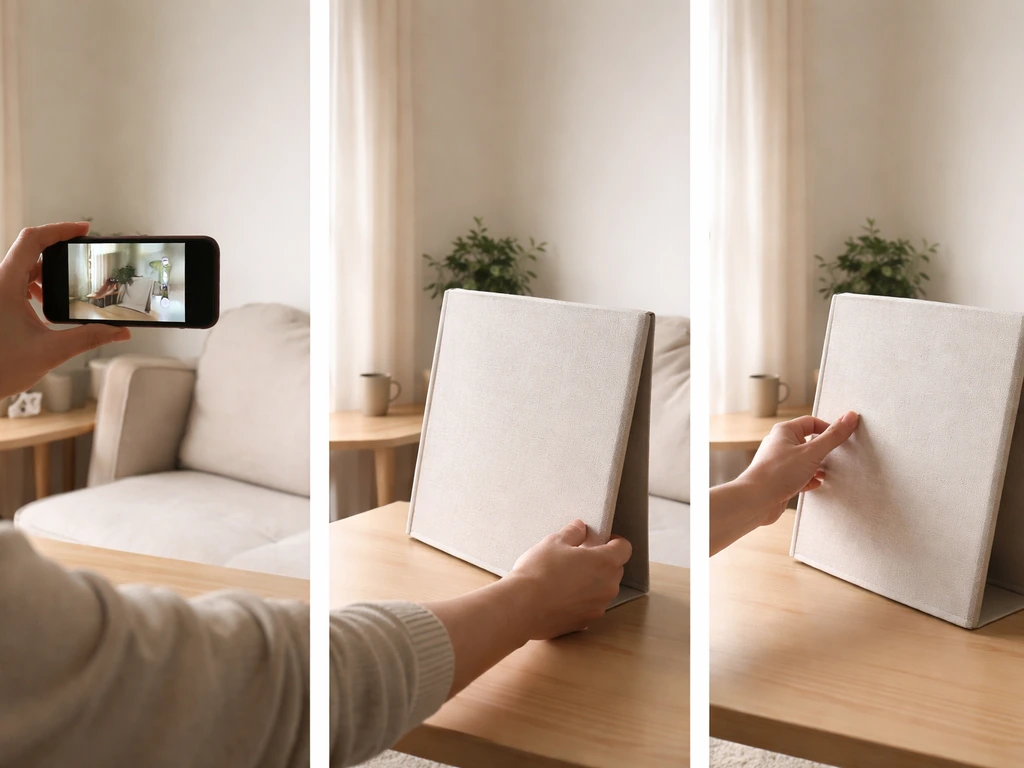
Yes. Do a quick test by standing at your seating height and then at a slightly higher height, using your phone camera’s front-facing view from the neighbor-facing direction to see where you’re exposed. This helps you catch side-angle leaks and areas where you appear visible only when you move or stand up.
What’s the best way to attach a privacy screen to glass or cable railings without drilling?
If you have glass or open cable railing, look for attachment methods designed for those systems, such as clamp-style attachments or adhesive-backed hook kits rated for outdoor use (and removable without leaving residue). Threading zip ties through cable gaps can work, but it often loosens over time if the gaps flex in wind.
What’s the most cost-effective upgrade path if my first solution only partially works?
Start with the lightest, reversible solution that covers the main sightline, then upgrade only where you still have exposure. For example, many people do one railing mesh section for immediate privacy, add planters only at the corners that remain visible, and skip larger full-length enclosures until you confirm the wind impact and coverage.
How do I keep tall planters from becoming a balcony-load problem?
Check the planter plan before buying. Many balcony load issues come from wet soil weight and oversized pots. Use lightweight potting mix, choose plastic or fiberglass containers, and place heavier planters closer to structural supports (often nearer the wall). If your building publishes load limits, treat them as a hard constraint.
How long should I expect trellis plants to take before they provide real privacy?
Vines are not immediate privacy, they are gradual. Plan for at least one growing season for meaningful coverage, and use a temporary backdrop (freestanding screen or mesh panel) while the trellis fills in. Also consider how much sun your patio gets, since low light can slow growth.
What are renter-safe options if my lease prohibits attaching anything to the railing?
If your lease mentions “no attachments” or prohibits modification to railings, prioritize freestanding screens with weighted bases or planter-box combos. They usually avoid permission issues because they do not require attaching to the building, but you still need to manage wind stability and ensure the base is not a trip hazard.
Why do some privacy screens flap or feel unstable, even when they are securely tied down?
Avoid rigid solid panels unless you have a plan for wind, because solid surfaces catch gusts and can behave like a sail. For a similar look with less wind risk, use open-weave mesh for railing screens, or smaller sectional coverage paired with plants to block the most important viewing angles.
What should I ask for in writing from HOA or building management before installing a privacy setup?
For HOA or condo rules, send a short description of the exact product and dimensions, including how it attaches and how it will be removed at move-out. Ask whether there are color or material restrictions for anything visible from common areas, and get written approval so you have documentation if a dispute happens later.
If my patio privacy issue is my door or window facing out, what’s the best approach?
Yes, and it helps identify the real constraint. Some people focus on blocking neighbors looking in, but forget the interior-facing side through the sliding door or window. Adding an outdoor curtain panel or exterior-rated shade at the transition zone can reduce visibility while keeping the patio feeling connected to the room.
Can a shade sail actually make an apartment patio private, or is it only about blocking sun?
A shade sail can help when your exposure is overhead or angled from above, but it usually will not fully block direct side-by-side sightlines at eye level. Position it so it interrupts the line of sight from the primary neighbor viewpoint, and treat it as a complementary layer to railing screens or planters.
Next Article
How to Make a Patio Private: Step-by-Step Options
Step-by-step ways to make a patio private, comparing fences, screens, curtains, and plants with costs, DIY tips, and nex