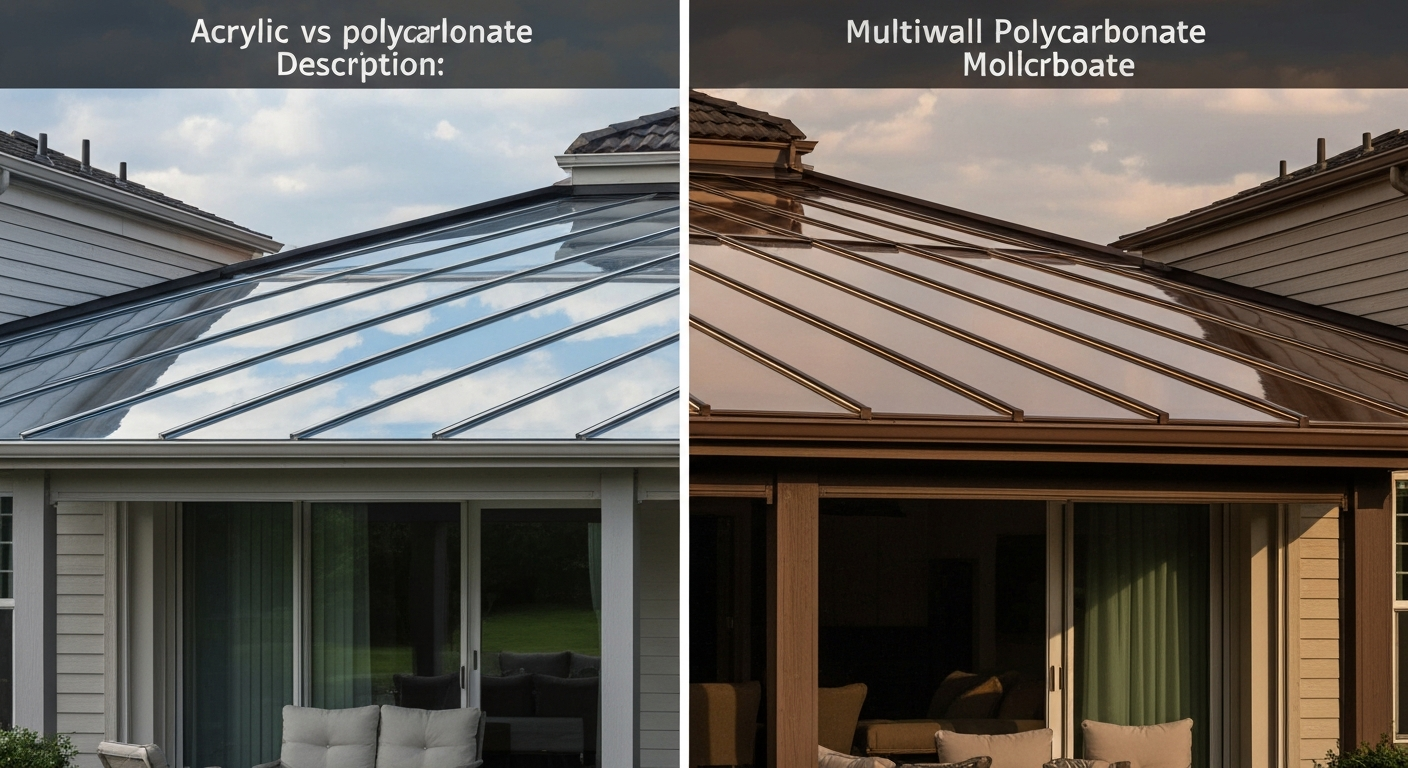
Polycarbonate is the stronger, more impact-resistant choice and works better for most patio cover projects. Acrylic delivers superior optical clarity and longer UV stability without a surface coating, but it cracks under impact and is harder to work with on a job site. Which one is right for your patio depends on your climate, how much light you want coming through, your budget, and whether you're doing the work yourself or hiring a contractor.
Acrylic vs Polycarbonate Patio Covers: Choose by Climate

Miles Hart
14 Jul 2026
Who this guide is for
This comparison is written for homeowners who are planning a covered patio structure and have landed on a clear or translucent roof panel rather than a solid opaque material. You've probably seen both acrylic and polycarbonate listed at home improvement stores or on fabricator websites, noticed the price difference, and wondered whether it matters. It does matter, but the answer isn't straightforward. The two materials look similar on a shelf and perform completely differently in the field. This guide walks through every meaningful difference, explains what the specs on manufacturer datasheets actually mean for your patio, and gives you a direct recommendation framework based on your situation.
The short version if you're in a hurry
Acrylic (sold under brand names like PLEXIGLAS and ACRYLITE) offers up to 90 to 92 percent visible light transmission and outstanding long-term color stability, with some clear grades backed by 30-year no-yellowing warranties. Polycarbonate multiwall panels typically transmit 80 to 85 percent of visible light, rely on a surface UV coating that degrades over time (warranties commonly run 5 to 10 years for many product lines), but are dramatically tougher and thermally better insulating when built as multiwall panels. For a covered patio that needs to handle hail, branches, snow load, or the occasional bump from a ladder, polycarbonate multiwall panels are the practical default. Acrylic shines where maximum clarity and long-term aesthetics matter more than toughness, such as a pergola roof panel you can see the sky through, in a mild climate, where the structure is protected.
Clarity and how much light comes through
Clear solid acrylic sheet is among the most optically transparent plastics available. Manufacturers report visible light transmission up to 90 to 92 percent for clear variants, tested under ASTM D1003, which is the industry standard for measuring haze and luminous transmittance in transparent plastics. In practical terms, looking through a clear acrylic patio panel feels almost like looking through glass. Haze levels are low, and the material doesn't scatter light the way diffused or opal panels do.
Multiwall polycarbonate panels, which are the format you'll actually use on most patio roofs, deliver a bit less light. Published datasheets from manufacturers like Palram (Sunlite) and Amerilux (CoverLite) show twinwall 6 mm panels at roughly 80 to 85 percent light transmission, with 8 mm and 10 mm versions coming in around 80 to 82 percent. The slight reduction comes from the internal ribs and air channels in the panel structure. Opal and diffused variants drop significantly lower, often to 50 to 60 percent, but scatter the light more evenly, which reduces glare under the cover.
If you're building an attached patio cover on a south-facing wall and want the space underneath to feel bright and open, acrylic solid sheet gets you closest to a glass-roof effect. If you want privacy, softer light, or coverage over a dining area where direct sun glare is a problem, the diffusing properties of multiwall polycarbonate or opal panels are actually an advantage. There's no universally correct answer here; it depends on what you're trying to create.
| Property | Clear Acrylic (solid sheet) | Twinwall Polycarbonate (6–10 mm) |
|---|---|---|
| Visible light transmission | Up to 90–92% | ~80–85% (clear); ~50–60% (opal) |
| Optical clarity | Very high, glass-like | Slightly diffused by internal ribs |
| Haze | Low | Moderate (increases with wall count) |
| Available finishes | Clear, tinted, frosted | Clear, opal, bronze, diffused, multicolor |
Impact resistance: this is where the two materials really diverge
This is the most practically important difference for a patio cover, and the numbers are stark. Acrylic (PMMA) has a notched Izod impact strength of roughly 0.3 to 0.5 ft-lb/in (approximately 16 to 27 J/m) according to standard fabrication datasheets. Polycarbonate's notched Izod values run in the range of 1 to 12 ft-lb/in depending on grade, with engineering-grade materials (Lexan, Makrolon family) reporting values an order of magnitude higher than PMMA. That isn't a minor difference; polycarbonate is genuinely in a different class for impact resistance.
What that means on a real patio: a golf ball, a hailstone, a falling branch, or a wayward piece of patio furniture will crack acrylic sheet. The same impact on a polycarbonate panel typically leaves a dent or scuff, not a crack. In areas with hail, heavy snow, or trees overhead, polycarbonate isn't just the better choice, it's the only sensible one. Acrylic's brittleness also shows up during installation. A mis-drilled hole, a screw overtightened, or a panel flexed too aggressively during fitting can crack acrylic in ways that don't happen with polycarbonate.
Tensile and flexural strength numbers are closer between the two materials. Polycarbonate engineering datasheets show flexural strength around 90 MPa, which is similar to or slightly higher than PMMA. Lexan® (polycarbonate) technical datasheet (Professional Plastics copy of manufacturer data) lists flexural strength ≈ 90 MPa and notched Izod impact values substantially higher than PMMA, depending on grade. But flexural strength isn't what breaks a patio panel in service. Impact events and thermal stress cycles are, and polycarbonate handles both better.
UV protection: acrylic's biggest structural advantage
This is the one area where acrylic has a meaningful, documented edge. High-quality acrylic sheet is UV-stable throughout the bulk of the material, not just at the surface. Brands like PLEXIGLAS and ACRYLITE market this as 'naturally UV-stable' technology, and they back it with 30-year no-yellowing warranties on many clear architectural grades. When the material weathers, it stays clear because the UV stabilizers are embedded in the polymer itself, not applied as a coating.
Polycarbonate handles UV differently. The base polymer is UV-sensitive and yellows without protection, so manufacturers co-extrude a UV-barrier layer onto the surface. That protective layer works well when new, but it's finite. Typical multiwall polycarbonate warranties for light transmission and yellowing commonly run around 5 to 10 years for many product lines. Some premium products offer longer coverage, but the point is that a polycarbonate panel's clarity over a 20 to 30 year lifespan depends heavily on how well that surface coating holds up, which is affected by installation (UV face must be oriented outward), cleaning practices, and regional UV intensity.
For a patio cover you want looking good for 25 or 30 years with minimal intervention, acrylic's inherent UV stability is genuinely valuable. For a 10 to 15 year functional lifespan, or for a structure in a climate with moderate UV exposure, the gap matters less in practice.
Thermal expansion, heat buildup, and ventilation
Both materials expand significantly with temperature changes, and this is one of the most common sources of installation problems for DIYers who skip the technical manuals. Polycarbonate has a coefficient of linear thermal expansion (CLTE) of approximately 0.065 mm per meter per degree Celsius (about 65 × 10-6 per °C), based on published technical manuals. To put that in practical terms: a polycarbonate panel that is 3 meters long can expand or contract by roughly 12 mm over a 60°C temperature swing, which is entirely realistic for a dark-colored panel on a sunny roof in summer versus a cold winter night. Installer guidance from manufacturers like Polycasa recommends allowing approximately 5 mm per meter of panel length for free movement in glazing conditions.
Acrylic has a similar thermal expansion range. Both materials require pre-drilled oversized fastener holes to allow that movement without cracking the panel. Palram installation guidance, for example, specifies pilot holes approximately 5 mm larger than the screw diameter, with neoprene or EPDM washers under fastener heads to cushion the panel and allow sliding. Over-tightening fasteners is one of the most common installation mistakes, and it causes stress cracking around holes in both materials, particularly acrylic.
Heat buildup under a patio cover is a real concern in hot climates. Clear and lightly tinted panels transmit a high percentage of solar energy as heat into the space below. Bronze and gray tints reduce solar heat gain. Multiwall polycarbonate panels with their air channels provide a modest thermal buffer between the hot outer surface and the underside of the panel, which a single solid sheet (acrylic or solid polycarbonate) doesn't offer. In climates where summer temperatures regularly exceed 95°F (35°C), ridge vents, open ends, or fans under the cover significantly improve comfort regardless of which panel material you choose.
Thickness, R-value, and how well each material insulates
This is where comparing solid acrylic sheet to multiwall polycarbonate isn't really a fair fight. A single sheet of either plastic, at 3 to 6 mm thickness, provides almost no thermal insulation. The R-value comes from air gaps, not the plastic itself. Multiwall polycarbonate panels are engineered specifically to trap air between structural walls, and that's where their insulation value comes from.
Published manufacturer data shows 6 mm twinwall polycarbonate at a U-value of approximately 0.61 W/m²K, which translates to roughly R-1.6 in imperial units. That's modest by wall insulation standards but meaningful for a roof panel compared to a single solid sheet. Triplewall and thicker multiwall panels (10 mm, 16 mm, 25 mm) do progressively better, with 25 mm five-wall panels reaching U-values around 0.20 to 0.25 W/m²K in manufacturer tables, equivalent to roughly R-4 to R-5.
If you want a patio enclosure that stays comfortable in winter, multiwall polycarbonate with a lower U-value is the relevant comparison point. Solid acrylic sheet isn't typically used where insulation matters, though you can find acrylic-faced insulated glazing units for more complex enclosures. For a standard open patio cover in a mild climate, the insulation difference between a 6 mm twinwall and a clear acrylic sheet is mostly academic. In a cold climate where you're trying to extend the season, it becomes the deciding factor.
| Panel type | Approximate U-value (W/m²K) | Approximate R-value (imperial) | Best use case |
|---|---|---|---|
| Solid acrylic sheet (3–6 mm) | ~5.0–6.0 | ~0.17–0.20 | Maximum clarity, mild climate |
| 6 mm twinwall polycarbonate | ~0.61 | ~1.6 | General patio cover, moderate climate |
| 10 mm twinwall polycarbonate | ~0.50 | ~2.0 | Patio cover, cooler climate |
| 16 mm multiwall polycarbonate | ~0.35–0.40 | ~2.5–3.0 | Three-season enclosure |
| 25 mm five-wall polycarbonate | ~0.20–0.25 | ~4.0–5.0 | Near-year-round enclosure |
What things actually cost: materials, installation, and long-term value
Material prices vary by region, panel size, and supplier, but here are realistic ranges based on typical retail and contractor pricing as of mid-2026. Clear acrylic sheet in the 3 to 6 mm range runs roughly $3 to $6 per square foot for standard sizes, with large-format architectural sheets or specialty UV grades pushing higher. Multiwall polycarbonate twinwall panels (6 to 10 mm) typically cost $2 to $5 per square foot for the panels themselves, with thicker multiwall (16 to 25 mm) ranging from $5 to $12 per square foot at retail.
Installed costs are a different conversation. A professionally installed patio cover with polycarbonate multiwall panels, including framing, fasteners, flashing, and labor, commonly runs $15 to $40 per square foot depending on the structure's complexity, region, and whether it's attached to the house or freestanding. Simple freestanding structures on the lower end, complex attached covers with custom framing and permit work at the upper end. Acrylic panels add modest material cost premiums but are slower to work with, which can increase labor time if your contractor isn't familiar with acrylic's specific cutting and fastening requirements.
DIY installation: what's realistic with each material
Polycarbonate multiwall panels are the more DIY-friendly material. They cut cleanly with a circular saw fitted with a 40 to 80 tooth carbide blade, they flex slightly to conform to minor framing irregularities, and they're forgiving of imperfect cuts because the edges are typically covered by aluminum extrusions or flashing. The main DIY pitfalls are forgetting to pre-drill oversized holes (which causes stress cracks at fasteners), over-tightening screws, and installing the panel UV-side down, which accelerates yellowing.
Acrylic requires more care. Manufacturer guidance recommends fine-tooth blades for sawing, careful pre-drilling, and keeping the protective film on the panel until after fabrication is complete to prevent surface scratches. Acrylic will crack at fastener holes if over-tightened or if the hole is too close to the panel edge, and it doesn't flex to accommodate framing that's slightly out of plane. For a first-time DIY patio cover project, polycarbonate multiwall is the more forgiving choice by a meaningful margin.
Both materials require a minimum roof slope of approximately 1:12 for drainage, as specified in most manufacturer installation guides. Purlins (the structural members the panels rest on) typically need to be spaced 500 to 600 mm (20 to 24 inches) apart, and most multiwall polycarbonate manufacturers publish specific fastening patterns tied to expected wind and snow loads for your region. Checking those tables before you build saves you from under-building a structure that fails in its first winter storm.
Permits and lifecycle costs
Most jurisdictions require a building permit for a permanent patio cover attached to the house, and some require permits for freestanding structures above a certain size. The panel material you choose doesn't usually affect permit requirements directly, but the structural design will need to meet local code for wind and snow loads. If you're in a high-wind or heavy-snow zone, the engineer or building department will want to see that your panel choice and fastening pattern is appropriate for the load. Polycarbonate multiwall panels are more commonly pre-engineered and come with manufacturer load tables; acrylic solid sheet requires more individual engineering scrutiny for structural applications.
Lifecycle cost is where acrylic's UV durability argument gets interesting. If a quality acrylic panel genuinely holds its clarity for 25 to 30 years (as the warranty coverage suggests) versus a polycarbonate panel that yellows noticeably after 10 to 15 years and needs replacing, the total cost of ownership can shift in acrylic's favor over a long time horizon, even if the initial material cost is similar or slightly higher. That said, polycarbonate panels are generally easier and cheaper to replace panel by panel than a custom acrylic installation, so the comparison depends heavily on how you manage the structure over time.
Maintenance: what you actually have to do
Both materials need gentle cleaning. Abrasive cleaners scratch both acrylic and polycarbonate surfaces and should be avoided. Manufacturer guidance for acrylic (PLEXIGLAS processing pages) recommends mild soap and water and soft cloths. Polycarbonate multiwall panels accumulate debris in the fluted channels at open ends, and sealing those ends with appropriate vented or solid tape at installation prevents that problem from developing. Algae and mold growth on the surface of either material in humid climates responds to diluted household cleaning solutions; avoid anything solvent-based on acrylic because it will craze the surface.
Scratches are a bigger issue with acrylic. The material is softer on the surface than polycarbonate, and foot traffic or dragged objects leave visible marks. For a patio roof panel that's overhead and out of reach, that's rarely a problem. For a lower application like a windscreen panel at sitting height, acrylic scratches more easily than polycarbonate in day-to-day use.
Which material fits which structure type
Patio cover design choices intersect with material selection in ways that matter. An attached patio cover built tight to the house fascia has different load and drainage requirements than a freestanding structure set out in the yard. The question of attached vs detached structures affects how you frame the roof and how you manage water at the house connection, but either design can use polycarbonate or acrylic panels once the framing is right.
If you're considering a lattice patio cover rather than a solid panel roof, neither acrylic nor polycarbonate applies in the traditional sense; lattice covers use open frameworks that provide partial shade without a solid panel. That's a fundamentally different design approach with its own trade-offs. Similarly, the comparison between a fixed panel cover and a retractable awning comes down to whether you want permanent weather protection or adjustable coverage. Panel roofs using polycarbonate or acrylic give you year-round structural coverage that an awning can't match; awnings offer flexibility and lower cost but don't protect against rain, hail, or snow the way a solid panel does. For guidance on how panel materials work with different roof styles, see our patio cover lattice vs solid comparison to help choose the right cover type for your needs.
How these materials affect curb appeal and home value
A well-framed patio cover with clean, clear polycarbonate panels reads as a thoughtful outdoor addition rather than a utilitarian shed. Bronze or gray tinted panels tend to look more intentional from the street than clear panels, which can look industrial depending on the house style. Acrylic's glass-like clarity gives a more architectural appearance when new, and its long-term UV stability means it continues to look good for many years without the yellowing that can make an aging polycarbonate cover look neglected.
From a home value standpoint, covered patio structures generally add usable outdoor square footage that buyers value, but the quality of construction and integration with the house matters more than the specific panel material. A properly permitted, structurally sound cover in good condition contributes positively. An aging, yellowed, or cracked panel cover detracts. Either material in good condition reads well; the long-term appearance argument favors acrylic's UV stability if aesthetics are a priority.
Scenario-based recommendations
Rather than a single winner, here's how to apply the comparison to common homeowner situations:
| Your situation | Better choice | Why |
|---|---|---|
| Hail-prone or high-wind climate | Polycarbonate multiwall | Impact resistance is essential; acrylic will crack |
| Hot climate, want to reduce heat under cover | Tinted multiwall polycarbonate | Bronze/gray tint cuts solar heat gain; air channels buffer heat |
| Cool climate, extending the season | Thick multiwall polycarbonate (16–25 mm) | Meaningful R-value; acrylic solid sheet provides almost none |
| Maximum clarity, mild climate, DIY not required | Clear acrylic solid sheet | Glass-like appearance, 30-year UV warranty, ideal for showcase structure |
| First-time DIY builder | Polycarbonate multiwall | More forgiving to cut, fasten, and handle on site |
| Long-term investment, don't want to replace panels | Acrylic (clear) or premium PC with strong warranty | Acrylic's UV stability reduces yellowing risk over 20–30 years |
| Budget-constrained project | 6 mm twinwall polycarbonate | Lowest material cost, adequate performance for most climates |
| Freestanding pergola-style roof with sky view | Clear acrylic or clear polycarbonate twin wall | High LT; polycarbonate if impact risk exists, acrylic for best optics |
A simple decision checklist before you buy
- Do you get hail, heavy snow, or large overhanging trees? If yes, choose polycarbonate multiwall.
- Do you want the patio to feel as bright and glass-like as possible? If yes and your climate is mild, acrylic solid sheet is worth considering.
- Are you building this yourself? Polycarbonate multiwall is the more forgiving DIY material.
- Do you need meaningful thermal insulation to extend the season? Choose multiwall polycarbonate at 16 mm or thicker.
- Is long-term UV clarity important to you over 20 to 30 years? Acrylic's inherent UV stability gives it an edge here.
- What's your framing span? Check manufacturer load tables for your panel choice against expected wind and snow loads before committing.
- Are you in a permit-required jurisdiction? Confirm your panel and framing plan meets local structural requirements before purchasing materials.
- What does your budget allow per square foot installed? For most patio cover budgets, 6 to 10 mm twinwall polycarbonate hits the best balance of performance and cost.
These two materials are often presented as interchangeable alternatives, but they solve different problems. Polycarbonate multiwall is the practical workhorse for most patio cover applications: tougher, better insulating, easier to DIY, and available in a range of thicknesses for different climates. Acrylic is the specialist choice where long-term optical clarity and UV stability are worth paying for and protecting. Knowing which problem you're actually trying to solve makes the decision straightforward.
FAQ
What standardized tests and datasheet metrics should I cite when comparing optical performance (clarity, visible light transmission, haze)?
Report ASTM D1003 luminous (visible) transmittance (%) and haze values for each product or product class. When manufacturers publish light transmission (LT) use their ASTM‑referenced LT and haze numbers or clearly label non‑ASTM values. For multiwall panels, list LT by construction (e.g., twinwall 6 mm, 8 mm, 10 mm) and by color/opal/opal‑diffuse variants, and note whether values are for clear or UV‑coated faces.
What specific optical ranges are realistic to report for acrylic vs polycarbonate roofing panels?
Use manufacturer and peer‑reviewed ranges: clear solid acrylic sheets: ~88–92% visible LT (brand variants may state up to ~92%). Multiwall polycarbonate: typical twinwall 6–10 mm commonly ~80–85% LT for clear constructions; opal/diffuse or colored variants often drop LT to ~50–60% depending on product. Cite product tables for the exact panel thickness and color used in the example.
How should I quantify impact resistance and mechanical toughness for readers?
Use common mechanical indicators from datasheets: notched Izod or Charpy impact values and flexural/tensile strengths. Cite representative values showing polycarbonate has much higher impact toughness (Izod values an order of magnitude greater than PMMA in many datasheets) while flexural/tensile strengths are similar. Include real datasheet examples (e.g., Lexan / Makrolon and PMMA manufacturer tables) rather than vague claims.
What UV‑stability and yellowing information must be included and how to source it?
Report whether the material is intrinsically UV‑resistant (bulk stability) or depends on a co‑extruded/surface UV layer. Use manufacturer warranty statements (years and coverage for light transmission or no‑yellowing) and accelerated weathering studies where available. Note that many acrylic architectural grades advertise long no‑yellowing warranties (examples: ~30 years), whereas many multiwall polycarbonates rely on a UV coating and commonly carry shorter LT/yellowing warranties (often ~5–10 years). Cite specific product warranty pages and peer‑reviewed greenhouse studies for long‑term behavior.
What thermal properties should the article compare and how should they be presented?
Provide U‑value (W/m²·K) or equivalent R‑value for the relevant constructions: multiwall panel U/R tables by wall count and thickness (e.g., 6 mm twinwall, 10–16 mm triplewall). Note that single‑sheet solid acrylic/polycarbonate have low insulation compared with multiwall panels. Include CLTE (coefficient of linear thermal expansion) values for solid polycarbonate (~65×10⁻⁶ /°C) and guidance on expected expansion per meter over typical temperature ranges and manufacturer recommendations for spacing/fastening to accommodate movement.
What installation and fastening details do I need to explain for DIY vs professional readers?
Summarize manufacturer installation best practices: minimum roof slope recommendations (e.g., many panels require ~1:12 min slope), recommended fastener spacing (~500–600 mm / 20–24 in on purlins), pre‑drilling oversized holes to allow thermal movement (oversize amounts per vendor), use of neoprene/EPDM washers, avoid over‑tightening, orient UV face outward, and edge engagement/clamp details. Include tooling guidance (blade tooth counts, saw types, PPE) and examples of common installer errors (insufficient expansion gap, over‑tightened fasteners) with citations to installation guides.
Next Article
My Lawn Is Higher Than My Patio: Fix Drainage and Grades
Fix yard grading where lawn sits higher than patio to stop pooling, runoff, and trip hazards with DIY or pro options.