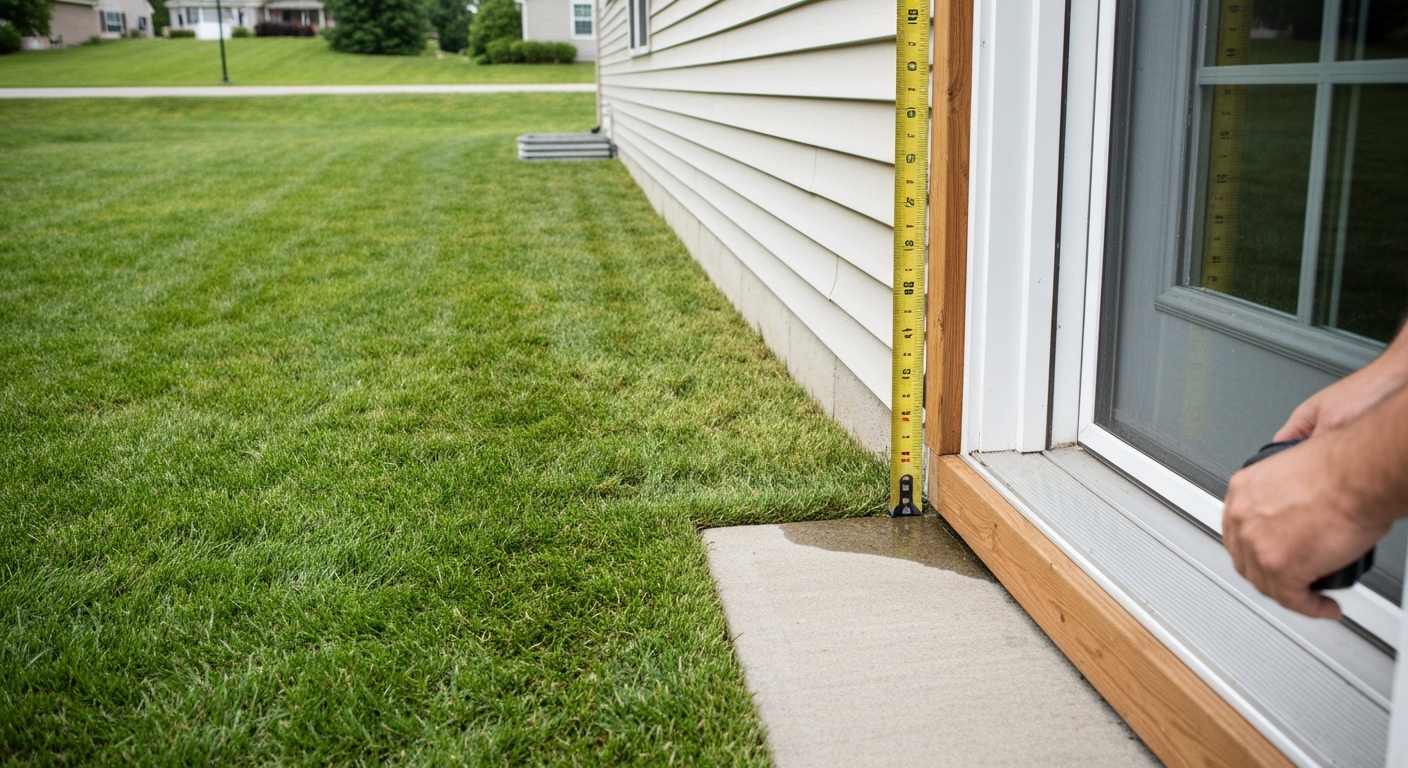
Most homeowners end up spending between $4,500 and $22,500 to have a patio cover professionally installed, with a national average sitting around $8,500 to $10,000. In raw per-square-foot terms, expect roughly $20 to $60 per sq ft for most standard materials and roof types, though that range stretches to $120 or more if you go with solid wood or a motorized louvered system.
How Much Do Patio Covers Cost in 2026? Pricing Guide

Miles Hart
2 May 2026
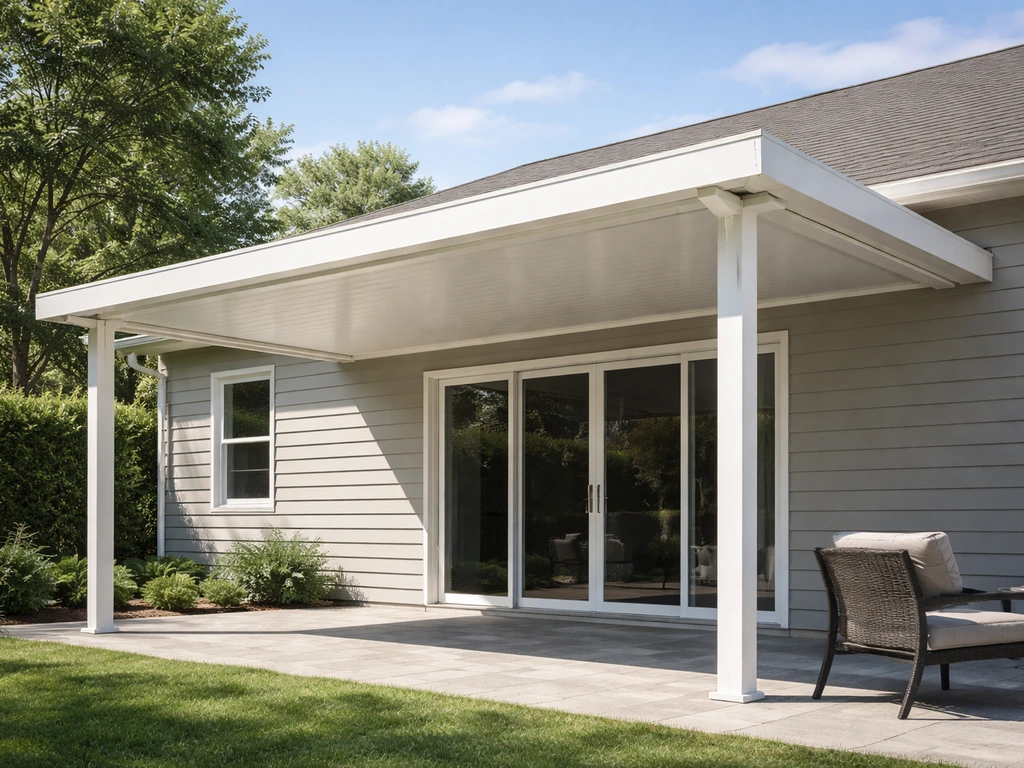
HomeGuide estimates that manual louvered pergolas cost about $45, $110 per square foot installed, with motorized versions typically priced higher $45–$110 per square foot installed. A basic 300 sq ft aluminum lattice cover might land around $7,000 to $10,000 installed. A 500 sq ft insulated solid-roof cover with lighting and gutters can easily push $20,000 to $30,000 once all the extras are factored in.
The number varies a lot depending on material, roof type, where you live, and what your site actually needs, so the rest of this guide breaks all of that down.
Typical patio cover cost ranges
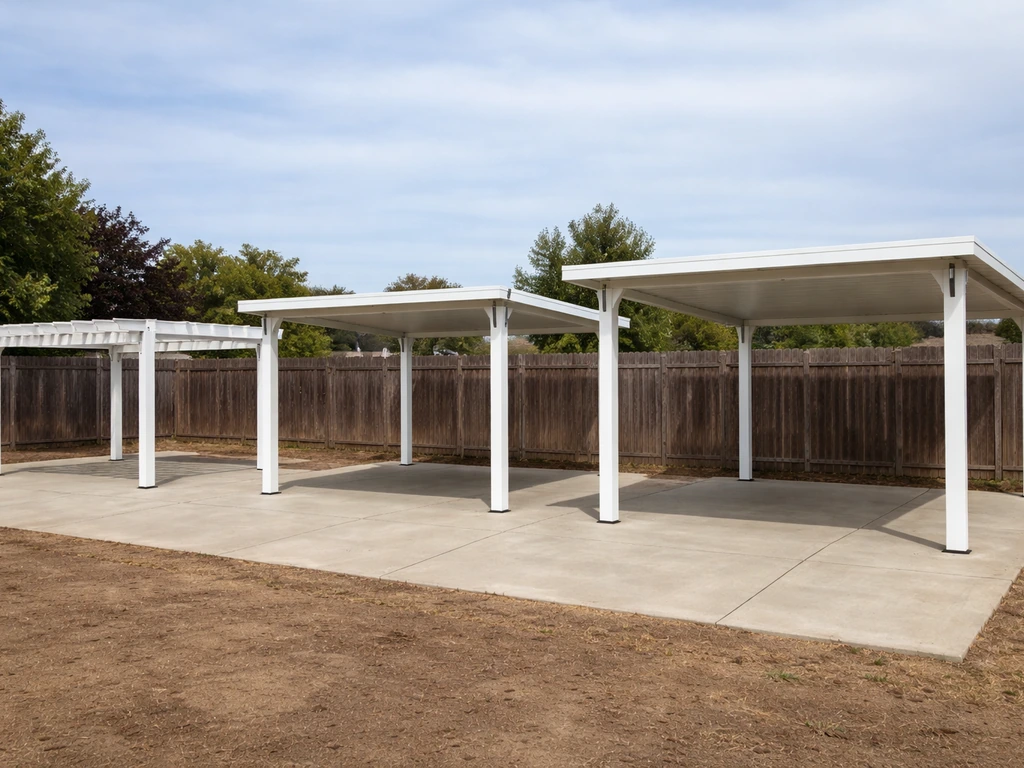
To give you a useful starting point, here are ballpark installed totals organized by cover size and a typical mid-range material (aluminum with a lattice or solid flat roof). These assume a straightforward installation with no major site prep, electrical work, or engineering surprises.
| Cover Size | Basic Aluminum Lattice | Solid/Insulated Aluminum | Wood or Steel (solid roof) |
|---|---|---|---|
| 200 sq ft | $4,000 – $7,000 | $6,000 – $12,000 | $12,000 – $24,000 |
| 300 sq ft | $6,000 – $10,500 | $9,000 – $18,000 | $18,000 – $36,000 |
| 400 sq ft | $8,000 – $14,000 | $12,000 – $24,000 | $24,000 – $48,000 |
| 500 sq ft | $10,000 – $17,500 | $15,000 – $30,000 | $30,000 – $60,000 |
These ranges reflect installed pricing, meaning material plus labor. They do not automatically include permits, engineering fees, electrical work, footings beyond a standard install, or removal of an existing structure. Those line items get their own discussion below because they can add thousands to a project that looks straightforward on paper.
One important thing to flag: many quotes you see online leave things out. Homeowner experience threads on Reddit about patio cover pricing also highlight how quotes can vary widely when contractors include different scope items like electrical, structure, and site details blank" rel="noopener noreferrer">many quotes you see online leave things out. A quote of $8,000 from one contractor and $14,000 from another for the same size cover often reflects a difference in scope, not just markup. Before comparing numbers, make sure both quotes include the same items.
Cost factors that change the price
Size is the most obvious driver, but several other variables can move your number significantly up or down.
- Material choice: Aluminum is typically the most cost-effective at $20 to $35 per sq ft installed. Wood and steel solid-roof options push toward $60 to $120 per sq ft once framing, finishing, and structural requirements are accounted for.
- Roof type: A lattice or open-beam cover costs less than a solid flat panel, which costs less than an insulated double-wall panel, which costs less than a motorized louvered system.
- Attachment style: Attached covers that tie into your existing roof structure are generally cheaper to frame than fully freestanding covers, which need their own posts and footings on all sides.
- Footings and site prep: If your patio slab is existing and level, this is minimal. If contractors need to pour new concrete footings or regrade, add $500 to several thousand depending on scope.
- Permits and inspections: Permit fees range widely by city, from flat fees around $225 (Universal City, TX) to percentage-of-value calculations or per-square-foot fees. Inspection costs typically add $50 to $300.
- Engineering: Structures that fall outside prescriptive code paths need stamped engineering drawings. This can add $500 to $2,000+ depending on complexity and your local requirements.
- Electrical work: Running wiring for lights or fans adds to the project. Electricians typically charge $50 to $130 per hour, and a basic lighting circuit can easily add $500 to $1,500.
- Removal of an existing cover: Tearing out an old structure typically adds $100 to $400 to the budget.
- Local labor rates: What contractors charge per hour varies significantly between markets. A job priced at $10,000 in a mid-size Midwest city might be $15,000 to $18,000 in coastal California.
Material and style comparisons
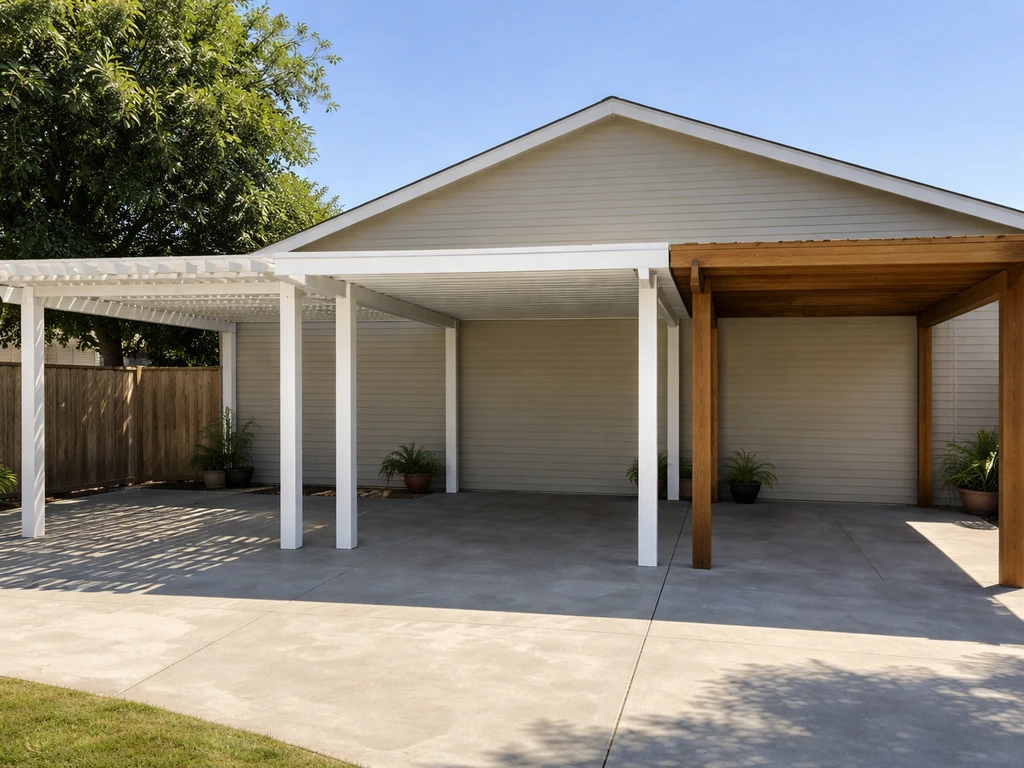
The material you choose affects not just upfront cost but also maintenance, lifespan, appearance, and how well the structure holds up in your climate. Here is how the common options stack up.
| Material | Typical Installed Cost | Maintenance | Lifespan | Best For |
|---|---|---|---|---|
| Aluminum (lattice or flat panel) | $20 – $35/sq ft | Very low | 30+ years | Budget-conscious, low-maintenance, modern look |
| Aluminum (insulated solid roof) | $30 – $60/sq ft | Very low | 30+ years | Full shade, better insulation, year-round use |
| Vinyl | $20 – $60/sq ft | Low | 20–30 years | Low maintenance, clean appearance, humid climates |
| Steel (structural framing) | $15 – $30/sq ft (gazebo/kit styles) | Moderate (rust risk) | 20–40 years | Heavy-duty freestanding structures, industrial aesthetic |
| Wood | $60 – $120/sq ft | High (paint/stain/seal) | 15–30 years | Custom, natural look, traditional architecture |
| Screen enclosure | $5 – $15/sq ft (screen panels) | Low to moderate | 10–20 years | Bug control, partial weather protection |
Aluminum is the most common choice for a reason: it's durable, does not rust or rot, holds paint well, and comes in both open-lattice and solid insulated configurations. Wood looks great and fits certain home styles better, but it demands ongoing maintenance and tends to be significantly more expensive once you factor in proper framing, finishing, and weather protection.
Steel is often underrated for freestanding kit-style structures like gazebos, where it can be quite economical. But for custom-built attached covers with detailed finishes, it is rarely the go-to material. Vinyl sits between aluminum and wood on most measures: better looking than aluminum to some eyes, lower maintenance than wood, but fewer configuration options for solid-roof designs.
Screen enclosures are a different category entirely. They are more about pest and light weather protection than true roofing, and they cost less per square foot for the screening itself. However, a fully screened patio enclosure with a solid roof, floor, and framing can still approach $20,000 to $40,000 for a larger space once all components are included.
If you are comparing a standard solid aluminum cover to a louvered patio cover system, the cost difference is significant. Louvered systems with adjustable slats typically run $40 to $180 per sq ft installed depending on whether they are manual or motorized, making them more of a premium choice. Similarly, insulated patio covers occupy their own pricing tier and are worth evaluating separately if full-shade performance matters to you.
Design details and add-ons that affect your total
Roof type
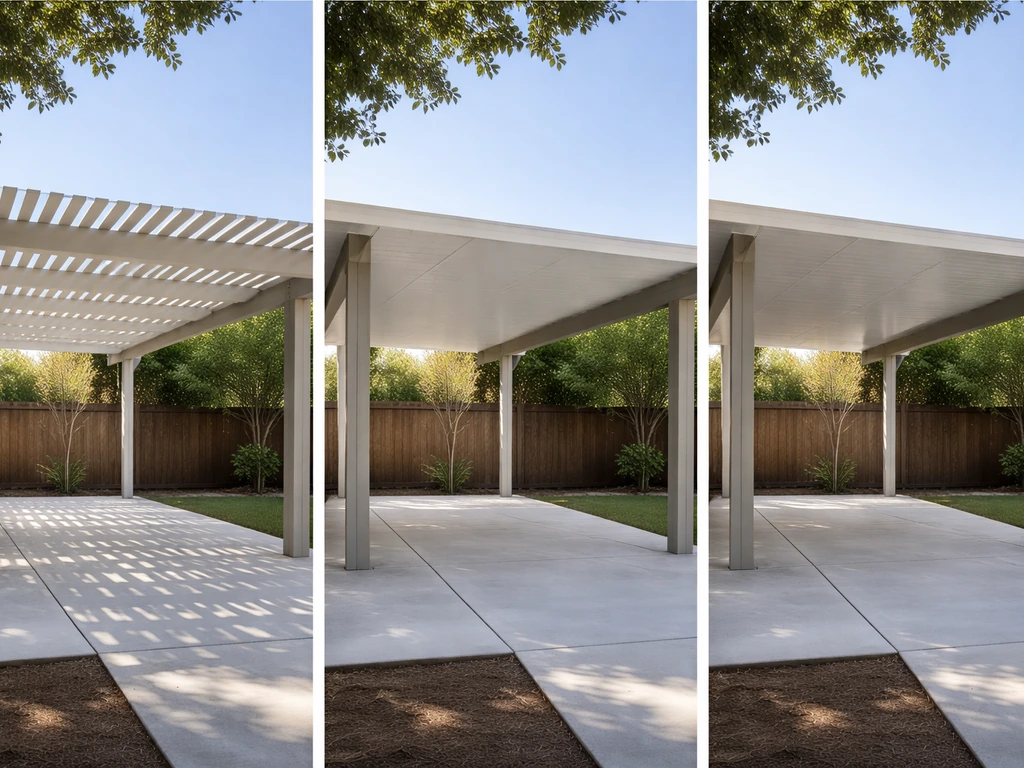
The roof configuration is the single biggest lever on cost after material choice. A simple lattice or open-beam roof lets light through but provides minimal shade and no rain protection. A solid flat-panel roof (aluminum or vinyl) blocks sun and handles rain but can feel heavy or institutional on some homes. An insulated double-wall panel adds thermal performance and cuts down on heat radiating through the roof on hot days. Insulated solid-roof aluminum covers typically run $30 to $60 per sq ft installed, compared to $20 to $35 per sq ft for a non-insulated aluminum option.
Lighting and ceiling fans
Most homeowners want at least one fan and a couple of lights in a covered patio, and this is where electrical costs sneak up on budgets. Running a new circuit from your panel, installing junction boxes in the roof structure, and connecting fixtures can add $800 to $2,500 depending on how far the run is and how many fixtures you need. Planning electrical before the cover goes up is much cheaper than retrofitting it afterward. If your contractor mentions hiding electrical connections inside the roof panels, that is a sign they are building it in properly.
Privacy screens and curtains
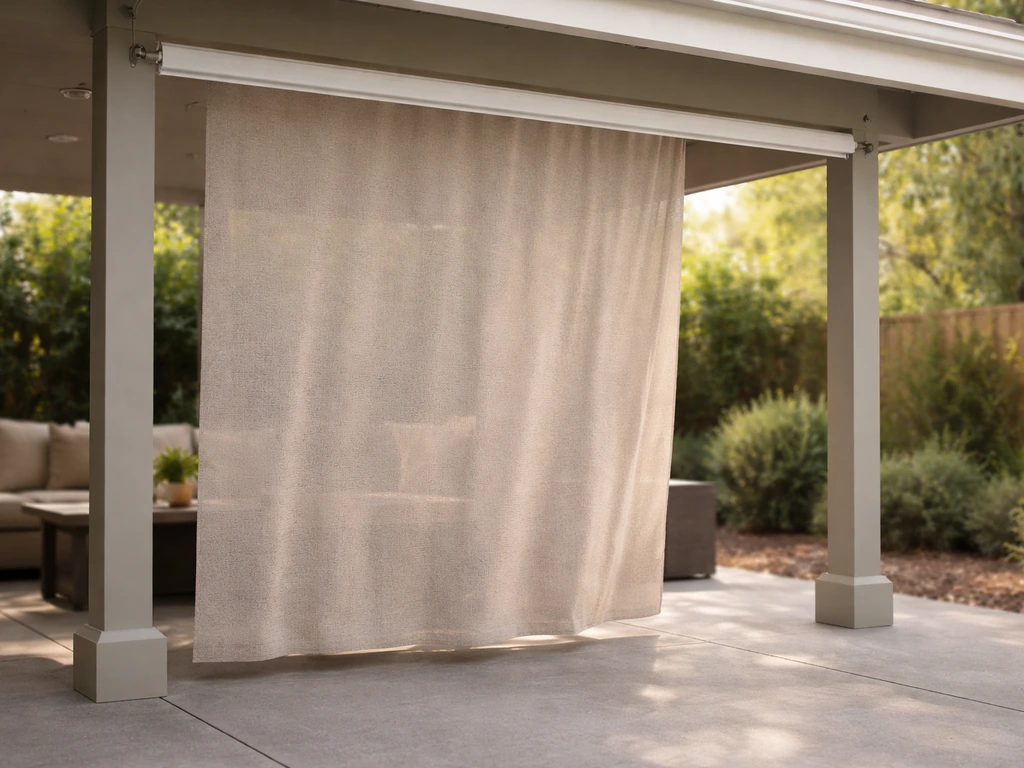
Outdoor curtain panels, drop-down shade screens, and retractable privacy systems can range from a few hundred dollars for basic fabric panels to $2,000 to $5,000 for motorized drop-down screens on a larger patio. These are typically add-ons that can be phased in later, which is a good option if you are working with a tight budget on the initial build.
Gutters and drainage
A solid-roof patio cover needs somewhere for water to go. Most professional solid-roof covers include gutters and downspouts as part of the install, but it is worth confirming this is in your quote. If drainage needs to be routed away from the foundation or tied into an existing system, that can add $200 to $1,000 depending on the complexity.
DIY vs. hiring a contractor
You can realistically DIY a basic aluminum patio cover kit. Many manufacturers sell pre-engineered kits specifically designed for homeowner installation, and the installation manuals are reasonably clear if you are comfortable with a drill, a level, and basic concrete work. A kit for a 200 to 300 sq ft aluminum lattice or flat-panel cover might cost $1,500 to $4,000 in materials, saving $3,000 to $6,000 or more compared to professional installation.
That said, DIY comes with real limitations. Most jurisdictions require a permit for any patio cover attached to the house or exceeding a certain height. Fort Collins, for example, requires a permit for any cover taller than 8 feet at any point. Richardson, TX requires you to demonstrate code compliance through conventional framing or submit engineer-stamped drawings. Pulling a permit as a homeowner is possible, but it means scheduling inspections yourself and being accountable for the work meeting code. If an inspection fails, you are responsible for corrections.
For anything involving a custom design, significant structural attachment to the house, new footings, or electrical work, hiring a licensed contractor is the safer path. A contractor handles permit pulls, manages inspections, and carries liability insurance if something goes wrong. Labor for professional installation typically accounts for 40 to 60 percent of the total project cost, so you can estimate roughly $10 to $25 per sq ft just for the labor side of a mid-range project.
One practical note: if you go the DIY route with a kit, still check with your local building department before starting. Some cities have pre-approved standard plans for common patio cover configurations, which can make the permit process much simpler and cheaper. San Diego has a pre-approved category for patio covers in their permit fee schedule, for instance.
How to estimate your patio cover budget
Here is a straightforward method to build a realistic budget before you talk to a single contractor.
- Measure your patio or the coverage area you want. Multiply length by width to get square footage. This is your baseline number.
- Choose a material and roof type. Use the per-sq-ft ranges in this guide to get a rough material-plus-labor estimate. For a standard insulated aluminum cover, use $35 to $55 per sq ft as a mid-range starting point.
- Multiply your square footage by that per-sq-ft rate. This gives you the base installed cost before extras.
- Add permit and inspection costs. Budget at least $300 to $700 for permits and inspections in most jurisdictions, more if your city uses a value-based fee formula or if engineering is required.
- Add electrical work if you want lights or fans. Budget $800 to $2,000 for a basic run with a couple of fixtures and a fan.
- Add drainage if you are going with a solid roof. Budget $200 to $600 for standard gutters and downspouts, more if routing is complex.
- Add site prep if needed. If you need footings poured, grading done, or an old structure removed, add $500 to $2,000 depending on scope.
- Add a 10 to 15 percent contingency. Surprises happen, especially once contractors get into the site. This buffer protects your budget.
- Total everything up. Compare this against the quotes you receive. If a quote comes in far below your estimate, ask what is not included.
As a concrete example: a 400 sq ft insulated aluminum cover at $45 per sq ft is $18,000 as a base. Add $500 in permits, $1,200 for electrical, $400 for gutters, and a $2,000 contingency, and you are looking at about $22,100 total. That is a realistic planning number for a quality mid-range project in most markets.
Regional and home-specific factors
Where you live affects patio cover costs in two distinct ways: what your structure needs to be built to, and what contractors charge for labor.
Climate and structural load requirements
In areas with significant snowfall, patio covers need to handle snow loads, which means heavier framing, stronger post connections, and often engineer review. A lightweight aluminum lattice cover that is perfectly fine in Phoenix will not pass code in Denver or Minneapolis without significant engineering upgrades. Similarly, high-wind zones (coastal areas, tornado corridors) require uplift-resistant connections and may push you toward heavier materials or more robust post-footing designs.
Coastal locations add another layer of complexity. Salt air is corrosive, which affects material selection and finish requirements. Some coastal jurisdictions (San Diego is a well-documented example) have ESL, or Exposure Severity Level, classifications that dictate minimum material and coating standards. This is why an aluminum cover that costs $30 per sq ft inland might be priced at $45 to $60 per sq ft in a coastal market, even before accounting for higher local labor rates.
Local labor rates and permit complexity
Labor costs vary substantially by region. High cost-of-living markets like the San Francisco Bay Area, Los Angeles, Seattle, and New York will push the total cost of the same project 30 to 60 percent higher than mid-size Midwest or Southern markets. This is not markup, it reflects what skilled tradespeople cost in those areas.
Permit complexity also varies significantly. Some cities have streamlined standard plan approvals for common patio cover configurations, which keeps fees and timelines manageable. Others require full plan sets, structural calculations, and multiple inspection stages. If you are in a jurisdiction with detailed requirements, plan for an extra two to six weeks in the timeline and an extra $500 to $2,000 in soft costs before construction even starts.
Site conditions specific to your property
Site-specific factors can quietly add thousands to a budget. Limited access for equipment, a sloped yard that requires grading or stepped footings, a long electrical run from your panel to the patio, or a house that does not have a standard ledger attachment point for the cover can all add cost. Before finalizing a budget, walk your site with a contractor and specifically ask about these items. A good contractor will flag them upfront rather than charging for them as change orders later.
FAQ
What is the best quick estimate for how much do patio covers cost in my situation?
A typical installed price is $4,500 to $22,500, with many projects landing near $8,500 to $10,000. The quickest way to narrow it for your case is to multiply your usable covered area by the relevant installed range for your roof type and material, then add the most common soft-costs (permits, electrical, gutters if solid-roof).
Why do two patio cover quotes for the same size patio come in so different?
The square footage used in quotes should match what is actually covered, including the depth of the roof projection and any side extensions. If one contractor quotes “roof area” and another quotes “footprint” differently, totals can drift by 10% or more, even with the same material and style.
When does DIY stop being cheaper for patio covers?
Yes, DIY pricing can look much lower, but the savings usually assume a simple site and no added structural or electrical complexity. If you need engineered attachments to the house, new footings, significant grading, or any non-basic electrical, the DIY “kit” total often narrows or disappears compared with professional installation.
What electrical costs should I expect, and what should I confirm in the quote?
If you plan any electrical or lighting, budget and design it before the roof goes up, because retrofits can require opening panels and relocating junction boxes. As a rule of thumb, plan for about $800 to $2,500 for a typical new run, and confirm whether fixture wiring, junction boxes, and switch locations are included.
Do patio cover prices include gutters and downspouts?
Solid-roof covers should include a drainage plan, usually gutters and downspouts, but not every quote includes them by default. Ask for confirmation that gutters, downspouts, and any tie-in to an existing drainage system are either included or listed as a separate line item.
Is it risky to skip the permit for a patio cover?
Not always. Some jurisdictions require permits for attached covers and others for height thresholds, and requirements can also trigger engineering in high snow or high wind areas. If you pull the permit yourself, inspections that fail usually force you to pay again for corrections, so it can become more expensive than hiring a contractor even if the labor quote looks higher.
How do snow and wind zones change patio cover cost?
In snowfall regions, cost can increase because you may need heavier framing, stronger post connections, and engineer review, even if you choose “lightweight” aluminum. Ask whether your contractor is designing for local snow load and whether engineering drawings are included if required.
Why are patio covers more expensive near the ocean?
Cost increases in coastal areas because salt air drives stricter material and coating requirements (for example, exposure classifications like ESL) and can require better finishes. If you are near the coast, ask what coating system and fasteners are used, and whether they are rated for your exposure level.
How much of the cost is labor, and why does it vary by city?
Labor can be a major driver because installation work is labor-intensive, and skilled-trade rates vary by market. If you move from a lower-cost region to a high-cost metro, the same project can end up 30% to 60% higher due to labor and overhead, not just material prices.
Do motorized shades and privacy screens change the patio cover budget a lot?
Extra shade and privacy add-ons are usually priced separately from the core patio cover. Outdoor curtain panels and shade screens can start at a few hundred dollars for basic options, while larger motorized drop-down screens can run roughly $2,000 to $5,000, so “installed patio cover” comparisons should confirm what is included.
What site conditions most often add surprise cost to patio cover installs?
If your yard access is limited for delivery and equipment, or if your grade is sloped and requires stepped footings or grading, that can add thousands. Before signing, ask the contractor how they plan to handle equipment access, site grading, and any required footing layout changes.
What should I ask for in writing so I can compare patio cover quotes fairly?
A good sanity check is to ask for a breakdown by category: roof/frame system, posts and footings/attachments, insulation (if any), gutters (if solid roof), electrical (if any), and permit/engineering line items. That makes it easier to compare “apples to apples” and spot which quote is missing a scope item.
Next Article
Grass Is Higher Than Patio: Causes, Fixes & Deck vs Patio
Grass higher than patio? Causes, slope checks, repair options, lower lawn, raise patio, or build a deck, with costs & DIY